Langfuse MCP: What It Is, How It Works, and Why It Matters for AI Systems
AI products are getting more capable, but they are also getting harder to understand. Once you move beyond a simple prompt and response flow, things become messy fast. A single user request may trigger multiple model calls, hit external APIs, fetch data from a database, and pass through several layers of business logic before returning an answer.
That creates a real challenge for teams building production AI systems. If something breaks, slows down, or produces a weak answer, you need to know where the problem happened and why. That is where Langfuse MCP becomes useful. It brings together observability and structured tool interaction so teams can see what their AI system is doing at every step and improve it with more confidence.
What Is Langfuse MCP?
Langfuse MCP is the combination of Langfuse and MCP, or Model Context Protocol. In simple terms, MCP helps an AI model connect to tools and data in a structured way, while Langfuse helps teams observe, trace, and analyse what happens across those interactions. Together, they make AI systems easier to understand, debug, and improve.
The short version is this: MCP manages how the model works with external systems, and Langfuse records what happened across the full workflow. That gives teams better visibility into prompts, tool calls, outputs, costs, and failure points.
What Is Langfuse?
Langfuse is an observability platform for LLM-based applications. A simple way to think about it is as analytics for AI systems. Just as product teams use analytics tools to understand user behaviour, AI teams use Langfuse to understand how their models and workflows behave in production.
It helps teams track prompts, responses, tool usage, traces, evaluations, and costs. That means if an AI feature starts producing weak answers or becomes expensive to run, teams have the data they need to investigate what changed. Instead of guessing, they can look at the full path from input to output.
What Is MCP (Model Context Protocol)?
MCP stands for Model Context Protocol. It is a standard that allows language models to interact with tools, APIs, and data sources in a more consistent and structured way. Rather than building one-off connections for every workflow, MCP gives teams a cleaner way to manage those interactions.
That matters because AI systems become harder to maintain when every tool integration is custom. Standardisation makes systems easier to scale, test, and extend. It also helps teams keep context more consistent as models work across multiple steps and external resources.
How Langfuse and MCP Work Together
MCP and Langfuse solve different parts of the same problem. MCP handles the connection layer between the model and external tools, while Langfuse captures what happened across that process. One manages structured interaction, and the other gives visibility into the results.
For example, imagine an AI assistant that receives a customer question, checks an internal knowledge base, calls a billing API, and then returns an answer. MCP can coordinate those tool interactions in a structured way. Langfuse can trace each step, log the prompts and outputs, and show where the answer went wrong if the result is incomplete or inaccurate.
Why Langfuse MCP Matters for Modern AI Applications
As AI features become part of real products, the need for visibility becomes much more serious. It is one thing to test a chatbot in a demo environment. It is very different to run a production AI system that affects customer experience, internal operations, cost, and reliability.
Langfuse MCP matters because modern AI applications are rarely simple. They often depend on multiple services, multi-step workflows, and external data. Without structure and observability, teams lose the ability to manage those systems with confidence.
The Problem: AI Systems Are Black Boxes
One of the biggest frustrations in AI development is that systems often feel like black boxes. You get an output, but you do not always know why the model produced it, what context it used, which tool it called, or where the workflow broke.
That makes debugging slow and improvement difficult. If an answer is wrong, the failure could come from the prompt, the retrieved data, the tool response, the model choice, or the orchestration logic. Without observability, teams are left guessing instead of diagnosing.
The Solution: Observability + Standardized Context
This is where the combination of Langfuse and MCP becomes valuable. MCP gives the system a structured way to interact with tools and data, while Langfuse records those interactions so teams can inspect what happened later. Together, they replace guesswork with visibility.
That helps teams monitor multi-step workflows, trace incorrect outputs, control token costs, and understand how AI agents behave in real conditions. It does not remove the complexity of AI systems, but it makes that complexity much easier to manage.
Real Impact on Product, Engineering, and Growth Teams
The value of Langfuse MCP is not limited to engineers. Developers use it to debug workflows and improve integration quality. Product teams use it to understand output quality and spot friction in AI-powered user experiences. Growth and business teams can use it to monitor cost, usage patterns, and system performance.
This matters because AI features are no longer isolated experiments. They affect product delivery, support operations, and business metrics. Teams need shared visibility into how those systems behave, and Langfuse MCP supports that across both technical and operational roles.
How Langfuse MCP Works (Architecture Explained)
Behind the scenes, Langfuse MCP sits inside the flow of an AI application rather than replacing the model or application stack. It works as a support layer around the core workflow, making tool interaction more structured and system behaviour easier to inspect.
The architecture is not overly complicated once you break it down. The important thing is understanding what each part does and how information moves from one step to the next.
Core Components of a Langfuse MCP Setup
A typical setup includes the LLM, the application logic, the tools or data sources, the MCP layer, and Langfuse. The model handles generation. The tools provide external capabilities such as retrieval, search, database access, or API calls. MCP helps organise those interactions. Langfuse traces and records what happens.
Each of these pieces has a different role, but together they support a more reliable AI workflow. Instead of treating every step as a hidden process, the system becomes more transparent and easier to improve over time.
Request Flow: From User Input to Final Output
A user starts by sending a request to the application. The application passes context and instructions to the model. If the model needs more information or needs to perform an action, it triggers tool interactions through the MCP layer. Those tools return data, and the model uses that information to generate a final response.
As this happens, Langfuse records the request path. It can log prompts, tool calls, model responses, timing, token usage, and other key signals. That gives teams a step-by-step view of how the final answer was created.
Tracing and Logging Across the AI Pipeline
Tracing is what makes observability useful. Instead of isolated logs, teams get connected views of the full workflow. A trace can show the user input, the prompt sent to the model, the tools that were called, the data returned, and the final output.
This is especially useful in multi-step systems where issues are not obvious. Rather than checking one log after another, teams can inspect a full chain of events and find the exact point where quality, performance, or logic broke down.
Where Langfuse Sits in the Stack
Langfuse is not a model provider, and it is not a replacement for your orchestration logic. It is an observability layer that sits alongside the AI workflow and helps you inspect how it behaves. That distinction is important because teams sometimes confuse observability tools with the model or runtime layer itself.
In practice, Langfuse complements the stack rather than replacing a core part of it. You still choose your LLM, retrieval system, and application architecture. Langfuse helps you see how those pieces perform together in real usage.
Key Features of Langfuse MCP
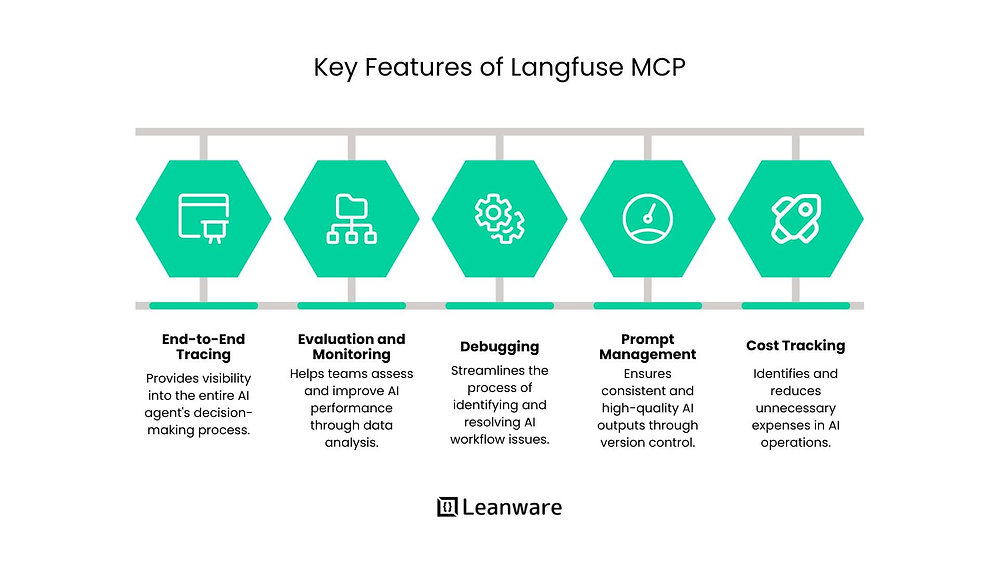
The value of Langfuse MCP becomes clearer when you look at the capabilities it adds to real AI systems. These features are not just technical extras. They directly affect how well teams can build, operate, and improve AI products in production.
For decision-makers, the key point is that Langfuse MCP supports visibility, quality, and control at the same time. That is what makes it useful beyond early experimentation.
End-to-End Tracing of AI Agents
One of the most useful features is end-to-end tracing. In agent-based systems, a single request may involve multiple steps, intermediate reasoning, and several tool calls before reaching a final answer. Langfuse helps teams see that full path.
This is valuable because agents can fail in subtle ways. They may choose the wrong tool, use incomplete data, or produce a weak answer after several correct steps. End-to-end tracing helps teams inspect the chain instead of only seeing the final result.
Prompt Management and Versioning
Prompt quality has a major effect on AI behaviour, especially in production systems. Teams often revise prompts over time as they learn what improves reliability, clarity, and output quality. Langfuse supports that process by making prompt iteration more visible and manageable.
Versioning matters because without it, teams lose track of what changed and why results improved or worsened. Structured prompt management helps teams test changes more confidently and maintain consistency as AI features grow.
Evaluation and Quality Monitoring
Observability alone is not enough if teams do not also evaluate output quality. Langfuse supports quality monitoring by helping teams collect performance data, review failures, and connect traces with evaluation workflows. That makes it easier to see whether changes are improving real outcomes.
This is useful for both automated and human evaluation. Teams can score outputs, identify repeated failure patterns, and use that feedback to refine prompts or workflow design. Over time, this creates a more disciplined improvement loop.
Cost and Token Usage Tracking
AI systems can become expensive very quickly, especially when prompts grow larger or workflows trigger multiple model calls. Langfuse helps teams track token usage and associated cost across interactions so they can spot inefficient patterns early.
This matters because cost problems are often hidden inside workflow design. A feature may look fine at low volume but become expensive in production. With better visibility into usage, teams can reduce unnecessary tokens and improve cost efficiency without lowering output quality.
Debugging Multi-Step AI Workflows
When an AI workflow breaks, the hardest part is often figuring out where the failure happened. Langfuse helps by surfacing the exact step that caused the issue, whether it came from the model, a tool response, a retrieval problem, or orchestration logic.
That is a major improvement over manual debugging. Instead of searching through disconnected logs, teams can inspect a trace and move directly to the problem point. This shortens debugging cycles and makes complex workflows easier to support.
Real-World Use Cases of Langfuse MCP
Langfuse MCP becomes most useful when applied to workflows that teams are already building. It is not just for abstract AI infrastructure. It supports very practical products and operational use cases where visibility, reliability, and iteration matter.
The strongest examples are the ones where AI is doing more than generating text once. As soon as a system includes multiple steps, external tools, or business-critical outcomes, observability starts to matter much more.
AI Customer Support Agents
Customer support agents often need to retrieve policy data, read order status, call external systems, and generate a response that is both accurate and helpful. Langfuse MCP helps teams trace that process and understand where support quality is breaking down.
Without observability, teams may only see that the answer was weak. With tracing, they can tell whether the issue came from bad retrieval, an unclear prompt, a missing tool call, or incorrect tool output. That makes quality improvement much more practical.
AI Content Generation Pipelines
Content workflows often involve multiple steps such as briefing, outlining, generation, editing, and evaluation. Langfuse helps teams monitor those workflows and understand how prompt changes affect output consistency, cost, and quality across high-volume tasks.
This is especially useful for teams producing SEO content, product copy, or structured content at scale. Rather than treating content generation as a single model call, they can inspect the full workflow and improve it more systematically.
Internal AI Assistants for Teams
Internal assistants are becoming common across operations, support, HR, finance, and knowledge management. These systems often answer questions, summarise documents, or help employees complete routine tasks faster. Langfuse MCP helps teams understand whether those assistants are actually reliable.
That visibility improves trust. Internal tools only create value if people feel confident using them. With better tracing and quality monitoring, teams can improve the assistant faster and reduce the frustration that comes from unpredictable responses.
Data-Enriched AI Applications
Many AI applications rely on external data rather than only the model itself. They may query a database, call a third-party API, or retrieve internal documents before producing an answer. MCP supports those interactions in a structured way, and Langfuse logs how they happen.
This is useful because the output quality often depends on the external data path as much as the model. If the data is incomplete, delayed, or irrelevant, the final answer suffers. Langfuse helps teams inspect that full picture instead of focusing only on the model layer.
Benefits of Using Langfuse MCP
For teams deciding whether to adopt Langfuse MCP, the main question is simple: Does it make AI systems easier to build and manage in production? In many cases, the answer is yes, especially when workflows are multi-step, tool-based, or business-critical.
The benefits are not just technical. They affect delivery speed, team efficiency, system reliability, and the ability to scale AI features with more confidence.
Better Visibility into AI Behavior
The clearest benefit is visibility. Teams can see how prompts, model responses, tools, and external systems interact across a single workflow. That removes much of the uncertainty that makes AI systems hard to operate.
With better visibility, teams gain more trust in what the system is doing. That trust matters for engineering, product, and leadership because it supports better decisions about improvement and deployment.
Faster Debugging and Iteration Cycles
When issues are easier to trace, debugging becomes faster. Teams spend less time searching through raw logs and more time fixing the actual problem. That shortens iteration cycles and helps AI features improve more quickly.
This is especially important in production environments where delays affect customers or internal workflows. Trace-based debugging is simply more efficient than reactive investigation without context.
Improved Output Quality Over Time
Better quality usually comes from better feedback loops. Langfuse helps teams connect outputs with traces, evaluations, and usage signals so they can see where performance is weak and refine the workflow over time.
This supports continuous improvement rather than one-time tuning. Teams can adjust prompts, change tool logic, improve retrieval, and measure whether those changes are producing better results.
Scalable AI Systems for Production
As AI systems grow, so do the demands around monitoring, governance, reliability, and cost control. Langfuse MCP supports production readiness by giving teams more structured workflows and more operational visibility.
That makes scaling more practical. Teams are not just adding more AI calls. They are building systems they can manage with discipline as usage, complexity, and business dependency increase.
Challenges and Limitations
Langfuse MCP is useful, but it is not free of trade-offs. Teams still need to plan implementation carefully and understand the overhead that comes with adding new infrastructure and observability practices.
Being honest about those limits matters. The goal is not to present it as necessary for every AI application, but to show where it fits well and where it may add more complexity than value.
Learning Curve for MCP and Observability
There is a learning curve, especially for teams that are new to MCP or observability concepts. Developers need to understand traces, events, structured workflows, and how to interpret the data coming back from the system.
That said, the complexity is manageable for most serious teams. Once the setup is in place, the long-term gain in visibility usually outweighs the initial adjustment period.
Integration Complexity in Existing Systems
Adding MCP and Langfuse to an existing application may require changes to orchestration, logging, and tool integration patterns. This can be more involved in legacy systems or products that were not designed with structured AI workflows in mind.
The effort is usually worth it when the AI workflow is important enough to justify better visibility. Still, teams should expect some implementation work rather than assuming it drops cleanly into every stack.
Data Privacy and Logging Considerations
Observability in AI systems can raise privacy concerns because traces may include prompts, outputs, or tool data that contain sensitive information. This is especially important in enterprise environments and regulated industries.
Teams need clear rules around what should be logged, masked, stored, or excluded. Observability is valuable, but it has to be implemented in a way that respects security, privacy, and compliance requirements.
Langfuse MCP vs Alternatives
Teams evaluating Langfuse MCP are usually comparing it against simpler logging setups, fully custom integrations, or other observability options. The right choice depends on how complex the AI system is and how much visibility the team actually needs.
The main difference is that Langfuse MCP is designed to be structured and production-oriented. AI workflows rather than basic experimentation.
Langfuse vs Basic Logging Tools
Basic logs can show isolated events, but they usually do not give a connected view of the full AI workflow. Langfuse provides structured traces, spans, evaluations, and cost data that make debugging and analysis much more practical.
For simple systems, basic logs may be enough. But as soon as workflows become multi-step or tool-driven, raw logs usually stop being sufficient.
MCP vs Custom Tool Integrations
Custom integrations can work, but they often become fragmented over time. Each new tool adds another one-off connection, and the system becomes harder to maintain. MCP offers a more standardised way to connect models with external tools and data.
That standardisation matters for scale. It makes workflows more consistent and reduces the maintenance burden that comes from ad hoc integrations.
Observability Platforms for AI (Comparison)
There are other observability tools in the AI space, and the best option depends on the team’s stack and needs. Some tools focus more on logging, some on evaluation, and some on workflow orchestration.
Langfuse stands out when teams want practical tracing, evaluation support, and visibility into real AI product behaviour. It is especially useful for teams that are already thinking beyond simple prompt-response apps.
How to Implement Langfuse MCP (Step-by-Step)
Implementation does not need to start with infrastructure. It should start with clarity about the workflow you are trying to observe. Once that is clear, the technical setup becomes much easier to reason about.
A good implementation approach is iterative. Start with one important workflow, trace it well, and improve from there instead of trying to instrument every possible path at once.
Step 1: Define Your AI Workflow
Start by mapping the workflow you want to observe. Identify the model calls, tool interactions, data sources, outputs, and business purpose behind the feature. This gives you the foundation for meaningful tracing.
If you do not define the workflow clearly first, observability data becomes noisy fast. Good visibility starts with knowing what matters.
Step 2: Integrate MCP-Compatible Tools
Next, connect the tools your model needs in a structured way. That may include APIs, databases, internal services, knowledge sources, or external applications. MCP helps standardise these interactions.
This step matters because the trace is only useful if the system interactions are clear and consistent. Structured tool usage creates better data for analysis later.
Step 3: Add Langfuse SDK for Tracing
Once the workflow is defined, add Langfuse tracing through the SDK or integration layer. The purpose is to capture the key steps in the request path, not just the final result.
At a high level, this gives the team visibility into prompts, tool calls, timing, outputs, and other signals that affect quality and cost.
Step 4: Capture and Analyze Traces
After setup, start reviewing traces regularly. Look for repeated failures, slow steps, poor tool usage, high token costs, or weak output patterns. The point is not only to collect data but also to learn from it.
This is where observability becomes useful. Traces should lead to decisions, not just dashboards.
Step 5: Iterate and Optimize
Use what you learn to improve the workflow. Adjust prompts, change tool logic, improve retrieval, reduce unnecessary calls, and repeat the cycle. Observability works best when it supports continuous refinement.
This creates a practical loop: trace, evaluate, refine, and measure again. Over time, that is what improves system quality.
Best Practices for Using Langfuse MCP
Like most infrastructure decisions, Langfuse MCP delivers the most value when teams use it with discipline. The tool itself helps, but the team still needs a clear approach to what they measure and why.
Good practices keep the data useful and make the system easier to improve over time rather than harder to manage.
Track Everything, But Prioritize Key Signals
It is helpful to capture broad visibility, but not every signal deserves equal attention. Teams should focus on the metrics that affect output quality, reliability, cost, and user experience the most.
Otherwise, observability can turn into noise. The goal is useful insight, not maximum data volume.
Use Structured Prompts and Versioning
Prompts should be managed with consistency. When prompts are structured and versioned, teams can compare changes more easily and understand which revisions improve performance.
Without versioning, it becomes hard to connect output changes to specific decisions. Structure makes evaluation much more practical.
Combine Human and Automated Evaluations
Automated scoring can help teams move quickly, but human review is still important for judging quality, nuance, and business fit. The best evaluation process usually combines both.
That balance helps teams scale improvement without losing the context that only people can provide. It also creates more reliable feedback loops.
Align Observability with Business KPIs
Technical metrics matter, but they should connect to business outcomes. Token cost, latency, resolution quality, and workflow reliability should be tied to the KPIs leadership actually cares about.
This makes observability more valuable across teams. It stops being an engineering-only concern and becomes part of product and business decision-making.
Future of AI Observability and MCP
AI observability is still developing, but the direction is becoming clearer. As AI systems become more central to products and operations, teams will need stronger standards, better monitoring, and more reliable infrastructure around them.
That is where MCP and observability platforms like Langfuse become part of a larger shift rather than just a tactical tool choice.
Rise of Standardized AI Protocols
MCP reflects a broader move toward standardisation in AI systems. Teams want cleaner ways to connect models to tools, data, and services without rebuilding integrations from scratch every time.
That trend is likely to continue because standardisation makes systems easier to scale and maintain. It reduces fragmentation and supports more consistent architecture decisions.
Increasing Need for AI Governance and Monitoring
As AI enters higher-risk workflows, governance becomes more important. Teams need to know how systems behave, what data they use, where they fail, and how much they cost. Monitoring is no longer optional in serious production environments.
This is especially relevant for companies dealing with compliance, customer trust, and operational dependency. Visibility becomes part of responsible deployment.
From Debugging to Autonomous Optimization
Today, observability is mainly used for debugging and improvement. Over time, it will likely support more automated optimisation as systems learn from performance data and adjust workflows more intelligently.
That does not mean teams lose control. It means observability data may increasingly feed into systems that help optimise prompts, routing, and cost decisions with less manual effort.
Conclusion: Is Langfuse MCP Worth It?
For teams building serious AI products, Langfuse MCP is often worth the effort. It adds structure where workflows are complex and visibility where AI systems would otherwise feel opaque. That becomes more valuable as products grow beyond demos and start affecting real users and business outcomes.
It is not a requirement for every use case. But for production AI systems with multiple tools, agents, and quality expectations, it solves problems that basic logging and ad hoc integrations usually cannot handle well.
When You Should Use It
Langfuse MCP is a strong fit when you are building agent workflows, production AI features, multi-step systems, or AI products where quality and cost need close monitoring. It is especially useful when tool calls and external data play a major role in the final output.
In these cases, visibility and structured integration are not nice extras. They are part of building a system you can trust and improve over time.
When You Might Not Need It
If you are working on a very small prototype with a single prompt-response flow and no meaningful tool integration, the overhead may not be justified yet. Basic instrumentation may be enough in early experiments.
That does not mean Langfuse MCP is unnecessary forever. It just means the need becomes clearer as the workflow becomes more complex and more important to the business.
Final Thoughts for Builders and Teams
Langfuse MCP is less about adding complexity and more about making AI complexity manageable. For builders, product teams, and engineering leads, that matters because the hardest part of AI is rarely getting the first output. The hard part is making the system reliable, scalable, and easier to improve.
That is why observability and structured context matter so much. Teams that invest in these foundations early will usually move faster later because they can debug with more clarity and iterate with more confidence.
Full observability for production AI workflows, prompts, tool calls, costs, and failure points, connected end-to-end. If your team is operating agent workflows or multi-step AI features, structured tracing is no longer optional. Contact our team to discuss how Langfuse MCP fits your stack.
Frequently Asked Questions
What is Langfuse MCP in simple terms?
Langfuse MCP is the combination of an AI observability platform, Langfuse, with a structured protocol, MCP, that connects models to tools and data. Together, they help teams monitor, debug, and improve AI systems by showing what happens across each step of the workflow.
What is Langfuse used for in AI applications?
Langfuse is used to monitor and analyse AI applications powered by large language models. It tracks prompts, responses, traces, tool usage, evaluations, and system behaviour so teams can understand how their AI systems perform in real-world use.
What is MCP (Model Context Protocol)?
MCP is a standard for connecting AI models to tools, APIs, and data sources in a structured way. It helps maintain consistency across interactions and makes AI systems easier to scale and maintain.
How do Langfuse and MCP work together?
MCP manages how the model interacts with tools and data, while Langfuse records and analyses those interactions. Together, they provide both structure and visibility across the AI workflow.
Why is observability important in AI systems?
Observability matters because AI systems can behave unpredictably, especially when they involve multiple steps, tools, and data sources. Without visibility, teams cannot easily understand why an output failed or how to improve it.
What problems does Langfuse MCP solve?
Langfuse MCP solves the lack of visibility in AI systems. It helps teams trace workflows, debug incorrect outputs, monitor costs, and improve reliability across more complex AI applications.
Is Langfuse MCP only for developers?
No. Developers use it for debugging and integration, but product teams, operations teams, and business stakeholders also benefit from better visibility into quality, cost, and performance.
Can Langfuse MCP be used with AI agents?
Yes. It is especially useful for AI agents because those systems often make several decisions and tool calls before producing an answer. Langfuse helps teams trace those steps and improve reliability over time.