Agentic Engineering: Definition, Workflow, and Professional Framework
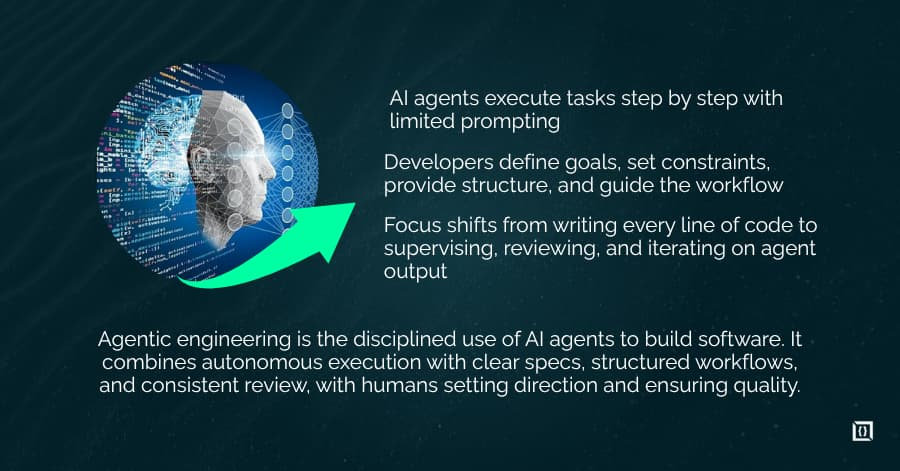
AI agentic engineering is the practice of building software with AI coding agents under deliberate human direction, with structured processes governing how those agents are used. It is not a tooling upgrade. It is a shift in how engineering decisions get made, how work is structured, and where developer judgment gets applied.
The difference from earlier AI-assisted coding is the discipline layer. Autocomplete and inline suggestions made individual developers faster. AI agentic engineering changes how teams operate, who owns what, how tasks are specified, and what gets reviewed before code ships.
From Vibe Coding to Agentic Engineering
Vibe coding works. For solo experiments, quick prototypes, and throwaway scripts, prompting an AI and iterating on the output is a reasonable way to move fast. The problem is that it breaks down the moment the codebase grows, the team scales, or the software needs to be maintained by someone who was not in the room when the prompt was written.
Vibe coding trades structure for speed. AI agentic engineering tries to keep both. The shift is not about using more AI. It is about using it more deliberately. Structure replaces intuition. Specs replace vibes. Review processes replace "ship it and see."
In February 2026, Andrej Karpathy, who coined "vibe coding" exactly a year earlier, declared the era over. His preferred replacement: "agentic engineering." His reasoning was direct: the new default is that you are not writing the code directly most of the time. You are orchestrating agents who do and acting as oversight. That is a different job than vibe coding describes, and it needs a different name.
What Agentic Engineering Actually Means
The term has two parts. "AI Agentic" refers to AI systems that take sequences of actions to complete a goal: reading files, writing code, running commands, checking output, and iterating without a human prompt at every step. "Engineering" means applying rigor, structure, and professional standards to how those systems are designed, directed, and supervised. The combination is what makes it a discipline rather than a technique.
What Is a Coding Agent?
A coding agent is an AI system that can read context, write code, run commands, and iterate — without requiring a human input at every step. It operates in a loop: receive a goal, take action, observe the result, adjust, repeat.
Three widely used examples are Claude Code (Anthropic's terminal-based agentic coding tool), GitHub Copilot Agent (integrated into GitHub's development workflow), and Cursor (an AI-native editor with deep codebase awareness). Each works differently under the hood, but all three share the same core property: they can act across multiple steps on your behalf.
What the Developer's Role Looks Like
The developer's job shifts from writing every line to directing, reviewing, and validating. In practice, this means setting the goal clearly, defining the constraints the agent should work within, reviewing what the agent produces, and deciding what ships.
Judgment and domain knowledge do not become less important under this model. They become more important because the agent can produce plausible-looking code faster than a human can write it, and plausible-looking code that is wrong is harder to catch than code you wrote yourself.
Why Context Quality Determines Agent Output
Agents are only as good as the context they receive. A weak prompt produces unpredictable output. A strong one produces reliable output. The difference is not about prompt engineering tricks - it is about giving the agent what it needs to reason about the problem correctly.
A weak prompt looks like this: "Add authentication to the app." The agent has no idea which authentication method, which routes to protect, what the existing user model looks like, or what the definition of done is. It will make assumptions, and some of them will be wrong.
A strong prompt looks like this: "Add JWT-based authentication to the Express API. Protect all routes under /api/v1/user. The existing User model is in /models/user.js and has id, email, and passwordHash fields. Do not modify the database schema. Return 401 with a JSON error message for unauthenticated requests." The agent now has a clear target. The output is reviewable against that target.
How AI Agentic Engineering Compares to Traditional Development
The differences are real, and they cut both ways.
Factor | Traditional Development | AI Agentic Engineering |
Workflow structure | Sequential, developer-driven | Iterative, agent-executed with human oversight |
Role of the developer | Writes and reviews code | Directs, reviews, and validates agent output |
Speed of iteration | Constrained by developer bandwidth | Fast, agents iterate in minutes |
Risk profile | Errors introduced manually, caught in review | Errors generated at scale, require systematic review |
Required discipline | Strong in execution | Strong in specification and review |
The key takeaway: AI agentic engineering is faster, but it requires more upfront thinking, not less. Teams that skip the specification and governance layer in exchange for raw speed end up with faster accumulation of technical debt, not faster delivery of reliable software.
How the Agentic Engineering Workflow Works
This is a repeatable, step-by-step process, not a loose set of suggestions. The stages that consistently separate teams getting reliable results from those that do not are: spec, prompt, review, test, iterate. In that order. Skipping any step does not make the process faster. It moves the cost downstream.
Why You Need to Write the Spec Before You Prompt
Skipping the spec is the most common mistake teams make. Without a written spec, the agent has no clear target, and the developer has no way to evaluate the output objectively. You end up reviewing code against a mental model that changes every time you look at it.
A useful spec does not need to be long. It needs to be precise. It includes the goal (what this code should do), the inputs and outputs (what comes in and what goes out), the constraints (what the agent should not do, what existing patterns to follow, what dependencies to use or avoid), and the definition of done (how you will know the output is correct). Four things. That is enough to give an agent a real target and give yourself a real review standard.
How to Write Prompts That Get Consistent Results
Effective prompting in an AI agentic context is not about cleverness. It is about precision. Four principles apply consistently: be explicit about the task, provide relevant context, define what you do not want, and specify the format of the expected output.
A prompt that follows these principles might look like: "Refactor the getUser function in /services/user.js to use async/await instead of callbacks. Keep the existing function signature. Do not modify the database query. Add error handling that throws a typed UserNotFoundError when the user does not exist. Return only the updated function, not the full file." That prompt is specific enough that the output can be evaluated against it immediately.
Prompt quality compounds. Better prompts reduce review cycles. Fewer review cycles mean faster iteration without sacrificing quality.
Why Testing Is Not Optional in AI Agentic Workflows
Agents iterate fast. Without tests, bad changes ship fast too. A test suite is not a quality checkbox in AI agentic engineering. It is the feedback mechanism that makes agent iteration safe. The agent runs the tests, sees what breaks, and adjusts. Without that loop, the agent is flying blind, and so are you.
The baseline is unit tests, integration tests, and regression tests covering the main paths. What happens in practice when teams skip this is predictable: bugs accumulate across iterations, refactors silently break existing functionality, and the team gradually loses confidence in the agent's output.
At that point they are reviewing every line manually, which eliminates most of the speed advantage. Getting tests in place before running agents is not overhead. It is the foundation that makes agentic iteration worth the investment.
How to Review and Validate Agent Output
Reviewing agent output is a skill, not a formality. Generated code can look correct and be wrong in ways that only become visible under edge cases, load, or integration with other systems. Developers need to read agent-generated code with the same critical eye they would apply to a junior developer's pull request, because in both cases, the code might be plausible and still miss something important.
Good review means checking for logic errors that the tests do not cover, verifying that edge cases are handled, confirming the output actually aligns with the original spec, and checking that the code follows the patterns established in the rest of the codebase. If you cannot explain what a block of generated code does, it does not ship. That rule is simple and it works.
How Multi-Agent Systems Work and When to Use Them
Most tasks require one agent. Multi-agent systems become necessary when a task has parallel workstreams, requires specialization across different domains, or exceeds the context window of a single agent. The basic model is an orchestrator agent that delegates to subagents, each responsible for a scoped task.
An example: building a feature that touches the backend API, the frontend components, and the database schema. A single agent trying to hold all three contexts simultaneously is more likely to make coordination errors than three specialized agents, one for each layer, coordinated by a planning agent that tracks the overall goal and resolves dependencies between them.
There is added coordination overhead. Multi-agent systems are harder to set up, harder to debug, and harder to reason about when something goes wrong. They should not be the default. Start with a single agent, expand to multi-agent only when the scope genuinely requires it.
Governance and Oversight in AI Agentic Engineering
Governance is not bureaucracy. It is the set of decisions a team makes before something goes wrong, so that when it does go wrong, there is a clear process for catching and correcting it.
Four principles apply to any team running agents in a serious engineering context.
First, define what agents are allowed to do and not do. Agents with unrestricted file system access or the ability to make network calls to production systems are a liability. Scope the permissions explicitly.
Second, establish a review process before code is merged. Agent-generated code goes through the same review gate as any other code. The speed of generation does not change the standard for what ships.
Third, log agent actions for auditability. When something breaks, you need to know what the agent did. Logs are not optional.
Fourth, set escalation rules for ambiguous situations. Agents should not be making judgment calls on security-sensitive decisions, schema changes, or anything with significant downstream impact. Define the boundaries and make them explicit.
Security Risks That Come With Autonomous Agents
The main risks are concrete and manageable with the right controls.
Prompt injection: Malicious content in files or external data sources can influence agent behavior. Mitigation: treat all external input as untrusted and validate before feeding to agents.
Unintended file or system access: Agents with broad permissions can modify files outside their intended scope. Mitigation: sandbox agents with explicit read/write permissions limited to the relevant directories.
Dependency on unvetted third-party tools: Agents may suggest or install packages that introduce vulnerabilities. Mitigation: maintain an approved dependency list and review any new packages before they are added.
Exposure of sensitive data in prompts: Secrets, credentials, and PII can end up in prompt context and in logs. Mitigation: strip sensitive values from context before prompting and use environment variables, not hardcoded values.
What a Realistic Adoption Journey Looks Like
Adoption is a progression, not a switch. Most teams that get it right start with low-stakes tasks (writing tests for existing code, generating boilerplate, drafting documentation) and expand to higher-stakes work as they build confidence in their review processes and tooling.
The common failure mode is moving too fast. Teams adopt agents for core feature development before they have test coverage, before they have established review standards, and before they understand how the agents behave under edge cases. After one bad incident (a broken deployment, a production bug that slipped through review) trust in the agent erodes and the team reverts to manual workflows. The effort invested in the agentic tooling is wasted.
The better path: prove the workflow on low-risk tasks first, build the governance layer in parallel, and expand scope only after the team has a repeatable process for catching what the agent gets wrong.
How AI Agentic Engineering Affects Senior and Junior Developers Differently
Senior developers benefit more immediately because they have the judgment to evaluate agent output, catch errors, and set effective constraints. They know when the generated code is architecturally wrong even if it passes tests.
Junior developers face a harder challenge: they may not recognize when the agent is wrong, which means they can ship generated code that looks correct and is not.
This is not an argument against junior developers using agents. It is an argument for structured onboarding. Pair junior developers with senior reviewers during the early adoption phase. Treat prompt writing and output review as teachable skills, not innate ones. The teams that handle this well invest in showing junior developers what good review looks like, not just telling them to review carefully.
What Teams Get Wrong When They Start
The most common mistakes are all correctable.
Going straight to prompting without a spec. The agent produces something. The developer is not sure if it is right. Review becomes guesswork. Spec first, always.
Running agents without tests in place. The agent iterates fast and nothing catches the breakage. Add tests before agents touch the code, not after.
Giving agents too much autonomy too early. Agents with access to production systems, broad file permissions, or the ability to make external API calls before the team understands their failure modes are a risk. Scope down and expand gradually.
Treating agent output as finished work. Generated code requires review. Every time. There is no scenario where this changes.
Tools and Frameworks Used in AI Agentic Engineering
The tooling evolves fast. What matters more than specific tools is understanding which category of tool you need.
Coding agents are the primary interface for most teams. Claude Code is well suited to complex, multi-file tasks and works directly in the terminal with strong context management. Cursor integrates deeply into an IDE workflow and is a good choice for teams that want agentic capability without leaving their editor. GitHub Copilot Agent is a strong option for teams already embedded in the GitHub ecosystem who want agent capabilities built into their existing workflow.
Orchestration frameworks become relevant when building multi-agent systems or custom agentic workflows. LangChain provides a broad set of abstractions for connecting agents to tools and data sources. LangGraph is better suited to stateful, multi-step agent workflows where the execution path is conditional. CrewAI is a good choice when you need multiple specialized agents working toward a shared goal.
Testing tools do not change in an AI agentic context. The standard stack (Jest, pytest) still applies, along with whatever integration testing framework your stack uses. What changes is the expectation that tests exist and run before agent output is considered reviewable.
The principle that holds across all of this: tools evolve fast, but the underlying discipline of spec, prompt, review, test, and iterate does not.
What It Takes to Get AI Agentic Engineering Right
AI agentic engineering is not about automating more. It is about thinking more clearly before you automate. The teams that get the most out of it invest in specs, tests, and review processes, not in adopting the latest tools. The tools are interchangeable. The discipline is not.
The teams that struggle treat it as a speed tool. They skip the spec, skip the tests, give agents broad permissions, and review output loosely. They move fast for a while and then spend the next sprint cleaning up what the agent broke. The teams that succeed treat it as a precision tool, one that amplifies their engineering judgment rather than replacing it.
If you are evaluating how to build AI agentic workflows into your development process, connect with us to structure an approach that fits your team's current stage, tooling, and quality standards.
Frequently Asked Questions
What is the difference between vibe coding and AI agentic engineering?
Vibe coding is informal and exploratory. You prompt an AI, accept what comes back, and iterate without rigorous review. It works for prototypes. AI agentic engineering applies engineering discipline to the same process. It relies on structured specs, defined constraints, systematic testing, and careful review of agent output before anything ships.
Can junior developers use AI agentic engineering effectively?
Yes, but with the right support. Junior developers can struggle to recognize when agent output is wrong, so they need senior reviewers in the early adoption phase. Prompt writing and output review are teachable skills. Teams that treat them this way see better results than teams that assume junior developers will figure it out on their own.
Which tools should a team start with?
Start with one coding agent that fits your existing workflow. Claude Code works well if you prefer the terminal. Cursor is a good fit if you prefer an IDE. Do not start with orchestration frameworks. Multi-agent systems add coordination complexity that is unnecessary until you have a repeatable single-agent workflow.
How should teams handle security concerns?
Define what the agent is allowed to access before it runs. Scope file permissions, avoid putting secrets in prompts, validate external input before feeding it to agents, and review any new dependencies the agent suggests. Security controls belong in the setup, not after something goes wrong.
What should a spec include?
A spec needs four things. The goal, which defines what the code should do. The inputs and outputs. The constraints, which define what the agent should not do and what patterns to follow. The definition of done. It does not need to be long. It needs to be precise enough that the output can be evaluated against it objectively.
How do you know if agent output is good enough to ship?
It passes the tests. It aligns with the spec. You can explain what every block of generated code does. If any of these conditions is not met, it does not ship. That standard does not change because the code was generated rather than written by hand.
Does AI agentic engineering replace developers?
No. It changes how developers spend their time. Writing code becomes a smaller part of the job. Setting goals, defining constraints, designing systems, and reviewing output take a larger role. The developers who adapt well are the ones who already think clearly about what they are building.
How do you get leadership buy-in for adopting AI agentic engineering?
Start with a concrete pilot on a low-stakes task with measurable output. For example, writing tests for an existing module or generating documentation for an undocumented service. Track the time saved and the quality of the output. Use that to make the case for expanding scope. Leadership buy-in comes from demonstrated results, not from explanations alone.