Agentic Workflows Explained: How They Work and Key Use Cases
Business processes still stall at the same points they always have: manual handoffs between teams, approval queues that sit for days, data that needs to be pulled from one system and entered into another, and decisions that wait for someone to review a dashboard.
Traditional automation handles the predictable parts. Agentic workflows handle the rest, using autonomous AI agents that plan, decide, execute, and iterate across multi-step processes without requiring human intervention at every stage.
Let’s see how agentic workflows work, where they deliver the most value, how to implement them, and what governance and security requirements come with autonomous systems.
What Are Agentic Workflows?
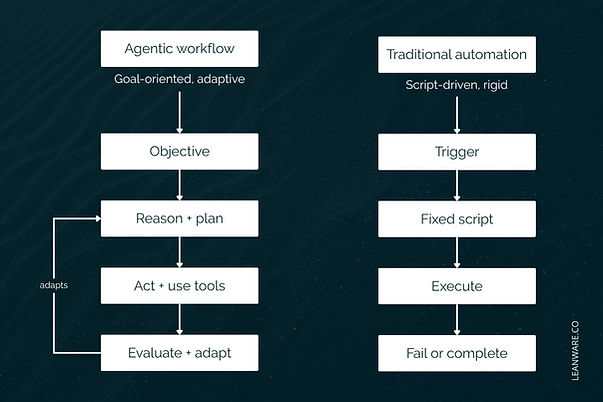
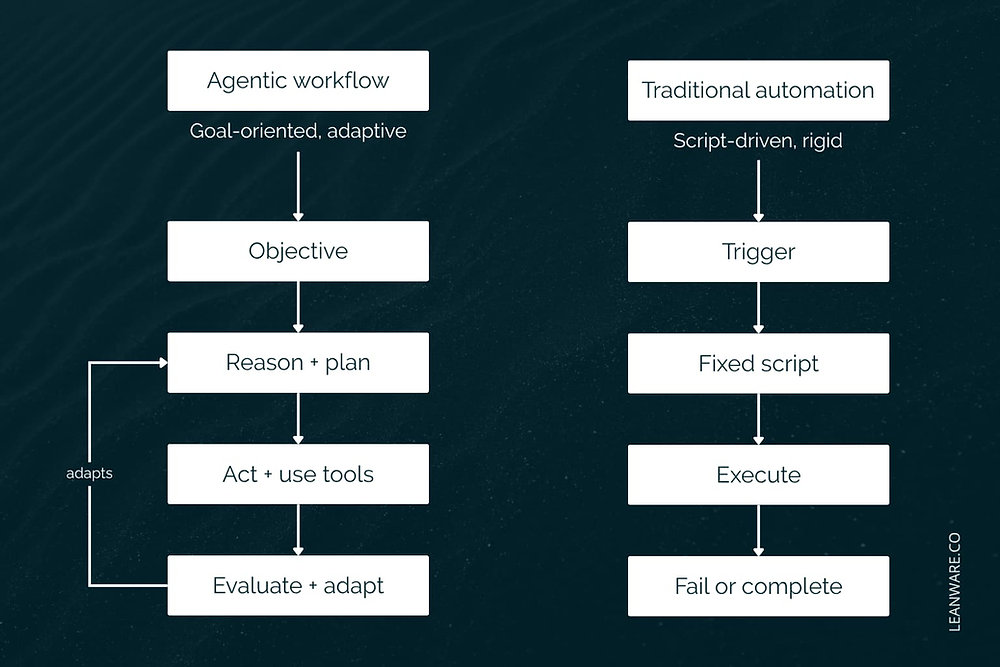
Agentic workflows are AI-driven processes where autonomous agents execute multi-step tasks with minimal human intervention. Each agent can reason about goals, decompose complex tasks into subtasks, select and use tools, evaluate its own outputs, and adjust its approach based on results. The workflow is goal-oriented rather than script-driven: the agent determines how to accomplish an objective rather than following a fixed sequence of rules.
This is structurally different from traditional automation. RPA follows predefined scripts and breaks when inputs deviate from expected patterns. Rule-based workflows execute if-then logic that someone programmed explicitly. Agentic workflows reason through ambiguity, adapt to unexpected inputs, and improve over time.
Agentic AI vs. Traditional Automation: The Real Difference
The difference spans three dimensions.
Flexibility: Traditional automation follows rigid scripts. If the input format changes or a new edge case appears, the automation fails until someone updates the rules. Agentic systems reason about inputs and adapt their behavior without manual reconfiguration.
Decision-making under uncertainty: Rule-based systems require explicit logic for every decision path. Agentic systems evaluate context, weigh alternatives, and make judgment calls when the situation does not match a predefined pattern.
Multi-step reasoning: Traditional automation executes a linear sequence. Agentic systems decompose goals into subtasks, execute them in parallel or sequence as needed, evaluate intermediate results, and adjust the plan if something does not work as expected.
Traditional automation remains valid for high-volume, highly predictable tasks where the rules are clear and the inputs are consistent. Agentic workflows are appropriate when the process involves reasoning, judgment, or adaptation.
Key Characteristics That Define an Agentic System
Three traits distinguish agentic systems from conventional AI applications.
- Autonomy: The system operates without requiring human approval at every step. It can initiate actions, call tools, and make decisions within defined boundaries.
- Adaptability: The system adjusts its behavior based on new information, changing conditions, or unexpected results. It does not follow a fixed script.
- Goal-orientation: The system works toward defined objectives rather than executing predefined instructions. It determines the steps needed to reach the goal, not just the next action in a sequence.
How Agentic Workflows Actually Work
An agentic workflow follows a lifecycle: the system receives a goal, decomposes it into tasks, selects the appropriate tools and actions for each task, executes them, evaluates the results, and iterates until the goal is achieved or the system determines it needs human input.
The Core Components Behind the System
Agentic workflows are built from several technical components working together.
AI agents are the autonomous units that reason, plan, and execute tasks. Each agent has a defined role, access to specific tools, and instructions that govern its behavior.
Large language models provide the reasoning and language understanding capabilities that enable agents to interpret goals, plan actions, and generate outputs.
Memory systems maintain context across interactions. Short-term memory holds the current task context. Long-term memory (typically backed by vector stores) retains information across sessions for retrieval when relevant.
Tool integration connects agents to external systems: APIs, databases, file systems, SaaS platforms, and enterprise applications. Tools are how agents take action in the real world rather than just generating text.
Orchestration layers coordinate multiple agents, manage task routing, handle agent-to-agent communication, and ensure the overall workflow progresses toward the goal.
How AI Agents Reason and Plan
When an agent receives a goal, it decomposes the goal into subtasks, determines which tools or actions each subtask requires, executes the first subtask, evaluates the result, and uses that evaluation to plan the next step. This loop (plan, execute, evaluate, adjust) repeats until the goal is met.
Function calling allows agents to invoke specific tools based on the task requirements. The agent determines which function to call, what parameters to pass, and how to use the result. Self-evaluation mechanisms allow the agent to assess whether its output meets the quality threshold before delivering it or iterating further.
Single-Agent vs. Multi-Agent Architectures
Single-agent systems handle workflows where one agent has all the capabilities needed. A SaaS support bot that answers billing and product questions from your docs is a single-agent system.
Multi-agent systems distribute work across specialized agents. A content pipeline where one agent researches, another writes, a third optimizes for SEO, and a fourth handles distribution is a multi-agent system. Each agent focuses on what it does best, and orchestration coordinates their work.
Multi-agent architectures are appropriate when the workflow requires multiple specialized capabilities, when tasks can run in parallel to reduce latency, or when the complexity exceeds what a single agent can manage reliably.
The Business Case for Agentic Workflows
AI is becoming core infrastructure for startups and scaling companies in 2026, with adoption quickly moving from prototypes to production. Teams of every size are seeing gains in productivity, shipping speed, and cost efficiency through automation and better use of data.
According to NVIDIA’s State of AI reports, about 44% of organizations are already deploying or exploring AI agents, with adoption highest in telecommunications (48%) and retail/CPG (47%). In healthcare use cases, AI agents have reduced documentation errors by up to 68% and lowered clinical workload by around 33%.
What's Driving Adoption Right Now
Adoption in 2026 is moving from side projects and prototypes to production systems, where ROI is becoming the main deciding factor especially for founders watching their burn rate.
LLMs have reached a level of production maturity, with reliable tool use, function calling, and multi-step reasoning.
Orchestration frameworks like LangGraph, CrewAI, and Microsoft’s Agent Framework are now better suited for coordinating agents at scale. Governance frameworks for autonomous systems are also starting to take shape, which helps teams building in regulated verticals move forward. Early deployments are also showing enough ROI to support broader investment.
Key Benefits for Startup Teams and Product Builders
The benefits map directly to the constraints that lean engineering teams and early-stage product builders face.
- Reduced manual overhead: Agents handle tasks that previously required human attention at every step: data gathering, analysis, report generation, and routine decision-making. This frees your small team to focus on building the product instead of running operations.
- Faster product iteration: Agentic workflows in development pipelines (automated code review, test generation, documentation, incident triage) compress cycle times without increasing headcount.
- Operational scalability without proportional headcount growth: Agents handle increasing workload volumes without requiring proportional staffing increases. A support system that handles 10,000 inquiries per day operates at the same staffing level as one handling 1,000 - critical when you're pre-Series B and can't hire a 20-person support team.
- Improved decision quality: Agents that analyze data across multiple systems and apply consistent evaluation criteria produce more reliable outputs than manual processes where quality depends on individual attention and fatigue levels.
Where Agentic Workflows Deliver the Most Impact
These are the areas where small teams spend disproportionate time on coordination rather than building.
IT operations and DevOps: Automated incident detection, triage, root cause analysis, and remediation. Agents correlate signals across monitoring systems and execute runbooks so your on-call engineer isn't woken up for issues that can be auto-resolved.
Customer support: End-to-end inquiry handling: intake, routing, resolution, follow-up, and escalation. Agents manage the full interaction arc and involve humans only for complex or sensitive cases.
HR and onboarding: Document processing, credential verification, system provisioning, and training coordination. Agents handle the administrative workflow and escalate exceptions.
Software development: Code review, test generation, documentation updates, sprint planning support, and deployment pipeline management. Senior engineers remain in the loop to validate AI-generated outputs.
Financial and compliance workflows: Transaction monitoring, regulatory reporting, audit preparation, and risk assessment. Agents process high-volume data and flag items that require human review.
How to Measure ROI from Agentic AI
Traditional efficiency metrics (time saved, cost reduced) capture part of the value. A broader measurement framework includes automation rate (what percentage of the workflow runs without human intervention), end-to-end workflow completion time, cross-functional process velocity (how fast work moves between teams), and output quality consistency (error rates, rework rates, compliance adherence).
Establish clear baselines before deployment. Track both direct cost savings and the compounding operational gains that come from agents that improve over time as they accumulate context and feedback.
Agentic Workflows by Industry
Agentic workflows produce measurable results across sectors where multi-step, data-intensive processes dominate.
Agentic AI in Software Development
Automated code review agents flag potential bugs, security vulnerabilities, and style violations before human reviewers see the code.
Test generation agents create test cases from code changes. Incident triage agents correlate alerts, assess severity, and route to the appropriate team. Documentation agents keep API docs and runbooks updated as the codebase evolves.
The value is in keeping your senior engineers - the ones who are hardest to hire and most expensive to lose, focused on architecture and design decisions rather than routine review tasks.
Agentic AI in Customer Operations
Agentic systems manage the full arc of customer interactions without requiring human intervention at every step.
An intake agent classifies the inquiry, a resolution agent pulls from knowledge bases, account data, and past interactions to generate a response, a quality agent checks the output before it’s sent, and an escalation agent routes complex cases to human operators with full context attached.
According to Gartner, by 2028 around 60% of brands will use agentic AI to enable streamlined one-to-one customer interactions.
How to Implement Agentic Workflows
Implementation follows a structured sequence: assess readiness, design the architecture, integrate with your existing stack, test in bounded conditions, establish governance, and scale gradually.
Readiness Assessment: What to Evaluate Before Building
There are five key factors that determine whether your team is ready for agentic workflows.
- Data quality and structure: Agents operate on data. If the data is fragmented, inconsistent, or inaccessible, agent outputs will be unreliable.
- API documentation completeness: Agents interact with systems through APIs. Incomplete or outdated API documentation slows integration and introduces errors.
- Defined success metrics: Without clear KPIs, you cannot evaluate whether the agentic workflow is delivering value.
- Security and access control readiness: Agents need permissions to access systems and data. Access controls must be defined before agents are deployed.
- Team alignment: The people who will work alongside agents need to understand how the system operates and when human intervention is appropriate. In a startup, that often means everyone.
Choosing the Right Architecture
Select between single-agent and multi-agent designs based on workflow complexity. If one agent can handle the entire workflow, a multi-agent design adds unnecessary coordination overhead.
If the workflow requires multiple specialized capabilities, a multi-agent architecture provides better modularity and fault isolation.
Orchestration models include centralized (one orchestrator coordinates all agents), decentralized (agents communicate directly), and hybrid (a coordinator manages high-level flow while agents handle local decisions). The choice depends on your compliance requirements, how far you need to scale, and how much autonomy individual agents need.
Common Implementation Pitfalls
Agentic deployments often fail due to a few recurring issues, including low-quality data that produces inconsistent outputs, partial integrations that prevent agents from fully accessing required systems, lack of governance that limits visibility and control, and pushing autonomy too quickly before workflows are properly tested.
Gartner expects that more than 40% of agentic AI projects could be canceled by the end of 2027, largely due to rising costs, unclear business value, or insufficient risk controls. For startups with limited runway, getting the scope right from day one matters even more.
Security and Governance
Agentic systems introduce security requirements that traditional software does not have. Agents hold credentials, access multiple systems, and make decisions autonomously. Each of these creates an attack surface.
Building Governance Into the Architecture
Governance needs to be designed into the system from the start.
Production agentic systems often include:
- Task boundaries so agents stay within defined limits
- Protection against prompt injection attempts
- PII detection to identify sensitive information
- Role-based access control to limit system permissions
- Audit logs to record agent actions and decisions
ISO/IEC 42001 provides a framework for AI management systems. The EU AI Act establishes regulatory requirements for high-risk AI systems that apply to autonomous agents operating in regulated contexts.
Human-in-the-Loop: Autonomy Levels and Oversight Design
Three levels of agent autonomy define how much human oversight is applied.
- Supervised: Agents propose actions and wait for human approval before executing. Appropriate for high-stakes decisions during initial deployment.
- Semi-autonomous: Agents execute routine actions independently and escalate exceptions to humans. This is where most production agentic systems operate today.
- Fully autonomous: Agents operate independently within defined boundaries, with human review happening after the fact through audit trails and monitoring. Appropriate for low-risk, high-volume workflows where the system has been thoroughly validated.
Human oversight should be a deliberate architectural decision. The goal is to move humans to higher-value decision points rather than removing them from the process entirely.
Tools and Frameworks for Agentic Workflows
The tool ecosystem for agentic systems has matured significantly.
LangChain/LangGraph provides stateful, multi-step workflows with conditional logic, cycles, and persistent state. Best suited for complex orchestration patterns.
CrewAI focuses on role-based agent collaboration with YAML-driven configuration. Best suited for rapid prototyping and getting a multi-agent system running quickly, ideal when you're validating an idea before committing to a heavier framework.
Microsoft Agent Framework (AutoGen + Semantic Kernel unified) provides production-grade orchestration with security, governance, and Azure integration. Best suited for teams that need compliance features out of the box.
Claude (Anthropic) offers tool use, multi-step reasoning, and extended context for agentic applications.
Vertex AI Agent Builder (Google Cloud) provides managed agent hosting with Google ecosystem integration.
AWS Bedrock Agents provides serverless agent deployment with AWS service integration.
Framework Evaluation Criteria
When evaluating frameworks, focus on how well they integrate with your existing stack, support security and role-based access control, enable multi-agent orchestration, provide observability and tracing, and the level of engineering effort required for setup and ongoing maintenance. For early-stage teams, time-to-first-working-agent matters as much as long-term scalability.
The Future of Agentic Workflows
Three directions are already emerging in current development work.
- AI-native product architecture: New products, especially in the SaaS space, are being designed with agents as core architectural components rather than added after the fact. If you're building a product from scratch, designing around agents now produces more capable and more efficient systems than bolting them on later.
- Cross-enterprise agent interoperability: Protocols like Anthropic's MCP and Google's A2A are establishing standards for how agents connect to tools and to each other across organizational boundaries.
- Mature human-AI collaboration models: The focus is shifting from "how much can we automate" to "how do we design systems where humans and agents complement each other."
Teams that invest in this collaboration design are positioned to scale agentic systems further than those focused purely on full automation.
Teams scaling multi-agent systems are projected to see exponential rather than linear value gains, because each additional agent capability compounds the system's overall capacity.
Implications for Engineering Teams
For CTOs and engineering managers at startups, the practical implications are clear. Skill requirements are shifting toward tool-use patterns, RAG workflows, and agent evaluation methodologies.
The senior engineer's role is evolving from writing every line of code to orchestrating AI systems: defining agent boundaries, designing evaluation pipelines, and managing model lifecycle. Teams that develop agentic fluency now will compound that advantage as the systems become more capable and as competitors catch up.
Final Thoughts
Agentic workflows are a present operational shift with measurable business impact. Teams that are building implementation capability now, investing in governance architecture, and developing internal expertise in agent orchestration are establishing advantages that compound with every deployment.
The gap between teams with production agentic systems and those still evaluating is widening. The time to build that capability is before the gap becomes structural.
If you are evaluating agentic workflow implementation for your product or operations, connect with us to design, build, and deploy agentic systems that work in production and scale with your business.
Frequently Asked Questions
What exactly are agentic workflows?
Agentic workflows are AI-driven processes where autonomous agents plan, execute, and iterate on multi-step tasks with minimal human intervention. They differ from traditional automation by using reasoning and adaptability rather than following fixed scripts.
Where should an organization start with agentic workflow implementation?
Start with a bounded, well-defined workflow where the data is clean, the success metrics are clear, and the consequences of agent errors are manageable. Validate the single-agent implementation before expanding to multi-agent architectures or higher-autonomy levels.
What ROI should organizations expect from agentic workflows?
Early adopters with structured implementations report average returns of 171% and ROI within the first year. Results depend on use case selection, data readiness, and implementation quality. Establish baselines before deployment and measure against specific KPIs.
How do agentic workflows differ from RPA and traditional automation?
RPA follows predefined scripts and breaks when inputs deviate from expected patterns. Agentic workflows reason about goals, adapt to unexpected inputs, and make decisions based on context. Traditional automation is appropriate for predictable, high-volume tasks. Agentic workflows handle processes that require judgment and adaptation.
What governance requirements apply to agentic systems?
Agentic systems require audit trails for every agent action, role-based access controls, prompt injection protection, PII detection, and defined escalation paths. Governance should be built into the architecture from day one. Relevant compliance frameworks include ISO/IEC 42001 and the EU AI Act for high-risk applications.