AI-Driven Process vs AI Workflow Automation

AI workflow automation executes predefined steps, even when AI assists with specific tasks. AI‑driven processes, by contrast, make decisions about what to run, when, and how, adapting dynamically to context, constraints, and changing conditions.
The difference isn’t speed or coverage - it’s which part of the system has control over decisions and how it responds when conditions deviate from the plan.
Let’s break down the architecture, design choices, and implications so you can see how each approach behaves in real-world systems.
Why Traditional Automation Breaks at Scale
Rule-based automation works well for predictable, repetitive tasks. Invoice processing with consistent formats, data entry from structured forms, report generation from fixed templates. These scenarios follow clear if-then patterns.
The problem arises when variance enters the system.
Traditional RPA fails when applications update or processes hit edge cases. Knowledge workers routinely navigate between eight to twelve different web applications during standard workflows, creating contexts that static rules cannot anticipate.
Three failure patterns are most common:
- Exception explosion happens when rule sets grow to accommodate edge cases. A process that started with 20 rules balloons to 200, then 2,000. Each new exception requires manual rule creation. The maintenance burden eventually exceeds the automation benefit.
- Fragile logic breaks when upstream systems change. A form field moves, an API response structure updates, a new approval path gets added. Static workflows lack the adaptability to handle these shifts without manual intervention.
- Human escalation loops create bottlenecks when automation cannot decide. Every ambiguous case routes to a human queue. At scale, these queues become the constraint rather than the automation itself.
The market for intelligent process automation is growing quickly - enterprises spent about $14.5 billion in 2024, and that’s expected to rise to nearly $45 billion by 2030. Traditional automation is struggling to keep up with the complexity of real-world workflows
What Is an AI-Driven Process?
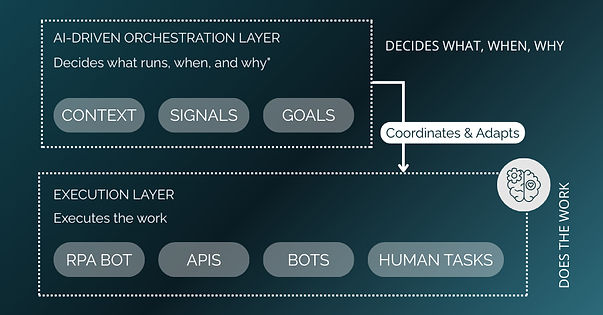
AI-driven process orchestration functions as an intelligent control layer. Rather than executing tasks, it determines what processes should run based on context. It prioritizes, coordinates, and adapts execution paths in response to changing conditions.
AI-driven process orchestration coordinates multiple automated tasks, data pipelines, systems, and human inputs to achieve business outcomes. It evaluates compromises, predicts likely outcomes, and adjusts process execution accordingly.
The orchestration layer does not replace your existing automation. It sits above it, making decisions about when, whether, and how to invoke those automated components.
Process Orchestration vs Task Automation
Task automation handles a specific action. An AI model reads an invoice, extracts the vendor name and amount, checks it against a purchase order. One smart job.
Process orchestration manages the entire flow. It ingests the invoice from email, triggers extraction automation, pushes extracted data to finance software for approval, schedules payment if approved, and archives the document in storage. The orchestration layer coordinates these steps, handles exceptions, and routes appropriately based on context.
The scope of control fundamentally differs. Automation asks "how do I complete this task?" Orchestration asks "what tasks need to happen, in what order, under what conditions?"
Why Decision Control Is the Core Differentiator
Controlling decisions delivers more value than automating execution steps. When you control what runs, when it runs, and why it runs, you manage risk and cost at the process level rather than the task level.
Consider claims processing. Task automation extracts data from claim documents. Decision control determines whether that claim needs fraud review, expedited processing, or standard handling. The extraction saves minutes per claim. The decision control prevents fraudulent payouts and allocates review resources effectively.
Risk management, cost control, and business outcomes depend on decision quality, not execution speed.
From Static Workflows to Intelligent Orchestration
BPM systems handle predictable tasks within structured processes. They struggle with work patterns where the end goal is known but the path varies due to unpredictable conditions.
Limitations of Rule-Based and BPM-Driven Automation
Rule-based systems operate on fixed if-then statements. Their effectiveness is limited by an inability to adapt to unforeseen situations or learn from past experiences. Every new scenario requires manual rule creation by someone who anticipated that scenario in advance.
Traditional automation follows rules: if condition X, then action Y. This approach breaks down when conditions are nuanced, when optimal decisions depend on complex patterns, when unanticipated situations arise, or when trade-offs require dynamic balancing.
The Shift to Context-Aware Systems
Modern systems rely on signals and state rather than fixed step sequences. Data becomes the driver of process behavior. Paths adjust dynamically based on data patterns. Historical data informs routing decisions. Real-time feeds trigger modifications.
This enables context-aware processes that understand customer history, operational conditions, risk levels, and compliance requirements. The process adapts to the situation rather than forcing the situation into predetermined paths.
What Orchestration Means in an AI-First Architecture
Orchestration functions as a control plane that governs processes across systems. It complements execution engines rather than replacing them.
Coordinating Systems, Humans, and Automation
AI handles volume through routine decisions that follow learnable patterns. Humans handle judgment through complex decisions requiring ethical consideration, stakeholder management, or novel situations.
AI augments humans by providing information, recommendations, and analysis for better, faster decisions. Humans train AI through their decisions on edge cases, which become training data that improves system performance over time.
This creates a continuous improvement loop where AI capabilities expand while humans focus on higher-value activities requiring creativity and judgment.
Orchestration as a Control Plane
The architectural boundary matters. Orchestration decides. Execution layers act.
Your existing automation tools, RPA bots, API integrations, and custom scripts handle execution. The orchestration layer determines which components to invoke, in what sequence, with what parameters, based on current context.
How AI-Driven Process Works
The lifecycle follows four phases: signal intake, decision, execution, and feedback.
- Signal intake consumes events from multiple sources: CRM updates, inventory changes, sentiment shifts, system health metrics. Relying on a single input source creates blind spots. Real-time signals matter more than historical volume.
- The decision layer combines multiple components. Machine learning models predict outcomes and classify inputs. Policy engines enforce business rules and compliance requirements. Reasoning engines evaluate trade-offs across competing priorities. This is not "LLMs only."
- Dynamic flow assembly means workflows compose, alter, or skip dynamically based on decisions. Intelligent routing determines optimal process paths based on learned patterns rather than static rules. Anomaly detection identifies unusual patterns indicating problems, fraud, or opportunities.
- Feedback loops mean outcomes feed back into future decisions. Every completed process generates data about what worked. Systems that learn from their decisions improve over time.
The Role of Context
Without context, AI decisions degrade quickly. Context transforms raw signals into meaningful inputs for decision-making.
User and role context means roles, permissions, and historical behavior influence decisions. A request from a new customer routes differently than one from a long-standing account.
Temporal and priority context means deadlines, urgency, SLAs, and time-based constraints affect decision-making. A task due in one hour receives different handling than one due next week.
Operational state context means system health, load, and availability shape choices. Routing around a degraded component maintains throughput.
Business objectives connect decisions to goals, risk tolerance, and cost limits. These constraints must be explicit in the decision layer.
Core Components of an AI-Driven Stack
These components work together to show how an AI-driven stack handles information, keeps track of state, and coordinates actions across systems.
- Event-driven infrastructure enables responsiveness and decoupling. Events trigger processes, and processes emit events. This architecture allows components to evolve independently.
- AI decision engines and predictive models evaluate trade-offs and predict outcomes. These components consume context and produce decisions, recommendations, or classifications.
- Workflow and state management engines handle state tracking independently of decision logic. They maintain awareness of where each process instance stands.
- Human-in-the-loop mechanisms define when and why human intervention is required. Not every decision should be automated. The architecture must accommodate human judgment at appropriate points.
- Observability, monitoring, and governance provide traceability and auditability. Every decision should be explainable. Every process should be visible. These are non-negotiable requirements.
AI-Driven Process vs AI Workflow Automation
AI workflow automation handles specific tasks with AI support, like document classification, data extraction, or response generation. Its scope is limited, and decision authority is narrow.
AI-driven process orchestration manages end-to-end flows across systems. It decides which processes to run, coordinates execution, handles exceptions, and adapts to changing conditions. Its scope is broad, and decision authority is substantial.
Aspect | AI Workflow Automation | AI-Driven Process Orchestration |
Scope | Task-level | End-to-end across systems |
Decision Authority | Limited | Broad |
Variability Handling | Predictable cases; escalates on exceptions | Adapts; reroutes and manages exceptions |
Focus | Execute steps | Make decisions and orchestrate flows |
Workflow automation works well for predictable variations. When unexpected situations arise, it fails or escalates. Process orchestration anticipates uncertainty and adapts, adjusting priorities and rerouting around failures programmatically.
When Workflow Automation Is Enough
Low-risk, low-variance scenarios add little value from full orchestration. If your process follows consistent patterns, encounters few exceptions, and failure impact is limited, workflow automation delivers results without orchestration complexity.
Document processing with consistent formats, scheduled report generation, standard data transformations. These scenarios benefit from automation without requiring intelligent orchestration.
Designing AI-Driven Systems
Map the decisions your process requires before modeling the workflow.
- What routing decisions exist?
- What choices need to be made?
- What judgment calls occur?
Decision mapping reveals where intelligence adds value. Task mapping reveals where automation saves time. Both matter, but decision mapping comes first.
Treat resilience and fallback paths as first-class design elements. Every component will fail eventually. Every process will encounter exceptions. Design assumes these conditions rather than treating them as afterthoughts.
Humans remain responsible even when AI decides. This means AI decisions must be explainable, auditable, and overridable. Design for accountability from the start.
Common Implementation Mistakes
Even experienced teams run into common issues in AI-driven processes: automating tasks without considering decision context, making choices with incomplete signals, and lacking visibility into system behavior. These issues can lead to misprioritized work, poor decisions, and difficulty improving the system.
Mistake | What Happens | Impact |
Over-automation | Tasks automated without decision context | Work may be misprioritized |
Poor context | AI lacks key signals | Decisions are off |
No observability | Can't trace inputs to decisions | Hard to debug or improve |
Measuring Success
Success measures outcomes and decision quality, not model metrics. Process outcomes matter: cycle time, error rates, cost per transaction. Decision quality matters: accuracy of routing decisions, appropriateness of escalations.
Model accuracy on test data does not indicate production success. A model that performs well in isolation may produce poor decisions when integrated into a process with incomplete context.
Security and Governance Considerations
Giving AI systems decision authority creates real security risks. The main concerns are over-privileged actions, limited auditability, and uncontrolled impact.
Access control must apply to decision-making authority, not just data access. An AI component that can route payments requires different controls than one that can only classify documents.
Auditability requires logging every decision, the inputs that informed it, and the outcome it produced. Regulated environments demand this traceability.
Getting Started
Organizations that master orchestration outperform those that only automate tasks. The difference is in decision control.
Task automation makes existing processes faster. Process orchestration makes them smarter. It allocates resources based on predicted outcomes, routes work based on current context, and adapts to changing conditions without manual intervention.
You can also connect with our experts to explore how AI-driven processes can be designed, monitored, and scaled effectively to improve your decision-making and operational outcomes.
Frequently Asked Questions
What tools implement AI-driven processes?
AI-driven process orchestration usually comes from combining decision engines, event systems, and workflow managers. There isn’t a single tool that does everything. Key capabilities include event processing infrastructure, AI decision engines, workflow management, state tracking, and observability tooling.
How much does implementation cost?
Cost depends on decision complexity, scope, and risk rather than company size. Engineering effort scales with decision points and integration requirements. Data integration costs depend on how many systems provide context. Change management effort reflects how significantly the new approach differs from current operations.
What skills are needed?
Traditional automation skills alone are insufficient. You need decision modeling expertise, systems thinking ability, and domain expertise. Successful implementations require collaboration between engineering, operations, and business owners.
How long does implementation take?
Discovery phase takes weeks. Pilot phase takes one to three months depending on complexity. Controlled rollout continues for several months. Value can appear early through pilot wins. Maturity takes longer.
What are the data requirements?
Signal quality and relevance matter more than large datasets. You need real-time events, system state information, and historical outcomes. Data timeliness often matters more than volume.
What are the security risks?
Risks relate to decision authority. Over-privileged actions occur when AI components have more authority than needed. Lack of auditability prevents understanding decisions. Uncontrolled blast radius means errors propagate widely. Governance and access control mitigate these risks.
Can small businesses benefit?
It depends on process complexity and variability, not size. Small teams with complex operations may gain more than large teams with simple workflows. Base the evaluation on operational needs rather than headcount.