How to Build a Software Engineering Team: A Complete Guide

The trajectory of a software product often depends less on the specific technologies used and more on the people building it. While a tech stack can be updated or changed, the culture and competency of an engineering team are much harder to adjust.
The challenge lies in knowing who to hire, when to scale, and how to maintain quality without compromising speed or momentum.
Let’s look at how to build a software engineering team that delivers reliable systems and effectively supports your product goals.
What Is a Software Engineering Team?
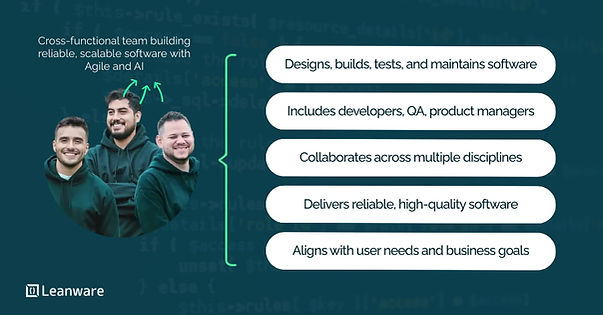
A software engineering team is a multidisciplinary group of professionals who collaborate to design, build, test, and maintain software products. These teams typically consist of core roles like software developers, who write the code, and quality assurance (QA) engineers, who verify functionality and find bugs.
They are supported by product managers or owners who define the vision and software architects who design the overall system structure. By pooling diverse skills in programming, design, and project management, the team aims to predictably deliver high-quality software that meets specific user needs and business goals.
Software Engineering Team vs Development Team
Development teams focus on delivering features, while software engineering teams take responsibility for system design, maintainability, and long-term reliability.
Feature | Software Engineering Team | Development Team |
Primary Focus | System architecture and infrastructure | Feature execution and hands-on coding |
Problem Scale | Holistic, system-wide challenges | Targeted tasks and algorithmic problems |
Approach | Systematic and analytical | Creative and brainstorming-driven |
Outcome | Scalable, reliable system frameworks | Functional, user-focused applications |
Engineering teams plan for growth and system health, whereas development teams concentrate on immediate feature delivery.
Why Building the Right Team Matters More Than the Tech Stack
Technologies go through cycles of popularity. Languages like Python or frameworks like React are tools, not end goals. A strong team can learn a new stack in weeks, but a weak team will produce brittle code regardless of the tools they use. So, investing in people who understand architectural principles and problem-solving ensures that your product can evolve even as the underlying technology shifts.
When Should You Build or Scale a Software Engineering Team?
Timing your hiring is a matter of judgment. Hiring too early consumes resources unnecessarily, while hiring too late can slow development and delay your market entry. Team growth should follow three distinct stages that align with the maturity of your product.
MVP Stage: Speed and Validation
At the MVP stage, your goal is survival through validation. You need a small, versatile team that can build, measure, and pivot quickly. Complexity is the enemy here. The team should focus on core features that prove the business case.
Usually, this requires two to three generalist engineers who can handle both frontend and backend tasks.
Growth Stage: Stability and Scalability
Once you find product-market fit, your user base grows, and so does the pressure on your infrastructure. This is the stage where "quick and dirty" code becomes a liability.
You need to start hiring senior engineers who can implement testing suites, improve deployment pipelines, and refine the architecture to handle increased traffic.
Scale Stage: Process, Leadership, and Reliability
In the scale stage, the product is established, and the team grows beyond ten or fifteen people. The focus shifts toward predictability and reliability.
You need leadership layers - tech leads and engineering managers - to ensure that communication doesn't break down as the organization expands.
Defining Your Product and Business Context
Before you write a single job description, get clarity on what the business actually needs from engineering. The structure of your team should follow from your product complexity, your revenue model, and your users' expectations.
Choosing Between Speed, Quality, and Innovation
Most teams can sustainably optimize for two of these three at a time. Early-stage teams usually choose speed and innovation. Growth-stage teams often shift to quality and speed. Being honest about your priorities helps you hire the right people and set realistic expectations.
In-House, Nearshore, Offshore, or Hybrid Teams
Model | Strengths | Weaknesses |
In-house | Full control, strong culture alignment | High cost, slow to hire |
Nearshore | Similar timezones, cost-effective | Smaller talent pool depending on region |
Offshore | Lower cost | Timezone gaps, ownership issues |
Hybrid | Flexibility | Requires strong coordination |
The best model depends on your budget, product complexity, and how much real-time collaboration your team requires.
For many companies, nearshore teams provide an effective option: you get timezone alignment and easier communication without the higher costs of a fully in-house team, while still maintaining strong collaboration compared with traditional offshore models.
Core Roles in a Software Engineering Team
Even a small team needs specific roles to ensure all aspects of the product lifecycle are covered. As you build the foundation, focus on these essential positions.
1. Software Engineers (Frontend, Backend, Full-Stack)
Frontend engineers own the user interface. Backend engineers own APIs, databases, and server-side logic. Full-stack engineers can work across both, which is useful for small teams but harder to scale.
Regardless of specialization, what you want from engineers is ownership: they should care about what they ship, not just close tickets.
2. Senior Engineers and Tech Leads
Senior engineers and tech leads do more than write code. They make architectural decisions, review other engineers' work, and raise problems before they become crises.
At a small company, this role often separates a team that scales well from one that constantly fights fires. Without senior engineering judgment, you end up paying for it later in rework and instability.
3. Product Managers and Product Owners
Product roles bridge business goals and engineering execution. A good product manager keeps the team working on the right things, writes clear requirements, and absorbs ambiguity so engineers can stay focused.
Without this role, engineers end up making product decisions they are not positioned to make, or waiting for direction that never comes.
4. QA Engineers and Testing Roles
QA is often the first role cut and the one teams regret cutting. Catching bugs before they reach production is significantly cheaper than fixing them after. Build a culture of testing early, because it is much harder to retrofit quality into a fast-moving codebase.
Additional Roles for Mature Engineering Teams
These roles are not required early, but they become important as product complexity grows.
DevOps and Platform Engineers own the infrastructure that makes development faster and safer: CI/CD pipelines, deployment automation, cloud cost management. Without this function, developers spend time on operational tasks that pull them away from product work.
UI/UX Designers reduce rework for engineers. When engineers build without design input, they make UX decisions they are not equipped to make, and those get rebuilt later at higher cost.
Data and ML Engineers make sense when data or AI is core to the product. If you are adding AI features experimentally, it is often better to use APIs and external tooling first before committing to dedicated headcount.
Security and Compliance Specialists are essential in regulated industries like healthcare or finance. Security cannot be retrofitted at scale. The earlier you build it into your practices, the cheaper it is to maintain.
How to Determine the Right Team Size
Larger teams are not always faster. In fact, adding more people to a late project often makes it later due to the communication tax.
Stage | Typical Team Size | Focus |
MVP | 2-4 | Rapid prototyping, validation |
Growth | 5-15 | Scalability, feature depth, testing |
Scale | 20+ | Departmentalization, platform stability |
As a team grows, the number of communication channels rises sharply. According to Brooks's Law, coordinating 50 people often results in less output per person than a team of 5. To manage this, large organizations break down into smaller squads or tribes that preserve the feel of a small team within a larger structure.
How to Hire Software Engineers Effectively
Hiring well is slow and hard. Rushing it is one of the most expensive mistakes you can make.
Skills That Matter More Than Programming Languages
Problem-solving, communication, and adaptability are harder to teach than any specific language.
An engineer who reasons clearly about a complex system and communicates that reasoning to non-technical stakeholders is more valuable than one who knows every feature of the latest framework. Languages and tools can be learned. Judgment and ownership cannot.
Evaluating Technical and Problem-Solving Skills
Skip the whiteboard algorithm questions that have no connection to the actual job. Use practical assessments: a small take-home project, a code review exercise, or a real-world debugging scenario.
In interviews, ask candidates to walk through a technical decision they made and what they would do differently now. The quality of their thinking matters more than whether they arrived at the "right" answer.
Cultural Fit and Ownership Mindset
Look for engineers who ask about what happens after deployment, who surface edge cases nobody asked them to think about, and who take responsibility when things go wrong. These signals predict long-term contribution more reliably than credentials.
Common Hiring Mistakes to Avoid
You can still make mistakes during hiring if the focus is on filling positions rather than solving specific team or product needs.
- Hiring to fill headcount rather than solve a specific problem
- Prioritizing a prestigious resume over demonstrated judgment
- Skipping senior talent because junior engineers are cheaper
- Moving too fast and skipping reference checks
Building a Strong Engineering Culture
Culture shows up in how people work and make decisions every day. It doesn’t develop on its own.
Code review is not just about finding bugs. It is about sharing knowledge, preventing silos, and maintaining consistent standards. Without it, knowledge concentrates in individuals and the team becomes fragile. Establish a code review practice early, even if it is just two engineers reviewing each other's work.
Documentation does not need to be extensive to be useful. Architecture decision records, onboarding guides, and operational runbooks get new hires productive faster and reduce the cost of team turnover. Write documentation that answers the questions you actually get asked.
Feedback and accountability are what allow teams to improve. Regular retrospectives and honest postmortems after incidents create a learning culture. The goal is not blame. It is understanding what went wrong and preventing it from happening again.
Processes and Methodologies That Actually Work
The right process is the one your team follows consistently. Do not adopt a methodology because it is popular.
Scrum works well for teams with predictable sprint cycles and a clear product backlog. Kanban works better for teams with more variable work, like operations or platform teams. The key is keeping processes as lightweight as possible. Every ceremony, every required ticket field, every approval step adds friction. If a process does not improve outcomes, remove it.
For roadmap management: the product manager and tech lead should align on what is being worked on, why, and in what order, then communicate that clearly to the team. A backlog that is not regularly groomed becomes a graveyard.
Tools and Infrastructure for Engineering Teams
Tools should support your process, not define it. Every team needs version control, an automated CI/CD pipeline that runs tests, and a deployment process that avoids manual steps. For project management, tools like Jira, Linear, or GitHub Issues work well as long as the team uses them consistently and keeps work visible.
Once you have users in production, monitoring and observability become essential. It is better to detect issues through alerts than through customer reports. Set up error tracking, latency monitoring, and uptime checks before launch so the team can respond quickly when problems arise.
Scaling a Software Engineering Team Without Losing Quality
Reactive hiring, adding engineers because you are behind, rarely works. Intentional scaling does.
Technical debt is not inherently bad. Taking shortcuts to ship faster is sometimes the right call. The problem is untracked debt that accumulates invisibly until it slows everything down. Keep a technical debt backlog, prioritize it alongside feature work, and address it before it compounds.
Leadership at scale requires delegation. At ten-plus engineers, no single person can hold all technical context. You need tech leads or staff engineers who own specific domains and can make architectural decisions within those domains. Trust and delegation become as important as technical ability.
Common Mistakes When Building Engineering Teams
Even well-intentioned teams can fall into patterns that slow progress and create avoidable problems.
Hiring too fast or too cheap: Hiring cheap engineers to save money almost always costs more in the long run. You pay in quality issues, rework, and senior engineer time required to manage the output.
Ignoring QA and testing: Teams that skip QA early spend disproportionate senior engineer time debugging production issues later. A bug that takes an hour to fix in development takes a week to fix after it has affected customers and corrupted data.
Lack of technical leadership: Teams without strong technical direction drift. Engineers make inconsistent architectural decisions. Technical debt grows in all directions. Bringing in strong senior engineers early is far cheaper than cleaning up the consequences of not doing so.
What Makes High-Performing Software Engineering Teams Successful
Strong teams usually follow a few common patterns.
Clear ownership: When something breaks, someone is responsible. When something ships late, there is a clear point of contact. Diffuse ownership leads to diffuse accountability, and that slows everything down.
Strong communication: The best engineers communicate clearly, surface blockers early, and collaborate across product, design, and business stakeholders. Teams where engineers only talk to other engineers miss context that directly affects the quality of their work.
Alignment between engineering and business: When engineering teams understand the goals behind their work, they make better decisions. They know which trade-offs are acceptable and which are not. This alignment does not happen automatically. It requires deliberate investment in cross-functional communication.
Your Next Move
The teams that sustain quality as they scale are rarely the ones with the best tech stack or the most engineers. They are the ones with clear ownership, consistent standards, and the discipline to invest in their own infrastructure alongside shipping features.
Build for the team you will need in two years. Start with fewer, stronger people.
Establish culture early, because it is much harder to change later. Invest in senior engineering judgment before you think you need it. When built well, an engineering team is one of the most durable competitive advantages a company has.
You can also connect with us to support your engineering team through nearshore development, staff augmentation, and targeted technical support.
Frequently Asked Questions
What is a software engineering team?
A software engineering team is a group responsible for designing, building, testing, and maintaining software systems. Beyond delivering features, it focuses on scalability, reliability, code quality, and long-term growth of the product.
How many engineers do you need to build a software product?
Early-stage products often succeed with 2 to 4 engineers. As the product grows, teams typically expand to 5-10. Larger teams require strong leadership and clear processes to avoid communication slowdowns and maintain productivity.
What roles are essential in a software engineering team?
At a minimum, a team needs software engineers, a senior engineer or tech lead, a product manager, and QA. As complexity grows, additional roles like DevOps, UX designers, and data or security specialists are often added.
When should a company start building an engineering team?
Once product development becomes central to the business - usually during MVP validation or early growth - building a team makes sense. At this stage, technical decisions and ownership start directly affecting user experience and revenue.
What skills matter most when hiring software engineers?
Problem-solving, communication, ownership, and adaptability matter more than specific programming languages. Engineers who can reason about complex systems and pick up new tools as needed provide the most long-term value.
How do you scale a software engineering team effectively?
Scale deliberately. Add leadership, improve processes, and invest in documentation and testing. Avoid reactive hiring. Maintain quality and clear communication to prevent technical debt from slowing the team as it grows.
What are the most common mistakes when building engineering teams?
Common mistakes include hiring too fast, prioritizing cost over quality, skipping QA, lacking technical leadership, and assuming more engineers automatically increase output. These often lead to delays, unstable systems, and expensive rework.
Why is engineering culture important?
Culture shapes how a team makes decisions, handles mistakes, and maintains quality. Strong cultures emphasize code reviews, feedback, accountability, and continuous learning - the practices that allow teams to deliver efficiently without compromising reliability.