Tailwind's AI Crisis: 75% Layoffs, 80% Revenue Drop

On January 6, 2026, Tailwind Labs laid off three of its four engineers. The framework they helped build now powers over 617,000 live websites, including major platforms like Shopify, GitHub, NASA's Jet Propulsion Laboratory, and AI products like Claude.ai, Cursor, and Grok. Usage has never been higher. Revenue has never been lower.
This paradox, which Adam Wathan, Tailwind's founder and CEO, described in a GitHub comment that quickly went viral, underscores the situation: "Tailwind is growing faster than it ever has and is bigger than it ever has been, and our revenue is down close to 80%." The culprit is not competition, but AI.
What Happened: Timeline of Events (January 6-8, 2026)
- November 18, 2025: A developer opens Pull Request #2388 proposing an /llms.txt endpoint to make Tailwind's documentation easier for large language models to consume. The PR sits for nearly two months as comments pile up asking why it hasn't been merged.
- January 6, 2026: Tailwind Labs lays off three of four engineers, reducing the engineering team by 75%.
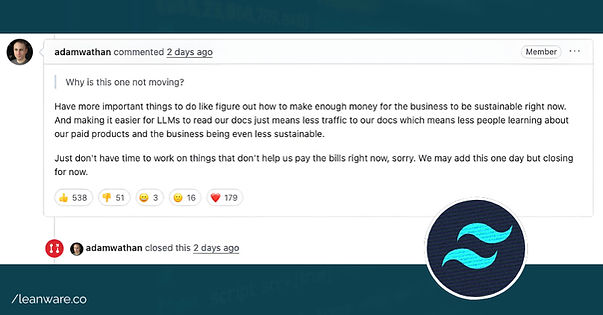
- January 7, 2026: Adam Wathan declines the PR and discloses the layoffs in the GitHub thread, explaining the "brutal impact AI has had on our business." The thread quickly goes viral.
- January 7, 2026: Wathan records an episode of his podcast "Adam's Morning Walk" titled "We had six months left," detailing the financial situation.
- January 8, 2026: The Hacker News discussion accumulates over 1,100 points and 635 comments. The GitHub thread gets locked after drawing hundreds of comments. Google AI Studio and Vercel announce sponsorships.
Background on Tailwind CSS and Tailwind Labs
Tailwind Labs is a small, bootstrapped company founded by Adam Wathan in January 2019. The company has never taken outside funding. At its peak, it employed eight people. After the layoffs, it operates with three co-founders, one engineer, and one part-time employee.
The Rise of Tailwind: From Utility-First CSS to Industry Standard
Tailwind CSS took a utility-first approach to styling that many developers initially dismissed as "inline styles with extra steps." That skepticism faded quickly. According to the 2025 State of CSS survey, 51% of respondents use Tailwind CSS, making it the most popular CSS framework. Monthly npm downloads now exceed 75 million.
Business Model: Open-Source Core + Paid Products
Tailwind CSS is free and open-source under the MIT license. Revenue comes from paid products: Tailwind Plus (500+ component templates sold as lifetime licenses) and an Insiders sponsorship program. The conversion funnel depended on developers visiting documentation, discovering paid products, and converting to customers. That funnel is now broken.
The Layoffs: 75% of Engineering Team Cut (January 6, 2026)
The announcement surfaced in an unlikely place: a GitHub pull request discussion. When a community member criticized Wathan for declining the llms.txt feature request, Wathan responded with unexpected transparency.
CEO Adam Wathan's Statement: "Brutal Impact" of AI
"The reality is that 75% of the people on our engineering team lost their jobs here yesterday because of the brutal impact AI has had on our business," Wathan wrote on GitHub PR #2388.
He elaborated on his podcast: "To say that we had to let go three people doesn't sound like we have to do much, but in reality, we have four engineers on staff and now we have one. So it is a big change."
Wathan described running revenue forecasts over the holidays and realizing "the situation was significantly worse than I realized." He called it a "boiling the frog situation" where revenue declined so slowly and steadily "you almost don't really notice. You just get used to the lower revenue being sort of normal."
His conclusion was: "If absolutely nothing changed, then in about six months we would no longer be able to meet payroll obligations."
"I feel like a fucking idiot for somehow being able to build this CSS framework that's taken over the world, and it's used by everything, and it's super popular, but I can't figure out how to have it make enough money that eight people can work on it," Wathan said. He later added: "I feel like a failure for having to do it. It's not good."
Scale of Impact: From 4 Engineers to 1 Remaining
Before Layoffs | After Layoffs |
4 engineers | 1 engineer |
~8 total employees | 5 total (3 co-founders + 1 engineer + 1 part-time) |
The remaining team after the layoffs is the three owners, one engineer, and one part-time employee. "That's all the resources we have," Wathan said.
Traffic Loss: The Root Cause
The financial collapse traces back to a single metric: documentation traffic. Tailwind Labs does not run ads on its website. It does not charge for the framework. The only way users discover paid products is by visiting the documentation site.
Documentation Traffic Decline: ~40% Since Early 2023
"Traffic to our docs is down like 40% or something from peak, even though Tailwind is like three times as popular as it was when traffic was at its peak," Wathan explained on his podcast. "And the only way people find out about our paid products is through the docs. That's our entire distribution."
The timing is significant - early 2023 marked the mainstream adoption of AI coding assistants. GitHub Copilot, ChatGPT, and Claude became standard tools in developer workflows. The correlation between AI adoption and traffic decline is unmistakable.
How AI Tools Bypass Docs: Direct Code Generation by LLMs
AI coding assistants train on publicly available documentation, including Tailwind's. When developers need to use Tailwind, they now have alternatives to visiting the official documentation:
- GitHub Copilot generates Tailwind classes directly in the code editor based on comments or partial code.
- Claude, ChatGPT, and other LLMs answer Tailwind questions in chat interfaces, pulling from training data that includes the documentation.
- Cursor and similar AI-native IDEs provide context-aware suggestions without requiring tab-switching to documentation.
Each of these interactions delivers value to the developer without a single page view on tailwindcss.com. The developer gets their answer. Tailwind Labs gets nothing.
Revenue Plunge: ~80% Drop Despite Record Usage
The disconnect between usage and revenue is the core of this crisis. More people use Tailwind than ever before. Fewer people pay for Tailwind products than ever before.
Record Downloads vs. Lost Conversions
Metric | Trend |
Monthly npm downloads | 75+ million (growing) |
Documentation traffic | Down ~40% |
Revenue | Down ~80% |
By 2020, Tailwind Labs had achieved over $2 million in annual revenue from Tailwind UI sales. Engineering positions were advertised at $250,000 to $300,000 in total compensation.
The pricing model compounds the problem. Tailwind Plus uses lifetime subscriptions at $299 for individuals and $979 for teams of up to 25. Customers get lifetime access to all current and future components, meaning once someone buys in, they never pay again. This trades long-term recurring revenue for one-time payments, making the company entirely dependent on new customer acquisition.
The PR request that triggered Wathan's disclosure asked for an /llms.txt file that would make documentation even easier for AI models to consume. From a technical standpoint, it was a reasonable feature request. From a business standpoint, it would accelerate the very trend destroying the company's revenue.
"Making it easier for LLMs to read our docs just means less traffic to our docs which means less people learning about our paid products and the business being even less sustainable," Wathan explained.
Broader Implications: AI's Disruption of Open-Source Sustainability
Tailwind's situation is not unique. It is the most visible example of a pattern affecting open-source projects that rely on documentation traffic for monetization. Stack Overflow has faced a similar collapse in question volume. Developer blogs that once drove traffic now see their content summarized in AI responses.
Software engineer Hugo Lassiege pointed out that the problem isn’t AI itself, but that the traditional open-source economic model was built for a world that no longer exists, and now that usage has moved from the browser to AI prompts, projects will need to find new ways to generate revenue.
The dynamics at play:
- AI models train on open-source documentation without compensating the creators. The same companies building AI coding assistants depend on Tailwind for their own products (Claude.ai, Cursor, OpenAI, and Grok all use Tailwind CSS) without contributing to its sustainability.
- Lifetime licensing models cannot sustain continuous development. Tailwind Plus uses one-time purchases, meaning revenue depends entirely on new customer acquisition. When that acquisition channel dies, so does the revenue stream.
- The discovery funnel from search to documentation to conversion is obsolete. Developers using LLMs can now generate Tailwind code without seeing ads for Tailwind UI, reading about the Insiders program, or even knowing paid products exist.
Community Reactions on GitHub, Reddit, and X
The GitHub thread on the layoffs quickly filled with hundreds of comments before being locked, with reactions split between sympathy and frustration. Many developers expressed support - Wathan’s explanation got over 1,000 positive reactions and 1,500 hearts, and Vercel, Google AI Studio, and Gumroad stepped in to sponsor tailwindcss.com.
People noted how central Tailwind has become to web development, and Wathan’s podcast gave an unusually candid look at the challenges of running a small engineering team in a world suddenly reshaped by AI.
At the same time, some criticism surfaced. Developers pointed out that Tailwind’s revenue model, built around selling UI components, is vulnerable now that free and AI-generated alternatives are widely available.
Wathan admitted he doesn’t have a clear answer yet, and it left a lot of people thinking: if the most-used CSS framework is in this position, what does that mean for smaller projects relying on similar models?
Lessons for Development Teams and Tech Decision-Makers
This crisis exposes real risks for organizations that depend on open-source tools. The framework you build your products on could face maintainability issues that have nothing to do with technical quality.
Assessing Dependency on Tailwind in Client Projects
If your team uses Tailwind extensively, consider a dependency audit:
- Upgrade path clarity: Do you understand how Tailwind 4 differs from Tailwind 3? Can you migrate if necessary?
- Team expertise: Do your developers understand utility-first CSS principles, or do they rely on AI tools to generate Tailwind classes?
- Component ownership: Are you using Tailwind Plus components, or have you built your own?
- Lock-in surface area: How deeply is Tailwind embedded in your component libraries?
Diversifying CSS Strategies in an AI-First World
Teams with risk concerns can evaluate alternatives that offer similar developer experience without depending on traffic-based business models.
Alternative | Model | Pros | Cons |
Copy-paste components (MIT license) | Full code ownership, no vendor dependency | Manual updates required | |
Tailwind plugin (MIT license) | 60+ components, 20+ themes, pure CSS | Still depends on Tailwind | |
Unstyled primitives from Tailwind Labs | Accessible, framework-agnostic | Styling still required |
Building Resilient Stacks
1. Favor truly open-source dependencies over "open core" models. Libraries with pure MIT licensing and no commercial layer cannot face the same business-model collapse.
2. Maintain internal expertise on foundational technologies. If your team only knows Tailwind and not the underlying CSS, you have created a fragility point.
3. Consider contributing to critical infrastructure. If Tailwind is foundational to your products, sponsorship is not charity. It is risk mitigation.
Wrap Up
Tailwind CSS will continue development, but the layoffs highlight a key challenge: models relying on documentation traffic to drive revenue may not hold up as AI changes how developers access information.
Wathan is focused on testing approaches to sustain the project and recommended the affected engineers to potential employers.
For teams using Tailwind or building developer tools, the takeaway is: look beyond adoption metrics and ensure the underlying business model can support long-term maintenance. Even widely used frameworks need stable support to keep evolving.
If you’re using Tailwind in production or evaluating developer tools, you can also reach out to us for guidance on assessing dependency risks, exploring alternative frameworks, and building resilient stacks that can adapt to AI-driven changes in workflows.
Frequently Asked Questions
Why did Tailwind Labs lay off 75% of its engineering team if Tailwind CSS is more popular than ever?
Because popularity no longer translates into revenue. AI coding assistants like ChatGPT, Copilot, and Cursor generate Tailwind code directly, bypassing Tailwind’s documentation site. Since Tailwind’s paid products are discovered almost entirely through documentation traffic, fewer page visits meant far fewer conversions—even as usage and npm downloads hit record highs.
How exactly did AI cause Tailwind’s revenue to drop by nearly 80%?
AI tools trained on Tailwind’s documentation now answer developer questions instantly inside IDEs and chat interfaces. Developers get what they need without visiting tailwindcss.com, breaking the search → docs → paid product funnel. With documentation traffic down ~40% since early 2023, Tailwind lost its primary customer acquisition channel.
Would adding an /llms.txt file help or hurt Tailwind Labs?
Technically, it would help AI models consume Tailwind’s docs more efficiently. From a business perspective, it would likely make the situation worse. Easier AI access means even fewer human visits to the docs, accelerating the traffic loss that already threatens Tailwind’s sustainability.
What does Tailwind’s situation mean for teams relying on open-source frameworks?
It’s a warning sign. Even massively adopted tools can face maintenance and staffing risks if their business models depend on documentation traffic. Teams should assess dependency risk, maintain internal expertise beyond AI-generated code, and consider supporting or diversifying away from tools whose sustainability depends on outdated discovery models.