Advertising Software Development | All You Need to Know

Digital advertising runs on software. Every ad you see online, every retargeting campaign, every real-time bid that happens in milliseconds while a page loads involves complex systems making decisions at scale. According to Statista, global programmatic ad spend reached $595 billion in 2024 and will approach $800 billion by 2028. That growth depends entirely on the software infrastructure behind it.
Let's explore what advertising software development involves, the types of tools in the AdTech ecosystem, and what to consider when building custom solutions.
What Is Advertising Software Development?
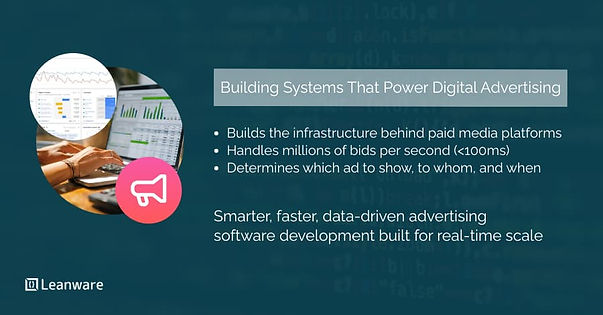
Advertising software development refers to building the systems that power digital ad operations. This includes demand-side platforms (DSPs) for buying ad inventory, supply-side platforms (SSPs) for publishers selling ad space, data management platforms (DMPs) for audience segmentation, and the analytics dashboards that tie everything together.
The terminology overlaps with MarTech (marketing technology), but AdTech specifically handles paid media placement and optimization. A CRM tracks customer relationships. An AdTech platform decides which ad to show, when, to whom, and for how much.
These systems must handle high throughput. A single ad exchange processes millions of bid requests per second, each requiring a response within 100 milliseconds. That imposes specific architectural constraints you won't find in typical web applications.
Why Your Business Needs Advertising Software
Most companies start with off-the-shelf solutions like Google Ads or Meta's ad manager. These work fine for standard campaigns, but limitations start to show as spend scales.
- Automation reduces manual work. Campaign managers spend hours adjusting bids, reallocating budgets, and pausing underperforming creatives. Custom software automates these decisions based on rules or machine learning models trained on your specific data.
- Real-time analytics improve decisions. Third-party platforms provide reporting, but the data arrives with delays and often lacks granularity. Custom dashboards pull data directly from APIs and display metrics that matter to your business.
- Targeting precision increases ROI. Generic platforms optimize for their average user. Custom systems can incorporate first-party data, proprietary audience segments, and business logic specific to your vertical.
- Fraud detection protects spend. Ad fraud remains a significant problem. According to Statista, ad fraud costs reached $88 billion globally in 2023 and will hit $172 billion by 2028. Custom validation layers can filter invalid traffic before it drains your budget.
Key Features of Effective Advertising Software
Effective advertising software brings together operational control, real-time insights, seamless integrations, automated bidding, and coordinated cross-channel management.
1. Campaign Management and Automation
Campaign management handles the operational side: creating campaigns, setting budgets, scheduling flights, and assigning creatives to placements. Automation extends this by making adjustments without human intervention.
Effective systems include rule-based triggers (pause campaign if CPA exceeds $50), budget pacing algorithms (distribute spend evenly across flight dates), and A/B test automation (rotate creatives and shift budget toward winners).
2. Data Analytics and Performance Tracking
Analytics covers everything from basic metrics (impressions, clicks, conversions) to advanced attribution modeling.
Key capabilities include real-time dashboards that update within minutes rather than hours, custom KPI definitions that match your business goals, cross-channel attribution that connects touchpoints across campaigns, and export functionality for integration with BI tools.
3. Integration with Marketing and CRM Tools
Advertising data becomes more valuable when integrated into the broader marketing stack. Typical integrations include:
- CRM platforms: Salesforce, HubSpot (lead scoring, pipeline tracking)
- Marketing automation tools: email campaigns, nurture sequences
- Customer data platforms (CDPs): unified audience profiles
- E-commerce platforms: track purchases, calculate ROAS
4. Programmatic Advertising Capabilities
Programmatic advertising automates the buying and selling of ad inventory through real-time bidding (RTB). When a user loads a webpage, an auction happens in milliseconds to determine which ad appears.
According to Grand View Research, the programmatic advertising market reached $678 billion in 2023 and will grow at 22.8% CAGR through 2030. Mobile and tablets accounted for 49.4% of that spend.
Key programmatic features include DSP integration for bid management, private marketplace (PMP) access for premium inventory, frequency capping to control ad exposure, and brand safety filters to avoid problematic placements.
5. Cross-Channel Ad Optimization
Modern campaigns span multiple channels: display, video, social, mobile, connected TV (CTV), and digital out-of-home. Managing these together ensures consistent messaging and efficiency. Features include:
- Unified reporting across all channels.
- Budget allocation algorithms that shift spend to top-performing channels.
- Frequency management to optimize exposure across touchpoints.
- Creative adaptation to match different formats and contexts.
Types of Advertising Software Solutions
Advertising software fulfills different roles across the AdTech ecosystem. The table below summarizes the main categories and their key functions.
Type | Purpose / Key Features |
Media Management Platforms | Consolidate campaigns, handle planning and reconciliation |
PPC Tools | Manage search ads, bids, keywords, and A/B testing |
Social Media Ad Platforms | Manage platform-specific ads, audiences, and reporting |
Programmatic Systems | Automated ad buying, RTB, targeting, measurement |
Display & Video Platforms | Manage banner/video ads, CTV, and viewability |
Email & Automation Tools | Connect email with ads, retargeting, suppression lists |
Affiliate & Influencer Platforms | Track referrals, manage partnerships and campaigns |
1. Media Management Platforms
Media management platforms consolidate campaign operations across publishers and channels. Tools like MediaOcean and Bionic handle planning, buying, and reconciliation for large advertisers managing millions in monthly spend.
2. Pay-Per-Click (PPC) Tools
PPC tools focus on search advertising through Google Ads and Microsoft Ads. Features include bid management algorithms, keyword research, ad copy testing with statistical significance calculations, and quality score optimization.
3. Social Media Ad Platforms
Social advertising requires platform-specific tools for Meta, LinkedIn, TikTok, and Pinterest. Management tools consolidate these into a single interface for audience building, creative management, and cross-platform reporting.
4. Programmatic Advertising Systems
Programmatic platforms like The Trade Desk, DV360, and Amazon DSP handle automated ad buying at scale. These systems connect to ad exchanges, execute bidding strategies, and provide targeting and measurement capabilities.
5. Display and Video Ad Platforms
Display and video platforms manage banner ads, rich media, and video campaigns, including connected TV (CTV) advertising. Video ad serving handles VAST tags, player integration, and viewability measurement.
6. Email and Automation Tools
Email platforms like Mailchimp and Klaviyo connect to advertising through retargeting and suppression lists. You suppress existing customers from acquisition campaigns and retarget email non-openers through paid channels.
7. Affiliate and Influencer Marketing Platforms
Affiliate platforms track referral-based advertising where partners earn commissions. Influencer platforms manage creator relationships and measure sponsored content performance.
Custom Advertising Software Development Services
Custom advertising software supports customized workflows, integrations, and analytics.
Service | Focus |
AdTech Design | Algorithms, legacy integration, UI |
Data & Analytics | Attribution, predictive insights, dashboards |
Tech Modernization | Cloud, real-time pipelines, security |
1. Custom AdTech Solution Design
Off-the-shelf platforms work for standard use cases. Custom development makes sense when you need proprietary algorithms that create competitive advantage, integration with legacy systems that lack standard APIs, data handling that meets specific compliance requirements, or user interfaces tailored to your team's workflow.
Architecture design starts with requirements: throughput expectations, latency constraints, data volume, integration points, and compliance needs.
2. Data and Analytics Systems
Custom analytics systems provide insights that generic platforms can't. This includes proprietary attribution models weighted for your business, predictive analytics using your historical data, custom dashboards for different stakeholders, and data warehousing that consolidates advertising data with other business data.
3. Tech Stack Enhancement and Modernization
Legacy advertising systems often run on outdated infrastructure. Modernization projects migrate to cloud-based architectures, replace batch processing with real-time pipelines, and update security practices to meet current standards.
Common upgrades include moving from on-premise servers to AWS/GCP/Azure, replacing nightly data syncs with streaming pipelines, and implementing proper API authentication and encryption.
How Advertising Software Improves Collaboration and Creativity
Advertising involves multiple teams - creative, media buying, analytics, and account management. Software can streamline collaboration and speed up creative production, reducing friction and improving efficiency.
1. Centralized Workflows and Asset Sharing
Advertising involves multiple teams: creative, media buying, analytics, and account management. Centralized systems reduce friction by providing shared asset libraries with version control, approval workflows with audit trails, permission systems that control access by role, and comment and annotation tools for creative review.
2. Streamlining Creative Processes
Creative production constraints slow campaign launches. Automation helps by generating size variations from master creatives, routing approvals to the right stakeholders, tracking revision history and feedback, and managing creative fatigue through rotation schedules.
Industry-Specific Advertising Software Solutions
Industries have distinct ad needs. Software designed for each improves efficiency and compliance.
Industry | Key Features |
Retail | Product feeds, inventory-aware ads, store visit attribution |
Telecom | Subscriber targeting, retention campaigns, data compliance |
Banking & Finance | Compliance, fair lending, audit trails |
Media & Publishing | Ad servers, yield optimization, high-volume support |
Retail and Retail Media Platforms
Retail advertising includes both retailer campaigns and retail media networks where retailers sell ad space on their properties. Key features include product feed management, inventory-aware advertising that pauses out-of-stock items, store visit attribution, and retail media integration with Amazon and Walmart.
Telecommunications Advertising Platforms
Telecom companies need subscriber acquisition campaigns, location-based targeting using network data, and retention marketing for contract renewals. Compliance requirements around subscriber data add complexity.
Banking and Financial Services AdTech
Financial advertising faces strict regulatory requirements including compliance review workflows, fair lending considerations in targeting, data security requirements, and audit trails for regulatory examination.
Media, Publishing, and Digital Marketing Tools
Publishers need supply-side tools: ad servers, yield optimization, and header bidding wrappers. High-volume sites require infrastructure handling millions of ad requests without impacting page load times.
Choosing the Right Advertising Software for Your Business
Selection criteria depend on your specific situation:
Factor | Questions to Ask |
Scale | What's your monthly ad spend? How many campaigns do you run? |
Integration | What existing systems must it connect with? |
Channels | Which advertising channels do you use? |
Team | How technical is your team? What's the learning curve tolerance? |
Budget | What's the total cost including implementation and training? |
Request demos with your actual data. Generic sales presentations hide limitations that surface when you try to implement real workflows.
Measuring Impact and Performance
Standard advertising KPIs include:
- CTR (Click-Through Rate): Clicks divided by impressions
- CPA (Cost Per Acquisition): Total spend divided by conversions
- ROAS (Return on Ad Spend): Revenue generated divided by ad spend
- CAC (Customer Acquisition Cost): Total marketing cost per new customer
- Conversion Rate: Conversions divided by clicks or sessions
Beyond these basics, custom analytics can track incrementality (lift over baseline), customer lifetime value by acquisition source, and cross-channel attribution that assigns credit across touchpoints.
Build Your Custom Advertising Solution
Advertising software operates at the intersection of high-volume data processing, real-time decision making, and business strategy. The right platform automates routine tasks, surfaces actionable insights, and creates competitive advantages through proprietary capabilities.
Start by mapping your current advertising operations: what works, what creates friction, and where manual processes limit scale. That analysis reveals whether off-the-shelf tools meet your needs or custom development delivers better ROI.
Connect with us for custom advertising software development services to streamline campaigns, improve insights, and improve team collaboration.
Frequently Asked Questions
What is advertising software development?
Advertising software development builds the systems that power digital ad campaigns: platforms for buying and selling inventory, analytics dashboards, automation tools, and marketing integrations.
What are the key features of advertising software?
Core features include campaign management, real-time bidding, audience targeting, performance analytics, A/B testing, and cross-channel optimization. Advanced systems add machine learning for bid optimization and fraud detection.
What types of advertising software are available?
The ecosystem includes DSPs for buying, SSPs for selling, DMPs for audience data, ad servers for delivery, and analytics platforms for measurement.
How do I choose the right advertising software?
Evaluate platforms against actual use cases rather than feature checklists. Consider channels you use, integration needs, team capabilities, implementation complexity, and total cost.
Why invest in custom advertising software development?
Custom development makes sense when off-the-shelf solutions can't handle proprietary algorithms, unusual data sources, strict compliance requirements, or legacy system integrations.
What industries benefit most from advertising software?
E-commerce and retail for product promotion. Financial services for compliance. Media companies for supply-side tools. B2B for account-based advertising.
How do you measure advertising software success?
Measure against original goals: reduced manual hours, improved campaign metrics, faster insights, or better fraud detection rates.
How much does custom advertising software cost?
Costs depend on complexity and team location.
Project Type | US Rates | LATAM Rates |
Simple dashboards | $40K-$80K | $15K-$35K |
Mid-range automation | $150K-$400K | $60K-$150K |
Enterprise platforms | $500K+ | $200K+ |
Annual maintenance runs about 20% of initial development costs regardless of region.
How long does advertising software development take?
MVP dashboard: 3 to 4 months. Full campaign platform: 9 to 12 months. Enterprise DSP: 18+ months. Agile delivers features incrementally.
What programming languages work best for advertising software?
Python for data and ML. JavaScript for dashboards. Go or Rust for high-throughput bid processors. Java in enterprise environments.
How do I handle GDPR and CCPA compliance?
Implement consent management, data retention policies, user deletion capabilities, and audit trails. Work with legal counsel for interpretation. Conduct regular audits.
How many developers do I need?
Small analytics project: 2 to 3 developers for 4 to 6 months. Full platform: 5 to 8 developers plus designers, QA, and project management.
Can I white-label existing advertising platforms?
White-label options exist for DSPs, ad servers, and analytics. Lower upfront costs but less customization. Works when needs align with platform capabilities.
How do I test advertising software before launch?
Unit testing, integration testing, load testing, and user acceptance testing. Use staging environments with production-like data. Beta test with limited campaigns.