AI Agent Orchestration: What It Is and How It Works

Single AI agents handle individual tasks well. They can generate text, retrieve information, analyze data, or call an API. They do not handle multi-step workflows that require coordination between several specialized capabilities, shared context across tasks, and decisions about what to do next based on intermediate results. That is what orchestration solves.
AI agent orchestration is the coordination layer that manages how multiple AI agents work together to accomplish complex goals. It handles task decomposition, agent selection, execution sequencing, context sharing, and output synthesis.
Let’s see how orchestration works, what the architecture looks like, and where it delivers value in production systems.
What Is AI Agent Orchestration?
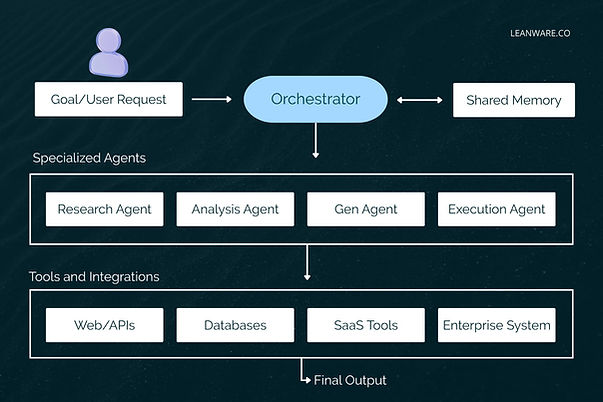
AI agent orchestration is the process of coordinating multiple specialized AI agents within structured workflows to complete tasks that no single agent can handle alone.
The orchestration layer manages how agents communicate, share information, and execute their responsibilities in a defined sequence.
A useful analogy is a project manager coordinating a team of specialists. The project manager does not write code, design interfaces, or test software. The project manager decides who works on what, in what order, ensures that outputs from one team member flow correctly to the next, and keeps the overall goal on track. The orchestrator serves the same function for AI agents.
Why AI Agent Orchestration Is Becoming Essential
Single-model AI applications work for simple tasks: answer a question, summarize a document, generate an email. They struggle with workflows that require multiple steps, external tool usage, reasoning over intermediate results, and integration with enterprise systems.
Modern AI workflows are growing more complex. A customer support system needs to understand the query, retrieve relevant knowledge, check account data, generate a response, and decide whether to escalate.
A content pipeline needs to research a topic, generate a draft, optimize for SEO, and schedule publication. Each step requires a different capability, and the steps need to be coordinated.
Gartner predicts that by 2028, 33% of enterprise software applications will include agentic AI, up from less than 1% in 2024. Orchestrated multi-agent systems deliver capabilities that single agents cannot match.
How AI Agent Orchestration Works
Orchestration involves breaking down the goal, assigning tasks to agents, managing execution, maintaining shared context, and synthesizing the final output.
Task Decomposition and Planning
The orchestrator receives a complex goal and breaks it into discrete tasks. Each task maps to a specific agent's capability.
A research report request might decompose into: gather data from specified sources, analyze the data for trends, generate a written summary, format the output, and deliver it to the specified destination. Each of these becomes a task assigned to a specialized agent.
Agent Coordination and Communication
Agents pass outputs, context, and instructions to one another through the orchestration layer. The output of one agent becomes the input for the next.
The orchestrator manages the sequencing: which agents run in parallel, which depend on previous results, and how to handle errors or unexpected outputs from individual agents.
Tool and API Integration
Agents interact with external systems: databases, APIs, SaaS platforms, file systems, and enterprise applications.
The orchestration layer manages how agents access these tools, handles authentication, and ensures that tool calls happen in the correct context. This integration layer is what connects AI agent capabilities to real business systems.
Memory and Context Management
Multi-step workflows require shared context. The orchestrator maintains a memory layer that stores intermediate results, conversation history, and state information that agents need to access across the workflow. Without shared context, each agent operates in isolation, which produces inconsistent or disconnected results.
Core Components of an AI Agent Orchestration System
A production orchestration system typically includes four layers.
AI Agents
Each agent is a specialized unit designed for a specific capability: research, reasoning, code generation, data analysis, content creation, or tool execution.
Agents are defined by their instructions, the model they use, the tools they can access, and the tasks they handle. Well-designed agents have clear responsibility boundaries.
The Orchestrator
The orchestrator is the central control layer. It receives the goal, decomposes it into tasks, selects the appropriate agents, manages execution order, handles errors, and assembles the final output.
The orchestrator makes the routing decisions: which agent handles which task, what happens when an agent fails, and when to involve a human in the loop.
Workflow Engine
The workflow engine defines the execution structure: sequential tasks, parallel execution, conditional branching, loops, and error handling. Workflows can be deterministic (follow a predefined sequence) or dynamic (the orchestrator decides the next step based on intermediate results). Most production systems combine both approaches.
Tooling and Integration Layer
This layer provides the connections between agents and external systems: REST APIs, databases, SaaS platforms, file storage, messaging systems, and enterprise applications. Standardized protocols like Anthropic's Model Context Protocol (MCP) and Google's Agent-to-Agent Protocol (A2A) are establishing interoperability standards for how agents connect to tools and to each other.
AI Agent Orchestration Architecture
A typical orchestration architecture operates in layers. The user or system provides a goal to the orchestrator. The orchestrator decomposes the goal into tasks and routes each task to the appropriate agent. Each agent executes its task, potentially calling external tools or APIs, and returns its output to the orchestrator. The orchestrator maintains shared memory across the workflow, validates intermediate results, and either routes the next task or assembles the final output.
The architecture supports several coordination patterns. In a sequential pattern, agents execute one after another, with each agent's output feeding the next. In a parallel pattern, independent tasks run simultaneously to reduce total execution time. In a hierarchical pattern, supervisor agents coordinate teams of worker agents, with each level handling a different scope of decision-making.
Real-World Use Cases of AI Agent Orchestration
Orchestration delivers value in workflows that involve multiple steps, multiple data sources, and multiple capabilities.
AI Customer Support Automation
A customer query triggers a classification agent that determines intent. A retrieval agent pulls relevant knowledge base articles and account data. A response generation agent drafts the reply using the retrieved context.
A quality assurance agent reviews the response for accuracy and tone. The orchestrator manages this pipeline and decides whether to send the response or escalate to a human agent.
Autonomous Software Development Workflows
A planning agent breaks a feature request into implementation tasks. A code generation agent writes the code. A review agent checks for bugs, security issues, and style violations. A testing agent runs the test suite.
A deployment agent handles CI/CD integration. Each agent specializes in one phase, and the orchestrator manages the handoffs between them.
Enterprise Data Analysis Pipelines
A data retrieval agent gathers information from databases, APIs, and documents. A preprocessing agent cleans and structures the data. An analysis agent identifies patterns and generates insights.
A reporting agent produces formatted outputs (charts, summaries, dashboards). The orchestrator ensures data flows correctly through each stage and handles errors at any point.
AI Marketing and Content Automation
A research agent gathers topic information and competitive data. A content generation agent produces the draft. An SEO optimization agent refines the content for search performance.
A distribution agent schedules publication across channels. The orchestrator coordinates the pipeline and ensures each agent's output meets quality standards before passing to the next stage.
AI Agent Orchestration vs Single-Agent AI Systems
Orchestrated multi-agent AI systems handle complex workflows more effectively than single-agent models by distributing tasks, managing context, and integrating multiple tools. The table below highlights the key differences:
Factor | Single-Agent System | Orchestrated Multi-Agent System |
Task Complexity | Simple, single-step tasks | Multi-step workflows with dependencies |
Specialization | One model handles everything | Specialized agents for each capability |
Scalability | Limited by single model's context and capability | Scales by adding agents and tools |
Reliability | Single point of failure | Agents can retry, fallback, or escalate |
Tool Integration | Direct, limited scope | Managed across multiple agents and systems |
Context Management | Single conversation thread | Shared memory across the workflow |
AI Agent Orchestration vs AI Workflow Automation
Rule-based workflow automation follows predefined scripts: if this condition, then that action. The logic is deterministic and static. AI agent orchestration uses intelligent agents that can reason, adapt, and make decisions during execution.
The orchestrator may adjust the workflow based on intermediate results, and individual agents may handle unexpected inputs through reasoning rather than predefined rules.
Most production systems combine both. Deterministic workflows handle predictable sequences. AI agents handle the steps that require reasoning, generation, or analysis. The orchestration layer manages the boundary between the two.
Popular AI Agent Orchestration Frameworks
Several frameworks provide the building blocks for orchestrated multi-agent systems.
LangChain
LangChain and its companion LangGraph provide tools for building stateful, multi-step agent workflows. LangGraph handles complex workflows with conditional logic, cycles, and persistent state. It is widely used for applications that require fine-grained control over agent execution flow.
AutoGen
AutoGen, developed by Microsoft, enables multi-agent collaboration through conversational patterns. Agents interact through structured conversations, and the framework manages turn-taking, tool use, and human-in-the-loop integration. Microsoft has merged AutoGen's capabilities with Semantic Kernel into the unified Microsoft Agent Framework.
CrewAI
CrewAI focuses on role-based agent collaboration. Developers define agents with specific roles, goals, and tools, then configure how they work together. The framework emphasizes team-oriented design, where agents have clear responsibilities and collaborate through defined workflows.
Semantic Kernel
Semantic Kernel is Microsoft's enterprise-focused orchestration SDK. It provides production-grade features including security, governance, observability, and integration with Azure services. It supports both Python and .NET and is designed for enterprise deployments that require compliance and auditability.
Challenges and Limitations of AI Agent Orchestration
Orchestration introduces complexity that single-agent systems do not have.
- Coordination Complexity: As the number of agents increases, the possible interactions between them grow rapidly. Designing workflows that handle all edge cases, error conditions, and coordination scenarios requires careful architecture. Poorly designed orchestration produces unpredictable behavior.
- Latency and Performance: Multi-agent workflows involve multiple LLM calls, tool invocations, and data transfers. Each step adds latency. A workflow with five sequential agents, each making an LLM call, takes at least five times longer than a single agent call. Parallel execution mitigates this, but not all tasks can run concurrently.
- Monitoring and Observability: Debugging a multi-agent system requires tracing execution across multiple agents, tool calls, and decision points. Without proper logging and observability, diagnosing failures in a multi-step workflow becomes difficult. Production systems need agent-level traces, execution timelines, and output validation at each step.
- Security and Governance: Each agent may access different tools, APIs, and data sources. Managing permissions, ensuring data isolation between agents, and maintaining audit trails requires deliberate security architecture. In regulated industries, the governance requirements for multi-agent systems are significantly more complex than for single-model applications.
Best Practices for Implementing AI Agent Orchestration
These four practices help ensure reliability and maintainability in orchestrated AI systems:
- Start With Clear Task Boundaries: Define exactly what each agent is responsible for and what it is not. Clear boundaries prevent confusion, redundant work, and make the system easier to test and maintain.
- Use Structured Workflows: Predefined sequences with conditional logic produce more predictable results than fully autonomous agent decision-making. Use structured workflows for routine steps and reserve autonomous reasoning for complex decisions.
- Implement Observability and Logging: Track every agent action, tool call, input, and output. Dashboards and observability tools like OpenTelemetry help monitor performance, identify failures, and manage costs across the workflow.
- Optimize Human-in-the-Loop Controls: Not every step needs human oversight, but critical decisions should include it. Define points for review and automate the rest, so humans intervene only when necessary.
The Future of AI Agent Orchestration
AI agent orchestration is evolving toward autonomous, interoperable, and self-managing systems. Protocols like MCP and A2A allow agents from different vendors to work together, letting organizations combine capabilities without vendor lock-in.
Interest in multi-agent systems is surging. Gartner reported a 1,445% increase in inquiries from Q1 2024 to Q2 2025, with many organizations moving from pilots to production. Agents are increasingly autonomous, selecting tools, managing execution, and self-correcting, while human oversight focuses on exceptions.
AI is transforming industries. Deloitte highlights that agentic AI is scaling beyond pilots, requiring integration with workflows, governance, and compliance. In the U.S., AI infrastructure spending is driving growth, and TMT sectors now account for nearly 53% of market capitalization, up from 19% in 2008, showing how AI is becoming a core layer of business operations and economic impact.
When Businesses Should Invest in AI Agent Orchestration
Orchestration becomes valuable when the workflow requires capabilities that a single agent cannot provide. If the task involves multiple steps, multiple data sources, multiple tools, and decisions that depend on intermediate results, orchestration is the architecture that makes it work.
Companies should consider orchestration when they are automating multi-step business processes, building AI-powered products with complex workflows, integrating AI capabilities across multiple enterprise systems, or deploying autonomous systems that need coordination, monitoring, and governance.
For simpler use cases (a chatbot, a content generator, a single-purpose automation), a single agent is sufficient. Orchestration adds value when the problem exceeds what a single agent can handle reliably.
How Leanware Helps Companies Build AI Agent Systems
Leanware designs and builds multi-agent orchestration architectures for companies implementing complex AI workflows. This includes selecting the right framework and coordination patterns for the use case, designing agent specialization and task boundaries, building the integration layer that connects agents to enterprise systems, implementing observability, monitoring, and governance controls, and deploying production-grade systems that scale.
Connect with our team to get expert support for building AI-powered products and automating complex workflows using multi-agent architecture.
Frequently Asked Questions
What is AI agent orchestration?
AI agent orchestration is the process of coordinating multiple AI agents so they can collaborate to complete complex tasks. An orchestration layer manages how agents communicate, share information, and execute workflows in a structured and efficient way.
How does AI agent orchestration work?
AI agent orchestration works by breaking a complex task into smaller steps and assigning those steps to specialized AI agents. The orchestrator manages the sequence of actions, routes outputs between agents, integrates external tools, and ensures the final result is delivered correctly.
What is the difference between AI agents and AI agent orchestration?
AI agents are individual systems designed to perform specific tasks such as retrieving information or generating content. AI agent orchestration is the framework that coordinates multiple agents so they can work together in a structured workflow.
Why is AI agent orchestration important?
AI agent orchestration allows organizations to automate complex processes that require multiple steps, reasoning stages, and integrations with external tools. It enables scalable AI systems that are more reliable and capable than single-model applications.
What are the main components of an AI agent orchestration system?
Most systems include AI agents with specialized capabilities, an orchestration engine that coordinates workflows, a memory or context layer, tool integrations such as APIs and databases, and monitoring and logging systems.
What are some real-world use cases of AI agent orchestration?
Common use cases include AI-powered customer support automation, autonomous software development workflows, enterprise data analysis pipelines, AI marketing and content generation systems, and financial analysis and research automation.
What frameworks support AI agent orchestration?
Several frameworks support orchestration, including LangChain/LangGraph, AutoGen, CrewAI, Semantic Kernel, and OpenAI's Agents SDK. These platforms help developers build and manage multi-agent AI systems.
What is the difference between AI orchestration and workflow automation?
Workflow automation typically follows predefined rules and scripts. AI orchestration uses intelligent agents that can reason, adapt, and make decisions during workflow execution, making the system more flexible and autonomous.
When should a company use AI agent orchestration?
Companies should consider orchestration when they need to automate complex processes involving multiple AI capabilities such as data retrieval, analysis, decision-making, and action execution that exceed what a single agent can handle.
What industries benefit most from AI agent orchestration?
Industries that benefit most include software development, finance and fintech, healthcare and healthtech, customer support and SaaS, marketing and media, and logistics and operations.