Context Management Using AI: Architecture, Strategies, and Real-World Implementation
Modern AI systems are no longer limited by model intelligence alone; they are constrained by how effectively they manage context. As enterprises adopt large language models (LLMs) and autonomous AI agents, maintaining relevant state, history, and situational awareness becomes a core challenge for infrastructure. Context management determines whether AI systems behave reliably across conversations, workflows, and long-running tasks.
Rather than treating context as simple memory storage, modern AI architectures treat it as an orchestration layer responsible for selecting, ranking, compressing, and maintaining relevant information during execution. Poor context handling leads directly to hallucinations, inconsistent outputs, and operational risk, especially in enterprise environments where accuracy and continuity are critical.
Context management, therefore, represents a foundational capability for scalable AI systems, enabling LLM-based platforms to operate consistently across sessions, users, and business workflows.
What Is Context Management in Artificial Intelligence?
Context management in artificial intelligence refers to the structured process of collecting, filtering, prioritizing, and maintaining relevant information so an AI system can produce accurate and coherent outputs over time. It goes beyond storing past interactions and instead focuses on deciding what information matters right now for a specific task or decision.
Effective context management combines memory systems, retrieval mechanisms, ranking models, and execution state tracking. It ensures AI systems remain aligned with objectives while adapting to new inputs dynamically.
Defining Context in AI Systems
Context in AI systems can be categorized into several structured types:
- Conversational context: prior dialogue exchanges and user intent history.
- Environmental context: system state, device information, geographic constraints, or regulatory requirements.
- Task-based context: current workflow steps and execution objectives.
- Regulatory context: compliance rules governing allowed outputs or actions.
- Historical context: persistent knowledge derived from past interactions.
Together, these layers allow AI systems to interpret inputs not in isolation but within an operational framework.
Why Context Is the Core Limitation of Traditional AI Systems
Traditional AI models operate largely as stateless systems. Each interaction is processed independently without persistent awareness of prior events. This limitation causes discontinuity, inconsistent reasoning, and increased hallucination risk.
Large language models further amplify this issue due to finite context windows. When relevant information falls outside the model’s token limit, it is effectively forgotten. Without structured context selection mechanisms, AI systems struggle to maintain continuity across complex workflows.
Why Context Management Matters in Modern AI Systems
As AI systems move from experimentation to enterprise deployment, context management directly impacts reliability, user trust, and operational safety. Organizations increasingly depend on AI for automation, decision support, and customer interaction, making contextual accuracy essential.
Impact on LLM Accuracy and Coherence
Transformer-based models rely on attention mechanisms that operate within limited token windows. When excessive or irrelevant information enters the prompt, important details may be truncated.
Effective context selection improves coherence by ensuring only relevant information is injected into the model. This reduces ambiguity and significantly lowers hallucination probability, particularly in long conversations or document-heavy workflows.
Role in Agentic AI and Autonomous Execution
Agentic AI systems perform multi-step tasks involving APIs, databases, and external tools. These systems must track objectives, intermediate outputs, and execution history.
Without structured context management, agents may repeat actions, misinterpret goals, or execute incorrect operations. Context, therefore, acts as the operational memory enabling reliable automation.
Context as a Competitive Advantage in Enterprise AI
Organizations that manage context effectively achieve higher personalization, safer automation, and improved compliance. Context-aware systems can adapt responses based on user history, regulatory rules, and operational state.
This capability transforms AI from a generic assistant into an enterprise-grade decision system aligned with business processes.
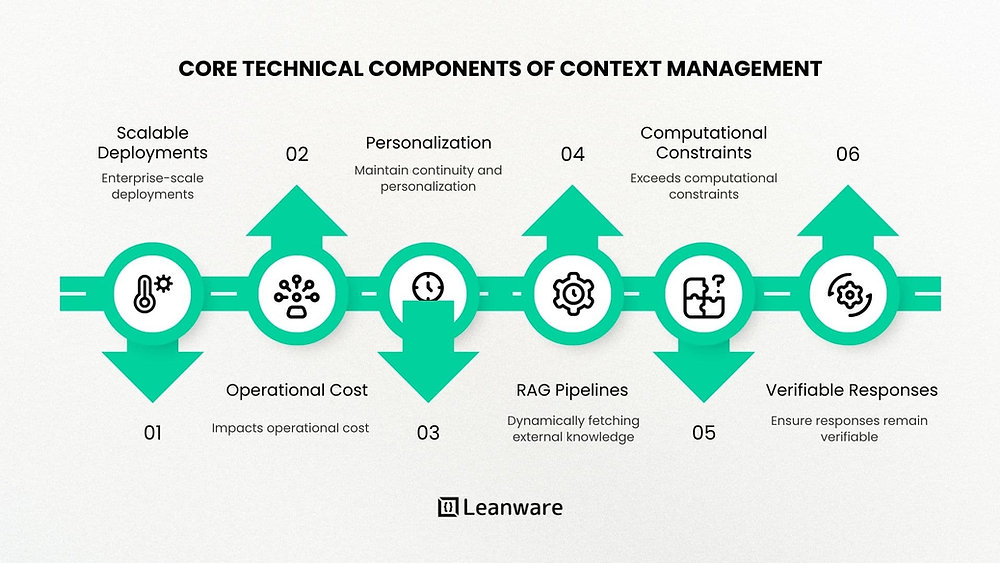
Core Technical Components of Context Management

Context Windows and Token Optimization
Context windows define how much information an AI model can process at one time. Because large language models operate within token limits, effective context management requires prioritizing relevant information while excluding unnecessary data. Token optimization techniques include selective prompting, structured inputs, and dynamic truncation strategies that retain critical instructions while removing redundancy.
Developers often implement sliding windows or hierarchical prompts to maintain continuity across long interactions. Proper token management directly impacts response accuracy, latency, and operational cost, especially in enterprise-scale deployments where large volumes of contextual data must be processed continuously.
Retrieval-Augmented Generation (RAG)
Retrieval-Augmented Generation enhances AI responses by dynamically fetching relevant external knowledge instead of relying solely on model training data. In context management systems, RAG pipelines retrieve documents, embeddings, or structured records from databases and inject them into prompts at runtime. This ensures responses remain current, domain-specific, and verifiable.
Effective RAG systems require intelligent query formulation, semantic search optimization, and ranking mechanisms to avoid irrelevant context injection. By separating knowledge storage from reasoning capability, RAG enables scalable and continuously updated AI systems suitable for enterprise environments.
Vector Databases and Memory Stores
Vector databases act as long-term memory layers for AI systems by storing embeddings that represent semantic meaning rather than raw text. These databases allow models to retrieve context based on similarity instead of keywords, improving accuracy in complex queries.
Memory stores may include conversation history, organizational documents, or operational data. Efficient indexing and embedding strategies are critical to ensure fast retrieval at scale. When integrated properly, vector storage enables persistent context across sessions, allowing AI applications to maintain continuity and personalization over time.
Context Ranking and Relevance Scoring
Not all retrieved information should be included in a model’s active context. Context ranking systems evaluate retrieved data using similarity scores, metadata filtering, and relevance algorithms. These mechanisms ensure that only the most useful information is injected into prompts.
Advanced systems combine semantic similarity with business rules or user intent analysis to refine ranking decisions. Without proper relevance scoring, models may experience noise overload, leading to hallucinations or inaccurate outputs. Effective ranking improves both performance efficiency and response reliability.
Context Compression and Summarization
As conversations and datasets grow, raw context quickly exceeds token limits. Compression and summarization techniques condense information while preserving essential meaning. AI-driven summarization pipelines create structured summaries of prior interactions, enabling long-term continuity without exceeding computational constraints.
Compression may include abstraction layers, hierarchical summaries, or semantic clustering. These methods are especially important for long-running AI agents or enterprise workflows where maintaining historical awareness is necessary for consistent decision-making.
State Machines and Agent Memory Layers
State machines help AI systems track progression through workflows, ensuring consistent behavior across multi-step interactions. Memory layers store task states, user preferences, and operational variables that guide agent decisions. By combining structured state tracking with contextual memory, AI systems can resume tasks, maintain logical continuity, and prevent repeated actions.
This architecture is essential for agentic AI applications such as automation agents, workflow assistants, and decision-support systems where context evolves dynamically over time.
Context Management in LLM-Based Systems
How Transformer Models Handle Context
Transformer-based models process context using attention mechanisms that evaluate relationships between tokens in an input sequence. Each token influences others through weighted attention scores, allowing the model to interpret meaning based on surrounding information.
However, attention operates only within the provided context window, meaning the model has no persistent memory beyond supplied inputs. Context management systems, therefore, play a critical role by selecting and structuring inputs that guide reasoning effectively.
Token Limits and Context Window Constraints
Every LLM has a maximum token capacity that restricts how much information can be processed simultaneously. Exceeding this limit forces truncation, which may remove essential instructions or historical data.
Developers must design strategies such as chunking documents, prioritizing recent interactions, or summarizing earlier conversations. Understanding token economics is also important because larger context windows increase computational cost. Balancing completeness and efficiency is a key challenge in production AI systems.
Memory Augmentation Techniques
Memory augmentation extends LLM capabilities beyond native limitations. Techniques include external memory databases, session storage, and iterative summarization layers that preserve essential knowledge.
Some systems implement episodic memory to retain session-specific context and semantic memory for long-term knowledge retrieval. These augmentations allow AI systems to behave more consistently across extended interactions, enabling applications like copilots, enterprise assistants, and intelligent automation tools.
Context Management for Agentic AI
Multi-Step Task Execution and State Persistence
Agentic AI systems perform sequences of actions rather than single responses. Context management ensures agents remember goals, intermediate outputs, and execution history across steps. Persistent state tracking allows agents to resume workflows, adapt strategies, and coordinate tasks effectively. Without structured context persistence, agents may repeat steps or lose progress, reducing reliability in real-world automation environments.
Risk of Context Drift in Autonomous Agents
Context drift occurs when an AI agent gradually deviates from its original objective due to accumulated irrelevant information or misinterpretation. Over long task chains, small contextual errors can compound, leading to incorrect outcomes. Monitoring mechanisms such as periodic context validation, instruction reinforcement, and relevance filtering help mitigate drift. Managing context integrity is essential for maintaining predictable agent behavior.
Guardrails and Execution Boundaries
Guardrails define operational limits that prevent AI agents from making unsafe or unintended decisions. Context management contributes by restricting which data sources and instructions influence decision-making. Policy enforcement layers, role-based context filtering, and validation checkpoints ensure agents operate within defined constraints. These safeguards are particularly important in regulated industries where compliance and accountability are critical.
Enterprise Use Cases of Context Management
AI Customer Support Systems
Customer support AI relies heavily on contextual understanding of past interactions, user history, and product knowledge. Context management enables chatbots and virtual assistants to maintain conversation continuity, personalize responses, and resolve issues efficiently. By integrating CRM data and knowledge bases through retrieval systems, organizations can deliver faster and more accurate support experiences while reducing operational workload.
Financial Services AI
In financial environments, AI systems must interpret transactional history, compliance rules, and risk indicators simultaneously. Context management allows models to combine structured financial data with regulatory guidelines during analysis. This improves fraud detection, advisory services, and automated reporting while ensuring decisions remain traceable and compliant with industry standards.
Healthcare AI Assistants
Healthcare AI applications require accurate contextual awareness of patient records, clinical guidelines, and historical interactions. Context management systems ensure relevant medical information is retrieved securely and presented appropriately during analysis or consultation support. Proper context handling enhances diagnostic assistance, patient engagement tools, and administrative automation while maintaining data privacy requirements.
DevOps and Infrastructure Agents
AI-powered DevOps assistants use context management to analyze logs, deployment histories, and system configurations. By maintaining operational context, these agents can diagnose issues, recommend fixes, and automate repetitive infrastructure tasks. Persistent memory enables continuous learning from past incidents, improving system reliability and reducing downtime in complex technical environments.
Common Challenges in Context Management Using AI
Context Explosion
As AI systems evolve from single prompts to persistent workflows, the amount of contextual information grows rapidly. This phenomenon, often called context explosion, occurs when systems continuously accumulate conversational history, retrieved documents, execution logs, and environmental data without clear retention limits.
Uncontrolled context growth introduces noise that reduces model effectiveness. Instead of improving reasoning, excessive context dilutes signal quality and increases ambiguity during inference. AI systems may reference outdated instructions or irrelevant historical interactions, leading to inconsistent decisions.
Engineering solutions typically involve retention policies, summarization pipelines, and memory expiration strategies that preserve meaningful knowledge while preventing uncontrolled expansion.
Irrelevant Retrieval
Retrieval systems are only as effective as their relevance mechanisms. Poor retrieval quality introduces unrelated documents into prompts, confusing the model and increasing hallucination risk. This challenge often arises when semantic similarity scoring favors loosely related results instead of task-specific relevance.
Balancing precision and recall becomes critical. High recall retrieves more information but risks noise, while high precision may omit necessary context. Advanced systems address this using re-ranking models, metadata filtering, and contextual scoring aligned with task intent.
Continuous evaluation of retrieval performance is essential to ensure context improves reasoning rather than degrading it.
Privacy and Data Governance Risks
Context frequently contains sensitive organizational or personal data. When AI systems aggregate historical interactions, compliance requirements become significantly more complex. Improper context handling may expose confidential information or violate regulatory frameworks.
Enterprises must enforce governance controls such as access restrictions, encryption, anonymization, and audit trails before contextual data reaches AI models. Context filtering mechanisms ensure only authorized information is injected into prompts.
Effective governance transforms context management from a technical optimization problem into a foundational trust requirement for enterprise AI adoption.
Latency and Cost Trade-offs
Sophisticated context pipelines introduce computational overhead. Retrieval queries, embedding generation, ranking operations, and summarization steps all contribute to increased latency and infrastructure cost.
Real-time applications must balance contextual richness with performance expectations. Excessive retrieval layers can slow response times, while minimal context reduces accuracy. Engineering teams, therefore, optimize pipelines using caching strategies, precomputed embeddings, and adaptive retrieval thresholds.
Scalable context management requires constant trade-off evaluation between speed, cost efficiency, and reasoning quality.
Architectural Patterns for Scalable Context Management
Layered Memory Architecture
A layered memory architecture separates contextual information into distinct categories such as short-term session memory, long-term knowledge storage, and system state memory. Each layer serves a specific role and operates under different retention policies.
Short-term memory handles immediate interactions within model token limits, while long-term memory stores embeddings representing persistent knowledge. System-state memory tracks workflow progress and operational status.
This separation prevents overload while enabling AI systems to maintain continuity across extended interactions.
Hybrid Retrieval Models
Modern context systems rarely rely on semantic retrieval alone. Hybrid retrieval combines vector similarity search with rule-based filtering, keyword matching, and metadata constraints. This approach improves precision by incorporating both semantic meaning and structured business logic.
For example, enterprise systems may restrict retrieval results by department, compliance category, or user role before semantic ranking occurs. Hybrid models reduce irrelevant retrieval and align context selection with operational requirements.
The combination of symbolic and semantic reasoning significantly improves reliability in complex environments.
Context Orchestration Pipelines
Context orchestration pipelines act as middleware between data sources and AI models. These pipelines collect, rank, transform, and inject context dynamically based on task requirements.
Rather than passing raw information directly to models, orchestration layers apply preprocessing steps such as deduplication, summarization, and formatting. This ensures prompts remain structured and efficient.
Orchestration pipelines also enable system flexibility, allowing organizations to modify retrieval logic independently of application interfaces or model configurations.
Context Observability and Monitoring
As context systems grow more complex, observability becomes essential. Engineers must understand why a specific context was selected and how it influenced outputs. Context observability introduces logging, tracing, and evaluation metrics that track retrieval decisions and prompt construction.
Monitoring tools help identify failures such as irrelevant context injection or missing information. Debugging becomes significantly easier when teams can trace model outputs back to contextual inputs.
Observability transforms context management into a measurable engineering discipline rather than a black-box process.
Best Practices for Designing Context-Aware AI Systems
Define Clear Memory Boundaries
Effective context systems begin with clearly defined memory scopes. Not all information should persist indefinitely. Organizations must decide what belongs in session memory, long-term storage, or temporary execution context.
Clear boundaries prevent uncontrolled growth and reduce operational complexity. Memory lifecycle policies ensure systems remain efficient while maintaining essential knowledge continuity.
Use Relevance Thresholding
Relevance thresholding ensures only high-confidence contextual data reaches the model. Retrieval systems assign similarity scores, and thresholds determine whether information is included or discarded.
This filtering reduces noise and prevents marginally related data from influencing outputs. Dynamic thresholds can adapt based on task sensitivity or system confidence requirements.
Relevance-driven selection consistently improves reasoning accuracy and output reliability.
Implement Context Versioning
Context evolves over time as workflows change and knowledge updates occur. Context versioning tracks these changes, enabling systems to reference correct historical states when necessary.
Version control prevents conflicts caused by outdated instructions or conflicting policies. It also supports auditing and rollback capabilities, which are essential in regulated enterprise environments.
Maintaining versioned context enhances transparency and long-term system stability.
Integrate Guardrails Early
Safety and governance mechanisms should be embedded during architecture design rather than added later. Guardrails restrict how context influences decision-making and enforce operational boundaries.
Examples include policy enforcement layers, restricted data categories, and action validation rules for AI agents. Early integration ensures safety scales alongside capability.
Proactive guardrail design reduces risks associated with autonomous AI execution.
How Leanware Designs Context-Aware AI Systems
Engineering for Accuracy and Scalability
Leanware approaches context management as an infrastructure challenge rather than a prompt engineering task. Systems are designed with scalable retrieval pipelines, structured memory layers, and performance-aware architectures that maintain reliability under increasing workloads.
This engineering-first mindset ensures AI systems remain accurate even as datasets and user interactions expand.
Outcome-Oriented AI Architecture
Leanware aligns context design with measurable business outcomes. Instead of maximizing data exposure, architectures focus on delivering relevant context that improves decision quality, automation success rates, and operational efficiency.
Context pipelines are mapped directly to workflow objectives, ensuring AI reasoning supports real organizational goals rather than experimental use cases.
Security, Compliance, and Reliability
Enterprise deployments require strong governance foundations. Leanware integrates access controls, encrypted storage, and compliance-aware retrieval mechanisms into context pipelines from the start.
Continuous monitoring and validation processes ensure context handling remains secure, traceable, and dependable across production environments. This approach enables organizations to deploy advanced AI systems while maintaining regulatory confidence and operational stability.
The Future of Context Management in AI
Context management is rapidly becoming a defining capability of advanced AI systems. As models grow more capable, the limiting factor is no longer raw intelligence, but the ability to maintain accurate, relevant, and stable context over time. The future of AI reliability, safety, and enterprise adoption depends heavily on how context is managed, structured, and optimized.
Rather than being a supporting feature, context management is evolving into a core AI infrastructure layer, shaping how systems reason, act, and adapt in complex environments.
Expanding Context Windows
One visible trend is the expansion of context windows in large language models. Larger context windows allow models to process more information at once, reducing the need for aggressive truncation or summarization.
However, expanded windows alone do not solve the problem. As context grows, relevance becomes harder to maintain. Without intelligent selection and ranking, larger windows can increase noise and dilute important signals. The future lies in combining larger windows with smarter context orchestration rather than relying on raw capacity alone.
Expanded windows reduce pressure, but they do not eliminate the need for disciplined context design.
Persistent AI Memory
Another major direction is the development of persistent AI memory. Instead of treating each interaction as isolated, AI systems are increasingly designed to retain long-term knowledge across sessions, users, and workflows.
This persistent memory is not simple storage. It requires careful governance to determine what should be remembered, how it should be retrieved, and when it should be forgotten. Long-term memory introduces challenges around relevance decay, privacy, and trust, especially in enterprise environments.
Future systems will likely differentiate between personal memory, organizational memory, and system-level memory, each with its own access controls and retention policies.
Self-Optimizing Context Pipelines
The most advanced evolution of context management is self-optimizing pipelines. These systems dynamically adjust retrieval strategies, relevance thresholds, and compression techniques based on observed performance.
For example, if certain types of retrieved context consistently improve accuracy, the system can prioritize them automatically. If certain memory sources introduce noise or latency, their influence can be reduced over time.
This adaptive behavior transforms context management from a static configuration problem into a continuously learning system, improving reliability without constant manual tuning.
In enterprise AI, this capability will be critical for scaling AI systems safely across teams, products, and use cases.
Conclusion
Context management is the foundation that determines whether AI systems are reliable, safe, and usable in real-world environments. As LLMs and agentic systems take on complex, multi-step workflows, the ability to select, prioritize, and govern context becomes more important than raw model intelligence. Weak context handling leads to hallucinations, inconsistency, and operational risk, while well-designed context pipelines enable accuracy, continuity, and trust.
Forward-thinking organizations treat context as core AI infrastructure, not a prompt-level fix. By combining layered memory, retrieval augmentation, relevance scoring, guardrails, and observability, AI systems can maintain alignment across long-running tasks and enterprise workflows. As AI adoption scales, disciplined context design will remain essential for building systems that are dependable, compliant, and ready for production.
If your AI systems struggle with unreliable outputs or context overload, it’s time to fix the foundation. Leanware builds context-aware AI with enterprise-grade memory, retrieval, and governance. Contact our team to create AI systems that stay accurate, compliant, and reliable at scale.
Frequently Asked Questions
What is context management in AI?
Context management in AI is the process of selecting, organizing, and maintaining relevant information so an AI system can generate accurate, coherent, and situation-aware responses. It goes beyond storing memory by actively ranking relevance, filtering noise, and maintaining system state across interactions.
Why is context management important for large language models (LLMs)?
LLMs operate within limited context windows and have no inherent long-term memory. Without proper context management, they may lose important information, generate inconsistent responses, or hallucinate. Effective context orchestration improves accuracy, continuity, and reliability, especially in complex or multi-step tasks.
How does context management reduce AI hallucinations?
Context management reduces hallucinations by narrowing the model’s attention to verified, relevant information. By retrieving trusted sources, ranking relevance, and filtering irrelevant data before prompt injection, the system minimizes ambiguity and guesswork during generation
What is the difference between short-term and long-term context in AI?
Short-term context refers to information stored within a single session or prompt window, such as recent conversation history. Long-term context is stored externally in systems like vector databases or structured memory stores and can be retrieved across sessions when needed.
How does Retrieval-Augmented Generation (RAG) support context management?
RAG enhances context management by retrieving relevant external information before generation. It embeds queries, searches a knowledge base, ranks the most relevant results, and injects them into the model’s prompt. This improves factual accuracy and reduces reliance on model-only reasoning.
What role does context management play in agentic AI systems?
In agentic AI systems, context management maintains task state, tracks progress across multiple steps, and ensures correct execution. Without structured state tracking, agents may repeat actions, lose objectives, or perform unsafe operations.
What is context drift in AI systems?
Context drift occurs when an AI system gradually loses alignment with its original task or objective due to accumulating irrelevant or outdated information. It commonly appears in long conversations or autonomous workflows without clear memory boundaries and pruning strategies.
How do vector databases help manage AI context?
Vector databases store embeddings of documents, interactions, or user data, enabling semantic search based on meaning rather than keywords. This allows AI systems to retrieve contextually relevant information efficiently, even from large and unstructured datasets.
What are the biggest challenges in the AI context management?
Key challenges include uncontrolled context growth, irrelevant retrieval, privacy and compliance risks, increased latency, and higher infrastructure costs. Balancing accuracy, performance, and governance is especially critical in enterprise deployments.
How does context management improve enterprise AI systems?
Enterprise AI systems require accuracy, compliance, and predictability. Context management ensures that the right information is injected into decision-making processes, enabling personalization, regulatory compliance, and reliable automation at scale.