AI Native Companies: Definition, Architecture, and Strategic Framework

Every product team shipping AI features today faces one defining choice: attach a model to an existing architecture, or rebuild the architecture around the model. That single decision determines how fast the product learns, how far it scales, and how hard it becomes for competitors to catch up. AI native companies chose the second path. They are not organizations that adopted AI. They are organizations that could not exist without it.
The difference is structural, not cosmetic. An AI native company accumulates intelligence the way a traditional company accumulates technical debt, except intelligence compounds in your favor. Every month of operation widens the gap against competitors still layering AI onto systems that were never designed for it.
Let's break down what AI native actually means, how the architecture works, where the strategic value lies, and how to start building toward it.
What Is AI Native?
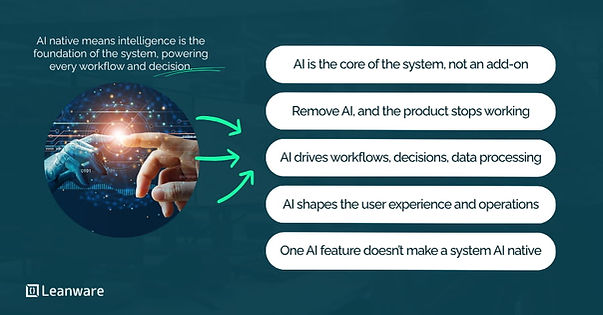
AI native describes a product, platform, company, or workflow designed from inception with AI as the foundational layer, not integrated after the fact. The term describes an architectural and strategic orientation, not a feature checklist.
If you removed the AI layer from an AI native product, the product would stop functioning entirely. The core workflows, decision logic, user experience, and data processing all depend on intelligence embedded at every level.
A genuine AI native company is one where AI drives the architecture, the data model, the operational logic, and the user interface. A system that uses AI for one feature (like a recommendation engine or a chatbot) is AI-powered or AI-enabled, not AI native.
Just as "mobile native" described apps built specifically for smartphones rather than ported from desktop, AI native signals an end-to-end architectural commitment to intelligence.
The Core Principle: AI as Foundation, Not Feature
The defining test of an AI native system is easy: if AI were removed, would the product still work? In an AI native system, the answer is no. The product ceases to function because AI is not an enhancement layer. It is the engine that processes inputs, makes decisions, generates outputs, and learns from results.
AI native means AI shapes data collection (what data is gathered and how it flows through the system), workload execution (how tasks are processed and distributed), decision logic (how the system decides what to do next), latency management (how the system balances speed and accuracy), and the user experience (how users interact with intelligence rather than static interfaces).
Where the Term Comes From and Why It Matters Now
The "native" framing has appeared at every major platform shift in technology. Web native described applications built for the browser rather than ported from desktop software. Mobile native described apps designed for smartphones rather than adapted from websites. Cloud native described systems architected for distributed cloud infrastructure rather than migrated from on-premise servers.
AI native is the current evolution of that progression. It describes systems built around intelligence rather than adapted to include it.
As AI becomes ubiquitous, the term will eventually fade, just as "cloud native" is now simply how serious infrastructure is built. But organizations that act on the concept now, while it still represents a structural advantage, position themselves ahead of the market before the window closes.
AI Native vs. Traditional Software: A Structural Comparison
Traditional software is deterministic. Every behavior is explicitly programmed. Given the same input, it produces the same output. This works well for structured, predictable workloads. AI native systems learn rules from data and adapt continuously. They handle unstructured data, dynamic variables, and environments where the optimal response changes over time.
Factor | Traditional Software | AI Native System |
Behavior definition | Explicitly programmed rules | Learned from data |
Adaptability | Static until manually updated | Continuously improving |
Data role | Input to predefined logic | Primary operational asset |
Unstructured data handling | Limited | Core capability |
Decision making | Rule-based, deterministic | Probabilistic, context-aware |
Improvement over time | Requires new code | Learns from usage and feedback |
This is not a question of which approach is more modern. Both have appropriate contexts. AI native systems unlock capabilities that rule-based software fundamentally cannot replicate, particularly in environments with unstructured data, dynamic variables, or the need for continuous improvement.
AI Native vs. AI-Powered vs. AI-Enabled: Know the Difference
AI-enabled systems are traditional applications with AI added as an external module. The core application works without AI. A CRM with an AI-powered lead scoring feature is AI-enabled. Remove the scoring feature, and the CRM still functions.
AI-powered systems integrate AI more deeply into specific features. The AI is central to certain capabilities, but traditional logic remains the backbone. A search engine with AI-enhanced ranking is AI-powered. The search works without AI, but the results are significantly worse.
AI native systems are built entirely around AI. Intelligence is pervasive across the product. A conversational AI assistant, an autonomous driving system, or a fraud detection platform where every decision path depends on model inference. These are AI native.
Category | AI Role | Without AI |
AI-Enabled | External module for specific features | Fully functional |
AI-Powered | Deeply integrated into key features | Functional but degraded |
AI Native | Foundation of the entire system | Non-functional |
Understanding where your current tools and products sit on this spectrum is the first step toward an honest assessment of your AI maturity.
AI Native vs. Cloud Native: Complementary Shifts
Cloud native solved the scaling problem: how to handle exponentially more users without failure. AI native solves the adaptation problem: how to build systems that improve rather than just grow.
Cloud native infrastructure is typically a prerequisite for AI native systems. AI workloads require elastic compute, containerized deployment, managed data services, and distributed architecture. Cloud native provides that foundation. The two concepts are complementary, not competing. Cloud native is the infrastructure layer that makes AI native architectures operationally viable.
Core Characteristics of AI Native Systems
Five characteristics distinguish genuinely AI native systems from those that merely use AI as a component. These traits manifest at the architectural, operational, and product level, and they serve as a diagnostic reference. Readers should be able to use these criteria to evaluate existing or prospective systems.
Intelligence Embedded at Every Layer
AI native systems deploy workloads (inference, model training, monitoring, and optimization) across every layer of the stack and every domain of the architecture, guided by cost-benefit logic rather than technical constraints.
This pervasive intelligence requires AI execution environments to be available everywhere the system operates, including edge and mobile contexts. Model lifecycle management (training, deployment, monitoring, retraining) becomes a first-class operational concern at this scale.
Data-Centric Architecture
AI native systems treat data as the primary operational asset rather than a byproduct of activity. Data collection, processing, storage, and transport are designed to support flexible, context-aware consumption by AI models across domains.
This requires infrastructure components working in coordination, not in isolation: observability, preprocessing, feature engineering, and model orchestration operating as an integrated system.
Continuous Learning and Self-Optimization
AI native systems improve over time through feedback loops, adaptive algorithms, and in some implementations, federated learning. This is different from periodic model updates. Continuous learning means the system is always incorporating new signal and refining its behavior.
The longer an AI native system operates, the more difficult it becomes to replicate. Its intelligence is shaped by accumulated usage data that competitors do not have, creating compounding returns that widen over time.
Zero-Touch Operations
The operational ideal of AI native systems is autonomous monitoring, diagnosis, and correction with minimal human intervention. Systems detect anomalies, adjust configurations, and recover from failures without manual operator action.
This reduces operational overhead and enables organizations to scale AI capabilities without proportionally scaling headcount. This is a critical consideration for IT, DevOps, and product teams managing systems at scale.
AI as a Service (AIaaS) Exposure
Mature AI native platforms expose core capabilities (model training environments, execution engines, data access APIs, and inference endpoints) as modular, consumable services. Internal teams build on top of a shared AI foundation rather than rebuilding capabilities from scratch.
In some cases, this enables organizations to extend platform value to third parties, unlocking new revenue streams and ecosystem opportunities. The AIaaS layer transforms an AI native platform from an internal tool into a platform business.
AI Native Architecture: How It Is Built
The architecture of an AI native system differs from traditional application architecture in four key areas: orchestration layers, agent coordination, prompt engineering as an architectural artifact, context management strategy, and data pipeline design.
Orchestration and Agent Coordination
AI native systems coordinate multiple models, tools, APIs, and agents through orchestration layers. Complex tasks are distributed across specialized agents with defined roles and toolsets.
This multi-agent architecture provides scalability (add agents for new capabilities), modularity (replace or upgrade agents independently), and fault tolerance (agent failures do not bring down the system). Orchestration differs from traditional workflow automation because agents reason and adapt rather than following static scripts.
Prompt Engineering as a First-Class Artifact
In AI native systems, prompts are not ad hoc strings. They are versioned, tested architectural artifacts that define system behavior, persona, and constraints.
Prompt libraries are managed with the same rigor as database schemas or API contracts. Changes to prompts are tracked, tested against evaluation datasets, and deployed through the same CI/CD processes as code changes. Prompt design directly affects the reliability and consistency of system outputs, making it an architectural concern rather than an afterthought.
Context Window and Memory Management
Multi-turn, multi-session AI interactions require a tiered memory model. Active context handles the current interaction. Rolling summaries compress recent history. Long-term retrieval via vector stores provides access to historical context.
Without deliberate context and memory management, model performance degrades and behavior becomes unpredictable at scale. Ignoring this dimension is one of the most common architectural mistakes in systems that attempt to be AI native.
Data Pipeline and Compute Infrastructure
AI native systems require real-time data pipelines, hybrid edge-cloud compute, GPU infrastructure, and containerized model deployment. Infrastructure decisions directly affect performance outcomes: latency, throughput, and cost efficiency.
Platform engineering teams are increasingly responsible for making AI workloads production-ready at global scale. The infrastructure layer is not a support function. It is a determinant of whether the system can deliver on its AI native promise.
The Generative AI Effect: How LLMs Accelerated AI Native Adoption
Large language models replaced narrow, task-specific systems with unified architectures capable of handling classification, summarization, extraction, and generation in a single model. Instead of stitching together dozens of specialized pipelines, teams could design products around one flexible foundation. The shift has moved past conversational demos toward agentic systems that monitor, plan, and execute end-to-end workflows with minimal human input.
Global AI startup funding spiked 75% in 2025 to $203 billion, with AI startups capturing 41% of all venture dollars. That is infrastructure spending by organizations building AI native products as their primary revenue engine.
Strategic Benefits of Going AI Native
Adopting AI native architecture changes how products and organizations operate, turning AI from an add-on into a core driver of value.
Building a Durable Intelligence Moat
AI native systems create competitive advantages that compound over time and are structurally difficult to replicate. Intelligence is embedded into workflows informed by historical usage, continuous feedback, and accumulated model refinement, not just features a competitor can copy.
A competitor can replicate your feature set. They cannot replicate the intelligence that comes from months or years of learning from production data. This compounding dynamic is the primary reason organizations should prioritize AI native architecture over incremental AI augmentation. The moat deepens with every day of accumulated data, usage, and model refinement.
Security and Governance Embedded by Design
AI native architectures embed identity management, access control, monitoring, and auditability from the first line of architecture, rather than enforcing governance after deployment.
In regulated industries where data sovereignty, compliance, and explainability are non-negotiable, this design-first approach to governance enables proactive risk management rather than reactive incident response. Retrofitting governance onto a system that was not designed for it is significantly more expensive and less reliable.
Competitive Positioning in the AI Native Market
Gartner predicts that 33% of enterprise software applications will include agentic AI by 2028. The adoption curve is accelerating, and the gap between organizations building AI native foundations now versus those still layering AI onto legacy architecture is widening.
This is a strategic window. The AI native companies making architectural commitments today are building advantages that will be significantly harder to close in three to five years. Every month of accumulated learning and optimization widens the gap, creating a long-term competitive position that incremental AI adoption cannot match.
Challenges of AI Native Development
AI native development carries real costs and complexity that organizations should assess clearly.
Cost profiles are non-linear and front-loaded. GPU infrastructure, data pipeline engineering, and model training require significant upfront investment before the system generates value. Data quality is an existential concern, not merely an operational one.
AI native systems trained on poor data produce poor results at scale, and the damage compounds as the system learns from its own outputs.
Migrating legacy systems without disrupting operations adds another layer of complexity. Testing and debugging adaptive systems require entirely new approaches compared to deterministic software. And the cultural and organizational shift required to manage systems that change their own behavior over time should not be underestimated.
The Migration Challenge: Greenfield vs. Legacy Transformation
Building AI native from scratch (greenfield) allows clean architectural decisions but requires full investment upfront. Evolving a legacy system toward AI nativeness means running parallel architectures during the transition, which compounds complexity before it reduces it.
Greenfield makes sense for new products where AI is the core value proposition. Legacy transformation makes sense when the existing system has significant user traction and data assets that would be lost in a rebuild. Most organizations will run hybrid architectures during the transition period.
"Architectural intent" (the commitment to making AI central rather than peripheral) matters even when a full rebuild is not possible. Organizations that cannot afford a greenfield approach can still make meaningful progress by designing every new component and workflow with AI nativeness as the target state.
Talent, Testing, and the New Engineering Paradigm
AI native development changes team requirements and engineering practices. Prompt engineering is now a legitimate architectural skill. Testing adaptive systems requires different methodologies than testing deterministic software. Debugging emergent behavior demands new tooling and mental models.
The senior engineer's role evolves from writing code to orchestrating AI systems: defining agent boundaries, designing prompt architectures, building evaluation pipelines, and managing model lifecycle. These shifts represent a talent and process investment, not just a technology investment. Organizations that develop this capability now compound that advantage as AI systems become more capable.
AI Native Maturity Model: Where Does Your Organization Stand?
AI native maturity is multi-dimensional. Architecture, data ingestion, collaboration, model lifecycle management, and operational automation can each be at a different maturity level independently. This framework serves as a self-assessment tool for organizations evaluating their current state.
Maturity Level | Architecture | Data | Operations | AI Integration |
Level 1: Exploring | Traditional stack | Siloed, manual | Fully manual | No AI in production |
Level 2: Experimenting | AI added to specific features | Basic pipelines | Semi-automated | AI in isolated use cases |
Level 3: Integrating | AI embedded in core workflows | Integrated pipelines | Automated monitoring | AI across multiple functions |
Level 4: AI Native | AI as foundational architecture | Data-centric design | Zero-touch operations | AI drives all core logic |
The goal is not to reach Level 4 on every dimension simultaneously. It is to understand the current state and prioritize investments that unlock the most business value at each stage. An organization might be Level 3 on architecture but Level 1 on operational automation, and that is a useful insight for setting a realistic roadmap.
AI Native Use Cases Across Industries
AI native architecture produces measurable results when intelligence is foundational rather than supplementary.
Financial services. Fraud detection systems that analyze transaction patterns in real time, adapting to new fraud vectors as they emerge. An AI native fraud platform catches schemes that rule-based systems miss because it learns continuously from new data rather than waiting for manual rule updates.
Healthcare. Diagnostic support systems that analyze medical imaging, patient history, and clinical data simultaneously. AI native architecture enables these systems to improve diagnostic accuracy over time as they process more cases, creating a capability that could not exist with traditional software.
Telecommunications. Network optimization systems that predict and prevent outages by analyzing traffic patterns, equipment telemetry, and historical failure data. AI native architecture enables autonomous network management that reduces downtime without proportional increases in operations staff.
Cybersecurity. Threat detection platforms that identify novel attack patterns by analyzing network behavior, user activity, and external threat intelligence in real time. AI native architecture is essential here because threats evolve faster than rule-based systems can be updated manually.
How to Build or Transition to an AI Native Architecture
The path depends on whether you are building a new product or evolving an existing one. Either way, cloud native infrastructure is a prerequisite, and data quality is an existential concern, not an operational one.
For new products, start with AI as the architectural foundation. Design data collection, processing, and storage around model consumption. Build orchestration and agent coordination as core infrastructure. Treat prompts as architectural artifacts from day one.
For existing products, identify the highest-value workflows where AI can replace deterministic logic. Build the data pipeline and model infrastructure to support those workflows. Migrate incrementally, running parallel architectures during the transition. Architectural intent (the commitment to making AI central rather than peripheral) matters more than the pace of implementation.
Building the Right Team for AI Native Development
AI native development changes how teams are structured and what skills matter. System design thinking, orchestration expertise, and prompt engineering sit alongside traditional engineering competencies as core requirements.
The senior engineer's role shifts from line-by-line implementation to AI orchestration: defining agent boundaries, designing evaluation pipelines, and managing model lifecycle. Organizations that build this capability now will compound that advantage as AI systems become more capable. This is not a one-time hire but a long-term capability investment.
Choosing Tools and Platforms
Evaluate AI native platforms on modularity (can you swap models and tools?), model portability (are you locked into one provider?), observability (can you trace and debug multi-agent workflows?), governance features (access control, audit trails, explainability), and cost structure at scale.
The critical architectural requirement is that the platform treats AI workloads as primary, not secondary. Platforms that layer AI onto a traditional application framework will constrain your architecture as your AI capabilities mature. The risk of locking into the wrong platform compounds over time, so evaluate with a three-to-five-year horizon rather than immediate convenience.
Final Thoughts
AI native is not a future aspiration but a present architectural decision with compounding consequences. Organizations that build intelligence into their foundation now will hold structural advantages that grow harder to close over time. The intelligence moat deepens with every day of accumulated data, usage, and model refinement.
The decision point is clear: build AI as the foundation of new products and workflows, or continue layering AI onto architectures that were not designed for it. The gap between these two approaches widens with every month. The AI native companies making this commitment today are not just adopting a technology. They are building a structural position that will define their competitive standing for years to come.
If you're looking to build or transition to an AI native architecture, connect with Leanware's engineering team to design systems, build orchestration, and set up the data and infrastructure that make intelligence central to your product.
Frequently Asked Questions
What is the difference between AI native and AI-powered?
AI-powered systems integrate AI into specific features while the core application runs on traditional logic. AI native systems are built with AI as the foundation. Removing AI from an AI-powered system degrades functionality. Removing AI from an AI native system makes it non-functional.
Can a legacy organization become AI native?
Yes, through incremental transformation. Most organizations evolve by identifying high-value workflows for AI migration, building data pipeline and model infrastructure to support those workflows, and running parallel architectures during the transition. Full AI nativeness typically requires years of systematic architectural change.
Is AI native architecture relevant for mid-sized companies?
Yes. Cloud-based AI services, managed model hosting, and open-source frameworks have reduced the infrastructure requirements significantly. Mid-sized companies can start with AI native architecture for new products or specific workflows without the upfront investment that enterprise-scale implementations require.
How does AI native architecture improve compliance and explainability?
AI native systems embed governance from the first line of architecture: access controls, audit trails, model versioning, and output tracing are built into the system design. This makes compliance reporting and explainability requirements easier to meet than retrofitting governance onto systems that were not designed for it.
How do AI native systems handle model upgrades without disrupting operations?
Through model versioning, canary deployments, and A/B testing infrastructure built into the platform. New model versions are deployed alongside existing ones, evaluated against production data, and promoted only when they meet performance thresholds. This approach treats model updates with the same rigor as code deployments in traditional CI/CD pipelines.