Context-Aware AI Systems: All You Need to Know 2026

Most AI systems fail in production not because the models are weak, but because they operate on isolated inputs.
The MIT Media Lab's Project NANDA confirmed in their 2025 report "The GenAI Divide": only about 5% of enterprise AI pilots reach production with meaningful business impact. Lead author Aditya Challapally put it directly: "It's not the quality of the AI models, but the learning gap for both tools and organizations."
That learning gap is often a context gap. Let’s break down what context-aware AI systems are, how they work, where they matter, and what it takes to build them.
What Are Context-Aware AI Systems?
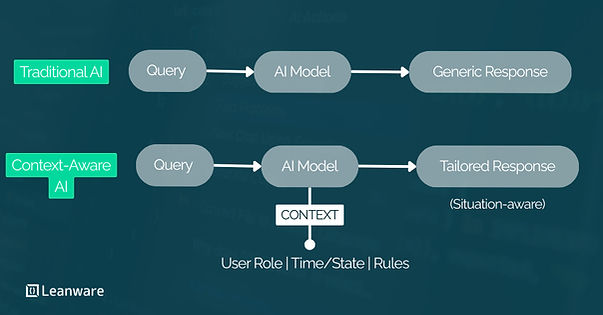
Context-aware AI refers to an architectural capability that allows AI systems to adjust decisions and outputs based on situational information, not just the immediate input or prompt.
A context-aware AI system incorporates relevant situational signals (user identity, workflow state, temporal constraints, business rules, environmental factors) into its decision-making process. The system uses this information to modify its behavior, not just its generated text.
For example, a document review system that knows the current user is a junior associate in the legal department, working on a contract nearing its deadline, under GDPR jurisdiction, will behave differently than if the same query came from a senior partner in a different region with no time pressure.
Why Context Is Critical for Real-World AI Applications
MIT NANDA research, based on 150 leadership interviews, 350 employee surveys, and 300 public AI deployments, reveals a consistent pattern. Demos usually work, pilots tend to stall, and production deployments break.
The problem is not model capability. Systems fail because they operate without enough context to handle real-world conditions.
Missing context causes specific failure modes:
- Compliance errors: A system that does not know which regulatory framework applies produces advice that violates local rules.
- Wrong recommendations: A product suggestion engine that ignores purchase history and inventory status recommends items the customer already owns or that are out of stock.
- Broken workflows: An approval system that does not know a request was already escalated triggers duplicate escalations.
Accuracy on benchmarks does not prevent these failures. The model can be correct about facts while being wrong about what to do in a specific situation.
What Does "Context" Mean in Artificial Intelligence?
Context is not a single signal. It consists of multiple types that must be modeled separately and combined deliberately.
User Context (Role, History, Preferences)
User context includes identity, role, permissions, historical actions, and stated preferences. A system behaves differently when the user is an administrator versus a guest, when they have a history of certain requests, or when they have explicitly set preferences.
Temporal Context (Time, Deadlines, Sequences)
Time affects what the AI should do. A support request submitted at 2 AM in a region where the support team is offline requires different handling than one submitted during business hours.
A contract expiring in 48 hours needs different prioritization than one expiring in six months. Sequences matter: step 3 of a workflow should not execute before step 2 completes.
Environmental and Domain Context
Regulations, jurisdiction, industry rules, and operating environment constrain what the AI can and should do. A healthcare recommendation in the EU operates under different privacy rules than one in the US. A construction permit workflow in California follows different codes than one in Texas.
System and Process Context
Workflow stage, prior system actions, and dependencies affect what the AI should do next. If a previous system already sent a notification, the AI should not send a duplicate. If the process is blocked waiting for external input, the AI should not proceed as if that input exists.
How Context-Aware AI Systems Work
Context-aware AI follows an end-to-end flow from collection to decision. It gathers situational signals, evaluates which ones matter for the current task, and uses them to guide decisions in real time, rather than relying on static prompts or retrained models.
Context Collection and Signal Sources
Context comes from multiple sources: APIs, event streams, databases, user sessions, and external services. Reliable collection requires explicit integration with each source, handling authentication, rate limits, and data freshness.
Context Processing and Interpretation
Raw signals must be evaluated for relevance, priority, and consistency. Not all available context belongs in every decision. The system must determine what matters for the current task and handle cases where signals conflict.
Adaptive Decision-Making Based on Context
Different contextual states lead to different outputs. The same user query produces different results depending on role, time, location, workflow state, and applicable rules. This adaptation happens at decision time, not through model retraining.
Core Components of a Context-Aware AI Architecture
A context-aware architecture separates memory, context enrichment, rules, and decision logic into clear layers. Each layer has a specific responsibility, and together they ensure the system can reason over situational information, enforce constraints, and produce reliable decisions in production environments.
Short-Term and Long-Term Memory Layers
Session memory holds information relevant to the current interaction. Persistent memory retains information across sessions.
Both are necessary: session memory for conversation continuity, persistent memory for user preferences, historical patterns, and accumulated knowledge.
Context Enrichment and Knowledge Retrieval
Raw context often needs enrichment. A customer ID becomes useful when resolved to account details, purchase history, and support ticket status. This enrichment draws from internal databases, external APIs, and knowledge bases. Retrieval-augmented generation (RAG) is one technique here, but context enrichment is broader than document retrieval.
Business Rules, Constraints, and Policies
Explicit rules interact with AI reasoning to enforce safety, compliance, and business logic. These are not suggestions to the model; they are hard constraints that override model outputs when necessary. A pricing rule that caps discounts at 15% cannot be overridden by a model that thinks 20% would be more helpful.
Reasoning and Decision Logic
The system combines context, rules, and reasoning to produce decisions. This layer determines what action to take, what information to return, and what constraints apply. The output is not always text; it may be a structured decision, a workflow trigger, or a routing instruction.
Context-Aware AI vs Other AI Approaches
Context-aware AI differs from related approaches in specific ways.
Context-Aware AI vs RAG (Retrieval-Augmented Generation)
Feature | RAG | Context-Aware AI |
Purpose | Retrieves documents to augment prompts | Reasoning over situational state and workflow |
Focus | “What info is relevant to this query?” | “What should the system do in this situation?” |
Context Handling | Limited to retrieved knowledge | Includes user state, rules, workflow, constraints |
Role | Component for knowledge retrieval | Core system combining context, rules, and decisions |
Strength | Fills gaps in training data | Produces actionable, context-aware outputs |
RAG retrieves relevant documents or passages to augment a prompt. It addresses the problem of outdated or missing knowledge in the model's training data. Context-aware AI reasons over situational state: who is asking what constraints apply, what has already happened in the workflow, and what should happen next.
RAG answers "what information is relevant to this query." Context-aware AI answers "what should the system to give everything it knows about this situation."
RAG is often a component within context-aware systems. It handles knowledge retrieval while other components handle user state, business rules, and decision logic.
Context-Aware AI vs Agentic AI Systems
Agentic AI focuses on autonomous task execution: planning, tool use, and multi-step actions. Context-aware AI focuses on situational decision-making: adjusting behavior based on who, when, where, and what constraints apply.
These are complementary. An agent needs context awareness to make good decisions at each step. Context-aware systems may or may not include agentic capabilities depending on whether autonomous action is required.
Context-Aware AI vs Rule-Based Systems
Rule-based systems use explicit logic (if X then Y) to determine behavior. They are deterministic and predictable but inflexible. They break when encountering situations not covered by existing rules.
Context-aware AI systems can incorporate rules as constraints while using AI to handle ambiguity and novel situations. The tradeoff is between predictability and flexibility. In high-risk domains, rule-based constraints on top of AI reasoning often make sense.
General Use Cases for Context-Aware AI Systems
Context-aware AI applies where situational factors materially affect outcomes.
- Intelligent Assistants and Enterprise Copilots: Assistants improve when they know user role, past interactions, and applicable policies. A finance copilot that knows the user's budget authority provides more relevant help than one that treats every query identically.
- Enterprise Knowledge Management: The right answer depends on department, region, and operational state. A policy question from HR in Germany requires different information than the same question from HR in Japan.
- Healthcare and Clinical Decision Support: Patient history, current medications, and clinical context influence recommendations. A drug interaction check requires knowing all current prescriptions.
- Legal, Construction, and Regulated Industries: Jurisdiction, regulation versions, and deadlines affect every decision. A contract review must apply the correct legal framework.
- Operations and Internal Workflows: Workflow state determines what happens next. An expense approval routes differently based on amount, department, and current approval chain.
Key Benefits of Context-Aware AI Systems for Organizations
Context-aware AI improves how systems behave in real operating conditions. By grounding decisions in situational information and enforcing constraints explicitly, these systems produce more reliable outcomes and integrate more cleanly into day-to-day workflows.
1. Improved Decision Accuracy
Context improves decision accuracy by ensuring the system accounts for relevant state, history, and constraints before responding.
Instead of relying on a single input, the AI evaluates surrounding conditions, which reduces incomplete answers and prevents decisions that only make sense in isolation.
2. Reduced Errors and Hallucinations
When context is explicit, the system has clear boundaries. It knows what information applies, what does not, and what rules must be enforced.
This grounding significantly reduces outputs that sound reasonable but are incorrect, out of date, or incompatible with operational reality.
3. Higher Trust and User Adoption
Consistency matters in production systems. When users see that responses align with their role, timing, and prior actions, confidence increases.
Over time, predictable and contextually correct behavior leads to higher adoption and less manual oversight.
4. Better Alignment With Business Constraints
Context-aware systems encode policies, deadlines, and approval rules directly into decision logic. This ensures outputs stay within business and regulatory boundaries, rather than relying on the model to infer constraints from prompts or training data.
When Does an Organization Need Context-Aware AI?
You need context-aware AI when isolated or prompt-driven systems can’t reliably handle real-world complexity. If AI outputs frequently require correction, ignore rules, or fail to adapt to workflow and user state, context-aware design becomes essential.
Limitations of Prompt-Based or Generic AI Tools
Prompt-only systems break down when:
- Users must repeatedly provide the same context
- Outputs vary unpredictably for similar situations
- Business rules are frequently violated
- The system cannot adapt to workflow state
Signals That Indicate the Need for Context-Aware Systems
- Frequent manual overrides of AI outputs
- Compliance violations from AI-generated content
- Inconsistent outputs for similar queries
- Users abandoning the system due to irrelevant responses
- Integration failures where the AI does not understand system state
Building Context-Aware AI Systems With Leanware
At Leanware, the focus is on guiding organizations in designing context-aware AI strategies. This includes defining robust context models, planning data integration, and shaping decision logic that aligns with business rules and workflow state. Leanware helps ensure AI systems can handle session and persistent context, enrich signals, and manage incomplete or conflicting information effectively.
For consultation, design guidance, or implementation support on context-aware AI systems, connect with our team to discuss options that fit your organization’s needs.
Frequently Asked Questions
Is Context-Aware AI the Same as Conversational Memory?
No. Conversational memory tracks what was said in a conversation. Context-aware AI also incorporates system state, user role, business rules, temporal constraints, and environmental factors. A system with good memory but no access to business rules will remember your question but still give policy-violating answers.
Can Context-Aware AI Work Without Large Language Models?
Yes. Context-aware systems can use classical ML models, rule engines, or deterministic logic enhanced with contextual signals. LLMs add flexibility for natural language understanding but are not mandatory.
How Complex Is It to Build a Context-Aware AI System?
Complexity varies by layer. Data integration can be straightforward or complex depending on existing infrastructure. Context modeling requires domain expertise. Decision logic varies from simple rules to sophisticated reasoning. Simple systems take weeks; enterprise-scale systems take months.
Which Industries Benefit Most From Context-Aware AI?
Industries where decisions are high-stakes, regulated, or state-dependent: healthcare, financial services, legal, construction, and government. The common factor is that wrong decisions have significant consequences.
How Much Does It Cost to Build a Context-Aware AI System?
POC: $30K-$100K (4-8 weeks). MVP: $100K-$500K (2-4 months). Production: $500K-$2M+ (6-12 months). Cost drivers include number of context sources, integration complexity, and compliance requirements.
How Do You Handle Conflicting or Incomplete Context Signals?
Use prioritization rules to rank signal sources by reliability. Apply confidence scoring. Implement fallback behaviors for missing data. Build guardrails that prevent action when critical context is unavailable.
Context-Aware AI vs Fine-Tuning: Which Approach Should You Choose?
Fine-tuning embeds knowledge into model weights. Context-aware AI provides knowledge at runtime. Fine-tuning suits stable domain knowledge. Context-aware AI suits dynamic information and user-specific data. Most production systems use both.
How Long Does It Take to Implement Context-Aware AI From POC to Production?
POC: 4-8 weeks. MVP: 2-4 months. Production: 6-12 months. Delays typically come from data access issues, unclear requirements, and compliance reviews.
Can Context-Aware AI Integrate With Existing Systems Like Salesforce or SAP?
Yes, through APIs, event streams, and data synchronization. Integration requires handling authentication, rate limits, data transformation, and error handling. It is not plug-and-play.
What Privacy and Compliance Considerations Exist for GDPR, HIPAA, and SOC 2?
Context collection affects data minimization, access control, auditability, and retention. Design systems to collect minimal context, control access strictly, log usage, and expire data appropriately.
What Is the Minimum Viable Context-Aware AI System for Startups vs Enterprises?
Startups: Focus on one or two critical context types. Use managed services. Accept some manual override. Enterprises: Require broader context coverage, stricter governance, audit trails, and integration with existing systems.
How Many Engineers Are Required to Build and Maintain Context-Aware AI?
POC/MVP: 2-4 engineers. Production: 4-8+ depending on scale. Roles needed: backend engineers, data engineers, ML engineers if using learned models, and domain experts for context modeling.