Sovereign AI Data Center: Definition, Components, and Strategic Framework

Most teams frame sovereign AI as an infrastructure choice, focusing on clouds, regions, and GPU clusters. That view misses the real issue. You can own your infrastructure and still depend on external models, unmanaged data, or APIs you do not control, which means you do not fully control your AI system.
Sovereign AI is an organizational capability. It is the ability to control, govern, and operate AI end-to-end without critical dependencies on external parties.
Let’s see what that capability requires, how deployment models affect sovereignty, and how to build a sovereign AI program that holds up under regulatory, competitive, and operational pressure.
What is Sovereign AI?
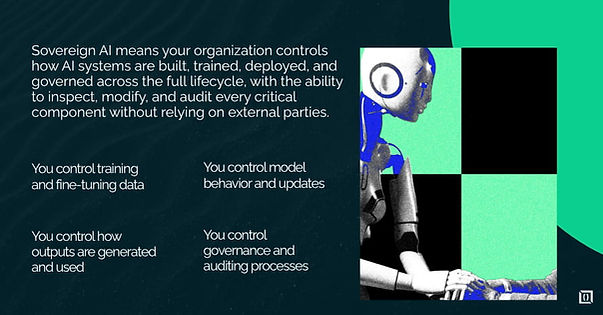
Sovereign AI means the organization retains meaningful control over the full AI lifecycle: the data used to train and fine-tune models, the models themselves, the inference outputs, the governance processes, and the ability to audit, explain, and modify any part of the system without depending on an external party's cooperation.
Self-hosting AI tools is not the same as sovereign AI. Running a vendor's model on your own hardware still means you depend on their model updates, their training data choices, and their architectural decisions. Sovereignty requires control at each layer.
Sovereign AI vs. AI Sovereignty
AI sovereignty is a policy and regulatory concept applied at the national level. It concerns a country's ability to develop and govern AI within its borders without depending on foreign technology providers. The EU AI Act, national AI strategies, and data localization laws are expressions of this concept.
Sovereign AI at the organizational level is about operational autonomy. It is the capacity to develop, audit, and govern AI systems without outsourcing control over critical components. The two concepts share principles (control, governance, independence) but operate at different scales and address different decision-makers.
Relationship to Data Sovereignty
Sovereign AI extends traditional data sovereignty beyond storage and residency. Data sovereignty asks: where does the data live? Sovereign AI asks: who controls the data throughout the AI lifecycle? That lifecycle includes how training data is collected and labeled, how models are trained on that data, what the model learns and how it behaves, what inference outputs are generated, and how governance evidence is documented and retained.
An organization can comply with data residency requirements while still lacking sovereignty over its AI systems if it cannot audit model behavior or control how its data shapes model outputs.
Why Sovereign AI Is More Than a Data Center Decision
Building or hosting a data center does not automatically produce sovereign AI. Infrastructure provides compute and storage. Sovereignty requires governance frameworks, internal talent, model development capability, security architecture, and operational processes that together give the organization end-to-end control.
Organizations that focus exclusively on infrastructure often discover they have solved the easiest part of the problem while leaving the harder parts (model governance, talent, data quality, testing adaptive systems) unaddressed.
Why Sovereign AI Is Strategically Important for Organizations
Four strategic drivers push organizations toward AI autonomy.
Reducing Dependency on External Vendors and Platforms
Building core AI capabilities on third-party models or platforms creates dependencies that carry real business risk. Pricing changes can alter the economics of your product overnight. API deprecations can break production systems. Model behavior updates can change how your product performs without your input. Loss of explainability means you cannot audit or explain the decisions your AI makes.
These are business continuity and competitive risks.
Protecting Sensitive Data and Proprietary Knowledge
Sovereign AI development keeps training data, business logic, fine-tuned models, and inference outputs within the organization's governance boundary. This reduces exposure to third-party breaches, unintended data sharing through model training, and the risk that proprietary knowledge embedded in fine-tuned models becomes accessible to competitors using the same vendor platform.
Regulatory Compliance and Risk Mitigation
Owning the AI development stack helps organizations meet data residency requirements, algorithmic accountability obligations, and AI governance regulations without relying solely on vendor certifications or black-box systems.
When a regulator asks how your AI system makes decisions, sovereign AI means you can answer from your own documentation and audit trails rather than pointing to a vendor's compliance page.
Competitive Advantage Through AI Autonomy
Organizations with self-contained AI capabilities iterate faster, customize models more deeply, and protect their intellectual property more effectively than those dependent on external providers.
The intelligence embedded in sovereign AI systems (trained on proprietary data, refined through internal feedback loops) creates a competitive moat that grows over time and is structurally difficult for competitors to replicate.
Core Organizational Capabilities for Sovereign AI
Sovereign AI requires five capabilities working together.
Control Over Training Data and Data Pipelines
Owning and governing the data used to train models is the foundational layer. This covers data collection, labeling, lineage tracking, quality assurance, and residency enforcement. Data you do not govern is a sovereignty gap, regardless of where it is stored.
If your training data comes from a third-party provider whose terms allow them to use it for other purposes, you do not have data sovereignty.
In-House or Controlled Model Development
The spectrum runs from fully in-house model training to fine-tuning open-source foundation models on private infrastructure. Fully in-house training provides maximum control but requires significant compute and talent investment.
Fine-tuning open-source models (Llama, Mistral, Qwen) on controlled infrastructure provides a practical middle path: model-level autonomy without building from scratch. The key criterion is whether the organization controls the model weights, the training process, and the deployment environment.
AI Model Governance and Lifecycle Ownership
Internal governance processes must cover model versioning, auditing, explainability, access control, and compliance monitoring across the full lifecycle.
This includes experimentation (who can train what, on which data), production (how models are deployed, monitored, and updated), and deprecation (how models are retired and their artifacts preserved for audit purposes).
Compute Autonomy and Infrastructure Control
The organization must retain control over where and how AI workloads run. This can be on-premises hardware, private cloud, or dedicated cloud environments.
The requirement is that compute resources are not shared with other tenants in ways that compromise data isolation, and that the organization can move workloads between environments without vendor lock-in.
Security and Access Architecture
AI environments require security controls beyond traditional application security: access controls for model weights and training data, encryption for data at rest and in transit, network isolation for training and inference environments, and protections against AI-specific threats like prompt injection, model extraction, and data poisoning.
Deployment Models That Support Organizational AI Sovereignty
Each deployment model represents a different sovereignty posture with different implications for organizational control, flexibility, and resource requirements.
Deployment Model | Control Level | Scalability | Cost | Best For |
On-Premises/Air-Gapped | Maximum | Limited by hardware | High upfront | Defense, intelligence, highly regulated industries |
Private Cloud | High | Elastic within provider | Medium-High | Enterprises with data residency requirements |
Hybrid (Centralized Governance) | High (if governed) | Flexible | Medium | Organizations transitioning to sovereignty |
Open-Source on Controlled Infra | High | Depends on infrastructure | Medium-Low | Teams that need model-level autonomy at lower cost |
Fully On-Premises and Air-Gapped Environments
The highest-control model. All AI workloads run on owned infrastructure with no external network connectivity.
This provides maximum sovereignty but requires significant upfront investment in hardware, facilities, and the operational team to maintain it. Appropriate for defense, intelligence, and organizations handling the most sensitive data classifications.
Private and Dedicated Cloud Environments
Organizations leverage private or dedicated cloud infrastructure to gain scalability while retaining control over data, models, and compute.
Resources are not shared with other tenants. The organization controls the governance boundary while the cloud provider manages the underlying hardware. This balances sovereignty with operational efficiency.
Hybrid Architectures with Centralized Governance
Organizations combine on-premises and cloud environments for different workload types. Less sensitive workloads run in cloud environments. Model training on proprietary data runs on controlled infrastructure.
This works only when governance is centralized across all environments. Hybrid without unified governance creates fragmented sovereignty that is difficult to audit and defend.
Open-Source Models on Controlled Infrastructure
Open-source foundation models provide a practical path to model-level sovereignty. Organizations fine-tune, audit, and deploy these models without inheriting a vendor's roadmap, pricing model, or black-box behavior.
The organization controls the model weights, the fine-tuning data, and the deployment environment. This is increasingly the approach that mid-sized organizations use to achieve meaningful AI sovereignty without enterprise-scale infrastructure investment.
Six Strategic Pillars for Building Sovereign AI Capacity
A framework for organizations building sovereign AI programs.
Internal Data Infrastructure and Governance
Data pipelines, storage controls, classification policies, and lineage tracking form the foundational layer. Data governance is the operational backbone of AI sovereignty. Without it, every subsequent layer (model development, deployment, monitoring) operates on an uncertain foundation.
AI Talent and Internal Capability Building
Data scientists, ML engineers, and AI governance roles are sovereignty assets. Organizations that outsource critical AI functions are outsourcing their sovereignty. Building internal expertise takes time, which is why it should start before the organization needs it rather than after.
Research, Experimentation, and Model Development
Sustained internal R&D and structured experimentation cycles are the mechanism by which organizations develop genuine AI capability. Consuming externally built models as a commodity is not sovereignty. Building the ability to evaluate, fine-tune, and develop models internally is.
Regulatory and Ethical Framework
Compliance, explainability, and ethical guidelines must be embedded into sovereign AI operations from the start. Sovereign AI without an ethical framework is a liability. The governance structure should be in place before models go into production.
Internal Adoption and Business Integration
Deploying internally developed models across business units creates feedback loops that improve model quality over time. Each deployment generates data, usage patterns, and performance signals that feed back into model refinement. This builds the institutional capability needed to sustain sovereign AI at scale.
Selective External Partnerships
Sovereignty does not mean total isolation. Organizations can engage with cloud providers, open-source communities, and specialist vendors without surrendering control. The requirement is that governance boundaries are defined, auditable, and enforced. Partnerships that bring expertise or infrastructure are compatible with sovereignty. Partnerships that create dependencies on black-box systems are not.
Best Practices for Building a Sovereign AI Program
Five practices address the most common failure modes.
Define sovereignty requirements before choosing tools. Map regulatory obligations, data sensitivity levels, and risk thresholds before evaluating platforms, models, or infrastructure. Tooling decisions made without a sovereignty framework create dependencies that are difficult to unwind.
Build governance into the development workflow. Integrate model auditing, access controls, and documentation into the AI development process natively. Governance retrofitted onto sovereign AI programs rarely holds under operational pressure.
Invest in internal data quality and ownership. Clean, well-governed, organizationally owned training data is often the most important and most underestimated prerequisite. Organizations that rely on externally sourced or poorly documented datasets cannot credibly claim control over their models.
Implement continuous monitoring and model auditing. Real-time visibility into model behavior, data flows, and inference outputs is essential for maintaining sovereignty over time. Sovereignty is not a state you achieve. It is a state you maintain.
Design for portability and avoid lock-in. Design AI systems and data pipelines to be portable across environments. Lock-in at the infrastructure level is a sovereignty risk. The organization must retain the ability to move workloads, models, and data between environments as regulations, tools, and business needs evolve.
Challenges and Limitations
Sovereign AI carries real costs and constraints.
1. Upfront Investment and Ongoing Operational Costs
GPU infrastructure, talent, tooling, and governance processes require significant investment. The cost profile is front-loaded. The strategic value compounds over time, but organizations must sustain the investment through the period before returns materialize.
The hidden cost of vendor dependency (pricing changes, API deprecations, loss of control) should be weighed against the visible cost of building internally.
2. Talent Scarcity and Internal Capability Gaps
Specialized AI, ML engineering, and governance talent is scarce and expensive. Building a sovereign AI program on a talent base that is thin or concentrated in a few individuals creates organizational risk.
Talent development, knowledge sharing, and documentation practices are as important as hiring.
3. Technical Complexity and Integration Risk
Building interoperable AI pipelines across sovereign and non-sovereign environments is complex. Internal silos can slow innovation or fragment governance. The architecture must support both sovereignty requirements and operational efficiency without sacrificing either.
4. Keeping Pace with External AI Advancement
Organizations building internally may lag behind the capabilities of large external model providers. Managing that gap requires a clear strategy: use open-source foundation models as a baseline, fine-tune on proprietary data for domain advantage, and evaluate external capabilities through a sovereignty lens before adopting them.
Final Thoughts
Sovereign AI is not an infrastructure project. It is an organizational capability that requires deliberate investment in data, talent, governance, and culture. The infrastructure layer matters, but it is the easiest part to solve. The harder work is building the internal capability to develop, govern, and operate AI systems that the organization truly controls.
Organizations that build this capability now are making a strategic investment that compounds over time. Those that defer it are accumulating dependencies that become more expensive and more difficult to unwind as AI becomes more central to their operations.
If you are evaluating how to build sovereign AI capabilities, Leanware’s engineering team works with organizations to design AI infrastructure, develop model pipelines, and implement the governance frameworks required for full lifecycle control.
Frequently Asked Questions
What is the sovereign AI data center definition and how does it relate to organizational sovereignty?
A sovereign AI data center is a dedicated computing facility designed to process AI workloads within defined governance and jurisdictional boundaries. It is an infrastructure component of a broader sovereign AI program. Organizational sovereignty goes beyond the data center to include data governance, model development, talent, security, and lifecycle management across the full AI stack.
Which industries benefit most from sovereign AI programs?
Industries with strict regulatory requirements, sensitive data, or national security considerations benefit most: financial services, healthcare, defense, government, critical infrastructure, and telecommunications. Any organization where AI decisions must be auditable, explainable, and governed under the organization's own policies is a candidate for sovereign AI.
How does sovereign AI align with current compliance frameworks?
Sovereign AI supports compliance with GDPR, the EU AI Act, sector-specific regulations (HIPAA, PCI-DSS), and data localization requirements by giving the organization direct control over data handling, model behavior, and audit trails. This is more defensible than relying on vendor certifications for systems the organization cannot independently audit.
How should organizations approach the build-vs-buy decision for AI capabilities?
Start with clear sovereignty requirements. Use external tools and models for non-critical workloads where sovereignty is not required. Build or fine-tune internally for capabilities where data sensitivity, regulatory obligations, or competitive differentiation demand organizational control. Most organizations operate with a hybrid approach, applying sovereignty principles selectively based on risk.
What is the most common misconception about what sovereign AI actually requires?
That it is primarily an infrastructure problem. Many organizations invest in hardware and hosting while neglecting the governance, talent, and process capabilities that determine whether they actually control their AI systems. Sovereign AI requires organizational capability across data, models, operations, and governance. Infrastructure without these capabilities is hosting, not sovereignty.