AI for Financial Operations & Reporting

Most finance teams still spend a lot of time on manual tasks like data entry, reconciliations, and report formatting. That effort could go toward analysis, forecasting, and advising the business. AI helps by taking over repetitive work and adding capabilities traditional software can’t, such as predicting late payments or generating clear explanations of financial variances.
The 2025 McKinsey CFO survey reports that 44% of CFOs now use generative AI for five or more use cases, up from 7% the year before. Adoption is rising because the benefits are clear: shorter close cycles, more reliable forecasts, and finance teams able to focus on higher-value work instead of routine data tasks.
Let’s look at what AI actually does in finance operations, where it delivers measurable improvements, and how to evaluate whether it fits your organization.
What Is AI for Financial Operations & Reporting?
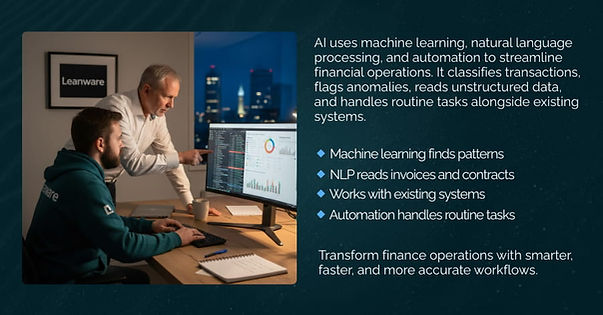
AI in finance brings together machine learning, natural language processing, and automation to improve operations and reporting. Machine learning identifies patterns in historical data to classify transactions, predict outcomes, and flag exceptions.
Natural language processing reads unstructured data from invoices, contracts, and emails. Automation, including robotic process automation, handles repetitive tasks like data entry and reconciliations.
These technologies work together within existing financial systems, augmenting the work finance teams already do. Understanding these core concepts, how AI differs from traditional software, and why adoption is increasing provides a foundation for evaluating specific applications in your organization.
How AI Differs from Traditional Financial Software
Traditional finance software operates on fixed rules. If an invoice matches a purchase order within a set tolerance, approve it. If a transaction contains certain keywords, categorize it a specific way. This works until it doesn't. Edge cases pile up, exceptions require manual review, and the rules never quite keep pace with how the business actually operates.
AI systems learn from data patterns rather than following static rules. They adapt as your business changes, improve accuracy over time, and handle nuance that rule-based systems miss. A machine learning model trained on your historical data will recognize that certain vendors frequently send invoices with different formats and adjust accordingly.
Why Finance Teams Are Adopting AI Now
CFOs are expected to deliver strategic insights, not just report historical results. Data volumes continue growing as businesses add systems and transaction channels. Compliance requirements keep expanding. And finance teams are often asked to do more without proportional increases in headcount.
According to research from Rossum, 49% of finance departments still operate with zero automation, relying entirely on manual processes and spreadsheets. Meanwhile, organizations with highly automated AP processes average just 3.1 days to process an invoice compared to 17.4 days for those with limited automation. The gap between leaders and laggards is widening.
How AI Transforms Financial Operations
AI removes manual bottlenecks across transaction classification, reconciliations, accounts payable, accounts receivable, and anomaly detection. Each area delivers measurable improvements in speed, accuracy, and cost reduction.
Area | How AI Works | Benefits |
Transaction Classification | Learns from past coding to categorize transactions. | Fewer errors, faster month-end close. |
Reconciliations | Matches transactions and flags discrepancies. | Shorter close, fewer adjustments. |
Invoice Processing / AP | OCR + AI for data extraction and approval. | Lower costs, higher accuracy. |
Accounts Receivable | Predicts late payments and prioritizes collections. | Better cash flow, fewer overdue invoices. |
Anomaly Detection | Monitors transactions for unusual activity. | Detects errors and potential fraud quickly. |
Intelligent Transaction Classification
AI categorizes transactions automatically by learning from how your team has coded entries historically. Instead of applying rigid rules, machine learning models recognize patterns and context. They improve over time as they process more data and receive feedback on exceptions.
This reduces errors and speeds month-end close. Rather than having staff manually review and categorize hundreds of transactions, AI handles the routine work and flags only the items that genuinely need human judgment.
Automated Reconciliations and Month-End Close
Reconciliation is where many finance teams lose days each month. AI accelerates this by matching transactions across systems, identifying discrepancies, and suggesting resolutions based on historical patterns.
Organizations implementing AI-driven reconciliation typically reduce close cycles by several days and see fewer post-close adjustments. The system learns which differences are routine (timing, rounding) versus those requiring investigation.
Invoice Processing and Accounts Payable Automation
AP automation combines optical character recognition with AI validation to process invoices without manual data entry. The system extracts key fields, matches against purchase orders, routes for approval, and handles exceptions.
The economics are compelling. Manual invoice processing costs $12-30 per invoice, according to APQC research, while automated processing drops to $1-5 per invoice. Organizations processing 5,000 invoices annually can save $50,000-125,000 in direct costs. AI-powered AP systems achieve accuracy rates above 99% compared to roughly 97% for manual processing.
Accounts Receivable and Cash Acceleration
AI predicts which invoices will pay late based on customer behavior patterns, enabling proactive outreach before payments become overdue.
Machine learning models analyze payment history, customer characteristics, and external factors to prioritize collection efforts where they will have the most impact. This translates directly to improved cash flow.
Anomaly Detection and Error Prevention
AI continuously monitors transaction patterns and flags unusual activity in real time. This includes duplicate payments, unusual vendor behavior, transactions outside normal ranges, and potential fraud indicators.
Finance teams catch issues as they happen rather than discovering errors during month-end close or audit.
AI-Powered Financial Reporting
AI changes reporting through real-time dashboards, automated financial statement generation, natural language explanations, and streamlined executive reporting. These capabilities shift finance teams from producing reports to analyzing insights.
Real-Time Dashboards and Continuous Visibility
AI enables dashboards that update continuously rather than waiting for batch processing. Finance leaders can see current cash positions, revenue trends, and expense patterns without waiting for reports to be manually compiled.
Financial statements can be generated on demand with current data rather than produced monthly as static snapshots. This shift toward continuous visibility means finance teams spend less time producing reports and more time analyzing what the numbers mean.
Natural Language and Executive Reporting
Generative AI produces written explanations of financial results, translating numbers into narrative that non-finance stakeholders understand. Instead of sending a spreadsheet with variance columns, you can deliver a summary that explains what changed and why.
AI also reduces manual preparation work for board and investor reports by automating data pulls, formatting, and initial commentary drafts. Finance teams review and refine rather than building from scratch each period. Consistency improves because reports follow the same structure and pull from validated data sources.
Predictive Analytics and Financial Forecasting
AI improves forecasting through better revenue and expense models, more accurate cash flow prediction, faster scenario modeling, and early risk detection. These capabilities represent the biggest leap forward from traditional spreadsheet-based planning.
Revenue, Expense, and Cash Flow Forecasting
Traditional forecasting relies on manual spreadsheet models updated quarterly or annually. AI allows continuous forecasting, incorporating more variables and adjusting as conditions change. According to IBM’s Institute for Business Value, organizations using AI report a 57% reduction in sales forecast errors, a 43% drop in uncollectable balances, and a 33% shorter monthly close.
Machine learning models analyze historical patterns alongside external factors like market conditions and seasonal trends, which spreadsheets often miss. AI also improves cash flow forecasting by learning actual payment behavior from customers and vendors, providing more reliable visibility into future cash positions, and supporting better capital allocation.
Scenario Modeling and Risk Detection
AI makes scenario planning faster and more comprehensive. Instead of manually building three scenarios in a spreadsheet, finance teams can model dozens of combinations and see probabilistic outcomes. This supports better decision-making around hiring, pricing, expansion, or cost reduction initiatives.
AI models can also identify leading indicators of financial risk before problems become obvious in the numbers. This might include changes in customer payment patterns, margin compression in specific product lines, or expense growth outpacing revenue. Proactive alerts enable intervention before problems escalate.
Compliance, Risk Management, and Audit Automation
AI strengthens compliance through behavioral fraud detection, automated controls monitoring, improved audit readiness, and reduced human error. These capabilities address governance requirements that finance teams must meet.
Fraud Detection and Controls Automation
AI enhances fraud detection by analyzing behavioral patterns rather than relying solely on predefined rules. It can spot unusual vendor activity, atypical payment behavior, or transactions that deviate from normal patterns, prompting further investigation. A 2025 study in WJARR found that machine learning models increase fraud detection rates by 65-90% over traditional approaches while reducing false positives.
In addition, AI helps maintain compliance by enforcing policies, keeping detailed audit trails, and alerting teams to potential violations in real time.
Audit Readiness and Error Reduction
Complete audit trails with automatic documentation reduce the stress and cost of audit preparation. AI systems maintain records of every transaction, approval, and change, making it straightforward to respond to auditor requests.
Automation eliminates many common sources of manual error: typos in data entry, copy-paste mistakes in spreadsheets, and overlooked exceptions. By handling routine tasks consistently, AI reduces the risk that human fatigue or distraction will introduce errors into financial data.
AI Integration with Existing Systems
AI connects to ERPs, accounting platforms, banking systems, and data warehouses through APIs and standard integrations. This layer approach protects existing technology investments while adding intelligent capabilities.
AI platforms connect to major ERPs, including SAP, Oracle, NetSuite, and Microsoft Dynamics. Data flows from existing systems into AI models, and results feed back into your ERP for action. Mid-market organizations using QuickBooks, Xero, or Sage can also benefit through direct integrations. AI connects to banking feeds for real-time cash visibility and works alongside existing BI tools by providing cleaner, more consistent data.
Build vs. Buy
Organizations can choose off-the-shelf tools for speed, custom development for differentiation, or hybrid approaches combining ERP with targeted AI layers. The right path depends on complexity, scale, and competitive requirements.
Pre-built solutions offer faster deployment and proven capabilities for common use cases like AP automation. Implementation can take weeks rather than months. Custom development provides flexibility for organizations with unique processes or data advantages but requires significant investment and internal expertise.
The most common enterprise path combines standard ERP functionality with targeted AI capabilities for specific high-value use cases. This balances speed to value with customization for unique requirements.
Cost, Timeline, and ROI
Implementation costs vary widely depending on scope, ranging from a few hundred dollars to several hundred K. Timelines can span from a few weeks for simple deployments to 18 months for comprehensive transformations. ROI comes from labor savings, error reduction, faster close cycles, improved forecasting, and captured early payment discounts.
For example, simple accounts payable automation can be deployed in 4-8 weeks. Broader transformations across forecasting, reporting, and operations typically take 6–18 months. Cloud-based AI tools for small businesses may cost $200-2K per month, while enterprise implementations that include integration and customization can range from $50K-500K annually.
The financial impact often starts with quick wins, such as faster invoice processing and reduced manual work, while longer-term value compounds over 1-3 years as teams leverage continuous forecasting, automated reconciliations, and more reliable reporting.
Common Challenges and Risks
Data quality issues, change management resistance, over-automation risks, and security concerns represent the main barriers. Addressing these proactively improves outcomes.
Data quality is the most frequent challenge - AI is only as reliable as the data it learns from. Finance teams may also resist new tools, especially if there’s concern about job displacement.
Successful implementations focus on how AI augments rather than replaces human judgment. Over-reliance on automation creates risk if humans disengage from oversight; AI should flag items for review, not make all decisions autonomously.
The Role of Finance Teams
AI changes finance roles from data processing toward strategic analysis. CFOs become forward-looking advisors, teams focus on judgment and relationships, and human-AI collaboration becomes the operating model.
The CFO role shifts from reporting historical results to providing strategic guidance. With AI handling data gathering and report production, CFOs can focus on interpretation and advising the business.
Organizations that successfully adopt AI invest in upskilling their teams to work effectively with new tools. AI handles routine decisions well; humans add value on judgment calls and strategic decisions where context matters.
How to Get Started
Start by assessing data readiness, identify high-impact use cases, choose appropriate technology, and plan for phased scaling. A focused pilot delivers faster learning than attempting organization-wide transformation immediately.
Begin with honest assessment of your data quality and process maturity. Identify specific use cases where AI can deliver measurable value quickly. AP automation, transaction categorization, and cash forecasting are common first initiatives.
Scale successful pilots by documenting results, training additional users, and expanding to related use cases.
You can reach out to our experts to explore how AI can streamline your financial operations, improve reporting accuracy, and support more confident decision-making across your organization.
Frequently Asked Questions
What does AI for financial operations actually do?
AI handles repetitive and rule-based tasks such as transaction categorization, invoice processing, reconciliations, and report generation. Beyond automation, it analyzes historical data to generate forecasts, detects anomalies in real time, and produces insights that help finance teams focus on strategy rather than manual work.
How much does implementation cost?
Costs vary based on scope, integration, and customization. Small-scale cloud tools can cost a few hundred to a few thousand dollars per month, while enterprise implementations with full system integration can run from $50K to $500K annually. Additional factors affecting cost include the number of users, volume of transactions, and level of workflow automation required.
How long does deployment take?
Simple AI solutions, like accounts payable automation, can be deployed in 4–8 weeks. More comprehensive projects that cover forecasting, reporting, and operational workflows typically take 6–18 months. The timeline depends on organizational readiness, data quality, and integration complexity.
Can AI replace accountants?
AI is designed to augment finance roles rather than replace them. It handles repetitive tasks, but human oversight remains essential for judgment calls, exceptions, and strategic decisions. In practice, teams often redeploy the time saved toward analysis, planning, and advisory work.
How accurate are AI forecasts?
AI can improve forecast accuracy by 20–50% compared to traditional methods. Accuracy depends on data quality, the relevance of historical patterns, and ongoing model adjustments. Combining AI outputs with human interpretation ensures reliable final decisions.
Does AI integrate with existing ERP systems?
Yes. Modern AI platforms integrate with major ERP systems like SAP, Oracle, NetSuite, and Dynamics through APIs. They operate as a layer on top of existing systems, enhancing capabilities without requiring a full replacement.
What are the biggest risks?
Key risks include poor data quality, over-reliance on automation, and potential security vulnerabilities. Mitigation requires strong data governance, clear oversight policies, and retaining human review for exceptions and critical decisions.
What is the ROI timeline?
Short-term ROI comes from automation, often realized within 3–6 months through labor savings, faster close cycles, and reduced errors. Longer-term ROI - through improved forecasting, working capital management, and strategic insights - typically compounds over 1-3 years.