Martech Software Development Services | All You Need to Know

The martech landscape has grown from 150 solutions in 2011 to over 15,384 in 2025, according to ChiefMartec's annual survey. That's a 100x increase in 14 years. The market itself is projected to reach $296 billion by 2030, growing at 11% annually. Yet despite this explosion of tools, most marketing teams still struggle with disconnected systems, inconsistent data, and workflows that require manual intervention at every step.
This gap between available tools and actual integration is where martech software development comes in. Off-the-shelf solutions handle common use cases well, but they rarely address the specific workflows, data models, or competitive advantages that differentiate one business from another.
Let’s explore what martech software development involves, when building makes more sense than buying, and how teams typically approach it in practice.
What Is Martech Software Development?
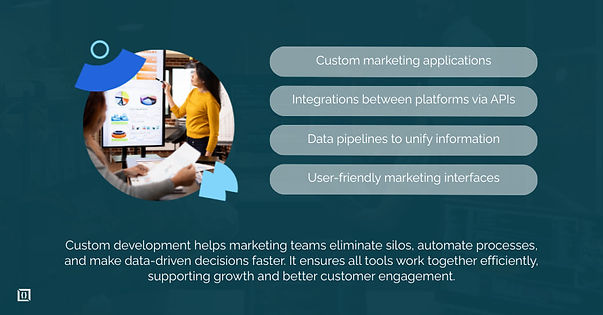
Martech software development is the process of building, customizing, and integrating marketing technology solutions. This includes creating custom applications from scratch, connecting existing platforms through APIs, building data pipelines between systems, and developing interfaces that make complex marketing operations accessible to non-technical teams.
The need for custom development has grown as marketing operations become more sophisticated. A typical enterprise now uses 91 different martech tools on average. These tools often don't communicate with each other out of the box, creating data silos and manual processes that slow down campaigns and introduce errors - custom development bridges all these gaps.
Difference Between Martech and Adtech
Martech focuses on systems that manage owned channels and long-term customer relationships, while Advertising Software Development supports paid media execution and audience acquisition. The difference affects how teams design systems, allocate budgets, and plan development work.
Aspect | Martech | Adtech |
Focus | Owned channels, customer relationships | Paid media, programmatic advertising |
Examples | CRM, email automation, CMS, analytics | DSPs, SSPs, ad exchanges, DMPs |
Data ownership | First-party data you control | Often third-party data from vendors |
Goal | Nurture existing relationships | Acquire new audiences |
Typical users | Marketing ops, content teams | Media buyers, performance marketers |
Martech investments typically have longer payback periods but build lasting assets. Adtech spending is more transactional but delivers faster measurable results.
Components of a Martech Stack
A well-architected martech stack typically has four layers:
- Data foundation: Customer Data Platform (CDP) or data warehouse that unifies customer information from all sources. This layer handles identity resolution, data cleaning, and creating a single customer view.
- Activation layer: Marketing automation platforms, CMS, email systems, and campaign tools that use the unified data to execute campaigns across channels.
- Analytics layer: Reporting dashboards, attribution models, and business intelligence tools that measure performance and inform decisions.
- Orchestration layer: Workflow tools and integration middleware that coordinate actions across systems and ensure data flows correctly.
For example, a B2B SaaS company might use Snowflake as their data warehouse, Segment for data collection, HubSpot for marketing automation, Webflow for their website, and Looker for analytics. The custom development work connects these systems and fills gaps where off-the-shelf features fall short.
Key Martech Tools & Technologies
Marketing teams rely on a mix of platforms to manage workflows, data, and customer interactions. Each tool has its strengths, but they rarely cover every need out of the box, which is where custom development often comes in.
Marketing Automation Platforms
The major platforms each focus on different use cases and come with their own limitations:
Platform | Best For | Common Limitations |
HubSpot | SMB to mid-market, ease of use | Complex enterprise workflows, custom objects |
Marketo | Enterprise B2B, lead scoring | Implementation complexity, cost |
Pardot | Salesforce-native companies | Limited flexibility outside Salesforce |
Klaviyo | E-commerce, lifecycle marketing | B2B use cases, complex attribution |
ActiveCampaign | Small business automation | Enterprise scale, advanced segmentation |
Custom development typically becomes necessary when you hit API rate limits during high-volume campaigns, need workflow logic that the platform doesn't support, require custom data transformations before syncing to other systems, or want to build proprietary scoring models using your own data.
CRM & Customer Data Platforms
CRMs like Salesforce and HubSpot store transactional data - deals, contacts, activities - while CDPs such as Segment, mParticle, and Rudderstack track behavioral data like website visits, product usage, and engagement patterns.
Many companies need both, plus a custom integration layer that unifies customer identity across systems.
For example, matching an anonymous website visitor to a known contact in your CRM, then enriching that profile with product usage data from your application database. This kind of identity resolution often requires custom development because each company's data model is unique.
Analytics & Data Visualization Software
Google Analytics handles basic web analytics, but most companies outgrow it when they need multi-touch attribution across channels, custom conversion path analysis, predictive modeling for lead scoring, or real-time reporting that combines marketing and sales data.
Custom analytics development typically involves building data pipelines that pull from multiple sources, creating attribution models tailored to your sales cycle, and developing dashboards that answer specific business questions rather than generic metrics.
Content Management Systems
Modern martech stacks increasingly use headless CMS architecture, where content is stored separately from presentation. This allows the same content to be delivered across web, mobile, email, and other channels through APIs.
CMS Type | Examples | Best For |
Traditional | WordPress, Drupal, Magento, Wix | Simple websites, blogs, e-commerce stores |
Headless | Contentful, Sanity, Strapi | Multi-channel content delivery |
Hybrid | Webflow, Prismic | Marketing sites with API access |
Custom development in this space often involves building content distribution systems that coordinate publishing across multiple channels or creating editorial workflows tailored to a team’s process.
AI-Powered Marketing Tools
AI in martech falls into a few practical categories: predictive lead scoring that identifies which prospects are likely to convert, content generation for email copy and ad variations, personalization engines that customize website experiences, and chatbots that handle routine customer inquiries.
The custom development opportunity here is training models on your proprietary data. A generic lead scoring model uses industry benchmarks, but a custom model trained on your actual conversion data will outperform it significantly. Similarly, recommendation engines work better when trained on your specific customer behavior patterns.
How Martech Software Development Works
Martech software development starts with understanding business needs, then moves on to choosing and designing the right tools, building and connecting systems, testing workflows, and finally deploying while keeping an eye on performance and improvements.
Step 1: Business Needs & Strategy
Good martech development starts with business problems, not technology. The discovery phase maps existing marketing processes, identifies pain points, and defines success metrics.
Common questions include:
- Where do campaigns get stuck waiting for manual data entry?
- Which reports require pulling data from multiple systems?
- What customer segments can't you reach because the data isn't connected?
A useful framework is the impact versus complexity matrix. Plot potential initiatives by business impact (revenue, efficiency, customer experience) against implementation complexity (technical difficulty, integration requirements, change management). Start with high-impact, low-complexity projects to build momentum and prove value.
Step 2: Tool Selection & Architecture
Deciding whether to build or buy depends on the problem:
- Buy if a commercial tool meets most of your requirements, addresses a standard use case, and reduces maintenance overhead.
- Build if your needs are unique, require deep integration with proprietary systems, or provide a competitive advantage.
Architecture planning should follow API-first principles, ensuring each system can send and receive data through well-documented interfaces. Teams also choose between microservices (modular, independently deployable components) and a monolithic approach (simpler initially, harder to scale).
Step 3: Custom Development & Integration
The actual development work typically involves API development for connecting systems, database design for storing marketing data, front-end interfaces for campaign management and reporting, and data transformation logic for normalizing information across sources.
Common technical challenges include handling rate limits from third-party APIs (especially during high-volume campaign sends), managing webhook reliability when systems need real-time updates, and ensuring data consistency when the same information exists in multiple places.
Step 4: Testing & Quality Assurance
Martech testing goes beyond typical software QA.
- Data accuracy validation ensures customer information syncs correctly.
- Integration testing confirms end-to-end workflows across platforms.
- Load testing verifies system performance under campaign volumes.
- A/B testing frameworks check that personalization and optimization work as intended.
Testing should simulate real marketing workflows: Can a campaign manager create a segment, design an email, and launch it without errors? Does the attribution model correctly credit touchpoints?
Step 5: Deployment & Optimization
Deployment strategies for martech typically involve gradual rollouts. Run new systems in parallel with legacy tools initially, giving teams time to validate data accuracy.
Plan for user training; martech tools fail most often because the people who need to use them don't understand how.
Monitor data quality continuously: Are records syncing on schedule? Are duplicates being created? Track feature adoption to understand which capabilities teams actually use.
Benefits of Martech Solutions for Businesses
Custom martech can improve engagement, make data more actionable, streamline operations, and scale as your business grows. Essentially, it turns disconnected tools into systems that support better decisions and stronger customer relationships.
1. Improved Customer Engagement
Custom martech enables personalization at scale. Instead of sending the same email to every subscriber, you can tailor content based on behavior, purchase history, and engagement patterns.
Personalized emails deliver 6x higher transaction rates, and data-driven personalization campaigns report 5-8x ROI compared to generic approaches.
2. Data-Driven Decisions
Integrated martech provides a unified customer view that makes patterns visible. You can identify which acquisition channels produce customers with the highest lifetime value, not just the most conversions.
3. Operational Efficiency
Automated workflows eliminate manual data entry and reduce errors. Marketing teams that implement proper automation typically reduce campaign setup time by 50-75%, allowing focus on strategy rather than execution tasks.
4. Scalability & Competitive Advantage
Custom-built martech grows with your business without hitting the limitations of off-the-shelf tools.
Proprietary martech also creates capabilities competitors can't replicate: a custom attribution model, a personalization engine built around your product catalog, or an engagement scoring system tuned to your customer journey.
Martech Software Development Services
Martech development covers building new applications, connecting existing systems, designing infrastructure, and ensuring tools are usable and maintainable. It’s about creating a setup that meets current needs while staying flexible for future growth.
1. Custom Martech App Development
Building net-new martech applications makes sense when existing platforms can't support your specific requirements.
Examples include custom marketing automation engines for complex product lines, proprietary analytics platforms with unique attribution logic, or specialized campaign management tools for niche industries.
2. Integration with Existing Systems
The most common martech development need is connecting disparate systems. This involves REST API integrations, webhook implementations, batch ETL processes, and handling authentication across platforms. A typical project might integrate CRM, marketing automation, e-commerce, and analytics into a unified system.
3. Cloud & Infrastructure Consulting
Infrastructure decisions include cloud platform selection, scaling architecture for campaign volumes, and data warehouse design.
Martech workloads often have spiky traffic patterns around campaign sends, requiring infrastructure that scales automatically.
4. UX/UI Design for Martech Products
Martech tools must be usable by marketers, not just engineers. Good design includes intuitive campaign builders, visual workflow editors, and clear analytics dashboards.
Poor UX is a primary reason martech implementations fail to achieve adoption.
5. Ongoing Support & Maintenance
Martech requires continuous evolution. Third-party APIs change, new marketing channels emerge, and business requirements evolve.
Plan for ongoing support including monitoring integrations, updating connections when APIs change, and iterating based on user feedback.
Challenges & Best Practices
Developing and running martech systems comes with technical, security, and organizational challenges. Planning for integration issues, compliance, and user adoption helps avoid common pitfalls and ensures the systems deliver real value.
Common Development Challenges
Third-party API instability is a persistent problem. Platforms change their APIs with varying levels of notice, breaking integrations.
Data mapping across systems is complex because every platform stores customer information differently. Handling large data volumes without performance degradation requires careful architecture.
Security & Compliance Considerations
Martech handles customer data, making compliance critical. GDPR and CCPA require consent management, data deletion workflows, and access controls. CAN-SPAM governs email marketing.
Technical implementation includes encrypting customer data, managing API credentials securely, maintaining audit logs, and building opt-out handling that works across all systems.
Successful Martech Adoption Tips
Start with high-impact use cases that demonstrate value quickly. Secure buy-in from marketing leadership before starting development.
Train users thoroughly; technology adoption fails more often from change management issues than technical problems.
How Leanware Can Help Develop Your Martech Software
Developing and maintaining martech systems involves technical, integration, and usability challenges. Leanware works alongside you to address these challenges by designing scalable integrations, building custom marketing applications, and creating user-friendly tools that align with real marketing workflows.
The approach starts with understanding business processes, then implements solutions that meet those needs and can grow with the organization.
Connect with us to discuss your martech development needs and explore solutions that streamline workflows and support growth.
Frequently Asked Questions
What Is Included in Martech Software Development?
Martech software development typically includes strategy and architecture planning, custom application development, third-party integrations, data pipeline engineering, UX/UI design, testing and QA, deployment, and ongoing support. Scope varies by project: a simple integration might take weeks, while a full custom platform takes months.
How Much Does Martech Development Cost?
Custom martech development typically ranges from $50K for basic integrations to $500K+ for enterprise platforms, with most projects falling between $100K and $250K. Costs depend on factors such as the complexity of requirements, the number of systems to integrate, data volume, and any custom features needed.
Geography can also influence pricing. For example, working with development teams based in Latin America often reduces costs for U.S.-based companies, while still providing experienced developers and high-quality output.
What Skills Are Required for Martech Development?
Martech developers need API integration expertise, database design skills, front-end development for dashboards and interfaces, understanding of marketing workflows, data transformation capabilities, and familiarity with platforms like Salesforce, HubSpot, and Google Analytics. Domain knowledge matters as much as technical skills. Developers who understand how marketing teams actually work build better solutions than those who only understand the code.