Microservices vs Monolith: Which Architecture Is Right for Your Business?
Amazon's Prime Video team moved its video monitoring system from distributed microservices to a monolith and cut infrastructure costs by over 90%. Twilio Segment consolidated 140+ microservices into a single application after its engineering team was spending more time managing service boundaries than shipping features. These are two well-resourced companies with strong engineering cultures, and both concluded that their distributed architecture was costing more than it was delivering.
The pattern here is not that microservices are wrong. It is that most teams adopt them before they have the operational maturity, team size, or scaling pressure that actually justifies the trade-off. Architecture is a business lever. The wrong choice at the wrong stage burns runway, slows delivery, and creates operational debt that compounds quietly until something breaks in production.
Let’s break down both architectures, the real costs behind each, and the specific conditions where one outperforms the other.
What Is a Monolithic Architecture?
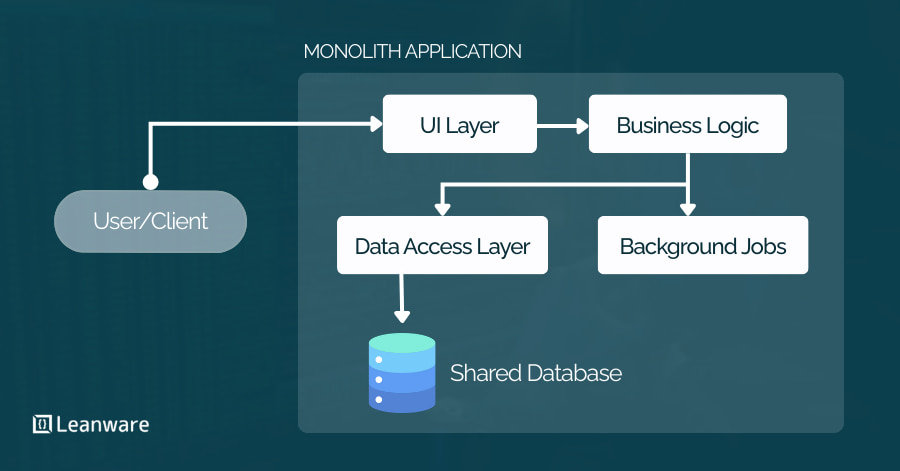
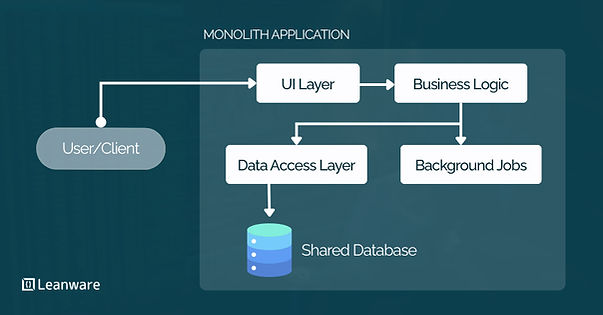
A monolith is a single, self-contained application where all components, the UI, business logic, data access layer, and background processing, live in one codebase and deploy as a single unit.
How a Monolith Works
In a monolithic architecture, every feature and module runs in the same process. The application connects to a shared database, and internal communication happens through direct function calls rather than network requests. When you deploy, you deploy everything at once.
This centralized model means one repository, one build pipeline, one deployment artifact. A developer working on the checkout flow and a developer working on the notification system both push changes to the same codebase and deploy together. All code shares the same runtime, the same memory space, and the same database connection pool.
Advantages of Monolithic Architecture
For teams in the early stages of building a product, a monolith offers a shorter path from idea to working software. There is one codebase to set up, one deployment to manage, and one environment to debug. Local development is straightforward because the entire application runs on a single machine without orchestration.
Testing is simpler because all components are available in the same process. End-to-end tests do not need to account for network latency, service discovery, or distributed state. Debugging follows a single execution path through one application rather than tracing requests across multiple services.
From an infrastructure perspective, a monolith requires fewer moving parts. No container orchestration, no service mesh, no distributed tracing system. A small team can focus entirely on building product rather than maintaining platform tooling.
When a Monolith Starts Working Against You
The problems show up as the team and the product grow. Deployments start taking longer because every change, no matter how small, requires rebuilding and redeploying the entire application. A bug in a low-priority feature can delay the release of a critical fix in a different part of the system.
Team collisions increase as more engineers work in the same codebase. Merge conflicts become routine. Code ownership becomes unclear because module boundaries inside a monolith are often informal and erode over time. A change to the payment logic accidentally breaks the search feature because both share underlying utilities that were never properly decoupled.
Scaling becomes coarse-grained. If the notification service is under heavy load, you cannot scale it independently. You scale the entire application, paying for compute resources across every component even if only one is under pressure.
What Are Microservices?
Microservices architecture decomposes a system into small, independently deployable services, each responsible for a specific business capability. These services communicate over the network, typically through REST APIs, gRPC, or message queues, and each one manages its own data store.
How Microservices Work
Each microservice is a standalone application with its own codebase, database, and deployment pipeline. A payment service, a user service, and a notification service each run in their own containers, deploy on their own schedules, and scale according to their own load profiles.
Services communicate through well-defined APIs or asynchronous events. A new order might trigger an event that the payment service consumes, processes, and acknowledges, all without the ordering service knowing the internal details of how payment processing works.
Container orchestration platforms like Kubernetes manage the lifecycle of these services, handling scaling, load balancing, health checks, and restarts. Each service can be written in a different language, use a different database, and follow a different deployment cadence.
Benefits of Microservices
Independent deployability is the most tangible advantage. Teams can ship changes to their service without coordinating a release with every other team. A fix to the search ranking algorithm does not require redeploying the payment service.
Fault isolation improves because a failure in one service does not necessarily bring down the entire system. A bug in the recommendation engine might degrade product suggestions without affecting checkout or authentication.
Scaling becomes granular. If the payment service handles ten times the load of the user profile service, you scale the payment service independently. You allocate resources where the demand actually exists rather than scaling everything uniformly.
Team autonomy increases because each service has clear ownership. A team can choose the best technology for their specific problem domain, iterate on their service independently, and maintain their own deployment velocity.
The Hidden Costs of Microservices
Every boundary between services introduces network communication, and network calls are orders of magnitude slower and less reliable than in-process function calls. Latency accumulates across service chains. A single user request that touches five services adds five network round trips, each with its own potential for failure, timeout, or retry.
Distributed debugging is significantly harder than tracing a request through a single application. When a request fails after passing through four services, identifying the root cause requires distributed tracing infrastructure, correlated logging, and engineers who understand how to navigate that tooling.
Data consistency becomes a design problem rather than something the database handles automatically. Transactions that span multiple services require patterns like sagas or eventual consistency, both of which add complexity and introduce failure modes that do not exist in a monolith.
Operational overhead scales with the number of services. Each service needs its own CI/CD pipeline, its own monitoring, its own alerting, its own health checks. The industry is seeing a measurable correction: teams that adopted microservices early are consolidating services back into larger deployable units as debugging complexity, operational costs, and network latency outweigh the autonomy benefits. Amazon's Prime Video team is the highest-profile example, but the pattern repeats across organizations that distributed their systems before they had the platform engineering maturity to manage them.
The infrastructure cost difference is real. Microservices architectures typically require container orchestration, service meshes, distributed tracing systems, centralized logging, and API gateways, none of which a monolith needs. Estimates from engineering teams that have measured both approaches suggest infrastructure costs for microservices run 3.75x to 6x higher than monoliths for equivalent functionality.
Microservices vs Monolith: Side-by-Side Comparison
Both architectures come with clear strengths and real costs across deployment, scaling, team structure, and operations. The table below puts those differences side by side before we go deeper into each one.
Factor | Monolith | Microservices |
Deployment | Single unit, all-or-nothing | Independent per service |
Initial Complexity | Low | High |
Time to Market (MVP) | Faster | Slower |
Scaling | Vertical, or horizontal as a whole unit | Granular, per service |
Team Size Fit | Small teams (under 10-15 engineers) | Multiple squads with clear domain ownership |
Debugging | Single process, straightforward | Distributed tracing across services |
Fault Isolation | Low - one failure can affect everything | High - failures can be contained per service |
Infrastructure Cost | Lower | Significantly higher |
DevOps Maturity Required | Basic | Advanced (CI/CD per service, orchestration, observability) |
Technology Flexibility | Single stack | Polyglot - each service can use different tech |
Data Consistency | ACID transactions, straightforward | Eventual consistency, saga patterns |
Performance and Scalability Differences
A monolith scales vertically by adding more CPU, memory, or storage to the server it runs on. It can also scale horizontally by running multiple instances behind a load balancer, though every instance carries the full application regardless of which component is under load.
Microservices scale horizontally at the service level. A payment processing service that handles peak transaction volume during a flash sale can scale to fifty instances while the user settings service stays at two. Resources go where demand exists.
The performance trade-off is latency. Internal function calls in a monolith happen in nanoseconds. Network calls between microservices happen in milliseconds and carry the overhead of serialization, deserialization, network hops, and potential retries. A request that passes through a chain of five services accumulates that latency at every hop.
For applications where consistent low latency matters more than independent scaling, a monolith often performs better out of the box. For applications where different components experience dramatically different load patterns, microservices provide scaling efficiency that a monolith cannot match.
Deployment and DevOps Considerations
A monolith needs one CI/CD pipeline, one deployment process, and one production environment to monitor. The operational surface area is small, and a lean team can manage it without dedicated platform engineering.
Microservices multiply that operational surface by the number of services. Each service requires its own build pipeline, automated tests, deployment configuration, health checks, and monitoring dashboards. Container orchestration with Kubernetes or a similar platform becomes a near-requirement for managing service lifecycles at scale.
Observability is not optional in a microservices environment. Distributed tracing tools like Jaeger or Zipkin, centralized logging with an ELK stack or similar, and service-level metrics become infrastructure you need to build and maintain before you can effectively operate the system. Without them, debugging production issues across multiple services becomes guesswork.
The DevOps maturity gap between the two architectures is significant. A monolith can operate on basic CI/CD and server monitoring. Microservices require a platform engineering practice, and building that practice takes time, specialized hiring, and sustained investment.
Cost Comparison: Infrastructure and Engineering
Infrastructure costs are the most visible difference, but engineering costs are often larger. A monolith can run on a few servers or a single container cluster. Microservices require additional components such as container orchestration, API gateways, service discovery, distributed tracing, centralized logging, and secrets management, each adding operational overhead.
Engineering costs also increase. Microservices typically require engineers familiar with distributed systems, networking, container orchestration, and observability tooling.
Platform engineers often earn between $140k and $180k annually.
A monolith may only require one or two operations-focused engineers. A microservices setup often involves two to four platform engineers, along with operational responsibilities shared across product teams. That difference alone can represent $140k to $360k in additional annual salary cost, even before accounting for infrastructure.
Team Structure and Organizational Impact
Conway's Law states that organizations produce system designs that reflect their communication structures. A dozen engineers working closely together will naturally produce a cohesive, tightly integrated system. Multiple autonomous teams with limited cross-team communication will produce a distributed system with well-defined boundaries between components.
This has direct implications for the microservices vs monolith decision. Microservices work best when each service is owned by a small team responsible for development, deployment, and operations. If there are not enough engineers to support independent teams, or if teams cannot manage their own deployments, microservices can introduce coordination overhead.
The Inverse Conway Maneuver takes this a step further: deliberately restructure teams to match the architecture you want. If you want independent services, build independent teams first. Attempting microservices with a team structure that still requires heavy cross-team coordination produces what many engineering leaders call a "distributed monolith," a system with all the operational cost of microservices and none of the autonomy benefits.
When Should You Choose a Monolith?
A monolith is the right starting point when the team is small, the product is still finding its shape, and speed of iteration matters more than independent scalability.
Concrete scenarios where a monolith fits well include building an MVP to validate product-market fit, operating with fewer than ten to fifteen engineers, working within a single, well-understood domain, running a product where traffic patterns are relatively uniform across features, and operating without dedicated platform engineering or DevOps capacity.
Many successful products ran as monoliths well into significant scale. Shopify, Basecamp, and Stack Overflow all operated monolithic architectures while serving millions of users. The monolith did not hold them back because their teams were disciplined about internal code structure even without distributed service boundaries.
The key is building a monolith with good internal boundaries, clear module separation, defined interfaces between components, and separate data access patterns per domain. That discipline pays off immediately in code quality and pays off later by making selective migration to microservices possible when the business actually needs it.
When Should You Choose Microservices?
Microservices earn their complexity when specific organizational and technical conditions are present.
Maturity signals that point toward microservices include multiple engineering squads that need to deploy independently without blocking each other, scaling requirements that differ significantly across features (a payment processing service handling ten times the traffic of a user settings service), domain complexity that benefits from strict service boundaries (multi-tenant SaaS with strong isolation requirements), regulatory constraints that require specific components to run in isolated environments (PCI compliance for payment processing), and deployment frequencies where teams ship multiple times per day and cannot afford coordinated release windows.
The common thread is that microservices solve coordination problems at scale. If your team is not yet experiencing those coordination problems, the architecture adds cost without delivering its primary benefit.
Can You Start Monolithic and Migrate Later?
Starting with a monolith and migrating to microservices as needs evolve is the path most experienced engineering leaders recommend. The key is building the monolith in a way that makes future extraction possible.
A modular monolith is a single deployable application with well-defined internal modules that communicate through explicit interfaces. Each module owns its own data access logic, avoids sharing database tables with other modules, and exposes functionality through internal APIs rather than direct function calls. The application deploys as one unit, but its internal structure mirrors what independent services would look like.
When the time comes to extract a module into a standalone service, the work is tractable because the boundaries already exist. The module already has a defined interface, its own data access layer, and limited coupling to other modules.
The Strangler Fig Pattern provides a framework for incremental migration. Rather than rewriting the entire system at once, you route specific functionality to a new service while the monolith continues handling everything else. Over time, the new services take over more functionality until the monolith is either fully replaced or reduced to a small core.
This approach avoids the biggest risk of premature microservices adoption: building distributed system complexity before the team has the operational maturity to manage it.
Common Myths About Microservices
A lot of the conventional wisdom around microservices comes from conference talks and blog posts written by engineers at companies operating at a scale most teams will never reach. Some of the most repeated claims do not hold up when applied to teams below that threshold.
- Microservices scale automatically. They do not. Microservices make independent scaling possible, but achieving it requires container orchestration, auto-scaling configuration, load testing, and ongoing tuning. Scaling still takes engineering work. The architecture just makes the scaling unit more granular.
- Big tech does it, so we should too. Netflix operates over a thousand microservices, but Netflix also has hundreds of platform engineers and a custom-built infrastructure platform that took years to develop. Adopting Netflix's architecture without Netflix's operational capacity produces the cost without the benefit.
- Microservices mean faster development. For small teams, microservices typically slow development down. The overhead of managing multiple repositories, deployment pipelines, inter-service contracts, and distributed debugging outweighs the productivity gains from service independence until the team is large enough for coordination costs to dominate.
- Monoliths cannot scale. A well-built monolith can scale horizontally behind a load balancer and handle significant traffic. Many companies serve millions of users on monolithic architectures with vertical and horizontal scaling strategies that work well within their traffic profiles.
- Microservices reduce complexity. Microservices redistribute complexity. Application-level complexity decreases because each service is smaller and more focused. But operational complexity increases because the system as a whole now involves network communication, distributed state, eventual consistency, and infrastructure tooling that a monolith does not require.
Real-World Examples
Three companies at very different scales made three different architecture decisions, and all three got it right.
Shopify runs one of the largest Ruby on Rails monoliths in production, serving millions of merchants globally. Rather than breaking into microservices, Shopify invested in a modular monolith - enforcing strict component boundaries within a single codebase using an internal tool called Packwerk. Their engineering team concluded that microservices would introduce coordination and operational overhead that was not justified by their scaling needs, even at their size.
Netflix went the opposite direction. After a major database outage in 2008 exposed the fragility of their monolith, they migrated to a microservices architecture on AWS over the course of several years and now operate over a thousand services, each owned by small autonomous teams. That architecture works for Netflix because they built a dedicated platform engineering organization and years of custom internal tooling to manage the complexity. The lesson is not that Netflix chose microservices - it is that they built the organizational infrastructure to support them before scaling the architecture.
Basecamp has operated as a monolith for over two decades, serving millions of users without moving to microservices. Their CTO David Heinemeier Hansson coined the term "The Majestic Monolith" and later wrote a guide on how to recover from premature microservices adoption, arguing that for most products with a single focused team, a well-structured monolith delivers faster and costs less to operate.
Each of these companies made a different call, and each call was right for their context. The common thread is that none of them chose their architecture based on what was popular. They chose it based on team size, operational capacity, and the specific scaling problems they actually faced.
A Practical Decision Framework
Rather than asking "should we use microservices or a monolith," run through these questions:
How many engineers will work on the system?
Below ten to fifteen, a monolith is almost always the right choice. Above fifty, microservices start delivering real coordination benefits.
Do different components of the system have significantly different scaling needs?
If your search service handles a hundred times more requests than your admin panel, granular scaling has measurable value. If load is roughly uniform, a monolith scales just as effectively.
Does your team have dedicated DevOps or platform engineering capacity?
Microservices require orchestration, observability, and deployment automation that someone needs to build and maintain. Without that capacity, the operational burden falls on product engineers and slows feature delivery.
Are teams blocking each other on deployments?
If engineers routinely wait for other teams' changes before they can ship, independent deployability is a real need. If the team deploys together without friction, that problem has not materialized yet.
Can you invest in the operational tooling microservices require?
Distributed tracing, centralized logging, service meshes, and API gateways are not optional in a microservices environment. They are prerequisites.
Is the domain complex enough to benefit from strict service boundaries?
Multi-tenant platforms, regulated environments, and systems with genuinely independent business domains benefit from formal service separation. Simpler products with a single domain often do not.
If the majority of these questions point toward simplicity, start with a modular monolith and revisit the decision when growth changes the calculus.
Architecture Should Serve the Business, Not the Ego
The best architecture is the one your team can build, operate, and evolve at your current stage without borrowing operational maturity from the future. A monolith built with discipline and clear internal boundaries will outperform a microservices architecture that the team cannot effectively operate.
Start with the simplest architecture that meets your current needs. Build it well. Add complexity when specific, measurable business requirements demand it, not when a conference talk makes it sound appealing.
Architecture is a business decision with engineering constraints, not an engineering decision with business implications. Treat it that way, and the right choice becomes clearer than any framework can make it.
If you are evaluating your architecture or planning a migration, connect with our engineering team to design a system that fits your current stage - not one you will need to rebuild in a year.
Frequently Asked Questions
What is the main difference between microservices and monolith architecture?
The main difference is structure and deployment. A monolith is a single unified application where all components run together, while microservices split the system into independent services that can be deployed and scaled separately. Monoliths prioritize simplicity; microservices prioritize scalability and flexibility.
Is microservices better than monolith?
Microservices are not inherently better. They are better for complex, large-scale systems with multiple teams. Monoliths are often better for startups and MVPs because they are simpler to build, deploy, and maintain in early stages.
When should you use a monolithic architecture?
You should use a monolithic architecture when building an MVP, working with a small team, validating product-market fit, or when system complexity is still low. It reduces infrastructure overhead and speeds up development.
When should you switch from monolith to microservices?
You should consider switching when deployments become risky, teams block each other, scaling needs differ across features, or when parts of the system require independent evolution. Migration should be driven by business growth, not trends.
Do microservices improve performance?
Microservices do not automatically improve performance. They improve scalability by allowing independent scaling of services. However, network communication between services can introduce latency and operational complexity.
Are microservices more expensive than monoliths?
Yes, in most cases microservices are more expensive. They require additional infrastructure, monitoring systems, DevOps maturity, and engineering time to manage distributed systems effectively.
Can a monolith scale?
Yes. A monolith can scale vertically by adding more resources to a server and horizontally by running multiple instances behind a load balancer. Many successful startups scale significantly before needing microservices.
What is a modular monolith?
A modular monolith is a monolithic application structured internally into well-defined modules with explicit interfaces and separated data access. It keeps deployment simple while reducing tight coupling, making future migration to microservices practical when the business requires it.
Are microservices necessary for cloud-native applications?
No. Cloud-native applications can run on monolithic architectures. Microservices align well with cloud environments, but cloud adoption does not require a microservices architecture.
What are the biggest risks of adopting microservices too early?
The biggest risks are operational complexity, higher infrastructure costs, debugging difficulty, team coordination overhead, and slower development velocity due to distributed system challenges that the team is not yet equipped to handle.