Physical Therapy Software Development for Modern Clinics
Physical therapy clinics operate with workflows that standard healthcare software was never designed to handle. Treatment plans span weeks or months, progress tracking is continuous, exercise adherence happens outside the clinic, and billing involves therapy-specific codes that general systems struggle with.
Building software that truly supports these workflows means designing around day-to-day therapy routines, patient progress tracking, and the coordination between therapists and administrative staff.
Let’s explore what physical therapy software development involves, why clinics need purpose-built solutions, and how to approach the build from features through compliance to long-term maintenance.
What Is Physical Therapy Software Development?
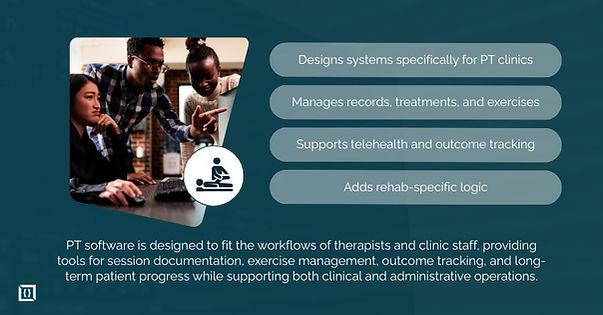
Physical therapy software development is the process of designing and building digital systems specifically for PT clinics and rehabilitation providers. These systems handle patient records, treatment planning, exercise management, scheduling, billing, telehealth, and outcome tracking in ways that align with how therapists and clinic staff actually work.
What distinguishes this from general healthcare or practice management software is the rehabilitation-specific logic. A standard EHR does not natively support exercise libraries, session-based documentation, functional outcome measures, or the kind of longitudinal progress tracking that defines physical therapy care. Purpose-built PT software fills those gaps.
Why Physical Therapy Clinics Need Specialized Software
Most clinics experience software inefficiency - using multiple tools that don’t communicate with each other. This fragmentation creates data silos that can slow operations and make it harder to monitor patient progress. Specialized software reduces these inefficiencies by aligning technology with the real flow of care a patient experiences in the clinic.
Operational Challenges in Traditional Physical Therapy Practices
Clinics running on paper charts, spreadsheets, or poorly fitting software deal with predictable problems. Documentation takes therapists away from patient care. Scheduling is manual and error-prone, leading to gaps, double bookings, and no-shows. Billing relies on staff manually entering therapy codes, which increases denial rates.
Patient progress lives in fragmented notes that are hard to review across sessions. And clinic owners have limited visibility into performance metrics like utilization rates or revenue per visit.
These are not minor inconveniences. They directly affect revenue, patient outcomes, and staff satisfaction.
How Custom Software Solves These Challenges
Custom software replaces manual effort with automated logic. Instead of a therapist manually checking if a patient completed their home exercise program (HEP), the software syncs data from a mobile app directly into the patient's record.
Challenge | Software Solution |
Documentation Burden | Smart templates and voice-to-text integration |
Fragmented Systems | Unified API-first architecture connecting billing and clinical notes |
Patient Drop-off | Automated reminders and engagement prompts based on activity |
Scheduling Errors | Real-time availability syncing across multiple locations |
Core Features of Physical Therapy Software
A well-built PT software system covers six core areas, each supporting a different part of the clinical and operational workflow.
1. Patient Management and Electronic Health Records (EHR/EMR)
Digital patient records replace paper charts with structured, searchable data. Therapists document evaluations, daily notes, and discharge summaries in standardized formats that support compliance and continuity of care. When a patient transfers to a different therapist, the full history is accessible immediately.
2. Treatment Planning and Exercise Management
This is where PT software diverges most from general healthcare systems. Therapists build personalized treatment plans with specific exercises, sets, reps, and progression criteria.
Exercise libraries with visual instructions help patients understand their programs. Progress tracking shows measurable changes in range of motion, strength, or functional scores over time.
3. Appointment Scheduling and Clinic Operations
Scheduling modules manage therapist availability, treatment room allocation, and patient appointments in one view. Automated reminders via text or email reduce no-shows.
For multi-location clinics, centralized scheduling coordinates resources across sites without manual phone calls between front desks.
4. Billing, Insurance and Revenue Cycle Management
PT billing is complex. Sessions involve time-based CPT codes, modifiers, and authorization tracking that general billing software handles poorly.
Purpose-built billing modules validate claims before submission, track authorization limits, manage copays, and flag denied claims for follow-up. This reduces the revenue cycle from weeks to days in many cases.
5. Telehealth and Remote Physical Therapy Solutions
Tele-rehabilitation became a standard care option after 2020 and remains relevant for patients with mobility limitations, rural access issues, or scheduling constraints. PT software with built-in telehealth supports video sessions, remote exercise monitoring, and secure messaging. Hybrid models where patients alternate between in-clinic and remote visits are now common.
6. Analytics, Reporting and Performance Tracking
Clinics need data to make informed decisions. Reporting modules track patient outcomes, clinic utilization rates, therapist productivity, revenue per visit, and payer mix. This data helps owners identify bottlenecks, optimize staffing, and demonstrate value to referral sources.
Types of Physical Therapy Software Solutions
Different clinic sizes and models benefit from different approaches.
Software Type | Use Case |
All-in-One Management | EHR, scheduling, billing in one; for small to mid-sized clinics |
Mobile Apps | Document and update plans on the go |
Patient Engagement Apps | Deliver exercises and track adherence |
Tele-Rehabilitation | Remote therapy with video and outcom |
All-in-One Practice Management Systems
These platforms combine EHR, scheduling, billing, and reporting into a single product. They work well for small to mid-sized clinics that want a unified system without managing multiple integrations. The trade-off is less flexibility in customizing individual modules.
Mobile Apps for Physical Therapists
Mobile applications let therapists document sessions, review patient histories, and update treatment plans from a tablet or phone. This is particularly useful in clinics where therapists move between treatment areas or travel to patient homes.
Patient Engagement and Home Exercise Apps
Patient-facing apps deliver exercise programs with video demonstrations, track adherence, and collect self-reported outcomes between visits. Clinics that use these consistently see better treatment adherence and fewer dropoffs before discharge.
Tele-Rehabilitation Platforms
Dedicated tele-rehab platforms focus on remote therapy delivery with features like real-time exercise guidance, asynchronous video review, and outcome measurement tools. These make sense for fully remote practices or clinics serving geographically dispersed populations.
Custom vs Off-the-Shelf Physical Therapy Software
This decision depends on clinic size, workflow complexity, and growth plans.
Limitations of Generic Physical Therapy Software
Off-the-shelf PT software covers common workflows well, but limitations appear as clinics grow. Rigid templates may not match your evaluation style. Integration options are limited. Reporting is often basic. And you follow the vendor's roadmap, which may not align with your priorities.
Vendor lock-in is another concern. Migrating patient data and retraining staff on a new system is expensive and disruptive.
Benefits of Custom Physical Therapy Software Development
Custom development builds the system around your specific workflows rather than forcing adaptation to someone else's product. You control the feature set, integration strategy, data model, and user experience.
This approach makes sense for multi-location practices, clinics with specialized protocols, organizations building competitive advantage through technology, or founders developing a PT software product for the broader market.
Key Technologies Used in Physical Therapy Software Development
Modern PT software relies on a few core technology patterns.
Technology | Benefit |
Cloud & SaaS | Easy access, lower IT overhead, scalable |
AI & Data Insights | Tracks recovery patterns, guides care |
Wearables & Monitoring | Monitors activity and adherence remotely |
Interoperability | Shares data securely with other systems |
Cloud Computing and SaaS Architecture
Cloud-hosted systems remove the need for on-premise servers, lower IT overhead, and let staff access data from any device with an internet connection.
SaaS architecture also makes updates and scaling simpler as clinics grow or add locations.
AI and Data-Driven Rehabilitation Insights
Machine learning can analyze treatment data to spot recovery patterns, highlight patients who may need extra attention, and suggest adjustments to care plans.
These tools are still developing, but clinics that consistently track structured outcome data can start laying the groundwork for smarter insights.
Wearables and Remote Patient Monitoring Integration
Devices like motion sensors, smartwatches, and connected exercise equipment generate objective data on patient activity and adherence between visits.
Bringing this data into the software gives therapists a fuller view of recovery outside the clinic.
Interoperability with Healthcare Systems
PT clinics interact with many other systems. Software needs to share data with referring physicians' EHRs, insurance platforms, and health information exchanges.
Standards like HL7 FHIR make this possible while keeping data structured and compliant.
Compliance, Security and Data Privacy in Physical Therapy Software
In healthcare, trust is the most important feature. If the software is not secure, nothing else matters.
HIPAA and Healthcare Regulatory Requirements
Any system that stores or transmits protected health information (PHI) must comply with HIPAA.
This covers data storage, transmission, access logging, breach notification, and business associate agreements with third-party services. Clinics in certain states may face additional requirements beyond federal rules.
Data Security, Encryption and Access Control
Compliance requires strong encryption for data at rest and in transit, role-based access controls that limit information based on job function, multi-factor authentication, detailed audit logs, and reliable backup procedures. These controls are standard expectations for any production-grade healthcare system.
Physical Therapy Software Development Process
Physical therapy software development follows a structured lifecycle, with added considerations related to clinical workflows and healthcare compliance.
Stage | Primary Focus | Outcome |
Discovery & Workflow Analysis | Documenting clinic processes | Clear, realistic requirements |
UX and UI Design | Usability for therapists and patients | Interfaces that support daily work |
Development & Integration | Incremental feature delivery | Core functionality in place |
Testing & Deployment | Validation and rollout | Stable system in production |
Ongoing Maintenance | Updates and adjustments | System remains current and usable |
Discovery and Clinical Workflow Analysis
Development begins with understanding how the clinic operates on a day-to-day basis. Teams typically interview therapists, front desk staff, billing personnel, and managers to document workflows, identify handoffs, and capture system requirements.
This step ensures the software reflects actual clinical and administrative processes rather than assumed ones.
UX/UI Design for Therapists and Patients
Interface design focuses on usability for non-technical users. For therapists, this means layouts that support session flow and documentation without unnecessary steps.
Patient-facing interfaces need to be clear and accessible, accounting for different ages and levels of comfort with technology.
Software Development and System Integration
Development usually proceeds in iterative cycles, allowing teams to implement features incrementally and adjust based on feedback. Integration with existing systems, such as EHRs, billing platforms, or scheduling tools, happens alongside feature development. Prioritization helps focus effort on core functionality first.
Testing, Deployment and Staff Training
Testing covers functional behavior, data security controls, and compliance requirements. Clinics often deploy software in stages, starting with a limited rollout before expanding to all users. Training helps staff understand how the system fits into existing workflows and reduces disruption during adoption.
Ongoing Maintenance and Feature Evolution
After deployment, the software requires regular updates to address security, regulatory changes, and evolving clinic needs. Maintenance also includes monitoring system performance and making incremental improvements over time.
Benefits of Physical Therapy Software for Clinics and Patients
When the technology is right, it creates a virtuous cycle where every stakeholder wins.
Improved Clinical Outcomes and Patient Adherence: Structured treatment plans, exercise tracking, and progress monitoring help therapists make better clinical decisions. Patients who use home exercise apps and receive automated reminders show higher adherence rates and more consistent recovery.
Increased Operational Efficiency: Automated scheduling, billing, and documentation reduce administrative overhead. Staff spend less time on paperwork and more time on patient care and clinic operations.
Better Patient Experience and Engagement: Online scheduling, digital intake forms, secure messaging, and transparent progress tracking give patients more control over their care. This improves satisfaction and retention.
How to Choose the Right Physical Therapy Software Development Partner
Selecting a development partner affects your clinic for years. Focus on three areas.
- Healthcare Experience and Domain Expertise: Building healthcare software requires understanding clinical workflows, regulatory requirements, and operational realities. General software agencies often underestimate these complexities.
- Customization and Scalability Capabilities: The partner should build systems that grow with your practice. Adding locations, users, or features should not require rebuilding the platform.
- Long-Term Support and Compliance Knowledge: Healthcare software needs ongoing updates for regulatory changes and security patches. Look for partners who offer long-term support, not just initial builds.
Cost of Physical Therapy Software Development
Development costs vary widely based on scope and complexity.
Factors That Affect Development Cost: Primary cost drivers include feature scope, integration requirements (EHR, billing, wearables), compliance work, design complexity (separate therapist and patient interfaces), and ongoing support needs.
Custom Software vs Subscription Platforms: Subscription platforms have lower upfront costs but accumulate significant fees over time, especially as you add users and locations. Custom development requires a larger initial investment but delivers better long-term ROI through lower per-user costs, data ownership, and platform flexibility.
Future Trends in Physical Therapy Software Development
The next five years will bring more innovation to PT than the last twenty.
AI-Powered Rehabilitation and Predictive Analytics: As more clinics collect structured outcome data, predictive models will improve at identifying which patients need treatment modifications early in their recovery. This moves care from reactive to proactive.
Virtual Reality and Gamified Physical Therapy: VR-based exercises and gamified rehabilitation programs show promising results for patient motivation and engagement, particularly in neurological rehabilitation and pediatric therapy.
Fully Remote and Hybrid Care Models: The shift toward flexible care delivery is permanent. Software that seamlessly supports in-clinic, remote, and hybrid workflows will define the next generation of PT platforms.
Your Next Move
When software is built around rehabilitation workflows, it functions as part of the clinic’s operating infrastructure rather than a separate tool. It supports consistent documentation, reduces administrative overhead, and improves visibility into patient progress.
Designing software with long-term operational use in mind, rather than as a fixed IT deployment, gives clinics room to evolve workflows and remain compliant as care models change.
You can also connect with us to explore physical therapy software development and solutions, assess how they fit your clinic’s workflows, and plan a system that supports both clinical care and operational efficiency.
Frequently Asked Questions
What is physical therapy software development?
Physical therapy software development involves designing and building digital systems specifically for PT clinics and rehabilitation providers. These systems support patient records, treatment planning, exercise management, scheduling, billing, telehealth, and regulatory compliance, all aligned with rehabilitation workflows.
How is physical therapy software different from general healthcare software?
Physical therapy software is designed around rehabilitation-specific workflows such as exercise prescription, session-based documentation, progress tracking, and long-term recovery monitoring. General healthcare systems typically focus on episodic care and do not support these therapy-focused needs well.
What features should physical therapy software include?
Most PT platforms include electronic health records, treatment and exercise management, appointment scheduling, billing and insurance workflows, tele-rehabilitation tools, patient portals, and reporting for clinical and operational metrics.
Do physical therapy clinics need custom software or off-the-shelf solutions?
Off-the-shelf software can work for smaller clinics with standardized workflows. Custom software is often a better fit for clinics with specialized processes, multiple locations, integration needs, or plans for long-term growth.
How does physical therapy software improve patient outcomes?
By centralizing patient information, tracking progress over time, and supporting consistent exercise adherence through digital plans and reminders, software helps therapists monitor recovery more closely and adjust care when needed.
Is physical therapy software HIPAA compliant?
Reputable PT software is built to meet HIPAA requirements. This includes secure data storage, encryption, role-based access controls, audit logging, and safeguards to protect patient information.
Can physical therapy software support telehealth?
Yes. Many modern PT platforms support telehealth through video sessions, remote exercise tracking, and secure messaging, enabling hybrid or fully remote care when appropriate.
How long does it take to develop physical therapy software?
Timelines vary by scope, but most custom physical therapy software projects take between three and nine months, covering discovery, design, development, testing, and deployment.
What technologies are used in physical therapy software development?
Common technologies include cloud-based platforms, mobile applications, APIs for system integration, data analytics tools, machine learning for insight generation, and integrations with wearable or remote monitoring devices.
How much does physical therapy software development cost?
Costs depend on the feature set, integration complexity, compliance requirements, and level of customization. Custom development usually involves a higher upfront investment but can provide better flexibility and long-term scalability.