Digital Health Software Development Services

Healthcare delivery has shifted permanently toward digital channels. Patients expect telehealth options. Providers need systems that integrate data across touchpoints. Payers want analytics for population health management. Digital health software development addresses these needs by building applications designed specifically for healthcare workflows, compliance requirements, and clinical outcomes.
The global digital health market reached approximately $312.9 billion in 2024 and continues growing at roughly 20% annually. This growth reflects genuine demand, not speculation. Healthcare organizations need software that handles regulatory compliance, integrates with existing systems, and delivers value to both providers and patients.
What is Digital Health Software Development?
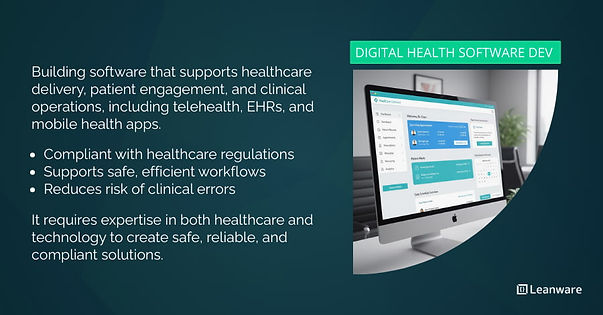
Digital health software development means building applications that support healthcare delivery, patient engagement, diagnostics, data management, and clinical operations. This includes telehealth platforms, EHR systems, mobile health apps, remote monitoring tools, and clinical decision support systems.
What separates digital health development from general software work is the regulatory environment and clinical context. You cannot treat healthcare software like a standard SaaS product.
Every design decision affects patient safety, privacy compliance, and clinical workflows. A bug in a banking app causes inconvenience. A bug in medication dosing software can harm patients.
Benefits for Healthcare Organizations
Healthcare organizations gain several concrete advantages from well-built digital health software:
- Operational efficiency: Automated scheduling, billing, and documentation reduce administrative burden. Staff spend less time on paperwork and more time on patient care.
- Reduced errors: Structured data entry, clinical decision support, and automated checks catch problems before they reach patients.
- Better patient engagement: Patient portals, mobile apps, and telehealth options make it easier for patients to participate in their care.
- Cost reduction: Remote monitoring and telehealth reduce unnecessary in-person visits. Automated workflows cut administrative costs.
- Data-driven decisions: Analytics tools surface patterns in patient populations, enabling proactive interventions.
Key Features of Digital Health Software
These core features define effective digital health software, ensuring it’s secure, user-friendly, interoperable, and scalable.
Feature | Focus | Notes |
Interoperability | Connect systems | EHR, lab, pharmacy, payer, devices; FHIR APIs |
Security & Compliance | Protect data | HIPAA/GDPR, encryption, access control, audit logs |
User Experience | Simple for all | Clinicians: minimal clicks; Patients: mobile-friendly; ADA compliant |
Scalability | Support growth | Cloud-native, multi-tenant, microservices, HIPAA-ready |
Interoperability and Integrations
Healthcare data lives in many systems: EHRs, lab systems, pharmacy systems, payer databases, and medical devices. Useful digital health software connects these sources rather than creating another data silo.
HL7 FHIR has become the standard for healthcare data exchange. FHIR provides a modern, RESTful API approach that makes integration more practical than older standards. Major EHR vendors like Epic and Cerner support FHIR APIs, enabling third-party applications to read and write clinical data with proper authorization.
Key integrations include: EHR/EMR systems for clinical data, pharmacy systems for e-prescribing, laboratory information systems for test results, payer systems for eligibility and claims, and medical devices for remote monitoring data.
Security & Compliance (HIPAA, GDPR)
Healthcare software must protect sensitive patient information. In the US, HIPAA compliance requires administrative, physical, and technical safeguards. Non-compliance can result in fines up to $2.1 million per year.
Technical requirements include:
- Encryption at rest and in transit (AES-256 for stored data, TLS for transmission)
- Role-based access control limiting data access to authorized users
- Audit trails logging all access to protected health information
- Multi-factor authentication for system access
- Business Associate Agreements with any third parties handling PHI
For organizations serving European patients, GDPR adds requirements around consent, data portability, and the right to erasure. Building compliance into the architecture from the start costs far less than retrofitting it later.
User-Centered Design & Experience
Healthcare software serves multiple user types: patients, physicians, nurses, administrators, and billing staff. Each group has different needs, technical comfort levels, and workflow constraints.
Physicians need minimal clicks and fast documentation. Patients need clear, accessible interfaces that work on mobile devices. Administrators need comprehensive dashboards without overwhelming complexity.
Accessibility matters particularly in healthcare. ADA compliance ensures people with disabilities can use your software. This includes screen reader compatibility, keyboard navigation, and appropriate color contrast.
Scalability and Robust Architecture
Healthcare software needs to grow with the organization. A system that works for one clinic should handle hundreds of locations without major rework. Cloud-native platforms like AWS and Azure provide HIPAA-compliant services, while microservices let different parts of the system scale independently as demand changes.
Digital Health Software Development Services
Digital health software development covers a wide range of solutions, from custom applications to patient-facing tools and administrative systems.
Service | Key Features |
Custom Software | Tailored workflows, unique integrations |
EHR/EMR | Modules, integrations, fill gaps |
Telehealth | Video visits, messaging, remote monitoring |
mHealth Apps | Patient tracking, mobile documentation |
Billing & Revenue | Claims, eligibility checks, automation |
Patient Management | Scheduling, reminders, portals |
Hospital & Practice | Staff, inventory, operations |
CRM | Patient relationship, care coordination |
Imaging | DICOM/PACS, 3D, AI analysis |
Compliance | Audit prep, regulatory tracking |
Custom Healthcare Software Development
Off-the-shelf solutions work for standard needs. Custom development makes sense when you have unique workflows, competitive differentiation requirements, or integration needs that standard products cannot address.
Custom development costs more upfront but provides exactly what you need without forcing workflow changes to fit software limitations.
Electronic Health Records (EHR/EMR)
EHR systems store and manage patient medical information. Building a full EHR replacement rarely makes sense given established players like Epic and Cerner. However, custom modules, integrations, and complementary applications often fill gaps in existing EHR functionality.
Telemedicine & Telehealth Platforms
Telehealth lets patients connect with providers without leaving home - through video visits, messaging, or connected devices. Teladoc reached a historic milestone of 50 million cumulative virtual visits in 2022, and by 2024 it was handling around 4.6 million visits per quarter. Its U.S. member reach grew from nearly 94 million in 2024 to over 102 million by mid-2025.
Most platforms cover video calls, appointment scheduling, patient intake, documentation, and payments. Some go further with AI symptom checkers, device integration, and care coordination tools to streamline care.
mHealth Apps for Patients and Providers
Mobile health applications serve both patients and clinical teams. Patient-facing apps support medication adherence, symptom tracking, health education, and communication with care teams. Provider apps enable mobile documentation, clinical reference, and care coordination.
Remote patient monitoring apps collect data from wearables and connected devices, enabling continuous health tracking between visits.
Medical Billing and Revenue Cycle Management
Revenue cycle management software handles patient registration, insurance verification, charge capture, claims submission, payment posting, and denial management. Automation reduces errors and accelerates cash flow.
Integration with clearinghouses and payer APIs enables real-time eligibility checks and electronic claims submission.
Patient Management Software
Patient management systems coordinate scheduling, communication, and care coordination. Features include appointment booking, automated reminders, patient portals, and secure messaging.
Hospital & Practice Management Systems
Administrative systems handle operations beyond clinical care: staff scheduling, inventory management, facility operations, and financial reporting.
Healthcare CRM & Customer Experience
Healthcare CRM systems track patient relationships, manage outreach campaigns, and coordinate care across touchpoints. These systems help organizations deliver more personalized care and improve patient retention.
Medical Imaging Software
Imaging software handles DICOM image storage, PACS integration, 3D rendering, and AI-assisted analysis. These applications require high-performance computing and specialized expertise in medical imaging standards.
Regulatory Compliance Solutions
Compliance software helps organizations track regulatory requirements, manage documentation, and prepare for audits. These systems monitor changes in regulations and alert organizations to required actions.
Technology Approach & Expertise
Building healthcare software relies on strategy, user-focused design, and solid technical foundations. Early planning, secure integrations, and compliance-focused development ensure it meets clinical and regulatory needs.
Strategy Advisory & Technology Roadmapping
Before writing code, you need a clear product roadmap aligned with business goals. This includes defining MVP scope, prioritizing features, planning integrations, and establishing success metrics.
Human-Centered Product Design
UX research with actual clinicians and patients prevents building software that looks good but fails in practice.
User personas, journey mapping, and usability testing should inform design decisions throughout development.
Healthcare Integrations & APIs
Integration planning must happen early. Identify which systems you need to connect, what data flows are required, and what API access is available. EHR integration alone can add months to a project timeline.
Custom Software Development Methodologies
Agile methodologies work well for healthcare software when adapted to compliance requirements. Sprint planning should include compliance review. CI/CD pipelines should include security scanning and compliance checks.
Security, Privacy & Data Protection
Security architecture must address threat modeling, penetration testing, vulnerability management, and incident response. Data protection requires encryption, access controls, and audit capabilities meeting HIPAA requirements.
Digital Health Innovation & Research Insights
Healthcare software is moving toward cloud-based SaaS, backed by investment in AI, remote monitoring, and workflow automation. Providers are adopting integrated digital strategies that combine analytics, interoperability, and patient-centered design to improve care and efficiency.
Healthcare SaaS: Market Overview
Software-as-a-Service now drives most healthcare software. Subscription pricing makes powerful tools accessible even to smaller organizations. B2B SaaS focuses on health systems and providers, while B2C apps help patients manage wellness, chronic conditions, and mental health.
MedTech Investment Trends
Venture capital continues flowing into digital health. Key investment areas include AI-powered diagnostics, remote patient monitoring, mental health platforms, and clinical workflow automation. Investors favor solutions addressing clear pain points with measurable ROI.
Digital Transformation in Healthcare
Healthcare organizations are moving beyond isolated digital tools toward comprehensive digital strategies. Cloud migration, data analytics, and AI integration are becoming standard components of healthcare IT modernization efforts.
Development Process for Healthcare Software
Developing healthcare software follows a structured process from understanding user needs and compliance requirements to designing, building, testing, and maintaining the system. Each phase ensures the product is secure, usable, and aligned with clinical workflows.
- Discovery & Requirements Gathering:Interview stakeholders, review workflows, and map compliance needs. Define integration scope and priorities. This phase usually takes 2–6 weeks.
- Planning & Architecture Design:Design system architecture with scalability, security, and compliance in mind. Outline APIs, data models, and integration patterns, and plan development milestones.
- UI/UX and Prototyping:Create interfaces for each user type and build clickable prototypes. Test with users and iterate before development begins.
- Development & Integration: Develop the software using secure coding practices. Integrate with EHRs and other systems. MVPs typically take 3-6 months; full-featured platforms can take 9–15 months.
- Testing & Quality Assurance:Run functional, security, and compliance tests. Conduct user acceptance testing to confirm the software meets clinical needs.
- Deployment & Launch:Set up production, configure monitoring, train users, and provide go-live support for a smooth rollout.
- Support & Post-Launch Optimization:Maintain the system with bug fixes, security patches, and feature updates. Monitor performance and use feedback to improve continuously.
Why Choose a Specialized Digital Health Development Team?
A team with healthcare experience knows the workflow, compliance rules, and integration challenges. They build software that’s secure, meets regulations, and actually works in real clinical settings.
Healthcare Domain Expertise
Teams with hands-on healthcare experience understand how clinical workflows really operate, along with the regulatory and integration challenges that come with them.
They’ve solved similar problems before, so they can anticipate potential issues that general-purpose developers might miss, helping avoid costly mistakes later.
Compliance and Security Excellence
Healthcare software has to meet strict regulations, and teams focused on this sector build compliance into every stage.
They understand HIPAA requirements, implement strong safeguards, and navigate complex rules without slowing down development. This approach reduces risk while keeping your system ready for audits and inspections.
Agile Delivery & Custom Solutions
Experienced teams adapt their process to the unique needs of each client while maintaining compliance. They balance speed and flexibility with the thoroughness required in healthcare, ensuring that features are practical, usable, and meet clinical standards.
Dedicated Support and Maintenance
Launching software is just the beginning. Healthcare systems require ongoing support, including security patches, updates for regulatory changes, and adjustments as workflows evolve. A dedicated team ensures the software stays reliable, secure, and aligned with the needs of users over time.
Getting Started
Building healthcare software isn’t like building a regular app. Whether you’re developing a new platform or improving an existing one, working with teams familiar with clinical workflows, EHR integrations, and regulatory requirements helps ensure the software works smoothly in actual care settings and avoids costly mistakes.
You can reach out to our software experts to discuss your project, explore technology options, and ensure your clinical documentation tools are built for real-world use.
Frequently Asked Questions
What is digital health software?
Digital health software covers applications that support patient care, clinical workflows, diagnostics, and healthcare operations. This includes EHRs, telehealth platforms, mobile apps for patients and clinicians, clinical decision support tools, and analytics systems that help improve outcomes and efficiency.
How is digital health software different from an EHR?
An EHR is primarily a digital record of patient medical history. Digital health software is broader - it includes EHRs but also telehealth tools, patient engagement apps, billing and revenue cycle systems, imaging software, and analytics platforms. It’s designed to support multiple aspects of care, not just record-keeping.
Is telehealth considered digital health software?
Yes. Telehealth platforms are a key part of digital health software. They enable remote consultations, real-time monitoring, messaging between patients and providers, and even integration with diagnostic devices, extending care beyond the clinic or hospital.
What technologies are commonly used in digital health apps?
Common technologies include cloud platforms like AWS and Azure, FHIR APIs for interoperability with EHRs, AI/ML models for analytics and decision support, mobile frameworks such as React Native and Flutter, and strong encryption methods to protect patient data.
How do you ensure HIPAA-compliant software?
HIPAA compliance requires a combination of technical and administrative safeguards. This includes encrypting data at rest and in transit, implementing role-based access controls, maintaining detailed audit logs, using secure authentication, establishing Business Associate Agreements with third parties, and conducting regular security assessments.
What does development cost for startups vs. enterprises?
For startups, developing a minimum viable product (MVP) usually costs between $50,000 and $150,000. Enterprise solutions that involve complex integrations, full regulatory compliance, and large-scale deployment often exceed $500,000 and can go over $1 million depending on scope and customization.
How long does it take to develop a HIPAA-compliant telehealth platform?
A basic MVP can typically be completed in 4–6 months. Platforms with full features—including EHR integration, advanced telemonitoring, and analytics—can take 9–15 months, depending on complexity, compliance requirements, and integration needs.
What does development cost for startups vs. enterprises?
For startups, developing a minimum viable product (MVP) usually costs between $50,000 and $150,000. Enterprise solutions that involve complex integrations, full regulatory compliance, and large-scale deployment often exceed $500,000 and can go over $1 million depending on scope and customization.
How long does it take to develop a HIPAA-compliant telehealth platform?
A basic MVP can typically be completed in 4–6 months. Platforms with full features—including EHR integration, advanced telemonitoring, and analytics—can take 9–15 months, depending on complexity, compliance requirements, and integration needs.
What happens if my software fails a HIPAA audit?
Failing a HIPAA audit requires remediation, may result in fines, and usually triggers re-audits. Penalties range from $137 to $68,928 per violation, with potential annual maximums exceeding $2 million. Immediate corrective action is essential to maintain trust and avoid long-term regulatory consequences.
How do I migrate from Epic or Cerner to a custom solution?
Migration involves extracting data, mapping it to the new system, building custom integrations, thorough testing, and regulatory review. A phased approach is recommended, often working with experts who understand EHR structures to avoid data loss and workflow disruptions.
What is the minimum team needed to build healthcare software?
A lean but functional team includes a product manager, full-stack developer, UX/UI designer, QA engineer, and a security/compliance specialist. Larger projects may also require backend specialists, DevOps engineers, integration experts, and clinical advisors.
How does digital health software integrate with insurance claim APIs?
Integration uses standards such as X12 and HL7 to connect with payer systems. This enables real-time eligibility checks, claim submissions, status tracking, and retrieval of Explanation of Benefits (EOBs), reducing errors and improving revenue cycle efficiency.
Can I build healthcare software without HIPAA certification?
HIPAA does not issue company certifications. However, your software and internal processes must meet HIPAA standards. Many organizations conduct third-party audits or certifications to demonstrate compliance and build trust with healthcare clients.