Rehabilitation Software Development

Rehabilitation has changed over the last decade, moving from clinic-centered, appointment-based care to a more continuous model that combines in-person sessions with remote monitoring and structured home exercises, with software playing a central role in supporting this shift.
Patients no longer depend only on scheduled clinic visits to move forward in their recovery, and therapists now rely on objective data to guide their clinical decisions.
Let’s look at what rehabilitation software development involves, the systems in use today, the technologies behind them, and the challenges developers face.
What Is Rehabilitation Software Development?
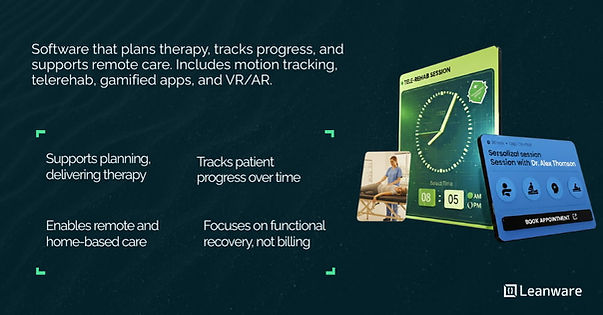
Rehabilitation software development is the process of designing, building, and maintaining digital systems that support clinical workflows. These systems help therapists plan and deliver treatment, track patient progress, provide remote care, and make data-driven clinical decisions.
It covers therapy management platforms, motion tracking systems, telerehabilitation tools, gamified therapy applications, and VR/AR-based therapy environments, but does not include general-purpose EHRs, fitness apps, or wellness platforms.
Rehabilitation follows its own clinical logic: Success isn’t measured by diagnosis or billing; it’s measured by functional recovery over weeks or months, with consistent adjustments along the way.
How It Differs From General Healthcare Software
The primary difference in is the nature of the data and the user's journey. While a standard EHR manages static patient records (diagnoses, medications, lab results), rehabilitation software manages dynamic performance data.
Feature | General Healthcare Software | Rehabilitation Software |
Primary Goal | Documentation and Diagnosis | Functional Recovery and Biofeedback |
Data Type | Text-based, Lab values, Images | Time-series motion data, ROM, Adherence |
User Interaction | Periodic (Doctor visits) | Frequent/Daily (Home exercise programs) |
Success Metrics | Curing an illness | Restoring a specific level of function |
Why Rehabilitation Software Matters in Modern Healthcare
Rehabilitation software has changed how care is delivered, connecting what happens in the clinic with what patients do at home. It helps patients continue structured exercises even when schedules or travel make regular visits difficult.
These platforms adjust exercises based on patient performance and use gamification or VR to make repetitive tasks more engaging.
They also reduce administrative work and use data from sensors and wearables to track progress more accurately. Tools like exoskeletons, robotics, and digital therapeutics add further support for mobility and cognitive rehabilitation.
Core Types of Rehabilitation Software
Rehabilitation software is not a single category. It includes specialized systems, each addressing a different part of the care journey.
Therapy Management Software
This is the operational core of any rehabilitation clinic. It handles treatment planning, scheduling, clinical documentation, and outcome reporting. Without it, therapists spend significant time on administrative tasks instead of patient care.
Good therapy management software lets clinicians design individualized treatment plans with specific exercises, session frequency, and progression criteria. Progress tracking captures standardized outcome measures and functional assessments over time, giving therapists the data to know whether a protocol adjustment is needed and how to document outcomes for clinical or insurance purposes.
Exercise and Motion Tracking Software
Motion tracking software analyzes how patients move during exercises and compares their movement to a target pattern.
Camera-based systems use computer vision to track body landmarks in real time, measuring joint angles and movement quality. A patient doing shoulder rehabilitation in front of their laptop camera gets immediate feedback on whether they are moving through the correct arc, without any additional hardware.
Wearable systems use inertial measurement units (IMUs) attached to the body. They tend to be more accurate than camera-based systems in clinical settings but require patients to wear and charge hardware, which can reduce adherence. The right choice depends on the clinical use case and what level of measurement accuracy the therapy requires.
Telerehabilitation Platforms
Telerehabilitation platforms connect patients and therapists remotely, enabling therapy delivery outside clinic walls.
Live video sessions let therapists guide patients through exercises, observe movement quality, and adjust treatment plans in real time. Many platforms also support asynchronous care models where patients complete sessions independently and upload data for therapist review. This model scales well and is particularly useful for maintaining progress between live sessions.
Rehabilitation Games and Gamified Therapy
The clinical problem gamification solves is adherence. Home exercise program compliance is consistently low across rehabilitation populations. Gamified therapy creates structured, goal-oriented activities that give patients feedback and a sense of achievement, which supports consistent participation.
For physical rehabilitation, serious games use real patient movement as input, meaning the patient has to perform the target exercise to progress. For cognitive rehabilitation, structured digital exercises target memory, attention, processing speed, and executive function, delivering the repetition central to neuroplasticity-based recovery in a scalable, trackable format.
VR and AR-Based Rehabilitation Solutions
The immersive experience boosts engagement, while repeated practice supports neuroplastic recovery. The neurorehabilitation market is expected to grow at a compound annual growth rate of 13.9% from 2024 to 2030, reaching approximately USD 4.98 billion, driven by a rising incidence of neurological conditions.
Clinical Decision Support Software
Clinical decision support tools analyze patient data to surface patterns, flag anomalies, and provide evidence-based recommendations. They are not autonomous systems that replace clinical judgment.
AI-driven recommendation engines can suggest exercise progressions based on performance data. These tools are most useful when they operate transparently, showing the data behind their suggestions rather than just outputting a recommendation with no context.
Technologies Powering Rehabilitation Software
The engineering decisions behind rehabilitation software are driven by clinical requirements.
Technology | Primary Application |
Computer Vision | Real-time movement analysis without wearables |
Machine Learning | Personalized therapy adjustment, trend analysis |
Wearables / IoT | Continuous movement and physiological monitoring |
Cloud Infrastructure | Scalable data storage, remote monitoring |
EHR Integration | Care continuity, shared patient records |
Mobile / Web Apps | Patient-facing exercise delivery and tracking |
In rehabilitation software, AI is mostly used to recognize patterns and personalize exercises, like adjusting difficulty or flagging consistent underperformance based on past sessions.
Computer vision has its limits - things like lighting, camera angle, and patient positioning can affect accuracy. Systems meant for home use need to be tested in different conditions to stay reliable.
Cloud infrastructure lets patient data from home sync to a central backend, so therapists can check progress from anywhere. Integration with EHRs using HL7 FHIR standards helps keep records consistent and avoids creating extra administrative work.
Rehabilitation Software Use Cases by Medical Field
Rehabilitation software applies differently across medical specialties, but the common goal is the same: support consistent, measurable recovery while extending care beyond the clinic.
- Physical Therapy and Musculoskeletal Rehabilitation: Software supports post-injury and post-surgical recovery by enabling exercise prescription, range of motion tracking, and pain and function score monitoring over time. Motion tracking adds objective measurement to what has historically been a subjective process.
- Neurological Rehabilitation: Long treatment timelines and highly individualized protocols define this space. Software enables consistent data collection across many sessions, flags progress plateaus, and delivers structured repetitive exercises between clinic visits.
- Post-Surgical Rehabilitation: Digital rehab tools guide patients through prescribed protocols at home, improve adherence, and alert care teams if a patient is falling behind recovery benchmarks, supporting early intervention before complications develop.
- Sports Injury Rehabilitation: Return-to-play decisions require objective performance data. Software that tracks force production, movement symmetry, and strength over time gives sports medicine teams a stronger evidential basis for these decisions.
- Cognitive and Speech Therapy: Structured repetitive practice maps naturally to digital delivery. Patients complete speech exercises or cognitive training programs independently, while therapists receive performance data to adjust programs efficiently.
Benefits of Custom Rehabilitation Software Development
While off-the-shelf solutions exist, custom development allows you to customize the software to its specific clinical protocols and patient demographics.
For patients, well-designed software maintains engagement through structured feedback, progress visualization, and guided exercise delivery. For patients in remote areas or with transportation barriers, it is often the difference between receiving rehabilitation and not receiving it at all.
For therapists and clinics, objective progress data reduces guesswork in treatment decisions. Automation of scheduling, documentation, and outcome reporting frees up clinical time that previously went to administrative work.
For healthcare organizations, software enables scalable care delivery. A clinical team can support a significantly larger patient panel without proportional staffing increases. The business case is straightforward given where the market is heading.
Challenges in Rehabilitation Software Development
Developing rehabilitation software involves managing issues like compliance, tracking accuracy, patient usability, and integration with existing systems.
- Data Privacy and Healthcare Compliance: HIPAA in the US and GDPR in Europe are mandatory requirements, not optional features. This affects storage architecture, access controls, audit logging, encryption, and third-party data sharing. Building compliance in after the fact is expensive and error-prone. Design for it from the start.
- Accuracy and Reliability of Motion Tracking: Camera-based and wearable systems both have accuracy limitations in real-world conditions. Clinical validation is not optional. Before a motion tracking system informs clinical decisions, its accuracy needs measurement against a reference standard, and its limitations need clear communication to clinicians.
- Patient Adherence and Usability: Patients may be recovering from serious injury or illness, have limited mobility or cognitive impairment, and may not be comfortable with technology. Poor UX directly translates to lower adherence and worse clinical outcomes. This is a clinical success factor, not just a design preference.
- Integration With Legacy Systems: Many clinics and hospitals operate on legacy EHR systems with limited integration support. This requires working with older data standards and often building custom integration layers, which is one of the most common sources of implementation delays in enterprise healthcare software projects.
Best Practices for Developing Rehabilitation Software
To build a successful product, follow these core principles:
User-Centered Design: Rehabilitation software serves two distinct user groups. Therapists need efficient clinical workflows and clear data visualization. Patients need simple, guided interfaces that work under physical and cognitive stress. Both groups need to be in the design process early, with iterative usability testing in realistic conditions.
Clinical Validation: Exercise protocols, assessment tools, and clinical logic built into the software should be grounded in clinical evidence. Partnering with clinicians during development and validating features against established standards builds the credibility healthcare buyers require.
Security and Compliance by Design: Treat these as architectural constraints. Encryption at rest and in transit, role-based access control, audit logs, and consent management built into patient-facing flows from day one.
Scalability and Maintainability: Plan for the data volumes that come with a growing patient panel, the API integrations enterprise clients require, and the regulatory changes that will affect compliance requirements over time. Decisions made in early development have long consequences in healthcare software.
Custom vs Off-the-Shelf Rehabilitation Software
Off-the-shelf platforms work well when your workflows fit the system and integration requirements are standard. Custom development is preferable when your clinical model doesn’t align with existing platforms, when you need specific integrations with proprietary systems, or when you are creating a rehabilitation product for the market.
Aspect | Off-the-Shelf | Custom Development |
Initial Cost | Lower | Higher |
Speed to Market | Fast | Slower |
Flexibility | Limited to vendor features | Unlimited |
Ownership | Subscription-based | You own the IP |
Integration | May be difficult | Built for your specific stack |
Future Trends in Rehabilitation Software Development
Rehabilitation software is gradually evolving to support more personalized, remote, and data-informed care, building on existing clinical workflows rather than replacing them.
AI-Driven Adaptive Rehabilitation: Systems that adjust exercise difficulty and sequencing based on ongoing performance data can help reduce manual adjustments while keeping therapists in control.
Home-Based Rehabilitation at Scale: Remote care is becoming a standard part of rehabilitation. Investment in monitoring infrastructure and patient-facing apps will continue as evidence grows for safe and effective home-based programs.
VR and AR in Clinical Practice: The virtual rehabilitation market, valued at USD 630.3 million in 2024, is projected to grow at a CAGR of 34.4%, reaching around USD 2.3 billion by 2030. As costs decrease and evidence accumulates, VR and AR are likely to be used more frequently in neurological and musculoskeletal rehabilitation.
Predictive Analytics: Improved data collection allows recovery trends to be monitored more closely. Tools that highlight patients at risk of slower progress give clinical teams earlier opportunities to adjust care.
How to Choose a Rehabilitation Software Development Partner
If you are looking for a partner to build these tools, look for:
- Healthcare Expertise: Do they understand HIPAA/GDPR? Have they worked with HL7/FHIR?
- Technical Depth: Can they handle the complexities of AI and computer vision?
- Process Transparency: Do they have a clear method for clinical validation and user testing?
Moving Forward
Software is not going to replace physical therapists. Instead, it acts as a force multiplier. It provides the objective data, the remote reach, and the engaging interfaces necessary to make rehabilitation more accessible and effective.
For developers and healthcare leaders, the goal is to build tools that feel like a natural extension of the therapeutic process - unobtrusive, helpful, and focused entirely on the patient's return to health.
Connect with our engineering team today for a technical consultation to explore your custom rehabilitation solution.
Frequently Asked Questions
What is rehabilitation software development?
It’s the process of creating digital systems that support physical, cognitive, and neurological rehabilitation. These tools help therapists plan treatments, track patient progress, and deliver personalized programs both in clinics and remotely.
How is rehabilitation software different from general healthcare software?
Unlike general healthcare systems, rehabilitation software focuses on therapy workflows, movement tracking, patient engagement, and functional recovery. It’s less about diagnosis, billing, or general administrative tasks.
Who uses rehabilitation software?
Therapists across physical, occupational, and speech therapy, as well as neurologists and rehabilitation clinics, rely on these tools. Hospitals and healthcare administrators also use them to monitor outcomes and manage care delivery at scale. Patients engage directly when completing exercises or tracking progress at home.
What problems does rehabilitation software solve?
It helps standardize treatment, track progress objectively, and support remote care. By automating administrative tasks, it reduces clinician workload and makes it easier to manage larger patient panels without increasing staff proportionally.
What types of rehabilitation software exist?
Common systems include therapy management platforms, motion tracking and exercise analysis tools, telerehabilitation platforms, gamified therapy applications, VR/AR therapy environments, and clinical decision support software.
How does motion tracking rehabilitation software work?
Camera-based systems use computer vision to track body landmarks and measure joint angles in real time. Wearables rely on inertial sensors attached to the body. Both compare patient movements against target patterns to assess accuracy and monitor progress over time.
Is rehabilitation software used for remote or home-based therapy?
Yes. Many platforms enable telerehabilitation, letting patients complete guided exercises at home while therapists track progress and adjust treatment plans as needed.
What technologies are commonly used in rehabilitation software?
Key technologies include AI, machine learning, computer vision, wearable sensors, mobile and web apps, cloud infrastructure, and EHR integration using HL7 FHIR standards.
Can rehabilitation software replace in-person therapy?
No. These tools complement clinical care by improving monitoring, personalization, and continuity between visits. Hands-on assessment and clinical judgment remain essential.
Is rehabilitation software compliant with healthcare regulations?
Well-designed systems follow HIPAA and GDPR requirements, including secure storage, encrypted communication, role-based access controls, audit logging, and careful handling of patient health information, all built in from the start.