Software Development Retainer Services: How They Work
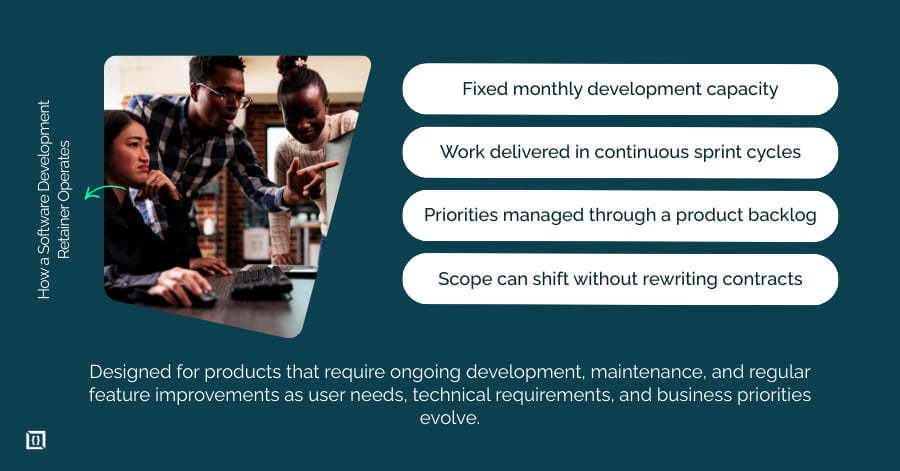
Software development retainer services are a monthly engagement model where a company pays a fixed fee for ongoing access to a development team. Instead of commissioning a single project with a defined end date, you retain a team that continuously works on your product across feature development, maintenance, bug fixes, infrastructure, and performance improvements.
The model exists because most digital products continue evolving after launch. SaaS platforms, marketplaces, and enterprise tools all require ongoing iteration. The retainer structure gives that work a stable, predictable operational container.
Let’s break down how software development retainers work, what they include, and when companies typically use them.
What Is a Software Development Retainer?
A software development retainer is a recurring agreement where a company pays a fixed monthly fee to reserve development capacity for its product. The team works in sprint cycles and pulls prioritized items from the backlog as work progresses, usually without requiring a new statement of work each time priorities change.
This differs from project-based work. In a fixed-scope project, deliverables, timeline, and cost are defined upfront, and changes typically require scope adjustments. In a retainer model, priorities can shift while the team continues working against the backlog.
This structure works well for products where requirements evolve based on user feedback, operational needs, or business goals.
How Software Development Retainer Services Work
In a retainer model, a company secures a fixed development capacity each month, and the team works through a prioritized backlog to deliver features, fixes, and improvements in regular sprint cycles.
Instead of locking work into a fixed project scope, priorities can shift as the product evolves while the team continues operating within the agreed monthly capacity.
Monthly Fee Structure
You pay a fixed monthly fee in exchange for defined team capacity, usually expressed as full-time team members or a block of hours. Common structures include hours-based retainers, service retainers for ongoing work such as maintenance or SaaS updates, and fractional team retainers where you reserve a portion of a developer’s or PM’s time.
Most retainer contracts run three to twelve months. Shorter terms offer more flexibility but often cost slightly more per month. Longer commitments usually provide better pricing and more stable team allocation.
Dedicated vs Shared Teams
With a dedicated team, every person assigned to your account works exclusively on your product. With a shared or pooled model, engineers split their time across multiple client accounts.
Dedicated teams deliver deeper product familiarity and faster context switching between tasks. Shared teams cost less but introduce variability in availability and attention. For products with active development backlogs, a dedicated arrangement is almost always worth the difference in cost.
Scope Flexibility and Prioritization
In a retainer model, priorities are managed through the product backlog rather than contract amendments. Sprint planning usually happens weekly or bi-weekly, and tasks move up or down based on current business needs. If a critical bug appears or priorities shift, the team adjusts in the next sprint.
The team's capacity remains fixed. Additional work affects timelines rather than automatically increasing cost, which makes backlog discipline important.
Governance and Communication Cadence
A well-run retainer includes a clear communication structure. This often involves team standups, bi-weekly sprint reviews, monthly roadmap discussions, and regular reporting on progress and blockers.
Without this structure, teams lose alignment and stakeholders lose visibility into development progress.
Software Development Retainer vs Other Engagement Models
Different engagement models distribute responsibility, cost control, and flexibility in different ways. The right option usually depends on how stable the scope is, how much internal management capacity exists, and how long development will continue.
Engagement Model | Scope Flexibility | Cost Predictability | Management Responsibility |
Retainer | Moderate to high | Predictable monthly cost | Shared |
Fixed-Price Project | Low | High upfront certainty | Vendor-led |
Staff Augmentation | Moderate | Variable | Client-managed |
In-House Team | High | Salary-based | Internal |
Retainer vs Fixed-Price Projects
Fixed-price projects work when scope is clearly defined, stable, and time-bounded. You get cost certainty upfront. The problem is that software requirements rarely stay stable. When scope changes inside a fixed-price contract, you negotiate change orders, reestimate timelines, and lose momentum.
A retainer absorbs scope evolution naturally. You redirect the team without renegotiating the engagement. For any product in active development, this flexibility alone justifies the model.
Retainer vs Staff Augmentation
Staff augmentation adds individual engineers to an internal team. The client manages task assignment, code reviews, sprint planning, and delivery.
In a retainer model, the provider typically manages the engineering team and delivery process, while the client sets product direction and priorities.
Organizations with strong internal engineering leadership may prefer staff augmentation when they mainly need additional capacity.
Retainer vs In-House Hiring
Building an internal engineering team provides direct control and deeper integration with the product.
However, hiring requires recruitment time, salaries, benefits, and long-term commitments. Adjusting team size can also take time.
A retainer provides development capacity without the hiring process, though the team operates through a service relationship rather than direct employment.
When Should You Choose a Retainer Model?
A retainer model works best when software development is ongoing rather than tied to a single project. Companies typically use it when a product requires continuous updates, maintenance, and feature development over time.
SaaS and Product Companies
SaaS products ship continuously. Every quarter brings new features, optimizations, A/B tests, and integrations. There is no project end date.
A fixed-scope contract structurally cannot support this. A retainer can, because the team simply moves from one sprint to the next without the overhead of re-engagement.
Startups in Growth Mode
Early-stage startups often need to move faster than internal hiring allows. Recruiting, onboarding, and ramping a five-person engineering team takes months.
A retainer team can be operational within two to four weeks. For startups under investor pressure to ship, that speed matters.
Enterprises with Continuous Digital Needs
Enterprises running legacy modernization programs, digital transformation initiatives, or ongoing platform optimization have a similar problem to SaaS companies: the work never ends. A retainer gives these organizations a predictable engineering capacity they can budget annually and scale as priorities shift.
What Is Included in Software Development Retainer Services?
Retainer services cover the full range of product development work. The actual scope depends on your roadmap and what you prioritize each sprint.
Feature Development
The team executes new features based on your product roadmap. Sprint by sprint, they build, test, and ship functionality. Because they accumulate product context over time, feature estimates become more accurate and implementation becomes faster as the engagement progresses.
Maintenance and Bug Fixing
Maintaining a software product typically costs 15 to 20% of its original development cost annually. A retainer absorbs this maintenance work within the same team that builds new features, which keeps context intact. Bugs get fixed by engineers who know the codebase, not by someone onboarding to a foreign system.
DevOps and Infrastructure
Retainer teams often include DevOps capacity covering CI/CD pipeline management, cloud infrastructure optimization, deployment automation, and environment maintenance.
This keeps your infrastructure current and reduces operational risk without requiring a separate infrastructure engagement.
Performance Optimization
As products scale, performance work becomes critical: database query optimization, load testing, caching strategy, and infrastructure right-sizing. This is ongoing, not a one-time project. A retainer team handles it as part of the regular sprint cycle.
UX/UI Iterations
Small interface improvements, driven by user feedback or analytics data, consistently outperform large periodic redesigns in their impact on retention and conversion.
A retainer allows for continuous UX iteration at a pace that matches your user data, rather than waiting for a project budget to open up.
Benefits of Software Development Retainer Services
Retainer engagements offer operational advantages for teams that maintain an active product roadmap. Because the same team stays involved over time, organizations often gain more stability in budgeting, delivery processes, and product knowledge.
Benefit | What It Means |
Predictable Costs | A fixed monthly fee keeps engineering spending consistent and easier to plan |
Faster Delivery Cycles | The team stays familiar with the codebase, reducing onboarding and restart delays |
Deep Product Knowledge | Long-term involvement improves system understanding and decision-making |
Strategic Alignment | The team works within the product roadmap rather than isolated tasks |
Potential Risks and How to Avoid Them
Like any engagement model, retainers work best when managed with clear structure and expectations. Most issues arise from planning gaps rather than the model itself.
Risk | Mitigation |
Underutilized Hours | Maintain a prioritized backlog and track monthly capacity usage |
Poor Scope Management | Assign a single backlog owner and follow a clear prioritization process |
Misaligned Expectations | Define KPIs early and review progress regularly |
How Much Do Software Development Retainer Services Cost?
Retainer pricing varies based on team size, location, and technical complexity. Small retainers that cover limited development capacity or maintenance work often start around $5k-$10k per month. Larger retainers that include a multi-role team such as developers, QA engineers, and a product manager can range from $20k-$60k+ per month.
Team Configuration | Typical Monthly Range |
1-2 developers (fractional support) | $5k-$15k |
Small team (3 developers + QA) | $15k-$35k |
Full team (4-6 developers + QA + PM) | $30k-$70k |
Actual ranges vary depending on geographic location and the experience level of the engineers involved.
Factors That Influence Cost
The main cost drivers are team size, seniority mix, geographic location, and technical complexity. Complex integrations, evolving tech stacks, AI and API layers, and specialized security requirements all push costs higher because they require engineers with narrower, more expensive skill sets.
Stack complexity also affects how quickly engineers can ramp, which impacts the effective cost of onboarding time.
Nearshore vs Onshore Retainers
Geography is one of the main factors affecting retainer pricing. Onshore teams in the US and Western Europe generally have the highest rates, while nearshore teams in regions such as Latin America or Eastern Europe often offer lower rates with workable time zone overlap.
Team Location | Characteristics |
Onshore (US / Western Europe) | Higher rates, full time zone alignment |
Nearshore (LATAM / Eastern Europe) | Lower rates with partial or full overlap |
Offshore (Asia / other regions) | Lower costs, larger time zone gaps |
Many development providers operate within an hourly range of roughly $20-$50, particularly in Eastern Europe, Latin America, and Southeast Asia.
For US companies, nearshore LATAM teams are often practical because shared or similar time zones support easier collaboration during sprint planning and reviews.
How to Structure a Successful Software Development Retainer
Retainers work best when the engagement structure is defined upfront. Teams should agree early on how work is prioritized, how progress is reported, and how production issues are handled.
- Define clear KPIs: Agree on measurable metrics such as sprint velocity, cycle time, bug response time, and roadmap milestone completion.
- Set sprint and reporting cadence: Establish a regular rhythm, typically with team standups, bi-weekly sprint reviews, and monthly roadmap check-ins. Reports should highlight progress, blockers, and upcoming work.
- Align on the product roadmap: Ensure the team understands how backlog items connect to product goals. This context improves technical decisions during development.
- Establish SLAs: Define response expectations for production issues, high-priority bugs, and standard feature work, along with escalation paths if incidents occur.
Is a Software Development Retainer Right for Your Business?
Use this as a self-check:
- Your product requires ongoing development, not a one-time build
- You have a roadmap that evolves based on user feedback or business conditions
- You cannot build or staff a full internal engineering team at the pace you need
- You need cost predictability over a multi-month horizon
- You have a product owner or PM who can maintain a prioritized backlog
If most of these apply, the retainer model is likely a structural fit. If you have a clearly scoped, time-bounded build with stable requirements, a fixed-price project may be more efficient.
The model is specifically suited to continuous product development where flexibility and accumulated team knowledge compound into delivery velocity over time.
You can also connect with us to discuss your product roadmap and explore how a software development retainer could support ongoing development.
Frequently Asked Questions
What is a software development retainer service?
A software development retainer service is a monthly engagement model where a company pays a fixed fee for ongoing access to a development team. Instead of working on a single project with a defined end date, the team continuously supports feature development, maintenance, and product improvements.
How does a software development retainer work?
A retainer allocates a fixed number of development hours or a dedicated team each month. Work is prioritized through a backlog, delivered in sprints, and adjusted as business needs evolve, without renegotiating scope for every change.
What is included in software development retainer services?
Retainer services typically include feature development, bug fixes, maintenance, DevOps support, infrastructure management, performance optimization, and UX/UI improvements. The exact scope depends on the agreement and what the product roadmap prioritizes each sprint.
How much do software development retainer services cost?
Small retainers may start around $5k-$10k per month. Dedicated multi-role teams typically range from $20k-$60k+ per month, depending on team size, seniority, and geographic location.
Is a software development retainer better than a fixed-price project?
For evolving products that require continuous updates, yes. Fixed-price projects work well for clearly defined, one-time builds. Retainers provide flexibility and long-term alignment that fixed-scope contracts structurally cannot support.
What is the difference between a retainer and staff augmentation?
In staff augmentation, you hire individual developers and manage them internally. In a retainer model, the provider manages the team and delivery process, operating as a delivery partner rather than a resource supplier.
Who should use software development retainer services?
SaaS companies, startups in growth mode, and enterprises with ongoing digital initiatives benefit most. Any business that needs continuous product development rather than a one-time build fits the model.
Can you cancel a software development retainer?
Most retainers operate on three to twelve month agreements with defined notice periods. Many providers allow cancellation with 30 to 60 days notice, depending on the contract terms.
Do you own the code in a retainer agreement?
In most professional retainer agreements, the client retains full ownership of all code and intellectual property. This should be explicitly stated in the contract before the engagement begins.
What are the risks of a software development retainer?
The main risks are underutilized capacity, unclear KPIs, and poor backlog management. All three are mitigable with structured sprint planning, defined reporting cadence, and measurable performance metrics.