What Is a Fractional CTO? Role, Services & When to Hire One

A Chief Technology Officer plays an important role in how a company builds, scales, and protects its technology. Traditionally, this role exists as a full-time executive responsible for aligning technical decisions with business strategy and overseeing engineering teams. However, many startups and growing companies do not need, or cannot justify, a permanent CTO in their early stages.
This gap led to the rise of the fractional CTO. A fractional CTO provides senior technical leadership on a part-time or contract basis, offering strategic direction and oversight with flexible engagement and lower financial commitment. Instead of committing to a full-time executive hire, companies access experienced leadership for a defined scope and cost.
Let’s break down what a fractional CTO does, how the role compares to traditional alternatives, how much it costs, and when it is the right fit.
What is a CTO?
A Chief Technology Officer is the executive responsible for a company's technology strategy.
A CTO does not just manage software development. Their core job is to connect what the technology can do with what the business needs to achieve. That means setting technical direction, making architectural decisions, evaluating build vs. buy considerations, managing engineering leadership, overseeing security and infrastructure, and acting as the technical voice in executive conversations.
At a startup, the CTO often carries dual responsibilities: setting strategy and staying close to the code. At a larger company, the role shifts toward organizational leadership, vendor relationships, technology investment, and alignment with product and finance.
On average, total CTO compensation in the United States reaches around $280K per year when including bonuses, and at senior levels in larger companies, total packages can exceed $400K, depending on company size, industry, and performance.
What Is a Fractional CTO?
A fractional CTO is a senior technology executive who works with a company on a part-time or contract basis rather than as a full-time employee.
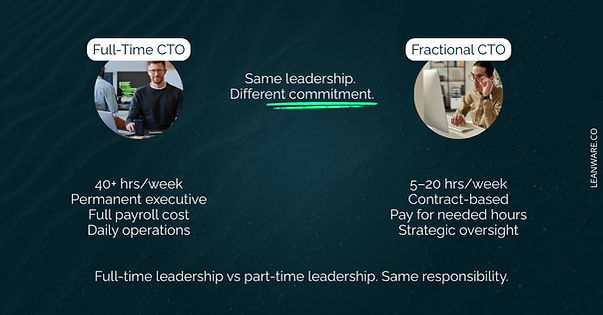
The word "fractional" refers to the time commitment: instead of owning the full role, they provide a fraction of it, typically between 5 and 20 hours per week depending on the engagement.
The scope of the work does not change. A fractional CTO performs the same strategic functions as a full-time one: technology roadmap, architecture oversight, team leadership, and executive alignment. The difference is that the company pays for the hours they actually need, rather than carrying the cost of a permanent executive hire.
Fractional CTO vs Full-Time CTO
The main difference lies in how much time the CTO commits, how the company pays for that leadership, and how closely the role integrates into daily operations.
Factor | Full-Time CTO | Fractional CTO |
Time commitment | 40+ hours/week | 5-20 hours/week |
Annual cost (US) | $250K–$400K+ (salary alone) | $36K–$180K/year (retainer-based) |
Benefits, bonus, equity | Yes, adds 20-30% overhead | No employment overhead |
Strategic involvement | Daily, embedded in operations | Focused, scheduled engagements |
Flexibility | Fixed headcount | Scales up or down as needed |
Ideal for | Companies needing daily executive leadership | Companies needing strategic direction without full-time cost |
Fractional CTO vs Virtual CTO
The terms fractional CTO and virtual CTO often get used interchangeably, and in most cases they describe the same thing: a part-time, remote senior technology leader. The distinction, where it exists, is mainly in positioning. Some firms brand the service as "vCTO" to emphasize the remote-first delivery model. The underlying engagement structure is typically identical.
Fractional CTO vs Technical Advisor
There is usually no real difference between a fractional CTO and a virtual CTO. Both refer to a senior technology leader who works part-time and remotely.
The difference is mainly in naming. “Virtual CTO” highlights remote work, while “fractional CTO” highlights limited hours. The responsibilities, authority, and engagement structure are typically the same.
What Does a Fractional CTO Do? Core Responsibilities
The responsibilities vary based on company stage and what the engagement covers, but there are five areas where fractional CTOs consistently add the most value.
1. Technology Strategy and Roadmap Planning
A fractional CTO takes what the company is trying to accomplish commercially and builds a technology roadmap around it. That means identifying which systems need to be built, which need to be improved, what the build sequence should be, and where infrastructure needs to be in 12 to 24 months.
They also make sure that engineering work is tied to actual business priorities, not just a backlog of technical tasks.
2. Architecture and Infrastructure Oversight
Stack decisions made early have long-term consequences. A fractional CTO evaluates current architecture, identifies structural problems before they compound, and guides decisions around cloud infrastructure, data management, scalability, and service design.
For companies that have been building fast without much architectural oversight, this is often where the most immediate value shows up.
3. Engineering Team Leadership and Mentorship
A fractional CTO can run hiring processes, set engineering standards, introduce development practices like code review and deployment processes, and mentor senior engineers.
They also help structure the team for the next growth phase, which matters a lot for companies that have outgrown their original team setup.
4. AI, Security, and Scalability Decisions
Almost every company has to make real decisions about AI adoption, data handling, and cybersecurity posture. A fractional CTO brings practical experience in evaluating these areas: which AI tools are worth integrating, what the security baseline should look like, how the architecture needs to change to handle 10x the current load.
5. Technical Due Diligence for Investors
If a company is raising capital, investors will scrutinize the technology. A fractional CTO can prepare the technical story, identify and address weaknesses before the diligence process begins, and give investors confidence that the architecture is sound and the engineering team is capable. For seed and Series A companies, this kind of preparation has a direct impact on deal outcomes.
When Does a Company Need a Fractional CTO?
Not every company needs a fractional CTO, but there are situations where the need is real and the absence of one is costing something.
Early-Stage Startups Without a Technical Founder
A non-technical founder relies entirely on the development team or agency for technical decisions.
That creates risk: wrong stack choices, poor architecture, misaligned vendor selection. A fractional CTO gives that founder a technical partner who can evaluate options, set direction, and prevent the costly mistakes that happen when no one is asking the right questions early.
Growing Companies Preparing to Scale
Post-MVP, companies often find that their infrastructure was not built for the load it now carries. Deployment becomes unpredictable, and the engineering team spends more time on fires than on features. A fractional CTO assesses what is causing the friction and builds a plan to address it before it becomes a production crisis.
Businesses Experiencing Technical Chaos
Some companies engage a fractional CTO when things are already messy: unclear code ownership, accumulated technical debt, no documentation, and inconsistent architectural decisions across the codebase.
A fractional CTO brings structure, prioritizes what to address first, and helps the team rebuild productive engineering habits.
Companies Preparing for Fundraising
Investors want to understand the architecture, the scalability plan, and how the team is structured. A fractional CTO can close the technical credibility gap, especially for founders who are strong commercially but less experienced presenting the technical side of their business.
Fractional CTO Services Explained
Fractional CTO engagements generally fall into one of three structures depending on what the company actually needs.
Model | Structure | Main Focus | Best Fit |
Strategic Advisory | Monthly retainer | Strategy, reviews, executive input | Teams needing senior oversight |
Project-Based | Fixed-term engagement | Audits, migrations, due diligence | Short-term technical initiatives |
Part-Time Leadership | Ongoing reduced hours | Hiring, reviews, planning | Companies needing steady leadership |
Strategic Advisory Packages
This model uses a monthly retainer that covers a set number of hours each week. The fractional CTO participates in executive discussions, helps shape technology direction, reviews major technical decisions, and provides ongoing input to leadership. It works well for companies with capable engineers that need stronger strategic guidance.
Project-Based CTO Engagement
This approach focuses on a specific initiative, such as an architecture audit, infrastructure migration, technical due diligence, or hiring support. Each engagement has a defined scope and timeline, with concentrated effort over a short period.
Ongoing Part-Time CTO Leadership
This is the closest model to a traditional CTO role, but with reduced hours. The fractional CTO remains involved in planning, hiring, technical reviews, and day-to-day leadership. It suits companies that need consistent technical direction but are not ready for a full-time executive.
How Much Does a Fractional CTO Cost?
Fractional CTO pricing depends on engagement scope, hours per week, industry experience, and geography. While rates vary, the ranges below are typical market patterns.
U.S. Market Pricing
In the United States, fractional CTO rates generally fall between $150 and $350 per hour. On a monthly retainer, engagements often range from $3K to $12K, depending on time commitment and responsibilities.
Leanware’s own fractional CTO services sit inside that range: a named tech lead at about $4,000 a month for one day a week or $10,000 a month for three days a week, depending on the project.
For comparison, full-time CTO base salaries in the U.S. commonly reach around $280K to $320K. After adding benefits, bonuses, payroll taxes, and potential equity, total employer cost can exceed $350K to $400K annually.
LATAM and Nearshore Pricing
Fractional CTOs based in Latin America typically charge lower rates than their U.S. counterparts. In many cases, companies see pricing that is 30 to 50 percent lower, based on regional cost structures.
Several countries in the region, including Mexico, Argentina, Colombia, and Brazil, have established technology sectors with experienced engineering leaders. Time zone overlap with North America also simplifies collaboration.
Cost vs Hiring a Full-Time CTO
A fractional CTO on an $8K to $10K monthly retainer costs approximately $96K to $120K per year.
For companies that do not require daily executive involvement, this structure reduces fixed payroll commitments while still providing senior technical oversight. The decision ultimately depends on how much consistent leadership the organization needs.
How to Hire a Fractional CTO
Hiring a fractional CTO follows a different structure than hiring a full-time executive, but the evaluation process should still be careful. Even in a part-time role, this person influences technical direction, hiring decisions, and system design. Taking time to assess fit helps reduce misalignment later.
What Skills to Look For
Look for someone who combines genuine technical depth with the ability to communicate clearly with non-technical stakeholders. They should have experience building and leading engineering teams, making architectural decisions at scale, and connecting technology work to business outcomes.
Candidates who can only operate in one mode, pure strategist with no technical grounding, or pure engineer with no leadership experience, typically underdeliver in this role.
Stage relevance also matters. A CTO who spent their career at large enterprises may not be the right fit for an early-stage startup navigating its first scaling challenges.
Questions to Ask Before Hiring
Ask questions that show how the candidate approaches the role:
- What companies have you worked with at our stage, and what did the engagement cover?
- How do you structure your involvement in the first 60 days?
- How do you handle disagreements with founders on technical direction?
- How do you measure whether the engagement is working?
- What happens if our needs change mid-engagement?
The answers reveal how they approach the role and whether they think in terms of outcomes or just deliverables.
Red Flags to Avoid
Be cautious of candidates who set unrealistic timelines, cannot explain past decisions clearly, or show limited interest in the business context. A fractional CTO should connect technical choices to how the company operates.
Also consider their management background. Advising a team differs from leading one, and the role requires experience working directly with engineers.
Benefits of Hiring a Fractional CTO
A fractional CTO mainly improves how companies plan, evaluate, and execute technical decisions. By adding experienced leadership without full-time overhead, the role brings structure and consistency to areas that often become fragmented as teams grow.
Benefit | What It Provides | Practical Impact |
Strategic Clarity Without Full-Time Cost | Clear view of systems and priorities | Reduces reactive work and misaligned engineering effort |
Faster Decision-Making | Defined technical ownership | Shortens approval cycles and limits repeated rework |
Reduced Technical Risk | Experienced oversight | Lowers the likelihood of costly redesigns and security gaps |
Is a Fractional CTO Right for Your Business?
A fractional CTO is a strong fit for companies that need strategic technology leadership but do not yet need someone in that role every day. That describes a meaningful portion of startups and growing companies. But it is not the right answer in every situation.
When You Might Need a Full-Time CTO Instead
If your company's core competitive advantage is technology, if you are building highly specialized systems that require daily executive oversight, or if the complexity of your engineering organization requires someone present and embedded five days a week, a full-time CTO is probably the right hire. The same applies if you are at a stage where the CTO needs to be a public-facing technical authority for enterprise customers or investors.
There is no universal formula here. The honest question is whether your current stage justifies a daily executive-level time commitment. If it does, hire full-time. If it does not, the fractional model gives you the same strategic input with significantly less overhead.
Final Thoughts
The fractional CTO model exists because the need for experienced technology leadership does not always match a company’s ability to hire a full-time executive. Many growing teams reach a point where technical direction matters, but a permanent CTO feels too early or too costly.
If you are considering this model, start by clearly defining what you need: a roadmap, an architectural review, fundraising support, team leadership, or something else. The more specific the problem, the easier it becomes to structure an engagement that delivers real value.
If you want experienced technical leadership without a full-time hire, connect with the team at Leanware to discuss how fractional CTO support can help guide your technology decisions.
Frequently Asked Questions
What is a fractional CTO?
A fractional CTO is a part-time Chief Technology Officer who provides strategic technology leadership without being hired full-time. Companies engage one on a retainer or contract basis to define technology strategy, oversee engineering, and guide architecture decisions at a lower cost than a permanent hire.
How is a fractional CTO different from a full-time CTO?
A full-time CTO works 40+ hours per week as a permanent executive. A fractional CTO works part-time, typically 5 to 20 hours per week. Both provide strategic technology leadership, but the fractional model offers flexibility and lower fixed costs for companies that do not need daily executive oversight.
What services does a fractional CTO provide?
Typical services include technology strategy, architecture planning, engineering team oversight, vendor evaluation, security planning, scalability assessments, and technical due diligence. The scope depends on company size, stage, and specific needs.
When should a company hire a fractional CTO?
When a company needs senior technical leadership but cannot justify a full-time executive. This applies to early-stage startups, growing SaaS businesses preparing to scale, and companies dealing with technical debt, unclear roadmaps, or upcoming fundraising.
How much does a fractional CTO cost?
In the US, monthly retainers typically range from $3,000 to $15,000 depending on scope and experience. LATAM and nearshore markets offer lower rates with senior-level expertise. Either way, the total annual cost sits well below the $400,000+ employer cost of a full-time CTO in the US.
Is a fractional CTO the same as CTO as a Service?
They describe similar models. The distinction is mainly in branding: "CTO as a Service" often implies a packaged offering, while "fractional CTO" emphasizes the executive working part-time inside the organization. The actual engagement structure is usually the same.
Can a fractional CTO manage developers?
Yes. They oversee technical decisions, review architecture, set development standards, mentor engineers, and ensure technology execution aligns with business goals. They may not write production code daily, but they actively lead the team.
How many hours does a fractional CTO work?
Typically 5 to 20 hours per week. Early-stage companies often start on the lower end for strategy-focused work, while scaling companies may require more involvement across hiring, architecture, and team oversight.
Is a fractional CTO suitable for startups?
Yes, particularly for startups without a technical founder. They help define the product roadmap, select the right stack, prevent architectural mistakes, and prepare the company for investor scrutiny without the cost of a full-time hire.
Can a fractional CTO help with AI strategy?
Yes. They can guide AI adoption, automation decisions, cloud infrastructure, cybersecurity planning, and data architecture, ensuring that emerging technologies get integrated based on actual business needs rather than hype.