AI Explainability & Traceability Systems: A Practical Guide
AI systems are making decisions that affect hiring, lending, healthcare, and countless other domains. Yet most organizations deploying these systems cannot fully explain how they arrive at specific outputs or trace the complete path from input to decision.
This creates regulatory exposure, debugging nightmares, and eroded stakeholder trust.
Let’s cover in this guide what AI explainability and traceability actually mean, why they matter for enterprise deployments, and how to architect systems that support both.
What Are AI Explainability & Traceability Systems?
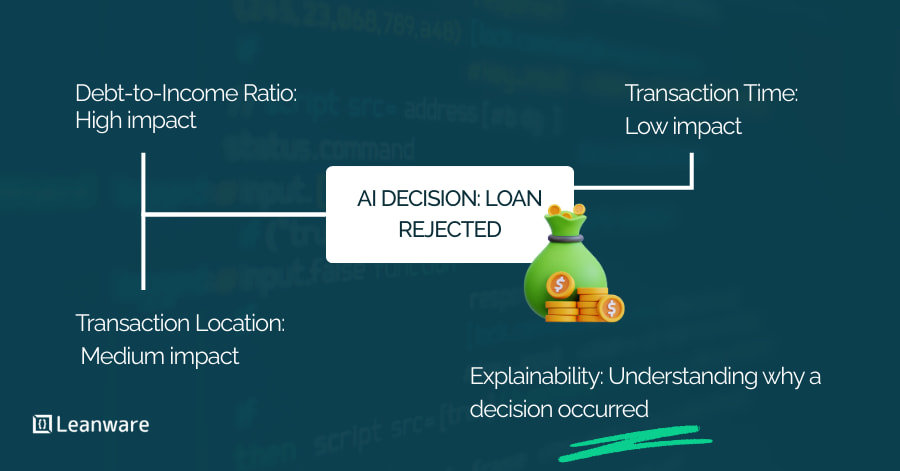
Explainability refers to the ability to understand why an AI system produced a specific output. When a credit model rejects a loan application, explainability answers: "What factors drove this rejection, and how did they contribute to the final decision?"
Consider a fraud detection model that flags a transaction. An explainable system can surface that the transaction was flagged because it occurred in a new geographic location, involved an unusually high amount, and happened outside normal business hours. Each factor has a quantifiable contribution to the final score.
The key distinction is that explainability operates at the decision level. It helps humans understand the reasoning behind individual predictions or outputs, making AI behavior interpretable to stakeholders who need to act on or validate those decisions.
Defining AI Traceability
Traceability takes a different angle. It focuses on reconstructing the complete lifecycle of a decision: what data went in, which model version processed it, what configurations were active, and when the inference occurred.
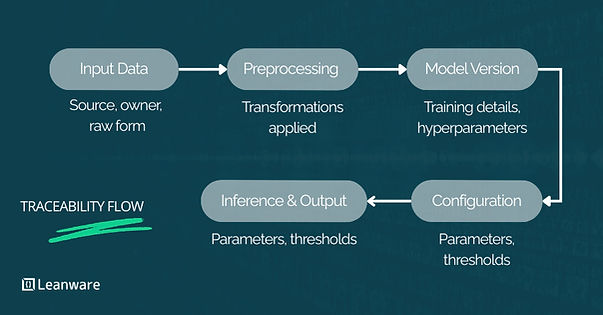
If that fraud detection model flags a transaction incorrectly, traceability lets you answer: "Was this the production model or a test variant? What was the input data? Were there preprocessing steps that transformed the original data? Who deployed this model version, and when?"
Traceability is fundamentally about auditability and reproducibility. You need it when something goes wrong and you have to reconstruct exactly what happened.
Why They Are Not the Same
These concepts complement each other but address different needs:
Aspect | Explainability | Traceability |
Core question | Why did the model decide this? | What happened during this decision? |
Focus | Model reasoning and feature contributions | Data flow, versions, execution context |
Primary users | Business stakeholders, regulators | Engineers, auditors, compliance teams |
Technical approach | Feature attribution (SHAP, LIME) | Logging, versioning, metadata management |
When needed | Justifying decisions to affected parties | Debugging, audits, incident investigation |
A system can be traceable without being explainable. You might have perfect logs of every inference but still cannot articulate why specific predictions occurred. Conversely, you could generate feature importance scores without knowing which model version produced them. Mature AI governance requires both.
Why Explainability and Traceability Matter
Explainability and traceability support different but related needs. Explainability helps clarify why a specific decision occurred, while traceability makes it possible to reconstruct how that decision was produced. Both become important once AI systems move from experimentation into routine operational use.
The Risks of Black-Box AI
When AI systems operate as black boxes, several problems emerge.
Legal and compliance exposure increases significantly. The EU AI Act, which entered into force in August 2024 and becomes fully applicable in August 2026, explicitly requires traceability and explainability for high-risk AI systems used in employment, credit, and healthcare. The regulation mandates that providers maintain detailed documentation, enable traceability, and ensure decisions can be explained to affected individuals.
Debugging becomes nearly impossible. When a model behaves unexpectedly in production, engineers need to understand what changed. Without traceability, you cannot determine whether issues stem from model drift, data quality problems, configuration errors, or something else entirely. You are reduced to guessing.
Trust erodes across stakeholders. End users who receive unexplained decisions lose confidence in the system. Internal teams cannot validate model behavior. Executives cannot answer basic questions about AI operations during board meetings or regulatory inquiries.
Trust and Accountability
Trust operates at multiple levels in AI systems.
End users need to understand why they received particular outcomes. A patient wants to know why an AI flagged their scan for review. A job applicant wants to understand why their resume was filtered out. Even if users cannot contest every decision, transparency reduces friction and builds acceptance.
Internal teams need confidence that models behave as intended. Data scientists need to verify that models use features appropriately. Product managers need to confirm that AI behavior aligns with business rules. Legal teams need assurance that decisions can be defended if challenged.
Leadership needs accountability mechanisms. When AI systems make mistakes, someone needs to own the investigation and remediation. This requires knowing who deployed what, when, and under what governance framework.
AI Explainability: Making Decisions Understandable
Explainability focuses on helping people understand how and why an AI system produces a particular outcome, without requiring them to inspect code or mathematical details.
Global vs Local Explainability
Global explainability describes how a model behaves overall. It answers questions like: "Which features does this model rely on most heavily across all predictions? What patterns has it learned?"
Local explainability focuses on individual predictions. It answers: "Why did this specific customer receive this specific risk score?"
Aspect | Global Explainability | Local Explainability |
Scope | Overall model behavior | Single prediction or decision |
Primary question | How does the model behave in general? | Why did this outcome occur? |
Typical audience | Data scientists, model reviewers | End users, compliance teams |
Common use | Validation, monitoring, bias detection | Decision review, justification, appeals |
Both have value. Global explanations help data scientists validate that models learned appropriate patterns and do not rely on problematic features. Local explanations help end users and compliance teams understand individual decisions.
Feature Importance and Attribution Methods
The most widely used explainability techniques quantify how much each input feature contributed to a prediction.
SHAP (SHapley Additive exPlanations) uses game theory concepts to distribute a prediction among input features. It provides both local explanations for individual predictions and global feature importance across the entire dataset. SHAP remains the dominant method for tabular data, particularly because it handles feature interactions better than alternatives.
LIME (Local Interpretable Model-agnostic Explanations) generates local approximations by fitting simple interpretable models around individual predictions. It works by perturbing the input and observing how predictions change, then fitting a linear model to explain local behavior. LIME is computationally simpler but provides only local, not global, explanations.
These methods are model-agnostic, meaning they can explain predictions from any model type. This matters because organizations often use complex ensemble methods or deep learning models that lack built-in interpretability.
Counterfactual Explanations
Counterfactual explanations answer: "What would need to change for the outcome to be different?"
For a rejected loan application, a counterfactual might indicate: "If your debt-to-income ratio were below 40% instead of 45%, and your employment tenure exceeded 2 years instead of 18 months, you would have been approved."
This framing is powerful for end users because it provides actionable guidance. It is also valuable for regulators who want to understand decision boundaries.
AI Traceability: Following the Decision Lifecycle
Traceability focuses on making it possible to reconstruct how an AI decision was produced, from initial inputs through execution and output.
Data Lineage and Input Tracking
Every AI decision starts with data. Traceability requires knowing what data was used for each inference, where that data originated, what transformations occurred between raw form and model input, and who owns the data under what governance framework.
This information becomes critical when data quality issues surface or regulations require deletion.
Model Versioning and Change History
Models change over time through retraining, parameter adjustments, and architecture modifications. Without version control, you cannot determine which model made a particular decision.
Version control should capture the model artifact itself, training data characteristics, hyperparameters, and evaluation metrics. It should also record who approved the model for deployment and when. When incidents occur, version history lets you compare current models against previous versions to identify what changed.
Prompt and Context Logging for LLMs
Large language model systems introduce additional traceability requirements. Prompts are first-class artifacts that must be logged. The same model produces different outputs depending on system prompts, user messages, and any examples provided. Without prompt logs, you cannot reproduce or explain LLM behavior.
For RAG (retrieval-augmented generation) systems, traceability requires logging not just the final prompt but also which documents were retrieved, from which sources, and how they were selected. Configuration parameters like temperature and token limits also affect outputs and should be recorded.
Inference Logs
At inference time, systems should capture the complete input as received by the model after preprocessing, raw model output before post-processing, any filtering or transformations applied, confidence scores, and latency metrics. These logs enable reconstruction of any decision after the fact.
Explainability vs Traceability vs Observability
Observability focuses on system health and operational metrics. It answers: "Is the system performing within acceptable parameters? Are latencies normal? Is the error rate elevated?"
Explainability focuses on decision reasoning. It answers: "Why did the model produce this output for this input?"
Traceability is the backbone enabling everything else. Without it, you cannot audit decisions, investigate incidents, or demonstrate compliance. You need traceability logs to feed explainability tools and contextualize observability metrics.
Architecture Considerations
A comprehensive system includes a data layer capturing inputs and lineage, a model layer tracking versions and artifacts, an orchestration layer managing pipelines and configurations, and an audit layer storing logs and supporting compliance reporting.
Traceability should be embedded in pipelines rather than bolted on afterward. Training pipelines should automatically log data snapshots, hyperparameters, and evaluation results. Inference pipelines should log inputs, outputs, and context at every stage.
Log retention must align with regulatory requirements. Query performance matters for investigations. Access control should follow least-privilege principles. Data privacy requirements apply to logs just as they do to primary data stores.
LLM-Specific Challenges
LLMs present distinct challenges compared to traditional ML models. They introduce non-determinism through temperature settings and sampling methods. Behavior depends heavily on prompts and context, which are often constructed dynamically. LLMs can hallucinate plausible-sounding but incorrect information.
Traceability helps diagnose whether hallucinations stem from missing context, retrieval failures, or model limitations. However, LLM explainability is inherently limited. You cannot compute SHAP values for a 100-billion parameter transformer the way you can for a gradient-boosted tree. Practical approaches focus on attribution: which parts of context influenced the response.
For high-stakes LLM applications, human review provides a governance safety net. Review workflows should be designed as part of the system, not as an afterthought.
Industry Applications
In finance, lenders must explain adverse credit decisions to applicants. This is regulatory requirement, not optional. Traceability supports audit requirements from financial regulators.
In healthcare, explainability helps clinicians understand AI recommendations and integrate them with clinical judgment. Traceability supports accountability if AI-assisted decisions contribute to patient harm.
In HR, explainability methods can reveal whether models rely on features correlated with protected characteristics. Traceability supports compliance with employment law mandating human review of automated decisions.
Challenges and Constraints
Inherently interpretable models like linear regression sacrifice predictive power for transparency. Complex models often perform better but resist interpretation. Post-hoc methods like SHAP provide approximations for complex models, but explanations can vary depending on method and feature correlations.
Comprehensive traceability generates substantial data. Explainability methods add computational overhead. Risk-based approaches focus resources where they matter most.
Feature importance scores do not reveal causal relationships. Post-hoc explanations approximate behavior rather than exposing internal logic. Traceability logs can be comprehensive without being useful if they cannot be queried effectively.
Best Practices
Start with governance and risk assessment. Clarify what decisions the system will make, who will be affected, and what regulations apply before selecting tools.
Design for explainability from day one. Retrofitting onto deployed systems is difficult. Consider explainability during model selection and build capabilities into production systems.
Standardize logging and versioning. Consistency pays dividends. Adopt structured logging standards and use model registries with consistent metadata schemas.
Align explanations to stakeholder needs. Data scientists need technical detail. End users need clear summaries. Regulators need compliance documentation.
The Future
The EU AI Act represents comprehensive regulation, but other jurisdictions are following. Organizations should expect expanding requirements across markets.
Tooling is maturing to automate logging, generate explanations, and streamline compliance reporting. Platforms are emerging that address observability, traceability, and explainability together.
As AI systems become more autonomous, operating with less human oversight and taking real-world actions, explainability and traceability stakes increase. Current methods require extension for multi-step, goal-directed behavior.
Your Next Step
In complex AI systems, explainability and traceability perform complementary roles. Explainability clarifies why decisions occur, while traceability allows teams to reconstruct how they happened.
Together, they support trust, accountability, and responsible AI approaches, helping organizations operate AI systems reliably, auditably, and with confidence.
You can also connect with us to discuss strategies for building reliable, auditable, and responsible AI systems in your organization.
Frequently Asked Questions
What are AI Explainability and Traceability Systems?
These are frameworks that make AI decisions both understandable and auditable. Explainability helps clarify why a model produced a specific output, providing insight into its reasoning or feature influences.
Traceability records how that output was generated, tracking data sources, model versions, configuration, and execution context. Together, they allow teams to investigate, defend, and improve AI decisions.
Can black-box models still be traceable?
Yes. Even if the internal logic of a model is not interpretable, traceability is still possible. Teams can capture all inputs, outputs, system configurations, and model versions associated with each decision. This enables auditing, incident analysis, and reconstruction of decision paths without needing to understand the model’s inner workings.
How does traceability work in LLM systems?
Traceability in LLMs requires logging all elements that influence outputs. This includes user prompts, system instructions, retrieved context (for retrieval-augmented generation), embeddings, model versions, and any configuration parameters like temperature or token limits. Maintaining these logs allows teams to reproduce or analyze results, even though the model behaves probabilistically.
What is global vs local explainability?
Global explainability describes how a model behaves across an entire dataset, highlighting patterns, feature importance, and overall tendencies. Local explainability focuses on single predictions or decisions, showing why a particular outcome occurred for an individual case. Global explanations support model validation and monitoring, while local explanations justify individual decisions to users, auditors, or regulators.
How do explainability and traceability support Responsible AI?
They provide transparency, accountability, and auditability. Explainability helps users, reviewers, and regulators understand why decisions are made. Traceability ensures that each decision can be reconstructed, investigated, and defended if challenged. Together, they form the foundation for responsible AI practices, enabling trust and compliance in high-stakes applications.