AI for Contract Analysis & Due Diligence: How AI Is Transforming Legal Risk Management
In modern transactions, the legal risk landscape is expanding faster than legal teams can review documents. Mergers, acquisitions, vendor relationships, compliance audits, and regulatory reporting all generate massive volumes of contractual data. A single acquisition can involve thousands of agreements, each containing clauses that may expose the acquiring company to financial obligations, operational restrictions, or regulatory liabilities.
Traditionally, due diligence has relied on large legal teams manually reviewing documents under intense time pressure. While experienced lawyers are highly skilled at interpreting complex agreements, the scale of modern transactions creates operational bottlenecks. Critical clauses can be buried across hundreds of pages, and the cost of review grows rapidly as document volume increases.
AI-driven contract analysis changes this dynamic. Instead of treating contracts as static documents requiring manual inspection, AI systems treat them as structured data sources. These systems can extract clauses, detect risks, and generate portfolio-level insights across thousands of agreements within minutes. The result is not just faster document review, but a shift toward contract intelligence as a strategic capability in legal operations.
What Is AI for Contract Analysis?
AI for contract analysis refers to the use of artificial intelligence to automatically review, extract, and evaluate information within legal agreements. Instead of reading documents line by line, AI systems scan contracts to identify clauses, obligations, and potential risks across large document sets.
These systems transform unstructured legal text into structured insights. They identify clauses such as termination rights, indemnity provisions, payment terms, and change-of-control conditions, enabling legal teams to understand contractual exposure at scale.
For organizations dealing with thousands of agreements—particularly during acquisitions or compliance reviews AI contract analysis provides visibility that would otherwise require weeks of manual work.
Traditional Contract Review vs AI-Assisted Review
Traditional contract review relies on manual reading and annotation. Lawyers review each agreement individually, searching for specific clauses and noting risks or obligations. While thorough, this process is slow, expensive, and difficult to scale when document volume increases.
AI-assisted review introduces automation into the process. Instead of reading every contract sequentially, AI systems analyze documents simultaneously and classify clauses automatically. This approach allows legal teams to focus on interpretation and decision-making rather than repetitive document scanning.
The result is a shift from document-by-document review toward portfolio-level analysis. Instead of asking “what does this contract contain?” teams can ask “where are the risks across all contracts?”
Core Technologies Behind AI Legal Analysis
Several technologies power modern AI contract analysis platforms. Natural Language Processing (NLP) enables systems to interpret legal language and extract relevant information from unstructured text.
Large Language Models (LLMs) enhance the ability to summarize documents, identify complex legal relationships, and generate structured insights. Named Entity Recognition (NER) helps identify key elements such as parties, dates, obligations, and monetary values within contracts.
Embeddings and semantic search technologies allow systems to compare clauses across thousands of agreements and detect variations from standard templates. These technologies together transform contracts from isolated documents into searchable, analyzable datasets.
What Is Due Diligence in Modern Transactions?
Due diligence is the process of investigating and evaluating legal, financial, and operational risks before completing a business transaction. In mergers and acquisitions, due diligence ensures that buyers understand the obligations, liabilities, and contractual relationships they will inherit.
Modern transactions generate enormous document sets. Vendor agreements, customer contracts, licensing terms, employment agreements, intellectual property rights, and regulatory filings all require review. For private equity firms and corporate acquirers, missing a single clause can have significant financial consequences.
As transaction sizes grow and timelines compress, due diligence has become both high-stakes and time-sensitive.
Why Due Diligence Is High-Stakes and High-Risk
Contractual clauses can significantly affect deal outcomes. A hidden change-of-control clause might allow a key customer to terminate a contract after acquisition. Assignment restrictions may prevent transferring agreements to the acquiring entity. Liability provisions can expose buyers to unexpected financial obligations.
Because these risks are embedded in complex legal language, identifying them quickly is critical. Missed clauses can translate into millions of dollars in lost revenue or legal disputes after a transaction closes.
The Bottlenecks of Manual Document Review
Manual contract review struggles to keep up with modern deal timelines. Large transactions often require weeks of document review, with multiple lawyers analyzing overlapping contract sets.
This process is expensive and prone to fatigue-related errors. As review hours accumulate, the risk of overlooking critical clauses increases. Scaling the review process simply means adding more reviewers, which increases cost without necessarily improving consistency.
AI systems address this bottleneck by analyzing documents simultaneously rather than sequentially.
How AI Transforms Contract Analysis & Due Diligence

Artificial intelligence fundamentally changes how organizations approach contract review and due diligence. Instead of treating contracts as static legal documents that must be reviewed individually, AI platforms convert them into structured, searchable data. This allows legal teams to analyze thousands of agreements simultaneously rather than sequentially.
In traditional workflows, lawyers manually scan contracts to identify important clauses such as termination rights, liability limitations, assignment restrictions, and renewal provisions. This process is slow and difficult to scale during large transactions. AI systems automate the first layer of analysis, allowing organizations to quickly understand contractual exposure across entire document portfolios.
The transformation is not simply about speed. AI introduces consistency and visibility into legal operations. Contracts that were previously buried in document repositories become searchable datasets, enabling legal teams to answer strategic questions such as which agreements contain change-of-control clauses or which vendors have unusual liability provisions.
Over time, this shift turns contract management into a form of risk intelligence infrastructure. Instead of performing contract analysis only during specific transactions, organizations gain continuous insight into contractual obligations and risk exposure across the business.
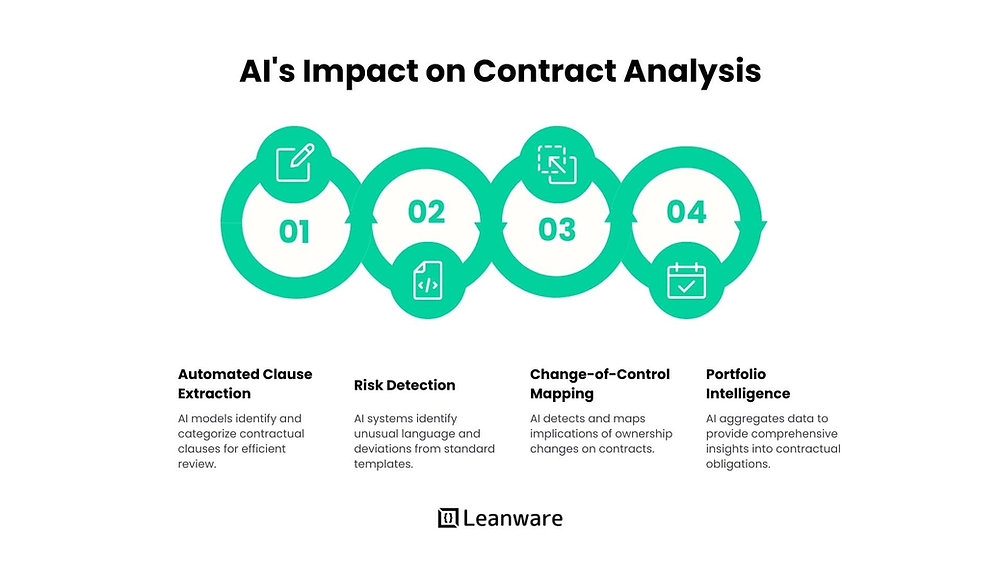
Automated Clause Extraction & Classification
AI models are trained to recognize and classify common contractual clauses across large document collections. These systems automatically identify sections related to confidentiality, termination rights, indemnification, payment obligations, renewal terms, and other legally significant provisions.
The extracted clauses are indexed and categorized, creating structured datasets that legal teams can search and analyze. Instead of manually reading each contract, lawyers can instantly locate agreements containing specific clause types. This dramatically reduces the time required to identify relevant documents during due diligence.
Clause classification also improves consistency across reviews. Human reviewers may interpret language differently, especially under time pressure. AI models apply standardized classification rules across every document, ensuring that similar clauses are tagged consistently across the entire contract set.
Risk Detection and Anomaly Identification
Beyond simple clause extraction, AI systems identify contractual risks by detecting unusual language or deviations from standard templates. Many organizations use standardized contract structures, and deviations from these patterns often signal potential legal or financial exposure.
AI models compare clauses across thousands of agreements to identify anomalies. For example, the system may flag an indemnification clause that expands liability beyond typical limits or detect payment terms that diverge from standard vendor agreements.
This anomaly detection allows legal teams to prioritize their attention. Instead of reviewing every clause in every contract, lawyers focus on documents that contain unusual or potentially problematic provisions.
Change-of-Control & Liability Mapping
Change-of-control clauses are one of the most critical elements in mergers and acquisitions. These provisions determine whether contracts remain valid when ownership of a company changes. Some agreements require customer consent or allow termination if control shifts to a new entity.
AI systems can automatically detect these clauses and map their implications across large contract portfolios. This enables deal teams to identify which agreements require approval or renegotiation before a transaction closes.
In addition to change-of-control provisions, AI platforms can map liability exposure across agreements. By analyzing indemnification terms, warranty clauses, and financial commitments, the system helps organizations understand their potential risk exposure before completing a transaction.
Portfolio-Level Contract Intelligence
One of the most powerful capabilities of AI-driven contract analysis is the ability to generate portfolio-level insights. Instead of analyzing agreements individually, AI platforms aggregate data across thousands of contracts to produce dashboards and analytical reports.
These insights allow executives to understand the overall structure of contractual obligations across the organization. Legal teams can identify patterns such as revenue concentration risks, vendor dependencies, or regulatory obligations embedded in agreements.
Portfolio-level intelligence transforms contract management into a strategic capability. Organizations gain visibility into their legal exposure and contractual commitments in ways that manual document review cannot provide.
Real-World Use Cases
AI-powered contract analysis is being adopted across industries where large volumes of agreements must be reviewed quickly and accurately. These applications extend beyond legal departments and increasingly support procurement, compliance, and executive decision-making.
In practice, AI systems are most valuable in environments where document volume and financial stakes intersect. Transactions involving acquisitions, vendor networks, regulatory obligations, or complex partnerships often generate thousands of contracts that must be analyzed within limited timeframes.
By automating clause extraction and risk detection, AI enables organizations to move from reactive document review toward proactive contract intelligence.
Mergers & Acquisitions (M&A)
In M&A transactions, time pressure is often intense. Acquirers must review extensive document sets within tight deal timelines while ensuring that hidden contractual risks do not jeopardize the transaction.
AI accelerates this process by scanning contracts and extracting key clauses relevant to the acquisition. These may include termination rights, assignment restrictions, exclusivity agreements, and revenue commitments tied to major customers.
Deal teams can quickly identify agreements that require renegotiation or third-party consent before closing the acquisition. This early visibility reduces the likelihood of last-minute surprises that could delay or derail the transaction.
Private Equity Portfolio Audits
Private equity firms manage portfolios of companies, each with its own network of contracts and obligations. Monitoring contractual risks across these portfolios can be challenging, especially as companies grow and agreements accumulate.
AI platforms enable continuous contract analysis across portfolio companies. Instead of conducting periodic manual audits, firms can monitor contractual obligations in real time and detect emerging risks earlier.
This capability helps portfolio managers identify legal exposures, vendor dependencies, and contractual commitments that could affect the performance or valuation of their investments.
Vendor & Procurement Risk Analysis
Procurement teams increasingly rely on AI to analyze supplier agreements and vendor contracts. These agreements often contain complex pricing structures, liability terms, and performance obligations that influence operational risk.
AI systems can scan vendor agreements to identify unfavorable clauses or deviations from standard procurement templates. This helps organizations negotiate stronger contracts and reduce exposure to supplier-related risks.
In addition, AI analysis can reveal patterns across supplier relationships, allowing procurement leaders to optimize vendor strategies and improve contractual consistency across departments.
Regulatory & Compliance Reviews
Regulatory compliance frequently requires reviewing contracts for specific legal provisions related to data protection, jurisdiction, and reporting obligations. Manually searching for these clauses across large document sets can be time-consuming.
AI systems accelerate compliance reviews by automatically identifying clauses related to regulatory frameworks such as GDPR or industry-specific regulations. Compliance teams can quickly locate agreements that require updates or additional documentation.
This automation helps organizations maintain regulatory readiness and reduces the risk of compliance violations caused by overlooked contractual obligations.
ROI of AI in Legal Operations
For enterprise leaders evaluating AI adoption, the return on investment often centers on operational efficiency and risk reduction. Contract analysis is a labor-intensive process, and AI significantly improves both speed and consistency.
Legal departments are under pressure to manage increasing document volumes without expanding headcount. AI enables them to scale their capabilities without relying exclusively on additional manual review resources.
Beyond efficiency gains, AI also improves decision-making by providing clearer visibility into contractual obligations and potential risks across the organization.
Time Reduction in Large Transactions
Large-scale due diligence projects often involve reviewing thousands of contracts. Traditional workflows require legal teams to analyze documents sequentially, which can extend review cycles for weeks.
AI dramatically compresses these timelines by processing documents simultaneously. Contracts can be analyzed and summarized in hours, allowing deal teams to quickly understand key risks and obligations.
This faster turnaround enables organizations to move through transaction stages more efficiently and maintain momentum during negotiations.
Cost Savings vs Billable Review Hours
Manual contract review often involves significant billable hours from external legal advisors or internal legal teams. While expert legal analysis remains essential, a large portion of review time is spent identifying clauses rather than interpreting them.
AI reduces this repetitive workload by automating clause detection and classification. Lawyers can focus their time on evaluating complex legal issues and advising stakeholders.
Over time, this shift reduces overall legal review costs while improving the efficiency of legal operations.
Risk Mitigation & Litigation Avoidance
One of the most important benefits of AI contract analysis is improved risk detection. Missed clauses can lead to disputes, unexpected liabilities, or regulatory violations.
By systematically scanning contracts and flagging unusual provisions, AI helps organizations detect risks before they escalate. Early identification allows legal teams to renegotiate problematic terms or address liabilities during transaction negotiations.
Reducing these hidden risks ultimately lowers the likelihood of litigation and strengthens overall legal risk management across the organization.
AI vs Human Lawyers: Collaboration, Not Replacement
AI in legal operations is most effective when it is treated as an augmentation layer, not a substitute for legal judgment. Contract analysis and due diligence involve two very different kinds of work. One is repetitive, large-scale, and pattern-driven. The other is interpretive, strategic, and context-dependent. AI is strong at the first category. Human lawyers remain essential for the second.
This distinction matters because resistance to legal AI often comes from framing the technology as a replacement. In practice, the real value is operational leverage. AI reduces the time spent locating clauses, summarizing obligations, and flagging unusual terms, which allows lawyers to spend more time on negotiation, legal interpretation, and strategic risk advice. That makes legal teams faster and more scalable without reducing the importance of legal expertise.
A well-designed workflow places AI at the front of the review process and lawyers at the decision layer. The system surfaces risk, organizes documents, and highlights anomalies. Legal professionals then validate findings, apply commercial context, and determine the right course of action.
What AI Can Do Better Than Humans
AI performs better than humans in tasks that require pattern recognition at scale. It can review thousands of agreements consistently, extract recurring clauses, classify contract language, and surface anomalies without fatigue. During large transactions or compliance reviews, this speed and consistency create a major operational advantage.
AI is also better at building structured visibility across contract portfolios. A lawyer can identify a risky clause in one agreement, but AI can identify that same clause across ten thousand agreements and group the results into dashboards, summaries, and searchable repositories. This turns contract review from a document-by-document exercise into a portfolio-level intelligence function.
Another strength is consistency. Human reviewers vary in pace and interpretation, especially under deadline pressure. AI applies the same classification logic across the full document set. That does not guarantee perfect legal interpretation, but it significantly improves the reliability of first-pass analysis.
What Still Requires Human Judgment
Legal reasoning still requires human judgment because contracts do not exist in isolation. The same clause can carry different implications depending on the transaction structure, negotiation posture, jurisdiction, regulatory environment, and business objective. AI can identify language patterns, but it does not own risk tolerance or commercial judgment.
Human lawyers remain essential for interpreting ambiguous clauses, negotiating changes, advising on litigation exposure, and balancing legal risk against business value. They also evaluate whether an AI-flagged issue is material or merely unusual. That difference is critical in real transactions, where not every anomaly is a meaningful legal problem.
Lawyers also perform the strategic work that AI cannot replace: aligning legal recommendations with board priorities, investor expectations, post-acquisition integration plans, or long-term commercial relationships. AI helps legal teams move faster and see more. It does not replace the human judgment that turns information into legal decisions.
Implementation Considerations for Enterprises
Enterprise implementation of AI contract analysis is not just a tooling decision. It is an architecture and governance decision. Organizations need to think about where contract data lives, how the AI layer integrates with existing systems, how confidentiality is maintained, and how the system will evolve beyond a one-time pilot.
This is where many initiatives fail. Teams buy or build a point solution that can summarize a contract, but it does not integrate well with document repositories, legal workflows, procurement systems, or internal reporting environments. The result is isolated capability rather than operational transformation. For enterprise use, AI contract analysis needs to function as infrastructure inside the broader legal and compliance stack.
Integration with Existing Legal Systems
Most enterprises already operate with multiple legal systems, including document management systems, CRMs, ERPs, procurement platforms, and internal contract repositories. AI contract analysis creates the most value when it integrates with these systems instead of forcing teams into disconnected workflows.
Integration matters for both ingestion and output. Contracts need to flow into the AI layer automatically through secure ingestion pipelines, APIs, or repository connectors. Just as important, analysis results need to flow back into the systems where legal, procurement, and compliance teams already work. If users must constantly export files and re-upload results manually, adoption will remain limited.
API-first architecture is especially important here. Enterprises need interoperability, not black-box isolation. The AI layer should enrich legal operations by plugging into existing systems rather than competing with them. That makes it easier to operationalize clause extraction, risk scoring, and reporting across the organization.
Data Security & Confidentiality
Contracts often contain highly sensitive information, including customer terms, pricing structures, acquisition details, intellectual property rights, employment obligations, and regulatory disclosures. Because of that, data security is one of the most important implementation requirements.
Enterprise deployments typically require encrypted storage, role-based access controls, secure cloud environments, and strong auditability. Security is not only about preventing external breaches. It is also about internal governance: who can access which contracts, who can view AI outputs, and how data is logged and retained. In regulated environments, these controls are not optional.
For many enterprises, trust in the AI system depends on deployment design. Private deployments, region-specific hosting, secure API layers, and compliance-aligned cloud architecture often matter more than the model itself. If confidentiality is weak, adoption will stall no matter how strong the analysis quality appears.
Custom Model Training for Industry-Specific Contracts
Generic models can identify common legal language, but industry-specific contracts often require a more specialized understanding. A healthcare agreement may contain detailed patient data handling terms. A fintech contract may include risk, liability, and regulatory language that differ significantly from standard SaaS or procurement agreements.
Custom model tuning or domain adaptation allows organizations to improve accuracy on the clauses that matter most to their business. This can involve training models on historical agreements, building specialized clause taxonomies, or refining extraction logic for specific legal structures. The goal is not just better generic summarization, but more useful risk intelligence in the organization’s actual domain.
This is where custom AI systems often outperform one-size-fits-all legal tools. They can be shaped around the enterprise’s own contract patterns, compliance environment, and reporting needs. That makes the system more strategically useful over time, particularly in industries where contractual language carries highly specific operational or regulatory consequences.
Challenges & Limitations of AI in Legal Analysis
AI contract analysis provides real leverage, but it is not infallible. The value of the technology comes from speed, scale, and structured insight — not from replacing legal review altogether. Enterprises need to approach implementation with a realistic understanding of where AI performs well and where it can introduce new risks if used carelessly.
A credible AI legal workflow is therefore hybrid by design. It uses AI to reduce manual burden and improve visibility, but it also includes validation processes, governance rules, and human oversight. This balance is essential because legal analysis is high-consequence work. Errors do not just affect user experience. They can affect transactions, compliance posture, and litigation risk.
Model Accuracy & False Positives
Even strong AI systems generate false positives and occasional misclassifications. A clause may be flagged as unusual when it is actually acceptable within a given contractual context. Conversely, subtle legal language may be missed if it appears in a form the model has not seen often enough.
That is why enterprise contract analysis systems need validation workflows. AI should surface potential issues, but legal teams must review material findings before they are treated as final. This is especially important in M&A and regulatory contexts, where a small classification error can distort risk perception.
Accuracy also depends heavily on document quality, clause variety, and training data. Scanned PDFs, inconsistent formatting, and contract language from multiple jurisdictions all increase complexity. A well-run implementation acknowledges these limitations and designs around them rather than assuming the system is correct by default.
Data Privacy & Regulatory Compliance
Using AI on contracts creates immediate privacy and governance questions. Contracts often contain personal data, pricing information, confidential commercial terms, and sensitive counterparty details. Enterprises must ensure that AI processing complies with internal governance rules and regional data protection laws.
This becomes especially important in cross-border operations. Regulatory requirements may affect where data can be processed, how long it can be retained, and whether contract data can be used for model improvement. Organizations need clear data handling policies, secure deployment models, and legal review of AI usage patterns before moving into production.
Privacy risk is not limited to the model layer. It also extends to logs, prompts, embeddings, document stores, and downstream analytics systems. A mature enterprise implementation treats privacy as an architectural requirement, not a procurement checkbox.
Over-Reliance on Automation
One of the biggest risks in legal AI is over-trusting automated outputs. When systems perform well in early use cases, teams may begin treating them as definitive rather than assistive. That creates the risk of missing nuanced legal issues because the AI did not flag them.
The correct operating model is not blind automation. It is guided automation. AI should reduce workload, structure information, and prioritize review, but legal professionals should remain responsible for interpretation and sign-off in material matters. This is especially important in high-stakes transactions, regulatory reviews, and disputes.
Over-reliance can also weaken institutional legal judgment if teams stop questioning outputs. The best legal AI workflows preserve human skepticism and review discipline while using AI to increase speed and visibility. That balance protects both legal quality and organizational trust in the system.
The Future of AI in Legal Risk Intelligence
The next phase of legal AI is not just faster contract review. It is the evolution from document analysis to ongoing legal risk intelligence. As organizations digitize more of their legal workflows, contract data becomes a continuous source of strategic information rather than a static archive reviewed only during transactions or disputes.
This shift matters because legal risk is rarely one-time. Obligations evolve, vendors change, regulations update, and M&A exposure accumulates over time. The future of AI in legal operations is therefore less about single-document review and more about continuous intelligence across large contract portfolios.
Predictive Risk Modeling
One of the most important future directions is predictive risk modeling. Instead of only identifying what a contract says today, AI systems will increasingly estimate the probability of future issues such as disputes, contract instability, non-renewal risk, or regulatory exposure.
This does not mean predicting litigation with perfect certainty. It means detecting patterns associated with legal friction: unusual liability structures, recurring amendment patterns, inconsistent obligations across customer tiers, or language historically associated with post-closing issues. For legal leaders, that turns AI into a proactive risk forecasting layer rather than a reactive review tool.
As these models improve, legal teams will be able to prioritize attention based not only on clause presence but on the likelihood of downstream consequences. That is a major step toward more strategic, data-informed legal operations.
Continuous Contract Monitoring
Traditional contract review is episodic. Contracts are reviewed during negotiation, due diligence, or audits, then often disappear into repositories until a problem arises. AI changes this by enabling continuous monitoring of contractual obligations, anomalies, and policy deviations.
In this model, contracts become living data assets. AI systems can monitor changes, detect expiring obligations, surface regulatory gaps, and notify teams when contract language becomes misaligned with new policies or standards. This is especially valuable in procurement-heavy enterprises, regulated industries, and private equity environments where contractual exposure changes over time.
Continuous monitoring shifts legal operations from event-driven review to persistent oversight. That creates earlier visibility into risk and reduces the chance that important obligations go unnoticed until they become costly.
AI-Powered Legal Decision Support Systems
The longer-term future is the emergence of AI-powered legal decision support systems. These systems will not replace lawyers, but they will provide structured recommendations, risk summaries, portfolio comparisons, and context-aware guidance that supports faster decision-making.
For example, a legal team may ask not only whether a clause exists, but how it compares to standard policy, how often it appears across the portfolio, what level of dispute risk it correlates with, and what remediation path is typically used. That is much closer to a legal intelligence platform than a contract parser.
As these systems mature, the legal function becomes more analytically powerful. Lawyers spend less time retrieving information and more time advising the business using AI-generated insights as structured support. That is the real long-term transformation: legal teams moving from document review capacity toward strategic risk intelligence capability.
How to Build an AI-Powered Contract Intelligence System
Building an AI-powered contract intelligence system requires more than simply applying a language model to legal documents. A robust system must be designed as part of an enterprise information architecture that connects document ingestion, analysis, storage, and reporting into a unified workflow. The objective is not just automated document review but a scalable infrastructure that transforms contract repositories into a continuous source of legal and operational insight.
In many organizations, contracts are scattered across multiple repositories such as document management systems, email archives, procurement platforms, and cloud storage. An effective AI contract intelligence system begins by centralizing access to these documents through secure ingestion pipelines. Once documents are collected, they can be processed using natural language processing and machine learning models that extract clauses, detect risk patterns, and organize information into structured formats.
Designing such a system requires careful attention to architecture, data governance, and integration with existing legal operations. When implemented correctly, AI contract intelligence becomes a long-term capability that supports due diligence, compliance monitoring, procurement oversight, and strategic decision-making.
Key Architectural Components
A modern contract intelligence system typically includes several interconnected architectural components that enable scalable analysis and insight generation. The first layer is the document ingestion pipeline, which collects contracts from enterprise repositories and prepares them for analysis. This stage often involves document parsing, optical character recognition for scanned files, and metadata extraction to standardize inputs.
The next layer involves language processing models that analyze the documents. These models perform tasks such as clause extraction, entity recognition, and semantic classification. Embedding models are commonly used to convert legal text into numerical representations that allow contracts to be indexed and searched using semantic similarity rather than simple keyword matching.
Vector databases play a key role in storing these embeddings and enabling efficient semantic search across large document collections. This allows users to locate clauses or risks even when the wording varies between agreements.
Above the processing layer sits the analytics and visualization layer. Dashboards provide legal teams and executives with visibility into contractual obligations, risk distribution, and key clause patterns across the organization. These tools transform raw contract data into actionable insights that can guide legal strategy and operational decision-making.
Finally, secure integration layers connect the AI system with enterprise tools such as document management systems, procurement platforms, and compliance reporting environments. This ensures that contract intelligence becomes part of everyday workflows rather than an isolated analytical tool.
Build vs Buy Considerations
Organizations implementing AI contract analysis often face a strategic choice between adopting commercial SaaS solutions and building custom systems tailored to their internal workflows. Each approach offers distinct advantages depending on the organization's priorities, scale, and regulatory environment.
SaaS-based legal AI platforms provide rapid deployment and pre-built functionality for clause extraction, document classification, and risk analysis. These tools can often be implemented within weeks and require minimal internal engineering resources. For organizations seeking immediate operational improvements, SaaS solutions offer a practical entry point into AI-assisted legal workflows.
However, SaaS platforms may provide limited flexibility when organizations require specialized capabilities or integration with complex internal systems. Enterprises operating in highly regulated industries or managing unique contract structures often benefit from custom-built solutions that allow deeper control over data handling, model configuration, and integration architecture.
Building a custom AI contract intelligence system requires greater upfront investment but offers long-term strategic advantages. Custom systems can be tailored to industry-specific contract structures, integrate seamlessly with internal systems, and evolve as legal and operational requirements change.
Many organizations adopt a hybrid approach, combining SaaS tools for rapid deployment with custom components that address specific operational or regulatory needs. This strategy allows companies to balance speed, flexibility, and long-term scalability when building their AI-powered legal infrastructure.
Conclusion
AI-powered contract analysis is transforming how organizations manage legal risk in complex transactions. By converting contracts into structured data, AI enables legal teams to review agreements faster, identify risks earlier, and gain clearer visibility into obligations across large contract portfolios.
However, AI is most effective when it supports legal professionals rather than replaces them. By automating tasks like clause extraction and document analysis, AI allows lawyers to focus on strategic review, negotiation, and decision-making—helping organizations move faster while maintaining accuracy and control.
If your organization handles large volumes of contracts or frequent due diligence reviews, AI-powered contract intelligence can significantly improve efficiency and risk visibility.
Contact Leanware to explore how AI-driven solutions can streamline your contract analysis and strengthen your legal operations.
Frequently Asked Questions
What is AI for contract analysis?
AI for contract analysis is the use of artificial intelligence technologies to automatically review, extract, classify, and assess legal contract clauses. By applying natural language processing and machine learning techniques, AI systems can identify obligations, risks, and anomalies across large collections of agreements. This allows organizations to analyze thousands of documents quickly while maintaining consistency in clause identification and classification.
How does AI improve due diligence processes?
AI improves due diligence by scanning large contract repositories and extracting key information such as termination rights, liabilities, payment obligations, and change-of-control clauses. Instead of manually reviewing each document, legal teams receive structured summaries and risk indicators generated by the AI system. This significantly accelerates review timelines while reducing the likelihood of missing important contractual risks during mergers, acquisitions, or regulatory audits.
Can AI replace lawyers in contract review?
No. AI does not replace lawyers in contract review. It automates repetitive tasks such as clause extraction, document classification, and risk detection, allowing legal professionals to focus on interpretation and decision-making. Lawyers remain responsible for evaluating legal implications, negotiating terms, and advising stakeholders on strategic legal matters.
What types of contracts can AI analyze?
AI systems can analyze a wide range of legal agreements, including commercial contracts, nondisclosure agreements, vendor contracts, employment agreements, licensing agreements, lease agreements, and SaaS service contracts. With custom model training, AI can also specialize in industry-specific documents such as healthcare compliance agreements, insurance contracts, or financial services documentation.
How accurate is AI contract analysis?
Modern AI systems can achieve high levels of accuracy in clause extraction and classification, often reaching accuracy rates between 85 and 95 percent when properly trained and validated. Accuracy depends on factors such as document quality, model training data, and the complexity of the contract language. Most enterprise deployments combine AI analysis with human validation to ensure reliable results.
How accurate is AI contract analysis?
Modern AI systems can achieve high levels of accuracy in clause extraction and classification, often reaching accuracy rates between 85 and 95 percent when properly trained and validated. Accuracy depends on factors such as document quality, model training data, and the complexity of the contract language. Most enterprise deployments combine AI analysis with human validation to ensure reliable results.
What risks can AI detect in contracts?
AI can detect many types of contractual risks, including change-of-control clauses, unusual liability provisions, indemnification obligations, assignment restrictions, termination rights, and regulatory compliance requirements. By analyzing patterns across multiple contracts, AI can also highlight deviations from standard templates that may signal hidden liabilities or negotiation exceptions.
Is AI contract analysis secure for confidential documents?
Yes, when deployed correctly. Enterprise-grade AI systems typically use encrypted storage, secure cloud environments, strict access controls, and compliance frameworks such as SOC 2 or ISO security standards. Some organizations also deploy AI models within private environments to maintain full control over sensitive legal data.
What is the ROI of AI in legal due diligence?
The return on investment from AI contract analysis comes from reduced review time, lower legal costs, and improved risk detection. In large transactions, AI can compress document review cycles from weeks to days, enabling faster deal execution and reducing reliance on extensive billable review hours.
How long does it take to implement AI contract analysis?
Implementation timelines vary depending on the deployment approach. SaaS solutions can often be implemented within a few weeks, while custom enterprise systems may require several months to integrate with internal repositories, train models on domain-specific contracts, and establish governance and security frameworks.
What is the difference between contract analysis and contract intelligence?
Contract analysis focuses on reviewing individual agreements to extract clauses and identify risks. Contract intelligence goes further by aggregating insights across entire contract portfolios. It enables analytics, risk scoring, trend identification, and continuous monitoring of contractual obligations at the organizational level.