AI for HealthTech Compliance Automation

Healthcare software that handles patient data must comply with HIPAA, and increasingly with GDPR, SOC 2, HITRUST, and FDA oversight depending on the product and market. HIPAA penalties alone reach up to $2.13 million per violation category per year, and healthcare breaches average $7.42 million in cost according to IBM Security's 2025 report.
For HealthTech companies selling into hospitals, insurers, or enterprise health systems, these requirements control whether the product can go to market at all.
AI-driven compliance automation replaces that manual process with systems that monitor every data access event, flag violations in real time, and generate audit documentation continuously rather than once a quarter.
Let’s look at how this works, which regulatory frameworks it supports, and how HealthTech engineering teams can implement it.
Why Compliance Is One of the Hardest Challenges in HealthTech
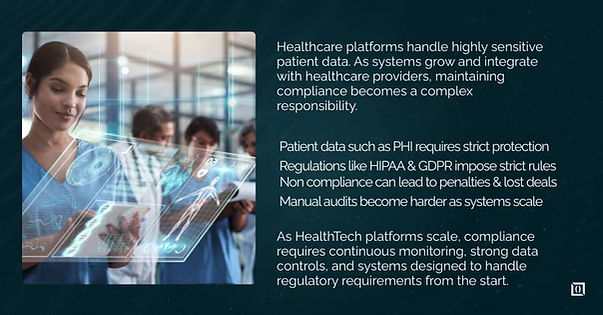
Healthcare is one of the most regulated industries in the world, and for good reason. The data involved (diagnoses, treatment histories, prescriptions, insurance records, mental health notes) is among the most sensitive information any system can hold.
The High Stakes of Healthcare Data Protection
Protected Health Information (PHI) carries legal, ethical, and operational weight that most other data categories do not. A leaked email list is a PR problem. A leaked patient record is a violation of someone's medical privacy, potentially affecting their employment, insurance, and personal life.
Healthcare platforms handle PHI at every layer, from the database where clinical records are stored to the API endpoints that transmit them to the frontend interfaces where providers and patients view them. Every access point is a potential compliance surface, and every unmonitored interaction with that data is a potential violation.
The Cost of Non-Compliance for HealthTech Companies
HHS Office for Civil Rights collected nearly $12.8 million in civil penalties in 2024 across 22 enforcement actions. Individual settlements have reached into the millions, including a $4.75 million settlement for a malicious insider incident in early 2024.
But the financial penalties are not the most damaging consequence. A compliance failure can prevent a HealthTech product from launching in hospital systems, block partnerships with insurers, and erode the trust that healthcare customers require before adopting new technology.
For startups, a single compliance incident can stall fundraising, kill a partnership, or end the business entirely.
Why Manual Compliance Processes No Longer Scale
Traditional compliance relies on periodic audits, spreadsheet-based tracking, and manual review of access logs. A compliance officer reviews who accessed what data, checks whether policies were followed, and documents the findings in a report that is accurate only as of the date it was produced.
This approach becomes harder to maintain as platforms grow. When systems handle thousands of access events across many services and user roles, manual review becomes time-consuming. Gaps can appear between audits, and reviewing logs or preparing documentation requires increasing effort as the platform expands.
What Is AI for HealthTech Compliance Automation?
AI for HealthTech compliance automation is the use of machine learning, natural language processing, and behavioral analytics to continuously monitor, detect, and enforce regulatory requirements across healthcare software systems, replacing manual audits and periodic reviews with real-time, automated compliance workflows.
AI-driven compliance means software that watches your systems for regulatory violations the same way a senior compliance officer would, except it operates continuously, across every access event, and at a speed that no human team can match.
How AI Changes the Compliance Workflow
The main shift is from reactive reviews to continuous monitoring. Traditional compliance often identifies issues after they occur, usually during an audit. AI-driven systems monitor activity as it happens and flag potential risks early.
Instead of reviewing access logs periodically, the system analyzes access events continuously. It can also scan databases and communication channels to identify PHI and apply classification labels automatically. Audit documentation is generated from ongoing system activity, which helps teams stay prepared for reviews.
Key Technologies Behind Compliance Automation
Multiple AI capabilities support these systems. Machine learning models analyze access patterns and detect anomalies that may indicate unauthorized data access or policy violations.
Natural language processing scans clinical notes, messages, and documents to identify PHI that may not be properly classified or protected. Behavioral analytics looks at how different user roles typically interact with the system and flags activity that deviates from those patterns.
Automated policy enforcement systems apply access controls and data handling rules programmatically across applications and infrastructure.
The Regulations HealthTech Companies Must Navigate
Compliance automation exists because HealthTech companies must satisfy multiple overlapping regulatory frameworks simultaneously.
HIPAA Compliance in the United States
HIPAA requires that any entity handling PHI implement administrative, technical, and physical safeguards to protect that data. For software systems, this means enforcing access controls, maintaining detailed audit trails of who accessed what data and when, encrypting ePHI in transit and at rest, and implementing breach notification procedures.
The 2025 proposed HIPAA Security Rule update, the first major revision in 20 years, eliminates the distinction between "required" and "addressable" safeguards, mandates encryption for all ePHI, shortens breach notification timelines to 30 days, and requires continuous monitoring through automated systems. These changes make manual compliance approaches even less viable going forward.
GDPR and Healthcare Data Protection in Europe
GDPR classifies health data as a "special category" requiring explicit consent for processing, strict limitations on data retention, and the right for patients to request deletion of their records.
For HealthTech companies operating in European markets, this adds consent management, data minimization, and cross-border data transfer compliance to the regulatory stack.
FDA Digital Health and Medical Device Regulations
Certain HealthTech platforms, particularly those that provide clinical decision support, diagnostic analysis, or treatment recommendations, may be classified as Software as a Medical Device (SaMD) under FDA regulation.
These products require validation documentation, version control, and quality management systems that demonstrate the software performs as intended and that changes are tracked and auditable.
Global Compliance Standards: SOC 2, HITRUST, ISO 27001
Enterprise healthcare customers like hospitals, insurers, and large health systems frequently require SOC 2 or HITRUST certification before they will evaluate a vendor.
These frameworks overlap with HIPAA requirements but add additional controls around organizational security practices, risk management, and operational continuity. For HealthTech startups, achieving these certifications is often a prerequisite for revenue, not a nice-to-have.
How AI Automates Compliance in HealthTech Systems
AI can support compliance across the lifecycle of data handling, access monitoring, and regulatory reporting.
1. Automated Monitoring of Patient Data Access
AI systems track every access event against patient records, tracking who accessed the data, when, from what device, and whether the access was consistent with that user's role and normal behavior.
When a billing administrator accesses clinical notes they do not normally view, the system flags it immediately rather than waiting for a quarterly audit to catch it.
2. AI-Powered Audit Trails and Compliance Reporting
Generating audit documentation manually is one of the most time-consuming compliance tasks. AI systems create audit trails automatically by logging every relevant event in a structured, queryable format.
When an auditor requests evidence of access controls or breach notification procedures, the documentation is already assembled and current.
3. Intelligent Data Classification for Sensitive Information
PHI does not always sit neatly in labeled database fields. It appears in free-text clinical notes, chat messages between providers, uploaded documents, and email threads. NLP-based classification systems scan these unstructured data sources, identify PHI, and ensure that proper protection policies are applied, even when the data was not explicitly tagged during ingestion.
4. AI-Driven Consent Management
Under GDPR and increasingly under state-level US privacy laws, patient consent must be tracked and verified before data is processed for specific purposes. AI systems can map consent records to data usage patterns, identifying cases where data is being used in ways that fall outside the scope of the patient's original authorization.
5. Risk Detection and Compliance Alerts
AI models trained on historical compliance data can identify patterns that precede violations, including unusual access spikes, data exports to unauthorized destinations, or configuration changes that weaken security controls. These systems trigger alerts that give compliance and security teams time to intervene before an incident becomes a reportable breach.
Use Cases of AI in HealthTech Compliance
AI compliance systems appear across many healthcare platforms, from virtual care applications to diagnostic software. Each environment has its own requirements around patient data handling, system access, and regulatory documentation.
- Telemedicine Platforms: Virtual care platforms handle PHI across video consultations, patient messaging, remote diagnostics, and prescriptions. AI monitors these data flows in real time, ensuring recordings are encrypted, access is restricted to authorized providers, and patient consent is verified.
- Electronic Health Record (EHR) Platforms: EHR systems store large volumes of clinical data. AI monitors access patterns across thousands of accounts and flags anomalies such as providers accessing records outside their department or unusually large data downloads.
- Digital Health Startups: Early-stage HealthTech companies often lack dedicated compliance teams. AI tools help small engineering teams maintain monitoring and documentation standards without building a full compliance department.
- AI Medical Devices and Diagnostics: AI diagnostic tools must track model versions, training data sources, and decision logic to meet FDA requirements. Automated systems record these artifacts and generate documentation required for regulatory review.
Benefits of AI-Driven Compliance Automation
Once monitoring and reporting become automated, the day-to-day work of compliance changes. Teams spend less time reviewing logs or assembling documentation and more time addressing actual security and regulatory issues.
1. Reduced Compliance Costs
Automation eliminates the manual labor involved in access reviews, log analysis, and report generation. For organizations that previously assigned one or more full-time staff to compliance documentation, the cost savings are direct and measurable.
2. Faster and More Reliable Audits
Organizations using continuous compliance monitoring are audit-ready at all times. There is no pre-audit scramble to assemble documentation, review logs, and fill gaps. The audit trail exists in real time, and generating a compliance report for an auditor is a query rather than a project.
3. Continuous Compliance Monitoring
The shift from periodic to continuous monitoring means violations are detected in hours or minutes rather than weeks or months. This reduces breach exposure time, limits the scope of potential incidents, and demonstrates to regulators that the organization takes compliance seriously.
4. Stronger Patient Data Protection
Automated access monitoring, anomaly detection, and real-time alerting reduce the window during which unauthorized access can occur undetected. This directly improves the security posture of the platform and reduces the likelihood and severity of data breaches.
Challenges and Risks of Using AI for Compliance
Automation does not remove the need for careful system design. Teams still need to ensure that AI systems remain explainable, integrate with existing infrastructure, and handle sensitive data responsibly.
1. AI Model Transparency and Explainability
Compliance decisions must be explainable to regulators. If an AI system flags a user for suspicious access, the organization must be able to explain why the system flagged that activity and what criteria were used. Black-box models that produce results without interpretable reasoning create a compliance risk of their own.
2. Integration with Legacy Healthcare Systems
Many hospitals and health systems operate on legacy infrastructure, including older EHR systems, on-premise databases, and proprietary interfaces that were not designed for modern API-based integrations.
Getting AI monitoring tools to work with these systems requires careful integration work and sometimes middleware that bridges the gap between legacy and modern architectures.
3. Data Privacy Risks in AI Training
AI models require data to train on. When that data includes PHI, the training process itself becomes a compliance concern. Organizations must ensure that training data is properly de-identified, that models are not trained on data outside the scope of patient consent, and that the training pipeline meets the same security standards as the production environment.
Technologies Enabling AI Compliance Automation
These capabilities rely on technologies that analyze system activity, process medical text, and enforce security policies across infrastructure.
1. Natural Language Processing for Medical Data
NLP extracts structured information from unstructured clinical text, identifying patient names, diagnoses, medications, and procedure codes in free-text notes that would otherwise require manual review to classify and protect.
2. Machine Learning for Risk Detection
ML models learn what normal system behavior looks like and flag deviations that may indicate compliance violations, security incidents, or policy breaches. These models improve over time as they ingest more data and receive feedback on false positives and confirmed incidents.
3. Behavioral Analytics for Access Monitoring
Behavioral analytics goes beyond role-based access control by establishing individual baselines for each user. If a nurse who normally accesses records for patients on their unit suddenly begins accessing records from a different department, the system flags that activity as anomalous even if the user's role technically permits the access.
4. Automated Policy Enforcement Systems
Policy enforcement systems apply security and compliance rules programmatically across the infrastructure. Access control policies, data encryption requirements, and retention rules are enforced automatically rather than depending on individual engineers or administrators to configure them correctly.
AI Compliance Tools and Platforms in the HealthTech Ecosystem
Many organizations use specialized tools that monitor infrastructure, manage privacy requirements, and support audit documentation alongside their internal systems.
Compliance Automation Platforms
Tools like Vanta, Drata, and Secureframe automate evidence collection for SOC 2, HIPAA, and ISO 27001 compliance. They integrate with cloud infrastructure, code repositories, and HR systems to continuously monitor compliance controls and generate audit-ready documentation.
Privacy Management Platforms
Privacy-focused tools handle data mapping, consent tracking, data subject access requests, and regulatory reporting. These platforms help organizations maintain GDPR and state-level privacy compliance across complex data architectures.
Security and Risk Monitoring Systems
Security information and event management (SIEM) platforms and cloud security posture management (CSPM) tools provide the monitoring infrastructure that feeds into compliance workflows. They detect threats, track configuration changes, and generate the security event logs that compliance reporting depends on.
How HealthTech Startups Can Implement AI Compliance Automation
Most teams adopt compliance automation gradually by mapping regulatory requirements, reviewing how patient data moves through the system, and adding monitoring in the areas where risk is highest.
Step 1: Map Regulatory Requirements
Before implementing any automation, identify every regulatory framework that applies to your product, including HIPAA, GDPR, FDA, SOC 2, and state-level privacy laws. Map these requirements to specific technical controls your system must enforce. This mapping becomes the specification that your compliance automation is built against.
Step 2: Audit Current Data Infrastructure
Trace how patient data flows through your system, from ingestion through processing, storage, and deletion. Identify every point where PHI is created, accessed, transmitted, or stored. This data flow map reveals where monitoring is needed and where existing controls have gaps.
Step 3: Implement Automated Monitoring Systems
Deploy AI monitoring tools that integrate with your infrastructure and applications. Start with the highest-risk areas like access to clinical data stores, user authentication events, and data exports, then expand coverage as the system matures.
Step 4: Build Continuous Compliance Workflows
Compliance should be an ongoing automated process, not a quarterly project. Configure your monitoring tools to generate continuous audit trails, trigger alerts for policy violations, and produce compliance reports on demand. The goal is to make your organization audit-ready at any point in time, not just during scheduled review periods.
The Future of AI in HealthTech Compliance
AI compliance systems are still evolving. As models improve and regulatory frameworks become more digital, automation will likely expand from monitoring violations to more proactive compliance management. Agentic AI represents a newer stage of healthcare AI, where autonomous systems support workflows like compliance monitoring, documentation, and policy enforcement.
1. Predictive Compliance Monitoring
Current AI systems detect violations as they occur. The next generation will anticipate them. By analyzing patterns across system changes, user behavior trends, and regulatory updates, predictive models will identify compliance risks before violations happen, giving organizations time to address issues proactively rather than reactively.
2. Autonomous Regulatory Documentation
As AI systems become more capable of understanding regulatory requirements, they will generate required documentation such as risk assessments, security plans, and breach response procedures with minimal human input. The compliance team's role shifts from producing documentation to reviewing and validating what the system produces.
3. AI-Native HealthTech Infrastructure
The long-term direction is toward healthcare platforms that are designed with compliance built into the architecture from the ground up. Instead of bolting compliance monitoring onto existing systems, the infrastructure itself enforces regulatory requirements as a core function, the same way modern cloud platforms enforce encryption by default rather than offering it as an optional configuration.
Why AI-Driven Compliance Will Become a Standard in HealthTech
Healthcare regulations require strict controls on how patient data is accessed, stored, and monitored. Proposed updates to the HIPAA Security Rule place greater emphasis on monitoring and security practices. At the same time, modern HealthTech platforms generate far more system activity and data than manual compliance processes can track.
Because of this, automated monitoring and documentation are becoming part of HealthTech infrastructure. When you build these capabilities into your platform early, it becomes easier to maintain audit readiness and meet the compliance expectations of healthcare partners.
Start Building Compliant HealthTech Platforms
Compliance automation is only as strong as the engineering behind it.
The monitoring systems, data pipelines, access controls, and audit infrastructure all require engineers who understand both the technical requirements and the regulatory context they operate in.
If you are building a HealthTech product and need engineering capacity familiar with regulated environments, connect with us at Leanware to work with nearshore LATAM engineers experienced in HIPAA, SOC 2, and enterprise healthcare systems.
Frequently Asked Questions
What is AI for HealthTech compliance automation?
AI for HealthTech compliance automation refers to the use of artificial intelligence to automatically monitor, manage, and enforce regulatory requirements in healthcare technology systems. These tools analyze patient data access, generate audit trails, detect compliance risks, and ensure that platforms follow healthcare regulations such as HIPAA, GDPR, and HITRUST without relying entirely on manual oversight.
Why is compliance so important in HealthTech?
Compliance is critical in HealthTech because companies handle highly sensitive patient data known as Protected Health Information (PHI). Regulations require strict safeguards to protect privacy and security. Failing to meet these standards can lead to heavy financial penalties, legal action, loss of trust, and restrictions that prevent healthcare platforms from operating or partnering with hospitals and insurers.
Which regulations affect HealthTech compliance?
HealthTech companies must follow several regulatory frameworks depending on their market. Common regulations include HIPAA in the United States, GDPR in Europe, and global security standards such as SOC 2, HITRUST, and ISO 27001. Some digital health products may also fall under FDA regulation if they qualify as software medical devices.
How does AI help automate healthcare compliance?
AI automates healthcare compliance by continuously analyzing system activity, identifying sensitive medical data, monitoring user behavior, and generating compliance reports. Instead of relying on periodic manual audits, AI systems provide real-time monitoring that can detect potential violations, enforce security policies, and alert teams before regulatory risks become serious incidents.
What types of compliance tasks can AI automate?
AI can automate many compliance-related processes including monitoring access to patient data, generating audit logs, classifying sensitive medical information, verifying patient consent records, detecting unusual system behavior, and preparing regulatory documentation.
Can AI detect healthcare data privacy violations?
Yes. AI systems can detect potential privacy violations by analyzing system logs, access patterns, and data flows. Machine learning models can identify unusual behavior such as unauthorized access to patient records, abnormal data transfers, or suspicious user activity and trigger alerts so compliance teams can investigate quickly.
Is AI compliance automation safe for patient data?
AI compliance systems can be safe when implemented with strong security controls, encryption, and strict access policies. Many platforms are designed specifically to handle sensitive healthcare data while maintaining regulatory compliance. However, organizations must ensure that AI models are trained responsibly and that data governance policies remain in place.
What are the benefits of AI compliance automation for HealthTech startups?
For HealthTech startups, AI compliance automation reduces operational costs, improves audit readiness, and allows companies to scale faster without building large compliance teams. Automated monitoring helps maintain regulatory standards while engineers focus on product development, making it easier for startups to partner with healthcare providers and enterprise customers.
What challenges exist when implementing AI compliance systems?
Implementing AI compliance tools can present challenges such as integrating with legacy healthcare systems, ensuring AI transparency, and managing sensitive training data. Healthcare organizations must also ensure that AI-generated decisions remain explainable and auditable so they can meet regulatory standards and pass external audits.
Will AI replace human compliance teams in healthcare?
AI is unlikely to replace compliance professionals entirely. It acts as an augmentation tool that automates repetitive monitoring and reporting tasks. Human experts remain responsible for interpreting regulations, making strategic decisions, managing audits, and ensuring that automated systems align with legal and ethical standards.