AI for LegalTech & Law Firms: Use Cases and Benefits

Law firms increased technology spending by 9.7% in 2025, the fastest real-term growth the legal industry has likely ever seen, according to a joint report from Thomson Reuters and Georgetown Law. Nearly seven in ten legal professionals now use generative AI tools for work, a figure that more than doubled in a single year.
The adoption is real, but so is the gap between individual usage and firm-wide implementation. Most law firms still lack formal AI policies, training programs, or a clear strategy for integrating these tools into their workflows.
Let’s look at how AI is actually used in the legal industry today, where it delivers real value, and what firms and LegalTech builders need to understand before adopting it.
What Is AI for LegalTech?
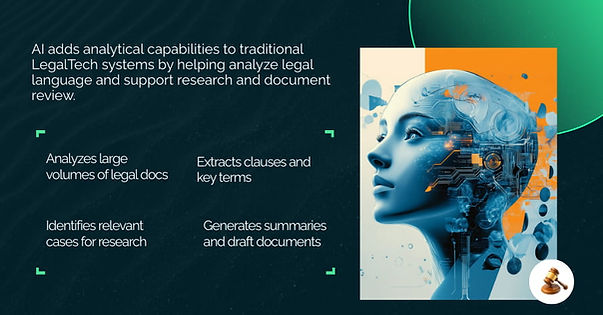
LegalTech refers to any technology used to support legal services, from document management systems and practice management software to legal research databases. It has existed in various forms for decades.
AI adds a different capability to that stack by automating analysis, generating content, and identifying patterns across large volumes of legal data that would take human reviewers significantly longer to process.
LegalTech encompasses the tools lawyers and legal teams use to manage their work, including case management platforms, billing systems, eDiscovery tools, contract repositories, and research databases. These systems digitized legal workflows but still relied on lawyers to do the analytical work manually. A legal research platform could return search results, but the lawyer still had to read every case and decide which ones were relevant.
How Artificial Intelligence Fits into Legal Technology
AI extends these systems by handling tasks that previously required human judgment at scale. Instead of searching for keywords across a database, an AI-powered research tool understands the legal question being asked and returns contextually relevant results ranked by relevance to the specific issue. Instead of a lawyer reading 500 pages of contracts to find non-standard clauses, an AI contract review tool flags the deviations automatically and explains why they matter.
The important distinction is that AI in legal practice is an augmentation tool, not a replacement for lawyers. It handles the volume and pattern recognition that consumes hours of associate time, freeing lawyers to focus on strategy, judgment, and client relationships.
Key AI Technologies Used in LegalTech
Legal AI systems rely on a few core technologies:
- Natural Language Processing: Understands and analyzes legal language in documents and research queries.
- Machine Learning: Learns patterns from legal datasets and improves accuracy over time.
- Large Language Models: Power document drafting, summarization, and conversational legal assistants.
- Document Classification: Automatically categorizes and tags legal documents.
- Predictive Analytics: Analyzes historical legal data to identify trends and estimate case outcomes.
Why AI Is Becoming Essential for Law Firms
AI adoption in the legal industry is driven by operational factors. Law firms handle growing volumes of legal data, clients expect lower costs, and some firms have already integrated AI into their operations.
The Growing Volume of Legal Data
A single litigation matter can involve millions of documents. Mergers and acquisitions require review of thousands of contracts across multiple jurisdictions. Regulatory compliance generates continuous documentation that must be monitored and updated.
The volume of legal data has grown well beyond what manual review processes can handle efficiently, and firms that rely solely on human reviewers for these tasks spend significantly more time and money reaching the same conclusions that AI-assisted teams reach faster.
Pressure to Reduce Legal Costs
Corporate legal departments are pushing back on hourly billing and demanding more predictable, cost-efficient service delivery. When an AI tool can review a set of contracts in hours that would take an associate several days, the pressure to adopt that technology becomes a business question, not just a technology one.
According to the Thomson Reuters 2025 Generative AI report, 40% of law firm respondents believe AI will drive an increase in non-hourly billing methods, reflecting a structural shift in how legal services are priced.
The Demand for Faster Legal Services
Speed has become a competitive differentiator. Clients expect faster turnaround on research, faster contract review cycles, and faster responses to regulatory inquiries.
AI compresses these timelines by handling the initial analysis, allowing lawyers to move directly to the decision-making and advisory work that clients value most.
Key Use Cases of AI in Law Firms
AI is already used across core legal workflows. These are the areas where firms are seeing the most direct impact today.
AI for Legal Research
Traditional legal research involves searching databases for relevant case law, statutes, and precedents, then reading through the results to determine applicability. AI-powered research tools like CoCounsel (Thomson Reuters) and Harvey understand the legal question in context and return results that are ranked by relevance, with citations and reasoning.
The first independent benchmark of legal AI tools found that Harvey achieved a 94.8% accuracy rate on document Q&A tasks, outperforming the lawyer baseline on several task categories.
AI-Powered Contract Analysis
Contract review is one of the most time-intensive tasks in legal practice, particularly during due diligence for M&A transactions. AI contract analysis tools like Luminance and Kira scan contracts at scale to identify key clauses, flag risks, detect deviations from standard templates, and highlight inconsistencies.
A review that might take a team of associates several weeks can be completed in days with AI handling the initial analysis and lawyers reviewing the flagged issues.
Document Review and eDiscovery
In litigation, document review often involves analyzing hundreds of thousands or millions of documents to identify those relevant to the case. AI-powered eDiscovery platforms like Everlaw use machine learning to classify documents by relevance, privilege status, and topic, dramatically reducing the volume that human reviewers need to examine.
This process, known as technology-assisted review (TAR), has been accepted by courts and has become standard practice in large-scale litigation.
Legal Document Drafting and Automation
AI drafting tools help lawyers generate first drafts of contracts, agreements, memos, and other legal documents based on templates, prior work product, and specific instructions.
Tools like Spellbook operate directly within Microsoft Word, suggesting language, flagging issues, and generating clauses based on the context of the document being drafted. The lawyer still reviews and refines the output, but the initial drafting time drops significantly.
Litigation Analytics and Case Prediction
AI systems can analyze historical court decisions to identify patterns in judicial behavior, estimate likely outcomes for specific case types, and inform litigation strategy.
These tools help lawyers make more informed decisions about whether to settle or proceed to trial, which arguments are most effective before specific judges, and how similar cases have been resolved historically.
AI Chatbots for Legal Intake and Client Support
AI-powered chatbots handle initial client intake by asking qualifying questions, collecting relevant information, and routing potential clients to the appropriate attorney or practice area. This reduces the administrative burden on staff and ensures that client inquiries are processed quickly, even outside business hours.
Benefits of AI for Law Firms
AI improves how legal teams handle research, documents, and client requests. Most gains come from automating time-intensive tasks and reducing the effort required to analyze large volumes of legal information.
Increased Efficiency and Productivity
The 2025 Clio Legal Trends Report found that more than half of legal professionals using AI reported improved work quality (65%), better client responsiveness (63%), and increased work capacity (54%). AI handles the repetitive analytical work that previously consumed a large portion of associate time, allowing lawyers to focus on the strategic and advisory work that drives higher value for clients.
Cost Reduction and Operational Efficiency
AI reduces the hours required for tasks like document review, contract analysis, and legal research.
For firms operating on fixed-fee arrangements or facing pressure to reduce billable hours on routine work, this directly improves margins. For firms on hourly billing, it frees capacity for higher-value work.
Improved Accuracy in Legal Work
AI tools can identify inconsistencies, missing clauses, and non-standard language in legal documents with a consistency that manual review struggles to match across large volumes. Human reviewers experience fatigue and attention drift over long review sessions. AI does not.
Better Client Service and Faster Responses
Faster research, faster document review, and automated intake mean shorter turnaround times for clients. In a competitive legal market, the ability to respond to client needs within hours rather than days is a meaningful differentiator.
Examples of AI Tools Used by Law Firms
Law firms use AI tools across different areas of legal work. The following categories show where adoption is most common and where many firms apply AI today.
AI Legal Research Platforms
CoCounsel (Thomson Reuters) and Harvey are the leading platforms for AI-assisted legal research.
CoCounsel integrates with Westlaw and provides verified citations, making it particularly strong for litigation-focused research. Harvey supports research across legal, regulatory, and tax domains and is widely adopted among Am Law 100 firms.
AI Contract Review Software
Luminance and Kira (now part of Litera) are the most established tools for AI-powered contract review and due diligence.
Both use a combination of NLP and machine learning to identify key provisions, flag anomalies, and accelerate large-scale document reviews. Luminance has expanded into compliance monitoring and contract lifecycle management.
AI Legal Assistants and Copilots
Clio's Vincent AI is a legal-specific AI trained on case law that integrates directly into the Clio practice management platform. It helps with research, drafting, and case strategy within the same environment where lawyers manage their matters and billing.
Several large firms have also built proprietary AI assistants, including Troutman Pepper's Athena and Dechert's DechertMind, both built on top of OpenAI's models and deployed within secure, private environments.
Challenges and Risks of Using AI in Legal Practice
AI adoption in legal comes with specific risks that firms must manage actively.
Data Privacy and Confidentiality Concerns
Legal work involves privileged and confidential client information. Using public AI tools such as the free version of ChatGPT with client data can raise confidentiality concerns because data entered into these systems may be used for model training.
The 2026 Wolters Kluwer Future Ready Lawyer Survey highlights this challenge. 46% of legal professionals cite data-protection compliance as a major concern, while 43% highlight client confidentiality. At the same time, 80% expect information-security risks to significantly affect their organizations, yet only 31% feel well prepared to handle them.
AI tools designed for legal environments typically address these risks through dedicated deployments, encryption, access controls, and contractual commitments that client data will not be used for model training.
Ethical Considerations in AI-Driven Legal Work
Lawyers have professional obligations that extend to the tools they use. If an AI tool generates a legal brief with fabricated citations, the lawyer who files it is responsible. Bar associations across the US are developing guidance on AI usage, and several jurisdictions already require lawyers to disclose when AI has been used in court filings.
The professional duty of competence now extends to understanding the capabilities and limitations of the AI tools being used.
Accuracy and Hallucination Risks
Large language models can generate outputs that sound authoritative but are factually incorrect, a phenomenon known as hallucination. In legal work, this can mean fabricated case citations, incorrect statutory references, or mischaracterized holdings.
Every AI-generated output in legal practice must be verified by a qualified lawyer before it is used in any professional context. This is not a limitation that will be fully resolved in the near term, and firms must build review processes around it.
Regulatory and Compliance Issues
AI usage in legal practice is subject to evolving regulatory frameworks. The EU AI Act takes full effect in August 2026 and will impose specific obligations on AI systems used in legal contexts.
In the US, state-level regulations are proliferating, and professional conduct rules are being updated to address AI-specific scenarios. Firms that adopt AI without establishing governance frameworks risk compliance violations alongside the operational benefits.
How Law Firms Can Implement AI Successfully
Most firms begin by identifying suitable use cases, evaluating tools carefully, training legal teams, and introducing AI into existing workflows step by step.
Identifying High-Impact Use Cases
Start with the tasks that consume the most time and produce the most consistent, repeatable work. Document review, contract analysis, and legal research are the areas where AI delivers the fastest return because the work is high-volume, pattern-based, and currently performed by expensive human labor.
Choosing the Right Legal AI Tools
Evaluate tools based on data security (does the vendor sign a BAA or equivalent? is data isolated?), accuracy (has the tool been independently benchmarked?), integration (does it work with your existing practice management and document systems?), and cost relative to the volume of work it will handle.
According to the ABA 2025 Legal Industry Report, 43% of firms prioritized integration with trusted existing software as the top factor when evaluating legal AI tools.
Training Lawyers and Legal Teams
AI tools are only effective when the people using them understand both their capabilities and their limitations.
Firms need structured training programs that cover how to use the tools effectively, how to verify AI-generated outputs, and what professional and ethical obligations apply when AI is part of the workflow.
Integrating AI Into Existing Legal Workflows
AI should supplement existing workflows, not replace them wholesale. A practical approach is to deploy AI in a specific practice group or workflow first, measure the results, and expand based on evidence rather than assumption. The firms with the highest adoption rates are those where innovation departments, not just IT, lead the AI strategy and ensure that implementation is grounded in actual legal work patterns.
The Future of AI in LegalTech
AI is becoming more integrated into legal workflows as the technology improves and tools become more specialized for legal tasks.
Autonomous Legal Research Assistants
Current legal AI tools respond to prompts. The next generation will operate more autonomously, analyzing a legal question across multiple jurisdictions, identifying relevant authorities, and producing a structured research memo with minimal human input.
The shift from tool to assistant to autonomous researcher is already underway in platforms that are integrating agentic AI capabilities.
AI-Powered Contract Lifecycle Management
AI is moving beyond point-in-time contract review toward managing the entire contract lifecycle, from initial drafting through negotiation, execution, compliance monitoring, and renewal.
This means a system that not only reviews a contract but also tracks obligations, flags upcoming deadlines, and alerts the legal team when terms require renegotiation.
The Rise of AI-Augmented Lawyers
The future of legal practice is not AI replacing lawyers. It is lawyers who use AI effectively outperforming those who do not. Clio's 2025 research found that 36% of legal professionals reported AI has already positively impacted revenue, with the figure rising to 69% among those who have widely adopted it.
The competitive advantage belongs to firms and lawyers that integrate AI into their practice thoughtfully and consistently.
Why AI Is Reshaping the Legal Industry
AI is already used in parts of the legal industry, especially for tasks such as document review, legal research, and contract analysis. As tools improve, more legal teams are testing how they fit into existing workflows.
For LegalTech builders, the focus is on creating AI systems that integrate with legal tools, handle sensitive data responsibly, and support how lawyers work. For law firms, adoption usually involves identifying suitable use cases, training teams, and maintaining human oversight over AI-generated outputs.
If you are building a LegalTech product or need engineering support for AI-powered legal software, connect with our team at Leanware to discuss how we can help you build, scale, and ship.
Frequently Asked Questions
What is AI in LegalTech?
AI in LegalTech refers to the use of artificial intelligence technologies like natural language processing, machine learning, and large language models to automate and enhance legal tasks such as research, contract analysis, document review, and client intake.
How is AI used in law firms?
Law firms use AI for legal research, contract review, document analysis, eDiscovery, litigation analytics, document drafting, and client intake automation. These tools handle high-volume analytical tasks so lawyers can focus on strategy and client advisory work.
What are the benefits of AI for law firms?
Key benefits include faster legal research, reduced time spent on document review and contract analysis, lower operational costs on repetitive tasks, improved accuracy in identifying risks and inconsistencies, and faster client response times.
Can AI replace lawyers?
AI is designed to assist lawyers, not replace them. Legal judgment, client relationships, courtroom advocacy, and strategic decision-making require human expertise. AI handles the analytical and administrative workload that supports those higher-value activities.
What types of legal tasks can AI automate?
AI can automate document review, contract analysis, case law research, legal document drafting, compliance monitoring, client intake, and litigation analytics. These tasks share common characteristics: they are high-volume, pattern-based, and time-intensive when done manually.
Is AI legal research reliable?
AI legal research tools have shown strong accuracy in independent benchmarks, but results must always be verified by a qualified lawyer. AI can miss nuance, mischaracterize holdings, or return incomplete results. It accelerates research significantly but does not replace the lawyer's judgment on applicability and strategy.
What is the difference between LegalTech and AI LegalTech?
LegalTech refers to any technology supporting legal services, including traditional tools like document management and billing systems. AI LegalTech specifically refers to tools powered by artificial intelligence that can analyze, generate, and learn from legal data.
What are the most common AI tools used by law firms?
The most widely adopted categories include AI legal research platforms (CoCounsel, Harvey), contract review tools (Luminance, Kira), AI drafting assistants (Spellbook, Clio Work), and practice management platforms with integrated AI capabilities.
How does AI help with contract review?
AI scans contracts to identify key clauses, flag deviations from standard templates, detect risks, and highlight inconsistencies. It processes large volumes of contracts in a fraction of the time manual review requires, allowing lawyers to focus on the flagged issues rather than reading every page.
Is AI safe for handling confidential legal information?
Enterprise-grade legal AI tools are designed with data security in mind, including encryption, isolated instances, and contractual commitments against using client data for model training. However, firms must evaluate each tool's security architecture carefully and avoid using consumer-grade AI products with confidential client information.