How to Integrate AI into Existing Applications: Architecture, Use Cases and Process

Most production systems today are the result of years of incremental changes, workarounds, and hard-earned stability. They handle real users, revenue, and compliance requirements. They were not designed for model inference or AI-driven workflows, yet teams are now expected to add intelligent features without increasing downtime or operational risk.
AI integration is the process of introducing these capabilities into systems that already operate under tight performance, security, and reliability constraints.
Let’s see how AI integration works at the architecture level, where it creates measurable business value, what makes it hard, and how to approach it in a structured way.
What Are AI Integration Services?
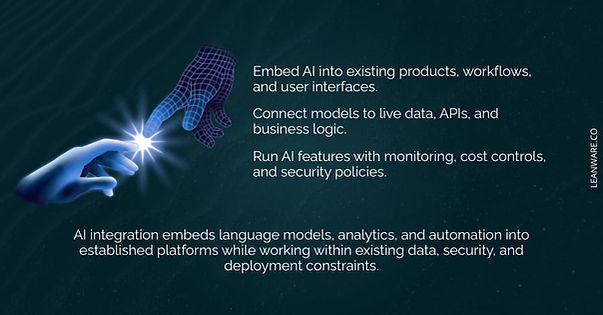
AI integration services refer to the practice of embedding AI capabilities into an existing software system. That means adding language models, predictive analytics, document processing, or recommendation engines into an application that was built without those capabilities in mind.
This is different from AI product development, where you design the entire system around AI from day one. Integration works within existing constraints: your current database schema, API contracts, deployment pipeline, and user-facing interfaces.
AI Integration vs. Building an AI-Native Product
When you build an AI-native product, AI sits at the core of the architecture. Data pipelines, storage choices, and UX patterns are all designed to support model inference. The timeline is longer, the cost is higher, and the risk is greater.
AI integration identifies specific workflows where AI creates measurable value, designs integration points into the existing system, and deploys capabilities without touching everything else. The result is faster to market, cheaper to validate, and much easier to roll back.
Dimension | AI Integration | AI-Native Build |
Timeline | 4-16 weeks | 6-18+ months |
Upfront cost | Moderate | High |
Architecture risk | Low | High |
Rollback complexity | Simple | Difficult |
Why Companies Prefer Integrating AI Instead of Rebuilding
A production application has years of business logic, edge case handling, and user trust baked into it. Rebuilding means re-creating all of that, and you will miss things.
Integration also lets you validate AI ROI before committing to a full architectural overhaul. You integrate a recommendation engine, measure the lift in conversion, and then decide whether deeper investment makes sense.
Why AI Integration is a Strategic Priority in 2026
According to Gartner, by the end of 2026 up to 40 percent of enterprise applications will include task-specific AI agents, up from less than 5 percent today. In addition, more than 80 percent of enterprises are expected to have used generative AI APIs or deployed generative AI-enabled applications by 2026, compared to a small share just a few years ago.
Adoption is moving beyond pilots and isolated experiments toward AI being embedded in core systems and everyday workflows.
Competitive Pressure and AI-Enhanced UX Expectations
Users now interact with AI-assisted tools daily. When they use a support tool that answers accurately within seconds, or a SaaS dashboard that surfaces anomalies automatically, that becomes their baseline expectation. P
roducts without similar intelligence start to feel slow and manual, regardless of how well built they are otherwise.
AI as a Revenue Multiplier, Not a Feature Add-On
When AI connects to core workflows, its impact usually appears in operating costs, conversion rates, and resource allocation rather than in isolated features. Automation reduces manual work, and better data-driven decisions improve prioritization and targeting.
Most of the benefit comes from small, consistent improvements in how systems operate over time. For most teams, AI integration is less about adding new features and more about making existing processes work more efficiently.
Common AI Use Cases for Existing Applications
The most effective integrations target high-frequency workflows where the cost of manual handling is measurable.
1. AI-Powered Customer Support and Smart Assistants
Basic chatbots use intent matching and break down outside predefined flows. RAG systems work differently. They pull from your actual documentation and support history at query time, generating responses grounded in your content rather than guessing.
The integration point is connecting your knowledge base to a vector database, embedding queries, retrieving relevant chunks, and passing them to the model.
2. Predictive Analytics and Lead Scoring
Most CRM systems store historical data that goes largely unused. A model trained on your conversion history assigns probabilities to new leads directly inside your CRM.
No new interface, no separate tool, just better signal in the system your team already uses. The integration requires clean data pipelines, a model serving layer, and a lightweight API your application calls when rendering records.
3. Intelligent Document Processing and OCR
Industries dealing with high-volume unstructured documents, like insurance claims, loan applications, or medical intake forms, spend significant time on manual review. Modern pipelines combine OCR, layout detection, and language models to extract structured data.
The extracted output flows into existing systems through the same APIs that manual entry uses. Compliance-sensitive deployments include audit logs and confidence scores so reviewers know when to check output.
4. Recommendation Engines and Personalization
Behavioral signals like clicks, purchases, and feature usage feed into a recommendation model that influences what each user sees.
The integration involves a feature store aggregating behavioral data, a model serving recommendations, and API endpoints your frontend calls when rendering dynamic content. The underlying application logic stays unchanged.
5. AI Workflow Automation and Smart Routing
Incoming requests, whether support tickets, expense reports, or approval workflows, can be classified, prioritized, and routed automatically. A support team spending 20% of its time on triage can reclaim that time when classification runs automatically. A well-trained classifier with a simple routing API is often enough to achieve this.
Technical Architecture of AI Integration
Architecture affects how reliable and maintainable AI features remain as traffic increases. Decisions around service boundaries, data flow, latency, and cost control matter more than the model itself. Most production integrations follow a few practical patterns, each with different operational implications.
API-Based AI Integration
The fastest path is calling an external model API. OpenAI, Anthropic, and Google provide REST APIs you call from your backend. This works well for moderate latency tolerance, but the tradeoffs are real: per-token cost, external dependency, and limits at high volume.
Microservices and AI Middleware Layers
Production-grade integrations place AI logic in its own service. Your application calls an internal AI service that handles model selection, prompt construction, caching, fallback logic, and output validation. This approach lets you swap models or update prompts without touching your core application, and it centralizes cost controls and monitoring.
Embeddings, Vector Databases, and RAG Systems
Semantic search-based integrations convert your content into vector embeddings stored in databases like Pinecone, Weaviate, or pgvector. When a user submits a query, you embed it, retrieve semantically similar content, and pass that context to the model. This dramatically reduces hallucinations because the model is grounded in your specific content rather than generating from memory.
Real-Time vs. Batch AI Processing
Not every AI feature needs to run in real time. Recommendation precomputation, lead score updates, and document classification can run on a schedule. Batch processing is cheaper and easier to debug. Real-time processing is necessary when the output directly affects user experience at the moment of interaction, such as live chat or fraud detection. Let that distinction drive the architecture decision, not a preference for complexity.
Key Challenges in AI Integration
Most AI integration problems do not come from model quality. They come from performance limits, regulatory exposure, unreliable outputs, and uncontrolled costs.
Challenge | Impact | Mitigation |
Latency and Performance | Model calls can take 1 to 5 seconds, which hurts interactive features and user experience | Streaming, caching, asynchronous processing, background loading |
Data Privacy and Compliance | Sending user data to external APIs triggers regulatory requirements under HIPAA, GDPR, and similar frameworks | Private hosting, regional endpoints, data masking, encryption, audit logs |
Model Hallucinations | Incorrect outputs create risk in financial, legal, and operational systems | Output constraints, validation, RAG, human review |
Cost and Token Usage | Token costs grow quickly at scale and can exceed projections | Prompt compression, caching, usage limits, cost monitoring |
Step-by-Step AI Integration Process
AI integration works best when teams move deliberately from system analysis to production rollout. Skipping early validation or operational planning often leads to rework later.
1. Technical Audit of the Existing System
Review your API surface, data models, authentication flows, and deployment pipeline. Identify where you can add integration points without destabilizing existing functionality. Assess data quality first because poor data is the most common reason integrations underperform.
2. Use Case Definition and ROI Modeling
Define the exact workflow you want to improve, the current baseline, and how you will measure success. Vague goals lead to unfocused development. A specific target, such as “reduce first-response time for 70 percent of tickets from four hours to under five minutes,” gives the team a clear benchmark to design and validate against.
3. Model Selection (OpenAI, Anthropic, Open Source)
Model choice affects integration speed, compliance, cost, and long-term flexibility. API-based models enable faster rollout, while self-hosted models offer more control for sensitive or regulated environments.
Factor | API Model | Open Source/Self-Hosted |
Time to integrate | Fast | Slower |
Data privacy | External dependency | Full control |
Cost at scale | Higher | Lower (infra cost) |
Compliance (HIPAA, GDPR) | Needs evaluation | Easier to achieve |
4. Architecture Design and Infrastructure Planning
Design the AI service layer, define data flow, and plan your observability stack. Set up logging for every model call from the start: input, output, latency, and cost. You will need this to debug and optimize.
5. Development, Testing, and Guardrails
Test prompts systematically in a staging environment that mirrors production data. Set up output validation, fallback logic for model failures, and confidence thresholds. Never push a model-dependent feature to production without a fallback that works if the API is unavailable.
6. Deployment, Monitoring, and Continuous Optimization
Model performance drifts as your data and user behavior change. Monitor output quality continuously, track feedback signals, and plan for prompt and model updates as part of your regular engineering cycle.
How to Measure ROI from AI Integration
Without clear measurement, AI features become difficult to justify and even harder to improve. You need practical metrics that connect model behavior to operating costs, revenue performance, and long-term user engagement.
Operational Efficiency Gains
Track time saved per workflow, automation rate, and error rate reduction. A document processing integration handling 80% of submissions without manual review has a straightforward calculation: compare labor hours saved against integration and running costs.
Revenue Impact and Conversion Improvements
Measure feature-level conversion rates before and after. For recommendation engines, track revenue per session and average order value. Run this as a controlled experiment where possible so you can attribute the change specifically to the integration.
User Retention and Engagement Signals
Track session frequency, feature adoption, and churn rates for cohorts that use AI-powered features versus those that do not. For SaaS products, retention signal is often the clearest indicator that an integration is adding durable value.
In-House vs. AI Integration Partner?
If your team has engineers with LLM integration experience, solid DevOps practices, and available capacity, many integrations are achievable in-house. API-based integrations with well-defined use cases are the clearest candidates. The main risk is underestimating the operational work of maintaining model quality post-deployment.
When Specialized AI Integration Services Are Necessary
Complex RAG systems, compliance-sensitive deployments, or integrations spanning multiple systems benefit from teams who have solved this class of problem before. Pattern recognition from repeated exposure to the same failure modes is hard to substitute.
Industry-Specific AI Integration Examples
AI integration looks different across industries because systems operate under different regulatory, operational, and commercial constraints.
AI Integration in SaaS Platforms
SaaS teams often use AI to improve usability and reduce churn. Common patterns include in-app assistants, contextual search, and usage-based recommendations that help users discover relevant features.
When these tools fit naturally into daily workflows, they tend to improve long-term product retention.
AI Integration in Fintech and Financial Services
In financial systems, AI is mainly used for fraud detection, credit risk assessment, and compliance review. These integrations depend on reliable data pipelines and explainable outputs. Strong data governance, audit logging, and regulatory oversight are part of normal implementation, not optional additions.
AI Integration in Healthcare Systems
Healthcare platforms must handle protected health information under HIPAA and similar regulations. Teams often rely on self-hosted models or compliant API providers to meet these requirements.
Typical use cases include clinical documentation support, patient intake automation, and diagnostic assistance. Outputs that influence care decisions usually pass through human review.
AI Integration in E-Commerce Platforms
E-commerce platforms apply AI to recommendations, search ranking, and content generation. Performance is typically measured through conversion rate, average order value, and engagement metrics. These systems need low latency and regular tuning as catalogs and user behavior change.
Future Trends in AI Integration
AI integration is moving from isolated model calls to more structured, managed systems. The focus is shifting toward control, visibility, and long-term maintainability rather than experimentation.
- AI Middleware Platforms: Managed platforms now handle model routing, prompt versioning, cost tracking, and output validation. This reduces the amount of custom infrastructure teams need to build and maintain.
- Agentic Systems in Enterprise Applications: Multi-step AI systems are starting to appear in production. Their main challenge is not capability but governance. Teams need clear guardrails, audit trails, and rollback mechanisms before allowing these systems to act on user data or workflows.
- AI Observability and Governance: Monitoring AI behavior is becoming standard practice. Teams track output quality, drift, latency, and cost alongside traditional system metrics, with auditability built into the core architecture.
Final Thoughts
Most existing systems were built to solve specific business problems under real operational constraints. Adding AI does not change that. It adds another layer that has to fit into existing performance budgets, security reviews, and maintenance cycles.
Rebuilding from scratch is rarely necessary, but careless integration usually creates more problems than it solves.
When AI is integrated with clear ownership, realistic cost expectations, and proper monitoring, it becomes easier to maintain over time.
Connect with our experts today to evaluate how AI integration can support your product and operational goals.
Frequently Asked Questions
What are AI integration services for existing applications?
AI integration services focus on adding machine learning, language models, analytics, or automation to an existing system without replacing its core architecture. The work involves connecting models to current data sources, workflows, and interfaces so they operate reliably in production.
How is AI integration different from building a new AI-powered product?
AI integration extends an existing platform by embedding AI into established systems and processes. Building a new AI-powered product means designing the entire stack around AI from the start, which usually takes longer, costs more, and introduces higher delivery and adoption risk.
How long does AI integration typically take?
Most integrations take between 4 and 16 weeks. Timelines depend on system complexity, data readiness, security reviews, and whether the use case requires custom workflows or compliance validation.
What types of AI can be integrated into existing systems?
Common integrations include large language models, predictive scoring systems, recommendation engines, document processing pipelines, automation workflows, and computer vision services. The choice depends on available data and business objectives.
Can AI be integrated into legacy systems?
Yes, in most cases. Legacy platforms often require middleware, API wrappers, or selective refactoring to expose usable data and workflows. Data quality and accessibility are usually the main constraints, not model capability.
What is the cost of integrating AI into an existing application?
Costs depend on model type, infrastructure setup, usage volume, and compliance needs. Small API-based integrations can remain relatively modest. High-volume systems, regulated environments, and custom deployments require significantly larger ongoing investment.
Is AI integration secure for sensitive industries like healthcare or fintech?
It can be, when security is built into the architecture. Secure integrations require controlled data access, encryption, audit logging, vendor assessments, and alignment with regulations such as HIPAA, GDPR, and SOC 2.
What are the biggest risks in AI integration?
The most common risks include unreliable outputs, data exposure, latency under load, escalating inference costs, and weak returns from poorly defined use cases. Careful system design, monitoring, and governance reduce these risks.
Do companies need a data science team to integrate AI?
Not in most cases. Many integrations use pre-trained models and focus on system design, data pipelines, and monitoring. Data science teams become necessary when organizations build or fine-tune their own models.
How do you measure ROI from AI integration?
ROI is measured through changes in operating costs, automation levels, conversion rates, response times, manual workload, and retention. Defining baseline metrics before deployment makes it easier to evaluate real impact after launch.