AI for Inventory & Supply Chain Automation: Complete Guide

Inventory and supply chain planning is evolving. Traditional forecasting and manual processes still play a role, but many organizations are turning to AI and advanced analytics to improve accuracy and efficiency. According to McKinsey, AI-driven forecasting can automate up to 50% of routine workforce tasks, reduce costs by 10-15%, and gradually improve operational performance.
These systems do not replace supply chain professionals. Instead, they continuously analyze data from ERP, warehouse, and logistics systems, adjust forecasts as conditions change, and automate routine actions like replenishment and safety-stock planning.
Let’s look at how AI technologies function in inventory and supply chains and the value they provide.
What Is AI for Inventory & Supply Chain Automation?
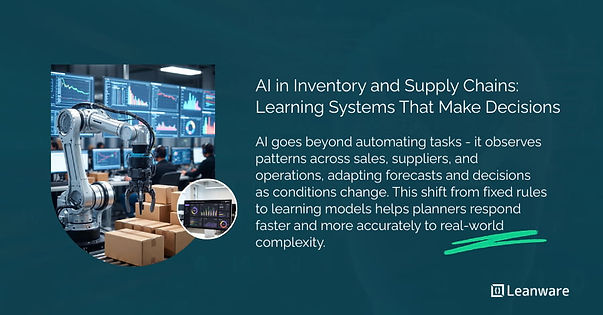
AI for inventory and supply chain automation uses machine learning models to predict demand, optimize stock levels, and automate operational decisions in real time. These systems learn from historical patterns, incorporate external signals, and continuously adjust without waiting for manual intervention.
AI automation relies on learning models that improve over time rather than static rules that require manual updates. By ingesting data from sales, inventory, suppliers, and external sources, the system identifies patterns, generates forecasts, and triggers actions such as purchase orders or inventory transfers based on configured thresholds.
How It Differs from Traditional Management
Traditional inventory management relies on fixed reorder points, safety stock formulas, and periodic forecast updates.
A planner sets parameters, and the system executes until someone changes them. AI systems work differently. They continuously recalculate based on incoming data, adjust safety stock dynamically based on forecast uncertainty, and flag anomalies before they become problems.
Why Rule-Based Systems Fall Short
Rule-based systems assume stable conditions. They work when demand patterns are predictable and lead times are consistent. In practice, those conditions rarely hold. Promotions spike demand unpredictably.
Supplier delays cascade through the network. Seasonal patterns shift year over year. Static rules cannot adapt fast enough, leaving planners to manually override systems that should be helping them.
Why Inventory and Supply Chains Are Hard to Manage Without AI
Managing inventory and supply chains is difficult because demand fluctuates, data is often scattered across multiple systems, and planning relies heavily on manual processes. These factors make it hard to align stock levels with actual needs, respond quickly to changes, and avoid costly imbalances.
Challenge | Cause | Impact |
Demand Volatility | Forecasts rely on historical averages | Stockouts, overstock, inaccurate planning |
Data Silos | Separate ERP, WMS, and logistics systems | Limited visibility, slower decisions |
Manual Planning | Spreadsheet-based updates and reconciliations | Decision lag, human bias |
Poor Decisions | Delayed or inaccurate planning | Lost sales, tied-up capital, higher costs |
Demand Volatility and Market Uncertainty
Traditional forecasts often rely on historical averages, which quickly become unreliable when conditions change. A three-year sales history offers limited insight if consumer behavior shifts, competitors enter the market, or economic conditions fluctuate.
Conventional models tend to smooth over volatility instead of capturing it. AI models, on the other hand, can incorporate leading indicators such as web traffic, social sentiment, or economic data to detect changes earlier and adjust forecasts accordingly.
Data Silos Across Systems
Many organizations run separate systems for ERP, warehouse management, transportation, and procurement. Each system contains only part of the picture. Without integration, it’s difficult to see inventory positions, inbound shipments, and demand signals together.
AI systems that aggregate and analyze data across these sources provide a complete view, enabling decisions based on the full operational picture rather than fragmented
departmental views.
Manual Planning Limitations
Spreadsheet-based planning cannot scale effectively. Planners spend hours updating forecasts, adjusting orders, and reconciling data across systems, which creates latency—decisions often lag behind reality.
Manual processes also introduce human bias: planners may over-order items they worry about and under-order items that appear stable, even if trends suggest otherwise.
The Cost of Poor Decisions
Stockouts result in lost sales and weakened customer relationships. Overstock ties up cash, consumes warehouse space, and can eventually lead to markdowns or write-offs. Poor forecasting and delayed decisions directly affect service levels and working capital, making accurate, timely planning critical for operational efficiency.
How AI Works in Inventory Management
AI changes how inventory is managed by shifting from periodic, manual planning to continuous, data-driven optimization. Each capability builds on the others to make decisions faster and more accurate.
Demand Forecasting Using Machine Learning
AI forecasting works differently from traditional methods. Instead of relying on fixed statistical models, machine learning algorithms look for patterns across many variables at once. They account for seasonality, promotions, pricing changes, and external factors like weather or economic shifts.
Forecasts are probabilistic, showing confidence ranges instead of a single number, which helps planners understand the uncertainty and make better decisions.
Automated Replenishment and Purchase Planning
With forecasts in place, AI can handle routine replenishment automatically. It calculates order quantities based on demand forecasts, lead times, supplier constraints, and carrying costs.
Rather than waiting for planners to approve every order, the system executes standard replenishment while flagging exceptions for human review.
Safety Stock Optimization
Traditional safety stock often uses fixed formulas based on past variability. AI takes a dynamic approach, adjusting buffer levels according to forecast uncertainty, supplier reliability, and current demand patterns. This reduces overstock that ties up capital and prevents stockouts that hurt service levels.
SKU Prioritization and ABC Analysis
Not every product needs the same level of attention. AI can continuously rank SKUs based on revenue, margin, velocity, and variability. This allows planners to focus on high-impact items while automating decisions for lower-risk products, improving efficiency across the board.
Real-Time Inventory Visibility
AI pulls data from multiple sources to give an accurate, up-to-date view of inventory across locations.
The value isn’t in dashboards - it’s in making actionable decisions: reallocating stock, transferring items between sites, or expediting orders as needed.
How AI Transforms Supply Chain Operations
Beyond inventory, AI improves upstream and downstream operations by anticipating problems rather than reacting to them.
Capability | How AI Helps |
Supplier Analysis | Scores suppliers to spot risks early |
Lead Time & Delay | Predicts actual lead times and flags delays |
Logistics Optimization | Optimizes shipments, carriers, and routes |
Risk Detection | Monitors external signals for disruptions |
Scenario Simulation | Runs what-if analyses for planning |
1. Supplier Performance Analysis
AI can score suppliers based on historical delivery performance, quality metrics, and cost trends. These scores inform sourcing decisions and identify suppliers likely to cause problems before issues materialize.
2. Lead Time Prediction and Delay Detection
Instead of relying on fixed lead times, AI models estimate actual lead times by considering supplier history, product characteristics, seasonal patterns, and current conditions. They can spot early signs of delays and alert planners to intervene before problems escalate.
3. Logistics and Route Optimization
AI optimizes transportation by balancing cost, time, and service requirements. It can consolidate shipments, choose the best carriers, and adjust routes dynamically based on real-time conditions, improving efficiency and reliability.
4. Risk Detection and Disruption Forecasting
AI systems monitor external signals that could disrupt supply chains, including weather events, port congestion, supplier financial health, and geopolitical factors. Early detection allows planners to mitigate risks proactively rather than reacting after disruptions occur.
5. Scenario Simulation
AI enables rapid what-if analysis. For example, planners can see the impact if a key supplier fails or if demand spikes by 30%. These simulations support contingency planning and more informed strategic decisions.
Key AI Technologies Behind the Automation
Knowing the technologies behind AI helps set realistic expectations and understand what these systems can actually do.
Machine Learning Models learn patterns from historical data and apply them to new situations. They improve as more data becomes available.
Time-Series Forecasting specializes in sequential data where patterns repeat over time, making it essential for demand and supply prediction.
Reinforcement Learning optimizes decisions over time by learning from outcomes, useful for inventory policies that balance competing objectives.
Predictive Analytics anticipates future states based on current data, enabling proactive rather than reactive management.
Real-Time Data Pipelines connect systems and sensors to provide current information for decision-making. Fresh data improves forecast accuracy and enables faster response.
AI-Powered Automation vs Traditional Systems
AI-powered systems handle inventory and supply chain tasks differently from traditional setups. Instead of relying on fixed rules and manual updates, they learn from data, adjust forecasts in real time, and take routine actions autonomously while alerting planners only when exceptions arise.
Aspect | Traditional Systems | AI-Powered Systems |
Rules | Static, manually configured | Adaptive, continuously learning |
Forecasting | Periodic updates | Continuous adjustment |
Decisions | Manual approval required | Autonomous with exception handling |
Planning | Reactive to problems | Predictive, anticipating issues |
Common Use Cases by Industry
AI applications vary by industry context:
- Retail and eCommerce: Managing demand spikes from promotions, handling fast-moving SKUs, and optimizing omnichannel inventory.
- Manufacturing: Coordinating raw material procurement with production schedules, managing supplier risk, and optimizing work-in-process inventory.
- Wholesale and Distribution: Balancing high volumes with thin margins, optimizing working capital, and managing complex customer requirements.
- Logistics: Route optimization, capacity planning, and predicting delays before they impact customers.
- Regulated Industries: Managing shelf life in food and pharma, maintaining traceability, and ensuring compliance while optimizing inventory.
Real-World Benefits
AI delivers measurable improvements across multiple dimensions. According to McKinsey, embedding AI in operations can reduce inventory by 20-30%, logistics costs by 5-20%, and procurement spend by 5-15%.
Reduced Stockouts and Overstock: Better forecasting means carrying the right inventory, not too much or too little.
Lower Carrying Costs: Optimized inventory levels free up cash and warehouse space.
Improved Service Levels: Higher product availability increases customer satisfaction and retention.
Faster Decisions: Automated systems respond in minutes rather than days.
Better Cash Flow: Less capital tied up in inventory improves financial flexibility.
AI + ERP: Integration with Existing Systems
AI doesn’t replace existing systems - it works alongside them, adding a layer of decision intelligence.
Integration Approach
Typically, AI operates on top of ERP, WMS, and TMS systems. It pulls data from these sources, runs it through machine learning models, and then provides recommendations or executes routine actions automatically, leaving planners to handle exceptions and strategic decisions.
Data Synchronization Challenges
For AI to work effectively, the underlying data must be clean and consistent. Master data alignment, transaction timing, and overall data quality are critical - without them, recommendations can be inaccurate or incomplete.
Buy vs Build Considerations
Developing a custom AI solution requires substantial investment in data science expertise and infrastructure. Off-the-shelf solutions offer faster deployment but may limit customization. Choosing the right approach depends on your organization’s capabilities, budget, and operational requirements.
Challenges and Limitations
AI can improve inventory and supply chain decisions, but its effectiveness depends on data quality, process alignment, and human oversight.
Data Quality Issues
AI depends on accurate, complete data. Any errors, gaps, or inconsistencies in historical or transactional records show up in forecasts and recommendations.
Aligning master data, standardizing formats, and cleaning records often take more effort than implementing the AI models themselves.
Model Explainability
Some AI models operate like a black box. When the system suggests an unusual order or adjustment, planners need clear reasoning to trust it. Without transparency, adoption slows and confidence in the system drops.
Change Management
The technology itself is usually the easier part. Getting teams to rely on AI requires training, clear communication, and visible results. Planners need to see that recommendations are reliable before they fully integrate AI into daily decision-making.
Over-Automation Risks
AI handles routine decisions well, but not every scenario should be automated. New products, irregular demand, or unique supplier issues benefit from human judgment. The most effective systems combine automation with human oversight to manage exceptions safely.
Implementation Strategy
Deploy AI in stages: first verify your data and system connections, then test the models on a small set of products or processes, and expand as the team gains experience and confidence.
- Assess Readiness: Evaluate data quality, system integration, and organizational appetite for change. Address gaps before launching AI initiatives.
- Define Scope: Start with a focused use case where data is available and business impact is measurable. For example, demand forecasting for stable products is often a good starting point.
- Run Pilots: Test AI recommendations against actual outcomes before automating decisions. Demonstrated accuracy builds confidence.
- Scale Gradually: Expand from decision support to automated execution as trust grows. Start with one product category or region, then broaden deployment over time.
Measuring ROI
The value of AI becomes clear when you connect its outputs to tangible business outcomes. Key metrics to track include:
- Operational KPIs: Forecast accuracy, inventory turns, stockout rates, service levels.
- Financial Impact: Inventory carrying costs, write-offs, expediting costs, working capital.
- Time Savings: Hours spent on manual planning and data reconciliation.
Most companies see measurable improvements within 3-6 months, with ROI compounding as models improve and automation expands.
SME vs Enterprise Considerations
AI adoption among SMEs is still relatively low compared with larger firms. According to OECD research, adoption varies widely depending on digital maturity, complexity of AI use, and the scope of applications.
SMEs often face gaps in connectivity, access to quality data, algorithmic tools, computing resources, skills, and financing, which limit how quickly they can implement
AI in supply chain and inventory operations.
SME Approach: Focus on simpler, cloud-based AI tools and use cases where data is accessible, such as demand forecasting or inventory visibility. Early deployments tend to be narrow but can deliver measurable operational improvements.
Enterprise Approach: Larger organizations often integrate AI across multiple regions, business units, and systems. They invest in advanced analytics, internal capabilities, and structured governance, allowing AI to support both operational decisions and broader strategic objectives.
Future Trends
AI in supply chains is evolving, with key developments shaping its capabilities:
- Autonomous Supply Chains: Gradual expansion of automated decision-making as models prove reliable.
- Multi-Agent Systems: AI agents coordinating across functions to optimize end-to-end rather than in silos.
- Real-Time Global Optimization: Faster data and better models enabling network-wide optimization rather than location-by-location decisions.
- Human-in-the-Loop Models: AI handling routine decisions while escalating exceptions to human experts who focus on strategy and judgment calls.
Final Thoughts
AI can play a useful role in inventory and supply chain management. Many companies are exploring or using it to support decision-making, improve stock visibility, and respond to changes more efficiently. The challenge is implementation: getting data right, building organizational trust, and balancing automation with human judgment.
Start with a focused use case. Prove value. Scale deliberately. AI becomes a competitive advantage when it is embedded in operations, not when it is a standalone project.
You can also connect with us to discuss how AI can support your inventory and supply chain processes, explore practical use cases, or evaluate potential integration with your existing systems.
Frequently Asked Questions
What data is required?
At a minimum, AI needs historical sales, current inventory levels, lead times, and basic supplier information. Additional data - such as promotions, market signals, or external factors - can improve accuracy but is not strictly required to start.
How accurate are AI forecasts?
AI can reduce forecast errors compared with traditional methods by continuously learning from new data and detecting patterns that static models might miss. Accuracy improvements vary depending on data quality, product complexity, and implementation scope.
Can AI replace supply chain planners?
No. AI automates routine tasks and highlights insights, but planners remain responsible for strategy, exceptions, and supplier or customer relationship management.
How does AI integrate with ERP?
AI typically works as a decision layer on top of ERP systems. It uses ERP data as input and delivers recommendations or automated actions through APIs or file interfaces, complementing existing workflows.
How long does it take to see ROI from AI in inventory and supply chain management?
Many organizations notice measurable improvements in forecast accuracy, inventory levels, and decision-making within three to six months. The timing depends on data quality, system integration, and the scope of AI deployment.
What are the main risks?
The primary risks include poor data quality, limited model transparency, and over-automation without adequate human oversight. Addressing these areas is critical for successful adoption.