Artificial Intelligence Enterprise Solutions | Complete Guide

Most companies adopting AI today are not short on enthusiasm. They are short on clarity. The gap between what enterprise AI is supposed to do and what it actually does inside a given organization comes down to how well the deployment is matched to real operational needs rather than technology trends.
AI adoption also looks different depending on the company. Large enterprises typically focus on scale, governance, and integration with existing systems. Startups and scaling SaaS teams, on the other hand, focus on speed, product experimentation, and getting AI features into users’ hands quickly. The underlying technology is often the same, but the constraints and priorities are not.
Let’s look at what enterprise AI is, how startups and larger organizations approach it, the main solution types, and how it’s implemented.
What Is Enterprise AI?
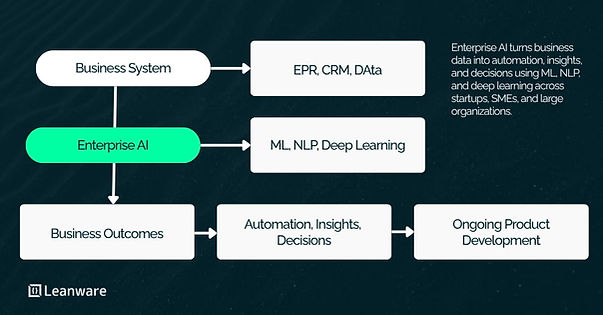
Enterprise AI is not a single product or platform. It is a category of AI applications designed for scale, security, and operational complexity across organizations of different sizes.
It includes machine learning, natural language processing, and deep learning systems that help automate processes, improve decision-making, and extract value from data. These systems are typically integrated into existing workflows and adapted to the specific needs of the business using them.
Enterprise AI vs. Consumer AI
The distinction is important because the two categories are built for fundamentally different environments.
Dimension | Consumer AI | Enterprise AI |
Data source | Generic, public datasets | Proprietary organizational data |
Scale | Individual users | Thousands of concurrent users |
Security | Standard encryption | Data governance, compliance frameworks |
Integration | Standalone apps | Connected to ERP, CRM, databases |
Customization | Limited | Deep, domain-specific tuning |
Accountability | None required | Audit trails, explainability required |
Consumer AI tools are built to be immediately useful to anyone. Enterprise AI is built to be reliably useful within a specific operational context, with the guardrails that context requires.
Key Differentiators: Scale, Security, and Contextual Awareness
Scale in enterprise AI means the system needs to handle petabyte-scale data repositories, process thousands of queries simultaneously, and maintain performance consistency across departments and geographies.
Security requirements go beyond encryption. Enterprise environments involve data governance frameworks, role-based access controls, audit logging, and compliance with regulations like GDPR and CCPA. The AI system itself must operate within those boundaries, not around them.
Contextual awareness is what separates useful enterprise AI from generic automation. A well-implemented system understands the business logic, terminology, and data relationships specific to that organization. That context is what makes outputs actionable rather than just technically accurate.
Why Enterprises Need AI Solutions
The business case for enterprise AI is built on two overlapping pressures: the scale of data that modern organizations generate and the competitive cost of not processing it effectively. Below are the two dimensions that drive most investment decisions.
Managing Data Volume and Complexity
Global data creation is tracking toward 175 zettabytes in 2025, according to Mordor Intelligence's enterprise AI market analysis. The organizations generating that data cannot process it manually.
Customer records, transaction logs, support tickets, sensor outputs, and supply chain events accumulate at a pace that outstrips human analysis capacity by orders of magnitude. Enterprise AI systems classify, extract, and act on that data in near real-time, turning volume from a liability into an operational input.
Productivity and GDP Growth Potential
Goldman Sachs research estimates that widespread AI adoption could lift global labor productivity growth by roughly 1.5 percentage points annually and raise global GDP by approximately 7% over a 10-year period. The same analysts have noted that those gains depend heavily on how well organizations implement AI at the operational level, not just whether they purchase tools.
Companies that quantify AI's impact on specific tasks are already reporting a median productivity gain of around 30% for targeted workflows. The macro impact follows from the micro work of actually restructuring processes around AI capabilities.
Core Types of Enterprise AI Solutions
Enterprise AI covers a broad landscape of tools and capabilities. The six categories below represent the most widely deployed solution types, each addressing a distinct operational challenge.
ERP Optimization
AI applied to enterprise resource planning systems improves how organizations allocate resources across procurement, inventory, HR, and finance. Rather than relying on static rules or historical averages, AI-enhanced ERP continuously analyzes cross-departmental data to surface inefficiencies, forecast demand more accurately, and recommend resource shifts before bottlenecks develop. The value comes from turning a system of record into a system of insight.
Intelligent Automation: RPA and AI-Driven Workflows
Robotic process automation handles rule-based, repetitive tasks by mimicking user actions within existing software. AI-driven automation goes further: it handles unstructured inputs, makes contextual judgments, and adapts to process variations.
The difference is that RPA breaks when the input format changes, while AI-driven workflows can accommodate variation. For operations with high transaction volume and moderate process complexity, combining both approaches in a layered architecture tends to produce the most reliable results.
Predictive Analytics
Predictive analytics uses historical and real-time data to forecast outcomes across sales, supply chain, risk management, and demand planning. A retailer using predictive models to optimize inventory placement reduces both overstock costs and stockout frequency.
A financial institution using predictive scoring for credit decisions improves approval accuracy while reducing default rates. The technology itself is mature; the variable is whether the organization has the data quality and labeling discipline to support model performance.
Conversational AI and Virtual Assistants
Natural language processing powers both customer-facing chatbots and employee-facing assistants. On the customer side, conversational AI handles tier-one support volume, resolves common issues, and escalates complex cases to human agents with full context attached. On the employee side, internal assistants answer HR policy questions, retrieve documentation, and guide users through workflows. Both use cases reduce the volume of routine queries that reach human teams, freeing those teams for higher-judgment work.
Enterprise Search and Knowledge Management
Most organizations have information scattered across wikis, shared drives, CRM records, email archives, and documentation systems. NLP-powered enterprise search unifies that data behind a single query interface, allowing employees to retrieve relevant information regardless of where it lives. This matters operationally because the cost of information fragmentation, in time spent searching or duplicating work, compounds quietly across large teams.
Fraud Detection and Security
Real-time anomaly detection using machine learning identifies transaction patterns that deviate from established baselines. In financial services, this means flagging potentially fraudulent transactions at the point of authorization rather than after the fact.
In enterprise security, similar pattern-recognition logic detects unusual access behavior, network anomalies, and identity threats before they escalate. The advantage over rule-based systems is that machine learning models adapt to new fraud patterns as they emerge, rather than requiring manual rule updates.
Key Enterprise AI Use Cases by Department
The most practical way to evaluate enterprise AI is by business function. Each department has distinct operational problems, and the value of AI in each context comes from solving those specific problems rather than applying general capability.
HR: Hiring, Onboarding, and Talent Development
AI reduces manual workload in resume screening, candidate ranking, and onboarding workflows. More meaningfully, it enables personalized learning paths in training programs by adapting content to each employee's role, progress, and skill gaps.
For large organizations running continuous hiring cycles, the reduction in time-to-hire and improvement in candidate-to-role fit justify the implementation cost.
Sales: Forecasting, Lead Scoring, and Personalization
Predictive lead scoring ranks prospects by likelihood to convert, based on behavioral signals, firmographic data, and CRM history. This concentrates sales effort on opportunities with the highest probability of closing rather than distributing attention equally across the pipeline.
CRM platforms with embedded AI have made this capability more accessible; the organizations extracting the most value from it are those with consistent data hygiene practices in their CRM.
Customer Service: 24/7 Support and Issue Resolution
AI-powered virtual agents handle high-volume, low-complexity support interactions around the clock. The measurable outcome is deflection rate: the percentage of inquiries resolved without human intervention.
Well-implemented conversational AI systems achieve deflection rates between 40 and 70 percent for standard support functions, which translates directly into reduced staffing costs and faster average resolution times.
Finance: Fraud Detection and Financial Forecasting
Real-time transaction monitoring identifies anomalies that rule-based systems miss, particularly for novel fraud vectors that haven't yet been encoded as rules. On the forecasting side, AI models incorporating market signals, internal financial data, and macroeconomic indicators produce more accurate short-term projections than traditional methods. For CFOs managing quarterly planning cycles, improved forecast accuracy has a direct effect on capital allocation decisions.
Engineering and Operations: Predictive Maintenance
Sensor data from industrial equipment feeds machine learning models that predict component failure before it occurs. The operational shift is from reactive maintenance, fixing things after they break, to proactive maintenance, replacing components before the failure window. Manufacturers using predictive maintenance report meaningful reductions in unplanned downtime, which in high-throughput environments translates to significant production value recovered.
Benefits of Implementing Enterprise AI
When enterprise AI is implemented with clear goals and sufficient data readiness, the outcomes fall into three consistent categories.
Increased Efficiency and Productivity
Automation of repetitive, rule-bound tasks frees employees to focus on work that requires judgment, creativity, or relationship management. The productivity improvement is most pronounced in roles with high transaction volume: customer support, data entry, compliance review, and financial reconciliation.
Organizations that have successfully measured AI's impact on targeted workflows are reporting median productivity gains around 30%, according to Goldman Sachs research, though those gains require structured implementation rather than tool deployment alone.
Cost Reduction and Resource Optimization
Direct cost savings come from reduced labor on automated tasks and fewer errors requiring rework. Indirect savings come from better resource allocation: predictive inventory reduces carrying costs, optimized scheduling reduces idle time, and improved fraud detection reduces financial losses.
The compounding effect of multiple small efficiency gains across an organization is usually more significant than any single automation project.
Improved Customer Experience and Loyalty
Personalization at scale is the most impactful customer-facing application of enterprise AI. When recommendation engines, support tools, and communication systems are calibrated to individual customer behavior, the result is interactions that feel more relevant and less friction-prone. For subscription-based businesses, improvement in perceived experience quality has a measurable effect on retention rates.
Challenges and Considerations
Enterprise AI works under the right conditions. Those conditions are not always present by default, and understanding the constraints prevents expensive deployments from underperforming.
Data Quality, Volume, and Accessibility
AI models are only as reliable as the data they train on. Inconsistent labeling, siloed storage systems, incomplete records, and stale data all degrade model performance. Before selecting a platform or defining use cases, a data audit that maps what data exists, where it lives, and what quality it's in is a necessary first step. Organizations that skip this step typically discover the problem mid-implementation.
Security, Privacy, and Regulatory Compliance
GDPR, CCPA, HIPAA, and sector-specific regulations impose requirements on how data is stored, processed, and accessed. An AI system that operates on regulated data needs to have compliance built into its architecture, not patched in afterward. This means access controls, audit logging, data residency options, and model explainability need to be part of the vendor evaluation process from the start.
Integration with Legacy Systems
Most enterprise environments run a mix of modern SaaS platforms and legacy infrastructure. Connecting AI to legacy systems requires APIs, middleware, or data pipeline engineering depending on what the legacy system supports.
This integration work is often underestimated in project planning. Phased rollouts that start with more accessible data sources and expand over time tend to produce more reliable outcomes than big-bang deployments.
How to Implement Enterprise AI: A Strategic Framework
Implementation quality, not tool selection, is what separates organizations that see measurable results from those that accumulate AI pilots that never scale. The framework below reflects how successful enterprise AI programs are structured.
Define Business Goals and Success Metrics
Start with the operational problem, not the technology. What decision do you need to make more accurately? What process takes too long? What information is currently inaccessible?
Defining the problem in business terms produces measurable KPIs: reduction in average handle time, improvement in forecast accuracy, decrease in manual processing cost. Those metrics then govern whether the implementation is working.
Identify High-Impact Use Cases
Prioritize use cases by three criteria: expected ROI, feasibility given current data availability, and organizational readiness to adopt the change. Starting with a use case that scores well on all three builds internal confidence in the technology and produces learnings that improve subsequent deployments.
Assess Data Readiness
Run a data audit before vendor selection. Identify which data sources are relevant to the target use case, evaluate their quality and completeness, and determine what preparation work is required before they can feed an AI system. This audit shapes both the timeline and the vendor requirements for the project.
Choose the Right AI Technology and Vendor
Vendor evaluation criteria should include integration capabilities with your existing stack, scalability to your data volumes, security and compliance certifications, quality of support, and total cost of ownership across implementation, licensing, and ongoing maintenance. The build vs. buy decision depends on whether your use case is standard enough to be served by an off-the-shelf solution or specific enough to require custom development.
Leading Enterprise AI Platforms and Vendors
The enterprise AI platform market is concentrated around a small number of major providers, each with distinct strengths. The right platform depends on your existing infrastructure, primary use cases, and internal technical capabilities.
Google Cloud Vertex AI
Vertex AI is Google Cloud's unified platform for building, deploying, and managing machine learning models at scale. It includes pre-trained APIs for vision, language, and structured data, along with tools for custom model development and agent-building. Its strength is breadth: organizations with diverse AI use cases across departments can work within a single managed environment rather than stitching together multiple tools.
Microsoft Azure AI and Copilot
Azure AI integrates directly with Microsoft 365, making it a natural fit for organizations already running on the Microsoft stack. The Azure AI model catalog covers generative AI, language models, vision, and speech, with built-in content safety features. Copilot embeds AI assistance directly into productivity tools, reducing the adoption friction that comes with asking employees to switch between applications.
IBM watsonx
watsonx is IBM's enterprise AI and data platform, consisting of watsonx.ai for model development, watsonx.data for governed data access, and watsonx Assistant for conversational AI. Its differentiator is governance depth: organizations in regulated industries with strict requirements around data lineage, model explainability, and audit trails find watsonx's architecture fits those constraints more readily than more developer-oriented platforms.
Salesforce Einstein and Agentforce
Einstein AI is native to the Salesforce CRM, which means it operates directly on customer data without the integration work required when connecting an external AI platform to CRM records. Agentforce extends this with autonomous AI agent capabilities that can take actions within Salesforce workflows. For sales-led and customer-experience-focused organizations, the combination of no-code model building and real-time customer data access makes Salesforce the path of least resistance for CRM-adjacent AI use cases.
Is Your Business Ready for Enterprise AI?
Enterprise AI delivers value in efficiency, cost reduction, and customer experience when it is grounded in well-defined business goals, reliable data, and realistic timelines. Many organizations struggle because they choose tools before defining the problem or underestimate the data readiness required.
The market is also expanding quickly. The global enterprise AI market was valued at about $24B in 2024 and is projected to grow at a CAGR of 37.6% through 2030, according to Grand View Research. This growth shows strong adoption, but success depends more on doing it in the right sequence than moving fast.
If you are a startup or scaling company evaluating where to start or scale AI initiatives, Leanware can help you identify the right approach. Whether it’s software development, AI consulting, or building product infrastructure, the starting point is always the same: defining the problem before choosing a solution.
Frequently Asked Questions
How much does implementing an enterprise AI solution typically cost?
Costs vary significantly based on scope, vendor, and deployment model. Cloud-based solutions may start at $50K to $200K annually for mid-sized organizations, while large-scale custom implementations can exceed $1M. Total cost should account for licensing, data migration, integration engineering, employee training, and ongoing support and maintenance.
How long does it take to deploy an enterprise AI solution?
Timelines range from three to eighteen months depending on the complexity of the use case, the degree of integration required, and the state of the organization's data infrastructure. Out-of-the-box SaaS solutions deploy faster; custom-built systems take longer. Phased rollouts, starting with one high-impact use case and expanding, are generally more reliable than simultaneous organization-wide deployments.
Can enterprise AI integrate with existing legacy systems?
Yes, though the complexity varies by system age and architecture. Most modern enterprise AI platforms offer APIs, pre-built connectors, and middleware support for common legacy environments. Compatibility with legacy infrastructure should be evaluated during vendor selection, not after contract signing.
What team or skill sets are needed to manage enterprise AI systems?
Core roles typically include a data engineer, an ML engineer or AI specialist, a business analyst, and a dedicated project lead with either AI or IT background. Many organizations supplement internal capabilities with vendor-managed services or external system integration partners, particularly during initial implementation.
Which enterprise AI solutions are best suited for specific industries?
It depends on both the use case and the compliance environment. Manufacturing benefits from IBM watsonx and Google Vertex AI for predictive maintenance and operations. Financial services align well with Salesforce Einstein and IBM watsonx for CRM and governance requirements. Healthcare implementations frequently use Google Cloud AI and Microsoft Azure AI given their compliance certifications. Retail-focused deployments often center on Salesforce Agentforce and Google Cloud AI for personalization and customer engagement. In all cases, industry-specific regulatory requirements should drive the shortlist.
Is enterprise AI suitable for small and mid-sized businesses?
Increasingly, yes. Many vendors now offer modular, usage-based pricing that makes enterprise AI accessible without enterprise-scale budgets. The most practical approach for SMBs is to identify one or two high-impact, lower-complexity use cases, such as customer service automation or sales forecasting, deploy there first, and use that implementation to build internal capability before expanding.
How do you train employees to work alongside AI systems?
Role-based training programs that explain both what the AI does and what it does not do tend to produce better adoption than generic awareness sessions. AI explainability tools help employees understand why the system is making a given recommendation, which builds trust in the output. Change management and clear communication from leadership about how AI changes workflows, rather than just adding to them, is consistently the difference between adoption and resistance.
What are the risks if an enterprise AI vendor discontinues support or shuts down?
Vendor risk is real and underplanned for in most AI procurement decisions. Mitigate it by ensuring data portability provisions in the contract, requiring open API access to your own model configurations and training data, and negotiating clear exit terms. Maintaining a third-party backup of model configurations and training datasets reduces the recovery cost if a vendor relationship ends unexpectedly.