Monthly Developer Retainer Packages: Benefits and Pricing
Software teams don’t just struggle because of talent gaps. More often, progress slows down because of how the work is structured. Fixed-price contracts run out just when the product starts getting interesting. Hourly billing turns sprint planning into budget discussions. And hiring in-house can take months before anything meaningful ships.
Monthly developer retainer packages take a different approach. You get consistent, structured access to engineering capacity so your product can move at the pace your market demands.
Let’s look at how these retainers work, what they cost, and when to use them.
What Is a Monthly Developer Retainer Package?
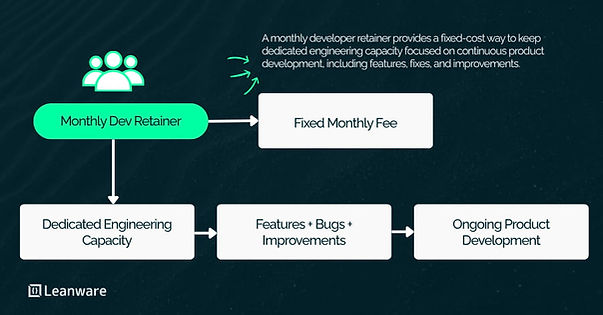
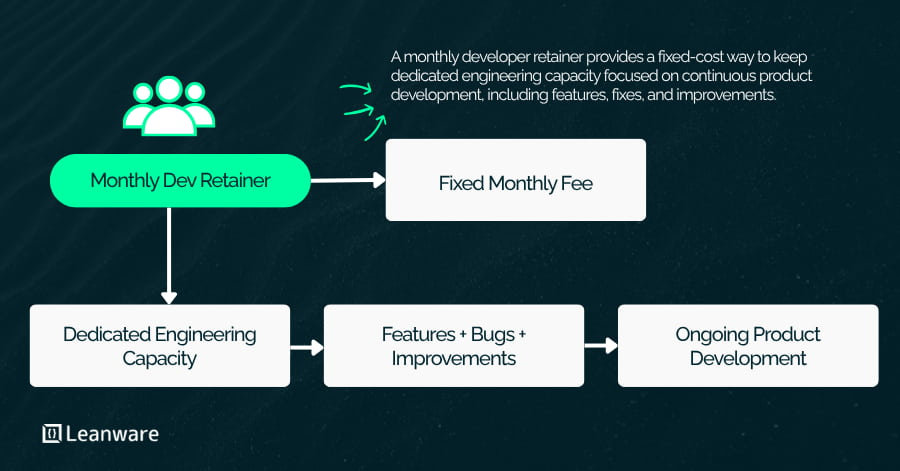
A monthly developer retainer is an agreement where a company pays a fixed monthly fee to secure ongoing engineering capacity. The developer or team works exclusively on your product during that engagement, handling feature development, fixes, optimizations, and whatever the roadmap requires that month.
This is different from hiring a developer by the hour, where the scope and cost float based on usage. It's also different from a traditional fixed-price project, which has a defined deliverable, a deadline, and a contract that expires. A retainer is an ongoing relationship with a defined capacity.
There are a few common structures:
- FTE-equivalent retainer: One full-time developer dedicated to your product, operating like an employee without the overhead of hiring one.
- Hourly block retainer: A set number of pre-purchased hours per month (e.g., 40h, 80h) used against a prioritized task list.
- Squad-based retainer: A cross-functional team (developer + QA + PM) operating as a product pod within your organization.
Each structure fits a different business context, but all three share the same core mechanic: predictable monthly cost, continuous team involvement, and no re-engagement overhead between cycles.
How Retainer Agreements Typically Work
A retainer agreement typically defines the monthly fee, the allocated capacity (either in hours or FTE equivalents), the communication cadence, and the SLA for things like bug response times and deployment windows.
The engagement looks like this: at the start of each month, the client shares prioritized backlog items. The team works through them in a structured sprint, with standups, mid-sprint check-ins, and a delivery review at the end of the cycle. Common configurations include:
- 40 hours/month: Part-time support, ideal for maintenance and minor feature work
- 80 hours/month: Growth-stage iteration with steady roadmap progress
- 160 hours/month: Near full-time capacity for active product development
The fee is fixed regardless of how complex any given task turns out to be, which protects both sides from scope-estimate arguments mid-sprint.
What's Usually Included in a Retainer
Most retainer packages cover feature development, bug fixing, technical debt reduction, performance optimization, DevOps support, code reviews, and QA. Some providers include light product management or sprint facilitation within higher-tier packages.
What's typically excluded: full platform rebuilds, unrelated large-scale projects, or anything that would require a separate discovery phase. Those are usually scoped as standalone fixed-price engagements before transitioning back into retainer work.
Why Companies Are Moving Away From Fixed-Price Projects
Fixed-price contracts work when software requirements stay stable. A project has a clear scope, timeline, and cost, and everyone knows what to expect. The problem is that requirements rarely stay fixed, and this model prioritizes upfront certainty while creating friction once the work begins.
The Problem With Scope-Based Contracts
Scope creep is inevitable in product development. Customer feedback arrives, competitors ship new features, and internal priorities shift. In a fixed-price contract, every one of those changes triggers a change order, a renegotiation, and a delay. The legal and administrative overhead of managing scope changes can consume more time than the engineering work itself.
This friction doesn't just slow delivery. It creates adversarial dynamics between the product team and the engineering vendor, because the vendor's incentive is to hold scope while the client's incentive is to expand it. Neither side is wrong. The contract structure is just misaligned with how real product development works.
Why Hourly Development Creates Budget Uncertainty
Hourly billing shifts the budget risk entirely to the client. When a task turns out to be more complex than estimated, the hours climb and the invoice grows. For a CFO trying to forecast quarterly spend, a variable engineering line item creates a planning problem. It's hard to commit to a roadmap when you can't commit to the cost of executing it.
This unpredictability also slows decision-making. Teams avoid asking for engineering support on smaller improvements because they're unsure what the work will cost. That backlog accumulates into technical debt, and the product gradually falls behind the pace needed to stay competitive.
When a Monthly Retainer Makes the Most Sense
A retainer is not the right model for every engagement. It creates the most value in specific situations where continuity, flexibility, and accumulated team knowledge compound into delivery speed.
SaaS Products in Active Growth
SaaS products don't have a finish line. Once you've shipped an MVP, the roadmap expands: new integrations, performance improvements, enterprise features, pricing experiments. Each sprint generates user feedback that reshapes the next one.
A team that's embedded in that cycle builds the context needed to make good technical decisions quickly. Re-onboarding a new team every quarter breaks that learning loop and slows execution.
Startups Building and Refining MVPs
Early-stage products require iteration above everything else. The initial assumptions about what users want are almost always partially wrong, and the fastest path to product-market fit is cycling through experiments quickly.
That requires engineering capacity that can pivot without renegotiating a contract. A retainer makes the engineering team part of the learning cycle rather than a vendor that needs to be briefed from scratch each time.
Companies Needing Ongoing Optimization and Support
Legacy systems don't fix themselves. If your product has accumulated technical debt, performance bottlenecks, or aging infrastructure, addressing those issues requires sustained effort over time. A retainer creates the dedicated capacity to do that work systematically rather than in reactive bursts after something breaks.
The Strategic Benefits of Developer Retainers
Developer retainers make costs more predictable, speed up delivery, and improve long-term technical alignment, while also giving you priority access to engineering capacity.
Predictable Monthly Costs
The financial planning benefit is real and often underestimated. When your engineering spend is fixed, your CFO can model cash flow accurately.
Quarterly budgets don't get disrupted by a sprint that ran long. That predictability creates confidence in committing to the roadmap rather than hedging every decision with a cost caveat.
Faster Product Iteration
Every time you bring in a new engineering vendor, there's an onboarding cost. The team needs to understand your architecture, your codebase conventions, your deployment process, and your product goals. That takes time, and during that time, velocity is low.
A retainer team stays continuously invested in the product, which means each sprint starts from a higher baseline of context. Over a six-month engagement, that context compounds into meaningfully faster execution.
Long-Term Technical Alignment
Engineers who work on a product long-term develop an understanding that goes beyond code. They understand why certain architectural decisions were made, where the technical risks are, and what the roadmap requires from an infrastructure standpoint. That knowledge doesn't appear in a handoff document. It lives in the team, and it's what prevents expensive mistakes when the product scales.
Priority Access to Engineering Talent
In a retainer model, the team's capacity is reserved for your product. You're not competing with other clients for bandwidth during a critical sprint. That stability matters most when you're operating on a tight launch timeline or responding to a competitive pressure that requires fast execution.
How Monthly Developer Retainers Compare to Other Hiring Models
Here’s how monthly retainers compare with other common hiring models across cost, flexibility, and speed.
Model | Cost Structure | Flexibility | Ramp-Up Time | Best For |
Retainer | Fixed monthly | High | Low (ongoing) | Continuous product development |
Fixed-price project | Per-project | Low | Medium | Clearly scoped, one-time builds |
In-house hiring | Salary + overhead | Medium | High (3-6 months) | Long-term, full-time needs |
Staff augmentation | Hourly/daily | High | Medium | Adding capacity to existing teams |
Retainer vs Fixed-Price Projects
Fixed-price projects work when the scope is genuinely stable and the deliverable is clearly defined before work begins.
If you're building a landing page or a specific integration with known requirements, a fixed-price contract gives you cost certainty and a clean finish line. Retainers work when the product continues evolving after delivery, which is the norm for anything customer-facing.
Retainer vs Hiring In-House Developers
Hiring in-house gives you full control and long-term institutional knowledge, but it comes with significant overhead: recruiting time (typically three to six months to fill a senior role), salary plus benefits, employer taxes, and the risk of attrition. A retainer provides similar continuity without those costs or timelines. For companies that aren't ready to commit to a full-time headcount, it's often the more practical path.
Retainer vs Staff Augmentation
Staff augmentation adds individual developers to your internal team. You manage them directly, assign the work, and coordinate the output. A retainer is a managed delivery model: the provider owns the process, the team operates as a unit, and there's shared accountability for the outcome. The distinction matters if you don't have the internal capacity to manage distributed developers effectively.
What a Typical Retainer Package Looks Like
Retainer packages usually vary based on how much dedicated engineering time you need each month.
40-Hour Retainer (Part-Time Support Model)
This is roughly ten hours per week. It covers bug fixes, minor feature additions, dependency updates, and light performance work. It's well-suited for products that are relatively stable but still need a developer on call rather than waiting for something to break before engaging one.
80-Hour Retainer (Growth Support Model)
Twenty hours per week allows for steady roadmap progress alongside ongoing maintenance. A team can ship meaningful features each month while managing the support load. This is where most growing SaaS products land when they're past the MVP stage but not yet at full-scale.
160-Hour Retainer (Dedicated Developer Model)
This is the equivalent of a full-time developer embedded in your workflow. All of their productive hours go toward your product. For companies with active roadmaps and regular releases, this tier typically produces the fastest velocity because there's no capacity-sharing and no context-switching between clients.
Dedicated Squad Retainer (Dev + QA + PM)
A product pod structure includes a developer, a QA engineer, and a part-time project manager operating as a coordinated unit. This model is particularly effective for scaling SaaS products or complex builds where quality assurance and roadmap management need to keep pace with engineering output.
How Pricing Works in Developer Retainers
Retainer pricing is driven by four variables: seniority level, technology stack, team location, and the number of hours or developers included. These factors compound, so a senior full-stack developer with deep cloud infrastructure experience in a high-cost market costs substantially more than a mid-level developer in a nearshore location.
Nearshore vs Onshore Cost Differences
Geography is one of the biggest cost factors in software development. Average software developer salaries in Latin America range from $53K to $63K USD per year, while equivalent US salary bands typically range from $85K to $160K+. This difference is what drives most of the cost advantage in nearshore retainers.
Nearshore teams in LATAM are often 40 to 60 percent more cost-efficient than comparable US-based developers, depending on experience and role. This allows companies to scale engineering output without increasing headcount at the same rate.
Time zone overlap also helps. LATAM developers usually share several working hours with US teams, which makes day-to-day collaboration smoother compared to offshore setups.
Leanware's nearshore engineering model is built around LATAM talent specifically because the combination of technical depth, time zone alignment, and cost efficiency is hard to replicate in other regions.
How Seniority and Tech Stack Influence Cost
Senior developers cost more, and for good reason. They identify architecture problems before they become expensive to fix, they write code that's easier to maintain, and they require less oversight. For a product at scale, the risk cost of a mid-level developer making an infrastructure decision incorrectly often exceeds the cost difference between seniority tiers.
Stack complexity also affects pricing. A developer working in a standard React and Node.js environment costs less than one who needs deep expertise in, say, distributed systems or specialized cloud infrastructure. Matching the seniority and stack requirements to the actual needs of the product is the most reliable way to avoid overpaying or under-investing.
Risks and Misconceptions About Retainers
A few common concerns around retainers come up repeatedly, but most of them depend more on structure than the model itself.
What If I Don't Use All the Hours?
Unused hours are a legitimate concern, and the answer depends on the provider's rollover policy. Some providers allow limited rollover into the next month. Others don't. The more practical solution is structured sprint planning at the start of each month.
When you prioritize tasks in advance and maintain a well-organized backlog, the hours get allocated before the cycle starts rather than running out at the end of it.
Am I Locked Into a Long-Term Contract?
Retainer agreements vary. Some providers require a minimum three-month commitment to account for onboarding. Others offer month-to-month flexibility. The right structure depends on your roadmap certainty.
If you have a clear six-month product plan, a longer commitment often comes with better rates. If your direction is still evolving, a shorter initial term lets you test the engagement before committing further.
Isn't a Retainer Just Expensive Maintenance?
This framing misunderstands what a retainer is for. Maintenance keeps a product running. A retainer keeps a product moving forward.
The distinction is the roadmap orientation: a well-run retainer is measured against product goals, not just uptime metrics. If the team is shipping features, reducing technical debt, and improving performance month over month, the engagement is functioning as growth infrastructure, not a support contract.
How to Structure a High-Performance Retainer Agreement
The effectiveness of a retainer depends less on the model itself and more on how clearly it is structured from the start.
Define Clear Scope Boundaries
Ambiguous scope is the most common reason retainers underperform. Before the engagement starts, both sides should agree on what work falls within the monthly capacity and what requires a separate conversation. This doesn't mean being rigid. It means being explicit so that expectations don't drift apart mid-engagement.
Establish KPIs and SLAs
Performance metrics for a retainer typically include sprint delivery rate, bug response time (usually tiered by severity), deployment frequency, and code review turnaround. SLAs for production incidents should be explicit from day one. Without these benchmarks, there's no objective way to evaluate whether the engagement is delivering value or sliding into reactive mode.
Align the Retainer With the Product Roadmap
The monthly sprint should map to where the product needs to be in six months, not just what's broken this week. That requires quarterly roadmap reviews where the retainer team understands the product direction well enough to make proactive recommendations. Leanware's engagement models are designed around this kind of roadmap alignment rather than transactional task delivery.
Is a Monthly Developer Retainer Right for Your Business?
Whether a retainer fits depends on how clearly defined your roadmap and ongoing development needs are.
Signs You're Ready for a Retainer
Your product has an active roadmap with at least three months of identified work. You have recurring development needs that don't fit neatly into a single project. You've experienced the cost of re-onboarding vendors repeatedly and want continuity. You're scaling a SaaS product and need engineering capacity that can keep pace with the product organization.
For teams at this stage, a dedicated software engineering partner structured around a retainer is often more effective than the alternatives.
Signs You're Not Ready Yet
Your product direction isn't defined enough to give a team clear priorities. You have a one-time build with genuinely stable requirements. Your internal development team has more capacity than work right now. In those cases, a fixed-price project or staff augmentation is the more appropriate structure.
Your Next Step
Software development is not a transaction. It’s an ongoing function that shapes how fast your product moves, how stable it runs, and how well it serves users over time. Treating it as a series of disconnected projects creates friction at every handoff and resets context each time.
A monthly developer retainer package creates something more durable: an engineering team that understands your product, works around your roadmap, and stays accountable to your product goals month after month.
Stop re-onboarding vendors every quarter. Leanware's monthly developer retainers give you dedicated LATAM engineering talent at a fixed cost - so your roadmap moves at the pace your market demands. Contact our team TODAY.
Frequently Asked Questions
What is a monthly developer retainer package?
A monthly developer retainer package is an agreement where a company pays a fixed monthly fee to secure ongoing access to engineering capacity. Instead of hiring per project or per hour, businesses retain dedicated development support for continuous improvements, maintenance, and feature development.
How does a developer retainer work?
A developer retainer allocates a fixed number of hours or a dedicated developer each month. The client pays a predictable monthly fee, and the engineering team works on prioritized tasks aligned with the product roadmap within structured sprint cycles.
What is included in a monthly developer retainer?
Most retainers include feature development, bug fixes, technical debt reduction, performance optimization, DevOps support, and ongoing product improvements. Large one-time rebuilds or unrelated projects are typically handled separately.
How much does a monthly developer retainer cost?
The cost depends on seniority, technology stack, team location, and allocated hours. Part-time retainers (40 hours/month) can start in the low thousands per month. A dedicated full-time developer or small squad retainer will range significantly higher. Nearshore LATAM teams typically cost 40 to 60 percent less than equivalent US-based capacity.
Is a developer retainer better than a fixed-price project?
A developer retainer is better for products that require continuous iteration and flexibility. Fixed-price projects work well for clearly defined scopes, but retainers provide more adaptability and long-term strategic alignment for evolving products.
What's the difference between a retainer and staff augmentation?
A retainer focuses on securing ongoing engineering capacity under a structured agreement with roadmap alignment and defined deliverables. Staff augmentation typically means adding individual developers to your internal team without the provider taking ownership of delivery outcomes.
When should a company use a developer retainer?
Companies should consider a retainer when they have an active product roadmap, recurring development needs, or require ongoing technical support. It works particularly well for SaaS businesses and growing startups past the initial build phase.
What happens if you don't use all retainer hours?
Policies vary by provider. Some allow limited hour rollovers, while others encourage proactive roadmap planning to fully utilize allocated capacity. Structured sprint planning at the start of each month is the most reliable way to maximize value.
Are developer retainers long-term contracts?
Retainers can be monthly, quarterly, or annual. Many providers offer flexible agreements to adapt to business needs, though some require minimum commitments to justify the onboarding investment on their side.
Do retainers improve development speed?
Yes, over time. Because the engineering team stays continuously involved, they build deep product knowledge that reduces onboarding time, context-switching, and communication friction. That accumulated context translates directly into faster execution month over month.