Hire Nearshore AWS App Runner Engineer
If you run containerized web services on AWS and your team doesn't have dedicated infrastructure coverage, you're absorbing more DevOps work than your sprint velocity can handle. Every delayed deployment, every scaling incident traced back to a misconfigured service, every weekend alert about an IAM permission issue - these are operational costs that compound quietly until they consume a sprint, then a quarter.
An AWS App Runner engineer reduces that load by owning deployment, scaling, and service reliability so your team isn’t pulled into infrastructure work every time something breaks.
Let’s look at what the role includes, when App Runner is the right infrastructure choice, and how to hire a nearshore engineer who can handle it independently.
What Is AWS App Runner?
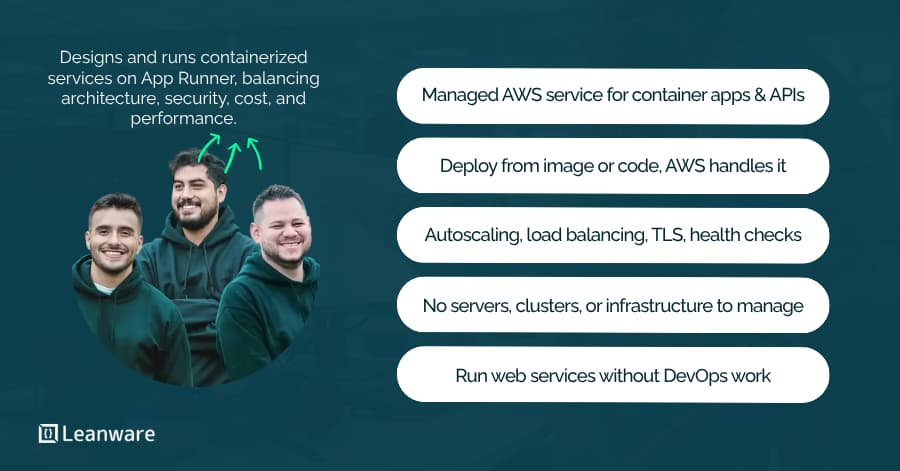
App Runner is a fully managed AWS service for deploying containerized web applications and APIs. You point it at a container image or a source repository, configure a few parameters, and AWS handles the rest: load balancing, TLS termination, auto-scaling, and health checks. There is no cluster to manage, no EC2 instances to patch, no service mesh to configure.
AWS launched App Runner in 2021 as an answer to the operational burden of running containers on ECS or EKS when you don't need that level of control. It became a practical option for startups and product teams that wanted AWS-native infrastructure without the DevOps overhead.
A note on current status: AWS has officially announced that App Runner will no longer accept new customers starting April 30, 2026. Existing customers continue using the service without disruption, and AWS maintains security and availability. For new deployments, AWS now recommends ECS Express Mode, a capability inside Amazon ECS that delivers the same deployment simplicity App Runner was designed for, with broader production controls.
This changes the hiring conversation in one specific way: the engineer you hire for App Runner work today is the same engineer you need to manage existing workloads and plan the ECS Express Mode transition. The patterns are the same. IAM design, VPC integration, container optimization, CI/CD pipelines - none of that changes between the two services. Hiring this expertise now means you have infrastructure coverage that can execute the migration on your timeline, not AWS's.
What Does an AWS App Runner Engineer Actually Do?
The actual scope of work is broader. An engineer in this role owns the full lifecycle of containerized services deployed on App Runner, and that includes decisions that affect security, cost, uptime, and developer velocity.
Architecture and Infrastructure Design
The first architectural decision is whether App Runner fits the workload at all. A qualified engineer evaluates this against traffic patterns, database architecture, and service boundaries. For straightforward web APIs or isolated microservices, App Runner is usually the fastest path to production. For services that need inter-container communication, advanced load balancer routing, or fine-grained task placement, ECS or ECS Express Mode is a better fit.
When App Runner is the right call, the engineer designs the service configuration: instance memory and CPU sizing, concurrency settings, health check parameters, and port bindings. They also connect the service to other AWS resources - RDS via VPC connectors, DynamoDB, S3, Secrets Manager - and make those connections work correctly from both a security and latency standpoint.
CI/CD and Automated Deployments
App Runner integrates directly with GitHub and Amazon ECR, which makes automated deployments straightforward to configure. The engineer sets up the pipeline: repository connection, build configuration, image tagging strategy, and deployment triggers. For production services, this typically means separating build from deploy, adding image vulnerability scanning, and configuring rollback behavior for failed health checks.
A well-built pipeline means developers push code and the deployment takes care of itself. A poorly built one means someone is manually rebuilding images or debugging a half-deployed service late on a Friday.
Security and IAM Configuration
IAM is where App Runner deployments most often go wrong. App Runner services run with an instance role that grants access to other AWS resources. If that role is too permissive - which happens when engineers are moving fast under deadline - you create a blast radius problem. A single compromised container can access every S3 bucket, every RDS instance, or every secret the role allows.
A competent engineer builds the instance role with least-privilege access, scoped precisely to what the service needs. They also configure VPC connectors so database connections stay inside a private subnet and are never exposed to the public internet. Private services require explicit configuration because App Runner defaults to public endpoints.
Performance and Cost Optimization
App Runner's pricing model charges for provisioned instances even when they're idle, unless auto-scaling is configured to pause them. Getting this wrong in either direction costs money. Scale too aggressively and you pay for unused capacity. Scale too conservatively and cold starts create latency spikes under real load.
The engineer monitors concurrency metrics in CloudWatch, tunes max concurrency per instance, and sets scaling thresholds that match actual traffic patterns. For production services with variable load, this requires iterating on configuration after deployment, not just setting it once before launch.
Why Hire a Nearshore AWS App Runner Engineer?
A full-time US-based senior cloud engineer runs roughly $140K to $180K per year in total compensation. If your App Runner deployment is one service among many, or if your infrastructure needs are growing but not yet at the scale that justifies a full-time US hire, that spend doesn't match the workload.
Nearshore engineers based in Latin America close that gap. They work within one to three hours of US Eastern time, which keeps the collaboration model intact: standups happen live, code reviews happen same-day, and production incidents don't wait for someone in a distant timezone to wake up.
Nearshore vs Onshore vs Offshore
Model | Time Zone Overlap | Cost vs US | Collaboration Quality |
Onshore (US) | Full | Baseline | High |
Nearshore (LATAM) | 1-3 hrs difference | 40-60% less | High |
Offshore (Asia/EU) | 8-12 hrs difference | 50-70% less | Lower |
The offshore cost advantage is real, but it comes with an async collaboration tax. Code reviews happen the next day. Production incidents go unaddressed for hours.
Architecture discussions require carefully written specs instead of a 30-minute call. For cloud infrastructure work specifically, where production issues don't follow business hours, that time zone gap has a real operational cost.
Why LATAM Is Ideal for AWS Engineering
Latin America has a growing concentration of AWS-certified cloud engineers, with strong experience across cloud infrastructure, DevOps, cybersecurity, and modern application platforms.
For startups, this opens access to senior-level engineering talent at a significantly lower cost than US-based contractors. Engineers in Mexico, Colombia, Brazil, and Argentina regularly support production AWS environments, including containerized workloads, CI/CD pipelines, and scaling systems.
Typical rates range from $35 to $70 per hour for senior engineers, compared to $75 to $150 for equivalent US contractors. This reflects regional cost differences, not a gap in capability.
For teams building on AWS, especially early-stage or scaling startups, nearshore hiring is a straightforward way to extend engineering capacity without slowing down delivery.
How to Find a Nearshore AWS App Runner Engineer
AWS certifications are useful but not sufficient on their own. What you're actually evaluating is whether the candidate has built and maintained App Runner services in production environments - not just deployed a test service.
Key Skills to Look For
The core technical requirements are:
- Docker and container image optimization, including multi-stage builds, layer caching, and vulnerability scanning
- AWS IAM design with demonstrated least-privilege patterns at the service level
- VPC networking: subnets, security groups, VPC connectors, and private endpoint configuration
- CI/CD pipelines using GitHub Actions, GitLab CI, or AWS CodePipeline
- Infrastructure-as-Code with Terraform or AWS CDK
- CloudWatch for logs, metrics, and alerting, with real experience diagnosing production issues
For engineers inheriting existing App Runner workloads with a migration ahead, add ECS and ECS Express Mode experience to that list.
Questions to Ask Before Hiring
These scenario-based questions reveal practical depth faster than theory questions do:
- Walk me through configuring a private App Runner service that connects to an RDS instance in a private subnet. What breaks if you skip the VPC connector?
- Your App Runner service is scaling to max instances but response times are still degraded. What do you investigate first?
- How would you design the IAM instance role for a service that needs to read from S3, write to DynamoDB, and pull credentials from Secrets Manager?
- A deployment is failing health checks and the service hasn't rolled back automatically. What's your manual recovery process?
Candidates with real production experience answer these from memory. Candidates who've only worked through tutorials hesitate at the failure modes.
When Should You Choose App Runner Over ECS or EKS?
App Runner is the right choice when deployment speed is your primary constraint and operational overhead is your secondary one. That means:
- You are deploying a web API or internal service that doesn't require custom inter-container networking
- Your team lacks dedicated DevOps capacity to manage ECS clusters or Kubernetes infrastructure
- Traffic patterns are predictable enough that App Runner's scaling model won't create cost surprises
- You are running a staging or development environment where iteration speed matters more than infrastructure control
ECS fits when you need service mesh configurations, advanced task placement, or tight orchestration with other AWS services. EKS makes sense when you're already running Kubernetes elsewhere and need infrastructure consistency. For most early-stage SaaS products and internal APIs, App Runner has historically delivered faster time to production with less operational risk.
For new deployments from late April 2026 onward, ECS Express Mode is the equivalent path. An engineer who understands App Runner deeply has the context to evaluate that choice correctly from day one.
Common Mistakes Companies Make with AWS App Runner
These are the ones that appear most consistently in real production environments:
Skipping VPC connector configuration: App Runner services connect to public AWS endpoints by default. Anything inside a VPC - RDS, ElastiCache, internal APIs - requires a configured VPC connector. Teams skip this during initial setup because the service deploys without it, then have to retrofit it when they realize their database needs to stay private.
Overly broad IAM instance roles: Attaching broad permissions to an App Runner service role because it's faster to configure is common and creates real exposure. Scope instance roles to exactly what the service needs, and audit them before going to production.
No auto-scaling pause configuration: Provisioned instances cost money even when idle. For non-production environments, configuring instances to pause after inactivity meaningfully reduces cost. Most teams skip this until they see the monthly bill.
Unstructured logging with no alerting: App Runner sends logs to CloudWatch by default, but raw logs without structured formats and alerting thresholds are hard to query when something breaks. Set log retention policies and build error-rate and latency alerts before you need them, not after an incident.
Cost of Hiring a Nearshore AWS App Runner Engineer
Rates vary by experience level and engagement model for LATAM cloud engineers:
Level | Monthly Retainer (Approx.) |
Mid-level (2-4 yrs) | $4K - $6K |
Senior (5+ yrs) | $7K - $10K |
Lead/Architect | $10K - $14K |
A US-based equivalent at senior level runs $12K to $18K per month when you account for base salary, benefits, and employer taxes. The nearshore alternative at $7K to $10K covers the same technical scope with matching time zone availability.
For staff augmentation engagements, the rate typically includes HR, compliance, and benefits management, which removes the administrative overhead of direct international hiring.
Dedicated Engineer vs On-Demand Squad
A dedicated engineer makes sense when you have ongoing infrastructure work: active development cycles, regular deployments, and production incidents that need a consistent owner. The engineer learns your architecture, your codebase patterns, and your team's working style. That context builds over time and makes incident response faster.
An on-demand squad fits better for a scoped migration project, an infrastructure audit, or a one-time build-out. You get focused delivery capacity for a defined period without a long-term headcount commitment.
Both approaches are available through Leanware's engagement models. The choice depends on whether your infrastructure needs a consistent owner or a burst of delivery capacity.
Why Companies Choose Leanware for AWS Cloud Engineering
Leanware sources and embeds senior engineers from Latin America into US and European product teams. The engineers are vetted for production experience in AWS environments, not just certifications. For cloud roles specifically, Leanware's screening evaluates whether a candidate has operated infrastructure under real conditions - variable load, IAM incidents, database failures - not whether they passed a multiple-choice exam.
Two things differentiate Leanware from a freelancer marketplace. First, engineers work on structured long-term contracts, which means you get continuity rather than churn. Second, Leanware incorporates AI-driven delivery workflows into its engineering process, which means the engineers working on your infrastructure are working with more tooling context and less friction than a standard contractor arrangement.
For teams that need cloud infrastructure alongside digital product development capacity, Leanware can scope a multi-role team rather than a single hire.
Is a Nearshore AWS App Runner Engineer Right for You?
If you have existing App Runner workloads and no dedicated infrastructure owner, the answer is probably yes. You need someone who can stabilize production, address configuration debt, and build a migration path to ECS Express Mode before the timeline becomes a constraint rather than a choice.
If you are evaluating App Runner for new infrastructure, the considerations are different. The right engineer for this role understands both App Runner and ECS Express Mode as implementations of the same deployment philosophy, not as separate specialties. Hiring that expertise now means your infrastructure coverage doesn’t become a liability the next time AWS changes direction on a managed service.
You can also connect with us to evaluate your AWS App Runner setup, hire a nearshore engineer, or build a team that can manage your containerized infrastructure at scale.
Frequently Asked Questions
What does an AWS App Runner engineer do?
An AWS App Runner engineer designs, deploys, and operates containerized web services on App Runner. That includes building CI/CD pipelines, writing scoped IAM policies, configuring VPC connectors for private resource access, setting up CloudWatch monitoring, and tuning scaling configuration for cost and performance.
When should I use AWS App Runner instead of ECS or EKS?
App Runner fits web APIs and services where deployment speed matters more than infrastructure control. ECS or EKS are better suited for complex microservices architectures that require advanced orchestration or custom networking. For new deployments after April 2026, ECS Express Mode delivers comparable simplicity to App Runner within the ECS service.
Is AWS App Runner good for production workloads?
Yes, for existing customers. App Runner supports automatic scaling, load balancing, TLS, VPC integration, and CloudWatch observability. New customers should note the April 2026 availability change and evaluate ECS Express Mode, which AWS recommends for new containerized deployments.
What skills should a nearshore AWS App Runner engineer have?
Docker, AWS IAM, VPC networking, CI/CD pipelines, CloudWatch, and Infrastructure-as-Code tools like Terraform or AWS CDK. For engineers taking over existing App Runner workloads with a migration planned, ECS experience adds practical value.
How much does it cost to hire a nearshore AWS App Runner engineer?
Senior engineers in LATAM run approximately $7K to $10K per month on a dedicated retainer. A comparable US hire costs $12K to $18K per month when factoring in salary, benefits, and employer taxes.
What are the benefits of hiring nearshore instead of offshore?
Time zone overlap of one to three hours means live standups, same-day code reviews, and real-time production incident response. Offshore engineers cost slightly less but require async communication patterns that add latency to every collaboration touchpoint - a real liability in infrastructure work.
Can AWS App Runner connect to private databases?
Yes. VPC connectors allow App Runner services to connect to private RDS instances, internal APIs, and other resources inside a VPC. Without a configured VPC connector, the service can only reach public AWS endpoints.
Does AWS App Runner support automatic scaling?
Yes. App Runner scales based on incoming requests. You configure maximum concurrency per instance and maximum instance count. The service scales down when traffic drops, which reduces cost for low-traffic or non-production services.
Is AWS App Runner serverless?
Not exactly. App Runner is fully managed and abstracts underlying infrastructure, but it runs containers rather than functions. It's closer to a managed container platform than a serverless runtime like Lambda.
How long does it take to deploy an app using AWS App Runner?
A basic deployment takes minutes once a repository or ECR image is connected. A production-ready deployment, with proper IAM configuration, VPC connectors, monitoring, and a CI/CD pipeline, typically takes one to two days of focused engineering work.