Boutique vs Traditional Development Company: Key Differences Explained

Selecting the right software development partner is one of the most critical decisions a founder, CTO, or product leader will make. Your development company doesn’t just write code—they influence your speed to market, product quality, scalability, and even how efficiently your budget is used.
When evaluating options, most teams narrow the choice down to two models: boutique development companies and traditional development companies. On the surface, both promise to build software, deliver features, and meet deadlines. But in practice, the way they operate and the results they produce can be dramatically different.
The boutique vs traditional development comparison is designed to help startups, SMBs, and growing SaaS businesses clearly understand how boutique and traditional firms differ, where each model works best, and how to choose the right partner based on your product stage, budget, and collaboration style.
What is a boutique development company?
A boutique development company is a small, specialized software firm that focuses on high-quality delivery, close collaboration, and tailored solutions. These companies are intentionally lean, often consisting of senior engineers, technical leads, and founders who stay hands-on with client work.
Boutique firms typically:
- Operate with small, senior-led teams
- Offer high-touch, personalized service
- Focus on specific domains like SaaS, AI, fintech, or marketplaces
- Maintain short decision-making cycles
- Prioritize long-term partnerships over volume
Because of their size, boutique companies work best with startups, scaleups, and SMBs that value agility, transparency, and direct access to experienced engineers.
Rather than acting as an outsourced vendor, a boutique firm often functions as an extension of the client’s internal team, contributing to product strategy, architecture decisions, and technical direction.
What is a traditional development company?
A traditional development company is usually a larger organization built to deliver software at scale. These firms often operate offshore or nearshore and serve enterprise clients, government organizations, or companies with large, predictable workloads.
Typical characteristics include:
- Large teams with mixed seniority levels
- Layered structures (account managers, PMs, BAs, QA, developers)
- Standardized processes and methodologies
- Longer approval and decision cycles
- Emphasis on contracts, scope, and utilization
Traditional firms are well-suited for organizations that require large teams, fixed scopes, formal governance, and compliance-heavy environments.
However, their size and structure can make them less adaptable to fast-changing product requirements or early-stage experimentation.
Boutique vs Traditional Development Company
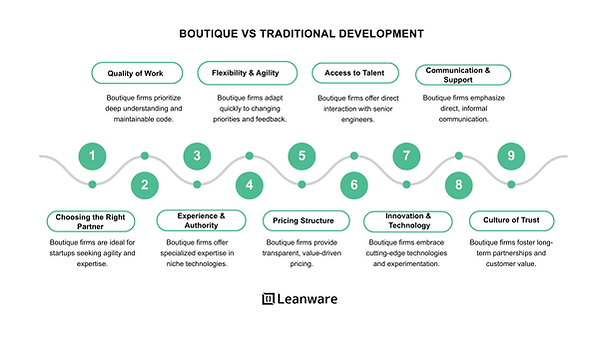
1. Quality of Work and Customer Satisfaction
One of the biggest differences between boutique and traditional development companies is how quality is achieved and maintained.
Boutique firms typically assign fewer clients per team, allowing developers to deeply understand the product, business model, and end users. This results in:
- Better architectural decisions
- Cleaner, more maintainable code
- Fewer misunderstandings and rework cycles
Customer satisfaction tends to be higher because communication is direct and accountability is clear.
Traditional firms, on the other hand, often manage dozens—or hundreds—of clients simultaneously. With higher client-to-developer ratios and frequent handoffs between roles, product context can be lost. While processes help maintain consistency, they don’t always guarantee quality tailored to a specific business.
2. Experience & Industry Authority
Experience is not just about years—it’s about relevance and depth.
Boutique development companies usually build deep expertise in a narrow set of industries or technologies. For example, a boutique firm may specialize exclusively in SaaS platforms, AI-powered products, or fintech applications. This allows them to:
- Anticipate common pitfalls
- Reuse proven patterns
- Offer strategic guidance beyond implementation
Traditional firms often bring broad experience across many industries. While this can be helpful for generic systems, it may result in more templated solutions that don’t fully align with modern product expectations or startup realities.
The choice here is clear:
- If you need specialized insight → boutique
- If you need generalized delivery at scale → traditional
3. Flexibility, Agility, and Client Focus
Startups and growing businesses change fast. Your development partner must be able to adapt just as quickly.
Boutique firms are designed for agility. When priorities shift, features change, or user feedback demands a pivot, small teams can respond immediately. Processes are tailored to the client, not the other way around.
Traditional firms often rely on fixed methodologies, predefined scopes, and formal change requests. While this reduces risk for large organizations, it can slow innovation for early-stage products.
Real-world example: A startup discovers mid-sprint that users don’t want Feature A but urgently need Feature B.
- Boutique firm: reprioritizes backlog within days
- Traditional firm: requires approvals, scope changes, and renegotiation.
4. Pricing Structure and Transparency
Pricing models differ significantly between the two approaches.
Boutique development companies typically offer:
- Hourly or monthly pricing
- Clear visibility into who is working on your product
- Minimal overhead costs
Traditional firms often bundle pricing to include management layers, administrative overhead, and standardized delivery processes. While the hourly rate may appear lower, inefficiencies can inflate the final cost.
A key consideration is value per hour, not just cost per hour. Boutique firms often deliver senior-level output consistently, reducing rework and long-term maintenance costs.
5. Access to Talent: Senior Experts vs Management Layers
With boutique firms, clients usually interact directly with:
- Senior developers
- Technical leads
- Founders
This direct access accelerates problem-solving, improves alignment, and reduces miscommunication.
In traditional development companies, communication often flows through account managers or project managers. While this structure supports scale, it can slow feedback loops and distance clients from the people actually building the product.
For complex or evolving products, direct access to senior talent is often a decisive advantage.
6. Innovation & Adaptation to Technology
Technology evolves quickly—especially in areas like AI, DevOps, cloud infrastructure, and modern frontend frameworks.
Boutique firms are often early adopters. Smaller teams can experiment, test new tools, and integrate emerging technologies without extensive internal approvals.
Traditional firms may be slower to innovate due to:
- Legacy tech stacks
- Risk-averse policies
- Enterprise client constraints
If your product relies on modern tooling or cutting-edge approaches, a boutique partner is often better positioned to move fast.
7. Support, Communication, and Client Relationship
Communication style is where many founders feel the difference immediately.
Boutique companies typically emphasize:
- Direct Slack or shared channels
- Weekly or bi-weekly check-ins
- Transparent progress updates
- Founder or lead involvement
Traditional firms often rely on:
- Ticketing systems
- Scheduled status meetings
- Formal reporting
While structured communication works for large enterprises, startups often prefer fast, informal access to their development team.
8. Culture of Trust and Customer Value
Boutique firms typically establish their reputation through referrals, long-term partnerships, and repeat business. This encourages a culture focused on trust, ownership, and customer value.
Traditional firms often operate on long contracts and fixed scopes, which can shift focus toward contract compliance rather than flexibility or experimentation.
For founders looking to co-build rather than outsource, cultural alignment matters as much as technical skill.
9. Choosing the Right Development Partner
Before choosing a partner, ask yourself:
- Do I need speed or scale?
- Do I want direct access to senior engineers?
- How often will requirements change?
- Is collaboration or predictability more important?
- What level of technical guidance do I expect?
Conclusion
Boutique and traditional development companies serve fundamentally different needs.
Traditional firms excel in large-scale delivery, standardized processes, and enterprise environments. Boutique firms thrive on agility, innovation, and close collaboration.
For startups and SMBs building modern SaaS products, partnering with ideal boutiques is always important. Our team at Leanware offers senior expertise, transparent communication, and the flexibility needed to move fast without sacrificing quality.
FAQs
What specific hourly rates should I expect from boutique vs traditional firms by technology stack?
Boutique firms typically charge $50–$150/hr, depending on stack and seniority (React, Node, Python, AI). Traditional firms often range from $30–$100/hr, but with more junior-heavy teams.
What happens when my boutique dev shop's key developer leaves mid-project?
Strong boutiques mitigate this risk through documentation, shared ownership, redundancy, and founder oversight.
How do I transition from a traditional firm to a boutique (with an actual migration plan)?
- Audit code and infrastructure
- Define knowledge transfer timelines
- Onboard the boutique team in phases
- Align tools and workflows
- Clearly assign responsibilities
What are the actual response times for bug fixes: boutique vs traditional?
Boutique firms often respond within 24 hours or less, while traditional firms rely on ticket-based workflows with 48+ hour SLAs.
How do boutique firms handle 24/7 support requirements?
Most don’t offer native 24/7 support but can provide on-call rotations, monitoring integrations, or partner-based coverage.
What's the typical contract termination process and cost for each model?
Boutique firms usually offer monthly contracts or 30-day notice periods. Traditional firms may require 6–12-month commitments with early termination fees.
Which certifications (SOC 2, ISO) are more common in boutique vs traditional firms?
Traditional firms more commonly hold SOC 2 or ISO 27001. Boutique firms typically pursue certifications only when required by regulated industries.
How do I evaluate code quality between boutique and traditional deliverables?
Review architecture, testing practices, documentation, and static analysis tools like SonarQube.
What's the real timeline difference for MVP development: 3 vs 30 developers?
Senior-led teams of 3–5 developers often deliver MVPs faster due to fewer handoffs and less coordination overhead.
When does a boutique firm become too small (warning signs)?
Red flags include lack of documentation, no backup developers, missed deadlines, founder-only communication, and inability to scale when needed.
For a fuller list, see the red flags when choosing a software development company.