Cloud Software Development Life Cycle Guide 2025
Cloud SDLC uses the power of cloud computing to deliver scalable, flexible, and continuously evolving applications.
This new perspective shifts the focus from static, hardware-bound processes to dynamic, automated workflows that accelerate innovation while managing complexity and risk.
Key Takeaways
- It emphasizes agile, iterative workflows for faster feature releases and continuous delivery.
- Infrastructure as Code (IaC) and CI/CD pipelines automate deployment, ensuring speed, consistency, and reduced manual effort.
- DevSecOps integrates security into every stage of development, ensuring data protection and compliance.
- Utilizes cloud-native tools and architectures like containers, Kubernetes, and serverless services to improve scalability, availability, and resilience.
In this article, you will learn what Cloud SDLC is, how it differs from traditional models, and its key development phases
What Is the Cloud Software Development Life Cycle?
The Cloud Software Development Life Cycle (Cloud SDLC) is a structured, iterative process for designing, building, testing, deploying, and maintaining software applications specifically for cloud environments.
Unlike traditional SDLC, which often targets on-premises infrastructure, Cloud SDLC leverages cloud-native principles, services, and architectures—such as microservices, serverless computing, and continuous integration/continuous deployment (CI/CD)—to deliver scalable, resilient, and cost-effective solutions.
Definition and Key Differences from Traditional SDLC
Aspect | Traditional SDLC | Cloud SDLC |
Infrastructure | On-premises servers, manual provisioning | Cloud-based, automated provisioning, Infrastructure as Code (IaC) |
Architecture | Monolithic or layered | Microservices, serverless, distributed systems |
Deployment | Manual, infrequent, often downtime-prone | Automated, frequent, zero-downtime (CI/CD pipelines) |
Scalability | Limited, hardware-bound | Elastic, on-demand scaling via cloud services |
Security | Perimeter-based, post-development | Integrated (DevSecOps), continuous monitoring |
Cost Model | Upfront capital expenditure | Pay-as-you-go, operational expenditure |
Development Model | Waterfall, sometimes Agile | Agile, DevOps, rapid iteration, continuous delivery |
Maintenance | Manual updates, slow cycles | Automated updates, rapid patching, continuous improvement |
Why It Matters in 2025
- Business Agility: In 2025, organizations must respond quickly to market changes. Cloud SDLC enables faster release cycles, allowing businesses to innovate and adapt rapidly.
- Cost Efficiency: The pay-as-you-go model and automation reduce infrastructure and operational costs, making software development more accessible and scalable.
- Scalability and Resilience: Cloud-native applications can scale automatically to meet demand and recover quickly from failures, which is critical for modern digital services.
- Security and Compliance: With increasing cyber threats, integrating security throughout the SDLC (DevSecOps) is essential for protecting data and maintaining compliance.
- Support for Modern Architectures: Trends like serverless computing, edge computing, and AI-driven management are becoming mainstream, and Cloud SDLC is designed to leverage these technologies for maximum efficiency and innovation.
- Remote and Distributed Teams: Cloud SDLC supports global collaboration, enabling teams to work from anywhere and access shared resources securely and efficiently
Cloud SDLC Phases

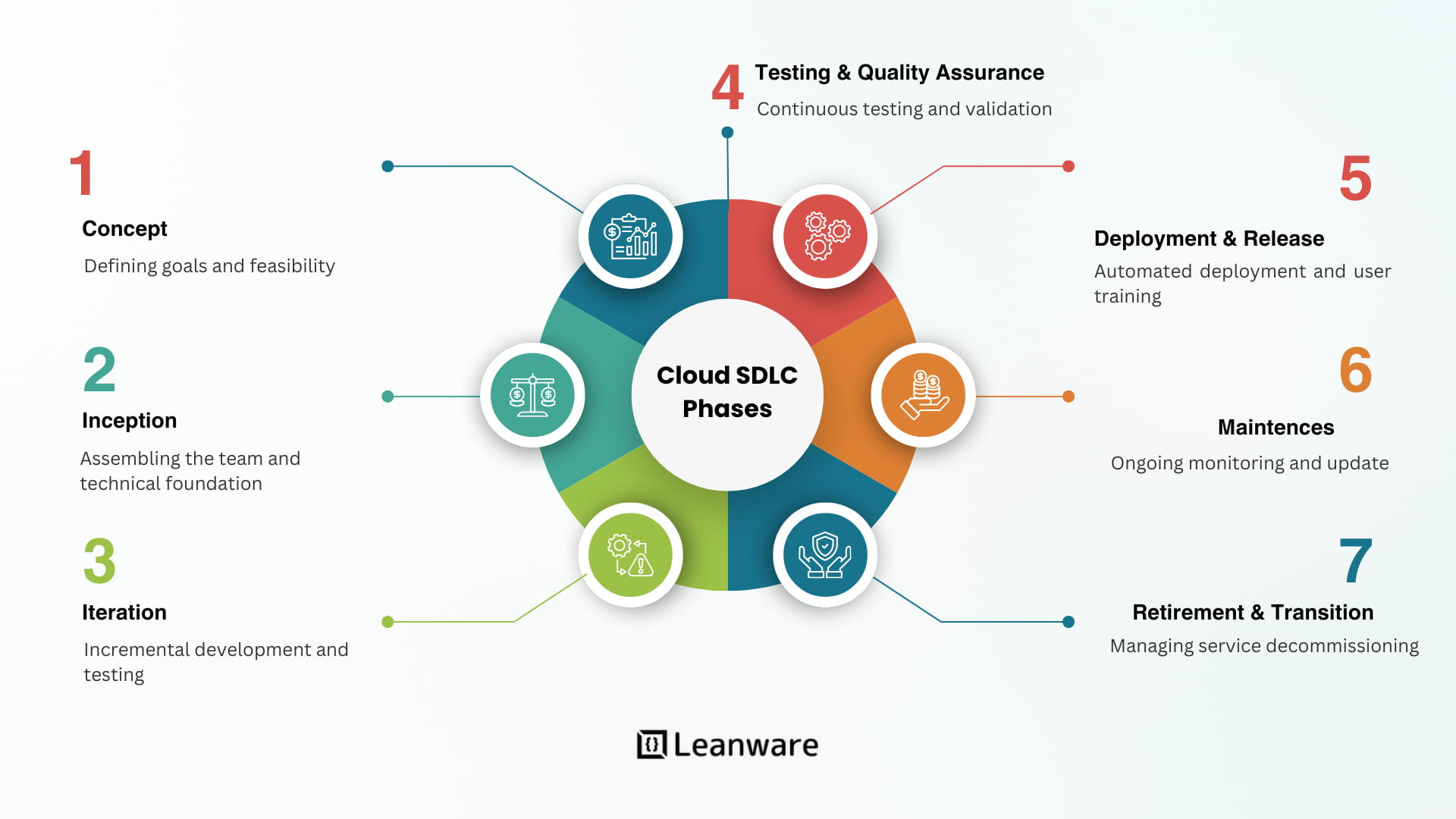
The software development life cycle is structured around seven key phases, each playing a critical role in delivering adaptive, high-quality software.
1. Concept
In this phase, the product owner and stakeholders define the goals, priorities, and feasibility of the cloud initiative. Requirements are gathered from user needs, business objectives, and market analysis.
Instead of exhaustive planning, Agile encourages outlining only essential features upfront, knowing enhancements will evolve later. This ensures faster alignment and reduces waste.
2. Inception
Once the vision is approved, the focus shifts to assembling a cross-functional Agile team—cloud architects, developers, designers, and QA engineers. Together, they define the software's technical foundation using cloud-native design principles like microservices, serverless computing, and containerization.
Interactive prototypes and early mockups guide design thinking, while architectural diagrams offer clarity for development. Continuous stakeholder involvement ensures the solution remains user-centered.
3. Iteration Phase
Development unfolds in short, focused sprints where teams build working software incrementally. Developers translate user stories and design blueprints into functional code. Key components—such as APIs, services, and user interfaces—are developed with testability, scalability, and modularity in mind.
Agile ceremonies like daily standups, sprint reviews, and retrospectives ensure transparency, continuous improvement, and rapid course correction.
4. Testing & Quality Assurance
Quality is not deferred to the end—it’s built into every sprint. Agile QA teams perform continuous testing across a unit, integration, security, and system levels. Automation, CI pipelines, and real-time feedback loops ensure every code change is validated.
This approach is especially vital in dynamic cloud environments where performance, security, and compatibility must be rigorously tested.
5. Deployment & Release
When a product increment is ready, it’s deployed through automated CI/CD pipelines. Agile supports progressive delivery strategies—such as canary releases, blue-green deployments, and feature flags—to minimize risks and gather live feedback.
Documentation, user training, and support are rolled out in parallel to ensure smooth adoption and operational readiness.
6. Maintenance
After release, the real work continues. Cloud-native solutions require ongoing monitoring to ensure uptime, performance, and security. Agile teams stay engaged, responding to incidents, gathering user feedback, and iterating with new features.
Regular updates and maintenance cycles keep the software aligned with evolving needs and technology shifts.
7. Retirement & Transition
Eventually, software reaches a stage where it must be retired, whether due to obsolescence or strategic evolution. Agile teams manage this transition by notifying users, providing migration paths, and securely decommissioning services.
Documentation and support ensure that retirement is a smooth, disruption-free process.
Common Cloud SDLC Models
Waterfall in the Cloud
The Waterfall model is a linear, sequential approach where each phase—from requirements to deployment—is completed before moving on to the next.
When applied to cloud projects, it involves upfront planning and design tailored to cloud infrastructure needs.
- Best suited for projects with well-defined requirements and low expected change.
- Cloud benefits include easier resource provisioning and predictable cost management.
- However, it can be less flexible in adapting to changes or iterative feedback common in cloud-native development.
Agile on Cloud Platforms
Agile emphasizes iterative development, frequent releases, and adaptability—qualities that align naturally with cloud environments.
- Cloud platforms facilitate Agile by providing on-demand resources, enabling rapid prototyping and testing.
- Teams can deploy features incrementally using cloud CI/CD pipelines, gaining fast feedback.
- Agile also supports managing technical debt and refactoring, which is critical for evolving cloud applications.
DevOps and DevSecOps for Cloud
DevOps integrates development and operations to automate and streamline software delivery, while DevSecOps adds security as a continuous, built-in process.
- Cloud infrastructure supports DevOps through automation tools, container orchestration, and scalable environments.
- Continuous Integration/Continuous Deployment (CI/CD) pipelines enable frequent, reliable releases.
- DevSecOps ensures security checks and compliance are embedded throughout the lifecycle, critical in multi-tenant cloud environments
Hybrid & Iterative Approaches
Hybrid models combine elements of Waterfall, Agile, and DevOps to suit complex projects or organizational needs.
- For example, initial planning and architecture might follow Waterfall, with subsequent development and deployment adopting Agile and DevOps practices.
- Iterative approaches enable continuous improvement and adaptation, leveraging the cloud’s flexibility.
- This model supports gradual cloud adoption or migration, balancing risk and innovation.
Pros and Cons of Each Model in the Cloud Context
Scalability & Flexibility Trade‑Offs
SDLC Model | Strengths in Cloud Scalability & Flexibility | Limitations & Trade-Offs |
Waterfall | -Predictable, structured phases fit well with fixed resource needs. - Easier to manage monolithic apps with clear scaling plans. | -Inflexible to change; scaling monoliths can be complex. - Not ideal for cloud-native microservices or elastic scaling. |
Agile | -Supports iterative development and frequent releases. - Easily adapts to microservices and elastic cloud scaling. - Enables continuous performance tuning | -Can introduce complexity when managing many microservices. - Risk of scope creep affecting scalability planning. |
DevOps/DevSecOps | -Automates scaling via CI/CD pipelines and container orchestration. - Supports microservices and serverless architectures for elastic scaling. - Integrates security into scaling processes. | -Requires mature tooling and skilled teams. - Complexity grows with automation and security layers. |
Hybrid & Iterative | - Combines the predictability of Waterfall with the flexibility of Agile/DevOps. - Enables phased migration to microservices and cloud-native scaling. - Balances monolith and microservices approaches | - Potentially higher complexity managing mixed models. - Requires careful coordination to avoid scaling bottlenecks. |
Key insight: Cloud environments favor microservices and elastic scaling, which Agile and DevOps models support well. Waterfall’s rigidity and monolithic focus may limit responsiveness to cloud scalability demands.
Security, Compliance & Cost Considerations
SDLC Model | Security & Compliance Strengths | Cost Management & Challenges |
Waterfall | - Allows thorough upfront security and compliance planning. - Easier to document controls for regulated industries. | - Potentially higher upfront infrastructure costs. - Less efficient resource use due to fixed provisioning. |
Agile | - Security is integrated iteratively but can risk missing controls if rushed. - Enables faster response to compliance changes. | - Continuous resource provisioning can lead to unpredictable costs. - Requires monitoring tools to manage cloud spend. |
DevOps / DevSecOps | - Embeds security throughout development and deployment. - Automates compliance checks with tools like IriusRisk. - Facilitates multi-tenant security management. | - Automation tools (e.g., CloudCheckr, Azure Cost Management) are needed to track cloud billing. - Risk of cost overruns if scaling is not monitored carefully. |
Hybrid & Iterative | - Allows phased security implementation, balancing risk. - Supports compliance across mixed environments (on-prem + cloud) | - Complexity in managing security policies across environments. - Cost management requires consolidated visibility tools. |
Cloud SDLC vs. Traditional SDLC
Infrastructure and Deployment Differences
In cloud SDLC, provisioning is automated via Infrastructure as Code tools, enabling rapid, repeatable environment setups—far faster than manual on-premises setups.
Scaling is elastic, adjusting resources dynamically based on demand, unlike fixed-capacity traditional servers.
Deployment frequency increases dramatically, supported by CI/CD pipelines, allowing multiple daily releases versus slower, scheduled rollouts in traditional models. This flexibility reduces downtime and accelerates innovation cycles
Security and Automation Comparison
Cloud-native security tools automate identity and access management, continuous vulnerability scanning, and patching, embedding security into every stage (DevSecOps). Examples include automated secrets management and real-time compliance checks.
Traditional on-premises security often relies on manual audits and patch cycles, increasing risk and slowing response.
Automation in the cloud reduces human error and ensures consistent enforcement of security policies across dynamic environments.
Application Lifecycle Management (ALM) in Cloud
Cloud ALM integrates development, testing, deployment, and monitoring into unified platforms that enhance collaboration and traceability.
Tools like Azure DevOps, GitHub, and Jira seamlessly connect issue tracking, source control, and CI/CD pipelines, providing real-time visibility into progress and quality.
For example, integrating Jira with Azure DevOps allows teams to sync work items and track deployments directly from issue tickets, streamlining workflows and accelerating delivery while maintaining governance and audit trails.
Best Practices and Tools for Cloud SDLC
DevOps, CI/CD & Infrastructure as Code
DevOps integrates development and operations teams to enhance collaboration and accelerate software delivery. Continuous Integration and Continuous Deployment (CI/CD) automate building, testing, and deploying code, enabling rapid and reliable releases.
Infrastructure as Code (IaC) automates the provisioning and management of cloud resources. This ensures consistency and scalability. Together, these practices reduce manual errors, improve efficiency, and support agile cloud SDLC workflows
Containerization & Kubernetes
Containerization packages applications and their dependencies into lightweight, portable units for consistent deployment across environments. Kubernetes orchestrates these containers, managing scaling, load balancing, and self-healing to ensure high availability.
This combination supports microservices architectures and cloud-native development by enabling flexible, scalable, and resilient application deployment. It also simplifies updates and rollbacks in dynamic cloud environments.
Security & Compliance (DevSecOps, Cloud-Native Tools)
Cloud-native security tools provide continuous monitoring, identity and access management (IAM), encryption, and threat detection tailored for cloud environments.
Zero-trust models and real-time risk assessment minimize vulnerabilities and ensure regulatory compliance. This proactive approach is critical to safeguarding cloud applications in 2025.
Monitoring, Logging & Feedback Loops
Continuous monitoring and centralized logging collect real-time data on application performance, security, and user behavior. These insights enable rapid detection of issues and informed decision-making for improvements.
Feedback loops incorporate this data into development cycles, fostering continuous enhancement and resilience. In cloud SDLC, such observability practices are essential for maintaining service reliability and optimizing user experience.
Final Thought
Adopting a well-structured Cloud Software Development Life Cycle (Cloud SDLC) is essential to building scalable, secure, and efficient cloud-native applications. Prioritize automation, continuous integration, and cloud-optimized architecture to stay ahead in today’s fast-paced digital landscape.
Businesses that align their development practices with cloud capabilities achieve faster delivery and long-term resilience.
Partnering with experienced cloud professionals can help you avoid common pitfalls and unlock long-term value. Ready to build smarter in the cloud? Connect with Leanware to get expert guidance.
FAQs
What is the cloud SDLC life cycle?
The cloud SDLC life cycle is the process of planning, developing, testing, deploying, and maintaining software specifically designed to run in cloud environments.
What are the 7 stages of the software development life cycle?
The 7 stages are: Planning, Requirements, Design, Development, Testing, Deployment, and Maintenance. In cloud SDLC, these stages emphasize scalability, automation, and rapid delivery.
What is the life cycle in cloud computing?
The cloud computing life cycle includes resource provisioning, deployment, management, scaling, monitoring, and decommissioning of cloud services and infrastructure.
What are the 5 phases of the SDLC life cycle?
The 5 simplified SDLC phases are Planning, Design, Development, Testing, and Maintenance—ideal for helping non-technical teams understand project flow.