LLM Cost Optimization Pipelines: Strategies & Tools

Production deployments now power customer support systems, content pipelines, code assistants, and document analysis tools across every industry. The challenge that follows this adoption is simple: costs scale with usage, and without deliberate optimization, monthly API bills can exceed infrastructure budgets within weeks.
The main cost drivers are token usage, model choice, and the infrastructure required to run inferences. For example, a service handling 10,000 requests per day at 500 tokens each processes 5 million tokens daily. At GPT‑4o pricing, this results in a recurring, measurable expense.
Let’s see in this guide how costs accumulate, which metrics to use to identify inefficiencies, and strategies that reduce spend while maintaining service performance.
Understanding the Cost Structure of LLMs
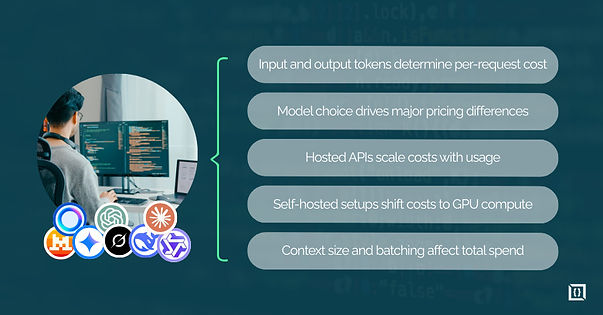
Before optimizing anything, you need to understand what you're actually paying for. LLM costs break down into several distinct components, each with different optimization approaches.
Token Usage and Model Size
Token-based pricing forms the foundation of LLM economics. Providers charge per million tokens processed, with separate rates for input (your prompts) and output (model responses).
Here's how current pricing (prices vary over time) compares across major providers:
Model | Provider | Input (per 1M tokens) | Output (per 1M tokens) |
GPT‑4o mini | OpenAI | $0.15 | $0.60 |
DeepSeek V3 | DeepSeek | $0.27 | $1.10 |
Gemini 2.5 Flash | $0.30 | $2.50 | |
DeepSeek R1 (reasoning) | DeepSeek | $0.55 | $2.19 |
Claude Haiku 4.5 | Anthropic | $1.00 | $5.00 |
Gemini 2.5 Pro | $1.25 | $10.00 | |
GPT‑4o | OpenAI | $2.50 | $10.00 |
o1‑mini (reasoning) | OpenAI | $3.00 | $12.00 |
Claude Sonnet 4.5 | Anthropic | $3.00 | $15.00 |
Claude Opus 4.5 | Anthropic | $5.00 | $25.00 |
o1 (reasoning) | OpenAI | $15.00 | $60.00 |
Output tokens consistently cost 3-5x more than input tokens. This pricing structure means controlling response length has an outsized impact on your bill.
Inference and Deployment Modes
You have two primary paths for running LLMs: hosted APIs and self-hosted infrastructure.
Hosted APIs (OpenAI, Anthropic, Google) provide zero infrastructure overhead. You pay per token with no upfront investment. The trade-off is ongoing variable costs that scale linearly with usage and limited control over latency.
Self-hosted deployments using tools like vLLM or HuggingFace eliminate per-token API fees but require GPU infrastructure. An H100 instance costs roughly $25-35/hour on major cloud providers. The break-even point depends on your volume. High-volume applications often achieve 50-70% cost reduction through self-hosting, though you take on infrastructure complexity.
Infrastructure and API Costs
Beyond token pricing, infrastructure costs accumulate from multiple sources. GPU compute time dominates self-hosted expenses. Memory requirements scale with model size, and larger context windows demand more VRAM. Rate limits on hosted APIs can force architectural decisions around queuing and retry logic.
Cloud providers bill for egress bandwidth, storage for fine-tuned models, and persistent infrastructure. These secondary costs compound at scale.
Key Metrics to Track for Cost Optimization
Effective optimization requires measurement. Without tracking the right metrics, you're guessing.
Token Count per Request
Accurate token counting is essential for managing LLM costs. OpenAI's tiktoken library provides exact token counts before API calls, matching what providers charge. Libraries like tokencost combine token counting with real-time pricing data for cost estimation.
Track both input and output tokens separately. Input tokens reveal prompt efficiency opportunities. Output token variance indicates where response length controls would help.
Model Utilization and Throughput
For self-hosted deployments, GPU utilization determines cost efficiency. Idle GPU time burns money. vLLM's continuous batching keeps GPUs saturated by processing multiple requests simultaneously, achieving 2-4x throughput improvements over naive implementations.
Monitor requests per second, batch sizes, and queue depths. Low utilization suggests over-provisioning or inefficient batching.
Latency and Compute Resources
Latency correlates with compute cost in self-hosted setups. Longer time-to-first-token means either undersized infrastructure or inefficient configuration. Track P50, P95, and P99 latencies to identify optimization opportunities.
Cost per Business Outcome
Raw token costs tell only part of the story. The meaningful metric is cost per business outcome: cost per support ticket resolved, cost per document processed, and cost per lead qualified. This framing connects technical optimization to business value and justifies investment in cost reduction efforts.
Top Strategies for Optimizing LLM Costs
Each strategy involves considerations around cost, output quality, and implementation complexity. Start with low-effort, high-impact approaches before moving on to more complex optimizations.
1. Prompt Engineering and Compression
Verbose prompts waste tokens. Consider this transformation:
Before (87 tokens):
Please analyze the following customer feedback and provide a comprehensive summary that includes the main sentiment, key concerns raised, specific product features mentioned, and actionable recommendations for our team.
After (18 tokens):
Analyze feedback for sentiment, concerns, features mentioned, and recommended actions.
This 79% token reduction produces equivalent output quality. Tools such as LLMLingua can compress prompts by up to 20x while keeping the original meaning intact.
2. Semantic and Token Caching
Prompt caching eliminates redundant computation. When requests share identical prefixes (system prompts, few-shot examples, document context), providers cache the computed key-value pairs.
Anthropic's prompt caching delivers up to 90% cost reduction on cached tokens. Cache reads cost $0.30/M tokens versus $3.00/M for fresh computation on Claude Sonnet. OpenAI provides automatic caching with a 50% discount on cached tokens.
Structure prompts with static content at the beginning to maximize cache hits.
3. Retrieval-Augmented Generation (RAG)
RAG replaces large context windows with targeted retrieval. Instead of stuffing 50,000 tokens of documentation into every prompt, retrieve only the 2,000 most relevant tokens using vector similarity search.
Vector databases like Pinecone, Weaviate, or Qdrant store embeddings for efficient retrieval. A well-implemented RAG system reduces input tokens by 80-90% while maintaining answer quality through precise context selection.
4. Model Selection and Routing
Not every query needs GPT-4. Simple classification tasks, text extraction, and basic summarization run perfectly on GPT-4o-mini at 1/16th the cost.
Implement a router that analyzes incoming requests and directs them to appropriate models:
- Simple queries → GPT-4o-mini or Claude Haiku
- Standard tasks → GPT-4o or Claude Sonnet
- Complex reasoning → GPT-4.1 or Claude Opus
Routing most traffic to smaller models while reserving larger models for complex queries improves cost efficiency compared with using expensive models for all requests.
5. Batch Inference and Parallelism
Batching aggregates multiple requests into single GPU operations, significantly improving throughput. vLLM's continuous batching keeps GPU utilization high by dynamically grouping requests rather than waiting for fixed batch sizes.
OpenAI's Batch API offers a 50% discount for non-urgent workloads processed within 24 hours. If your use case tolerates latency, batch processing halves costs immediately.
6. Chat History Summarization
Multi-turn conversations accumulate tokens rapidly. Each exchange adds to the context window, and after 10-15 turns, you're sending thousands of historical tokens with every request.
Periodically summarize conversation history into a compact representation. Replace 3,000 tokens of raw chat history with a 300-token summary, reducing per-request costs by 90% for that context.
7. Using Smaller or Distilled Models
Distillation trains smaller models to mimic larger ones on specific tasks. A 7B parameter model fine-tuned on GPT-4 outputs can achieve 90% of the quality at a fraction of the cost.
For high-volume, domain-specific tasks, distilled models eliminate API dependency entirely. The upfront training investment pays off through zero per-token costs in production.
8. Fine-Tuning vs Few-Shot Considerations
Few-shot prompting adds examples to every request, consuming tokens repeatedly. Fine-tuning embeds that knowledge into the model itself.
The break-even calculation: if your few-shot examples add 500 tokens per request and you make 100,000 requests monthly, that's 50 million tokens just for examples. Fine-tuning costs typically recover within 2-3 months for high-volume applications.
9. Model and Weight Quantization
Quantization reduces model precision from 16-bit to 8-bit or 4-bit, cutting memory requirements by 50-75%. This allows running larger models on smaller GPUs or fitting more concurrent requests.
Tools like bitsandbytes and GPTQ enable quantization with minimal quality loss. A 4-bit quantized 70B model fits in 35GB VRAM, making it runnable on a single A100.
10. Scalable Infrastructure Deployment
Production deployments benefit from purpose-built serving infrastructure. vLLM provides PagedAttention for efficient memory management, continuous batching for throughput, and tensor parallelism for multi-GPU scaling.
Ray Serve adds autoscaling and load balancing on top of vLLM, automatically adjusting capacity based on demand. This prevents both over-provisioning waste and under-provisioning failures.
Tools and Pipelines to Implement Optimization
Effective cost optimization relies on building observability and control into your pipeline. With the right tools, you can measure token usage, track model performance, and implement caching or routing strategies without guessing where costs are coming from.
Popular Libraries and APIs
- LangChain / LlamaIndex: Frameworks for building LLM applications with built-in support for caching, routing, and RAG.
- liteLLM: Unified API across providers with cost tracking.
- vLLM: High-throughput inference engine for self-hosting.
- tiktoken: Token counting for OpenAI models.
Monitoring and Logging Pipelines
Observability prevents cost surprises. Deploy monitoring that tracks:
- Token usage per endpoint and user
- Cost per request and aggregate daily spend
- Cache hit rates and latency percentiles
Tools like Helicone, LangSmith, and custom Prometheus exporters provide visibility into LLM operations.
Optimization Checklist
Before production deployment, verify:
- Token counts tracked for all requests
- Prompts compressed and structured for caching
- Model routing implemented based on query complexity
- Output token limits configured
- Batch processing enabled for non-urgent workloads
- Monitoring and alerting active
Building a Cost-Efficient LLM Pipeline
A cost-efficient LLM pipeline integrates measurement, caching, and routing to reduce unnecessary computation. Flexible design, including fallback paths and layered caches, allows optimizations to evolve without disrupting service.
Continuous monitoring ensures changes actually lower costs while maintaining output quality, keeping the pipeline efficient as usage grows.
Designing for Flexibility and Scale
Modular architecture enables optimization iteration. Abstract model selection behind routing logic. Implement caching at multiple levels. Build fallback paths to cheaper models when premium models are unavailable.
A flexible pipeline might route through semantic cache → prompt cache → model router → inference engine → response cache. Each layer reduces load on downstream components.
Incorporating Feedback Loops
Cost optimization is iterative. Track which optimizations actually reduce costs without degrading quality. Monitor user feedback and task completion rates alongside cost metrics. Some prompt compressions save tokens but reduce accuracy. Data shows where these compromises occur and guides adjustments.
Sustainable and Scalable AI with LLMs
LLM costs need not spiral out of control. The strategies outlined here achieve 60-80% cost reduction in typical deployments through systematic optimization.
Start with the basics: compress prompts, enable caching, and route to appropriate models. Monitor everything. Build infrastructure that adapts to load. Over time, evaluate fine-tuning and self-hosting for high-volume workloads.
The goal is sustainable LLM deployment that scales with your business without proportional cost growth.
Getting Started
LLM costs usually grow through small inefficiencies that compound over time. Untracked tokens, oversized prompts, default model choices, and underutilized infrastructure add up faster than most teams expect. Sustainable systems come from measuring usage, tightening prompts, routing intelligently, and designing pipelines that adapt as demand changes.
If you are building or scaling LLM-powered systems and want experienced guidance on architecture, cost controls, or deployment strategy, connect with us to discuss how to design production-ready AI systems that scale without runaway costs.
Frequently Asked Questions
What are the biggest cost drivers in LLM deployment?
Token volume is the primary driver, especially output tokens, which cost several times more than input. Model choice has an outsized impact as well, with small models costing a fraction of frontier models for many tasks. In self-hosted setups, token fees are replaced by GPU compute, memory, and utilization efficiency, making batching and throughput critical.
How can prompt engineering reduce LLM costs?
Prompt engineering reduces cost by cutting unnecessary tokens without changing task intent. Shorter instructions, structured prompts, and removal of repeated context routinely reduce input size by 50-80%. These savings apply to every request, making prompt optimization one of the highest-ROI changes in production systems.
What tools help monitor LLM cost and performance?
Cost monitoring requires visibility into token usage, model routing, and latency. Tools like Helicone and LangSmith provide request-level tracing and spend breakdowns for hosted APIs. For self-hosted systems, combining token counters with metrics systems such as Prometheus gives control over throughput, GPU utilization, and cost per request.
Is self-hosting LLMs cheaper than APIs?
Self-hosting becomes cheaper only at sustained high volumes where GPUs remain well utilized. The break-even point depends on model size, batching efficiency, and hardware costs but typically falls in the tens of millions of tokens per month. Below that, managed APIs are often more cost-effective due to lower operational overhead.
What is RAG and how does it reduce LLM costs?
Retrieval-Augmented Generation avoids sending entire documents in every prompt. Instead, it retrieves only the most relevant chunks at inference time. This sharply reduces input token counts for document-heavy workloads while preserving answer quality through targeted context.
Do LLM providers charge differently for input vs output tokens?
Yes. Output tokens are consistently priced higher than input tokens across providers. This reflects the higher compute cost of generation compared to prompt encoding and makes response length control a key cost lever in production systems.
What's the token limit for each model tier and how does it affect pricing?
Larger context windows allow more input but increase per-request cost. Long-context modes process more tokens per call and, in some cases, apply higher rates beyond certain thresholds. Large contexts should be used selectively, paired with retrieval or summarization to avoid unnecessary spend.
How do I prevent token stuffing attacks that inflate costs?
Preventing abuse requires enforcing token limits before requests are sent to the model. Count tokens pre-request, reject oversized inputs, and apply per-user rate limits. Monitoring sudden changes in token usage per endpoint or user helps catch issues before costs escalate.