Custom AI Agent Development: Autonomous Systems

AI tools work well until they run into the specific logic, edge cases, and system integrations that define how a business actually operates. Many teams try vertical SaaS products or self serve agent builders and find they can handle about 70% of the workflow, but struggle with the 30% that matters most.
Custom AI agent development is built in that gap. It is centered on creating systems that match how your business actually runs, including your data structures, approval flows, tools, and exceptions. Instead of forcing your operations into a predefined product, the system is designed around them.
What Sets Leanware Apart as a Custom AI Agent Development Company
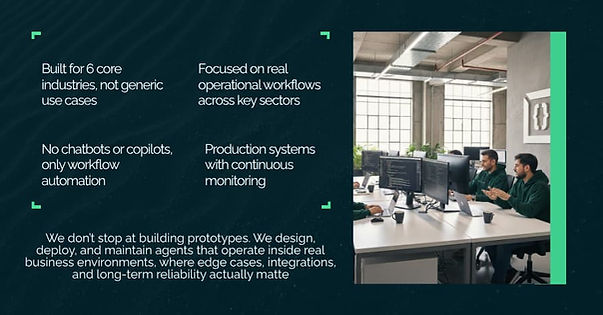
Leanware concentrates on six industries where the workflow patterns, integration requirements, and operational constraints reward custom engineering: 3PL and B2B distribution, SMB job shop manufacturing, insurance MGAs, multi office residential brokerages, multi truck home services, and financial services firms with bespoke books.
We do not build coding copilots, developer productivity tools, or general purpose chatbots. We build agents that automate business workflows in these verticals and own the system after deployment.
If you are still mapping out whether agents fit your operations, start with our overview of AI agent development services.
The Difference Between Leanware and a Generalist Dev Shop
Generalist agencies can build an agent prototype. The complexity shows up after deployment: when the agent encounters an invoice format it has never seen, when an API changes its response structure, when edge cases accumulate faster than the team anticipated. Production grade agents require ongoing monitoring, prompt refinement, and model updates that most generalist shops are neither staffed nor structured to provide.
Leanware is built for that post deployment reality. Our delivery model is structured around continuous ownership of the live system, with engineering resources dedicated to monitoring, refinement, and expansion.
A 3PL agent that reconciles invoices against bills of lading across carriers with different document formats is a different engineering challenge than a generic document extraction tool. We build for that specificity because we operate in these verticals every day.
End to End Ownership: From Discovery to Live System
Leanware owns the full engagement: architecture, integration, deployment, monitoring, and continuous improvement. Buyers receive one invoice. There are no separate charges from OpenAI, Anthropic, or AWS. Model API costs, hosting, and infrastructure are bundled into the monthly fee.
This is a structural advantage over fragmented vendor relationships where the client ends up managing the integration layer, reconciling cloud bills, and coordinating between an AI vendor, an infrastructure provider, and an internal team. Leanware eliminates that coordination overhead entirely.
How Engagements Are Scoped and Priced
Scope and pricing follow from the engagement variables uncovered during the Assessment: the number of workflow steps being automated, the integrations under management, the complexity of decision logic, and the target savings baseline. These variables determine what the build requires and what the monthly fee covers. Reference cases on the marketing site provide ballpark anchors for comparable workflows.
All engagements include model API access, hosting, monitoring, and ongoing optimization. Voice is one modality inside a multi channel intake build (voice + email + chat + portal), not a standalone product. Single workflow voice agents are commodity infrastructure at this point: Retell and Vapi handle that at $0.07/min. The value in custom is the orchestration across channels and into your systems of record.
Start with an AI ROI Assessment: $4,500, two weeks, 100% credited toward your build if you proceed within 30 days.
Core Capabilities That Justify the Investment
Each capability maps to a workflow that buyers in our six priority industries deal with daily.
Agent Design and Architecture Consulting
The strategic phase where business goals translate into agent logic, data flows, and decision models. We map the actual operational constraints: approval chains, system boundaries, exception handling rules, and the judgment calls that your best team members make instinctively.
This is where most vendors cut corners by jumping straight to model selection. Leanware invests here first because agent behavior that does not reflect real operational logic produces systems that break under production conditions.
Tool Integration and External System Connectivity
Agents connect to CRMs, ERPs, databases, APIs, and vertical specific tools: TMS platforms for logistics, MGA systems for insurance, MLS for real estate. We use MCP and similar standards for secure, reliable integrations that maintain data integrity across systems.
This integration depth is what separates a custom agent from a tool that covers generic workflows but cannot reach the specific systems where your data lives.
Custom Model Fine Tuning and Prompt Engineering
Leanware handles all model adaptation as part of the engagement: fine tuning for domain specific terminology, RAG configuration for knowledge retrieval, and prompt design that encodes your business rules into the agent's reasoning. Buyers do not manage this layer.
Memory, Context, and Long Horizon Reasoning
Production agents handle tasks that unfold over hours or days. An insurance submission received Monday may require follow up documents that arrive Wednesday and a decision that depends on both.
The agent maintains state across sessions, retrieves relevant history from previous interactions, and reasons over accumulated context. This capability separates production grade agents from simple automations that reset with every interaction, and from what most vendors actually ship.
Industries We Serve and Typical Use Cases
Below are real operational workflows where custom AI agents are commonly applied across different business environments.
AI Agents for 3PL and B2B Distribution Operations
These workflows sit inside high volume logistics operations where documents, carriers, and exceptions constantly overlap.
Agents handle extracting structured data from bills of lading, invoices, and rate confirmations, even when formats vary across carriers. They track shipment exceptions, flag inconsistencies, and route them to the right internal teams with full context attached. On the communication side, they manage carrier updates, appointment scheduling, and claims. RFQ to quote flows pull rate data, apply margin logic, and return structured quotes ready for review.
AI Agents for SMB Job Shop Manufacturing
Most of the work here revolves around turning messy inbound requests into structured production decisions.
Agents read RFQs from email and web forms, extract part specifications, quantities, materials, and delivery requirements, then generate quotes using material pricing and labor estimates based on shop rules. Once work is approved, they help route jobs based on machine capacity and operator skill sets. They also coordinate with suppliers for materials and delivery timing.
AI Agents for Insurance MGAs
This is largely about intake speed and decision consistency across underwriting pipelines.
Agents process broker submissions by extracting data from applications, loss runs, and attachments. They pre screen submissions against underwriting appetite before anything reaches a human underwriter. They also handle broker communication for missing documents, status updates, and declinations, keeping submission flows structured and trackable.
AI Agents for Residential Real Estate Brokerages
For multi office brokerages routing leads from Zillow, brokerage websites, and partner sites across agents and offices through a custom CRM. Single agent operations are typically better served by verticalized SaaS like Compass AI or kvCORE.
Agents capture leads from portals, web forms, and phone inquiries, then structure and qualify them for immediate response. They handle listing questions using MLS data, support transaction coordination by tracking deadlines and follow ups, and manage document workflows like disclosures and contracts across multiple parties.
AI Agents for Home Services Operations
For multi truck, multi region operators with custom dispatch logic and a real customer database. Single location operators are typically better served by verticalized SaaS like Avoca or ServiceTitan AI.
Agents unify inbound requests from phone, web, and SMS into a single structured pipeline. They schedule jobs based on technician availability, location, and skill match, then handle dispatch and routing with customer notifications. After service, they trigger follow ups for reviews, rebooking, and maintenance reminders.
Voice is one of the intake channels, but part of a broader multi channel system rather than a standalone workflow.
AI Agents for Financial Services Workflows
Most of these workflows revolve around K-1 and financial statement extraction across portfolio companies, SEC/FINRA audit prep packages, SOC 2 control evidence assembly, and compliant prospect outreach for RIAs. Audit trail logging and human review gates are designed in from the start.
This includes professional services firms such as accounting and wealth management teams operating within financial services.
The Delivery Process: What Buying From Leanware Actually Looks Like
The engagement follows a managed lifecycle with a fixed setup fee and monthly subscription. One invoice covers everything.
Discovery and Requirements Mapping
A structured audit of real operational workflows: stakeholder conversations, process mapping, and identification of high value automation candidates. This phase produces a fixed scope Statement of Work that defines which systems the agent will and will not touch, approval thresholds for edge cases, deliverables, and success metrics. You know exactly what you are committing to before development begins.
Prototyping and Iterative Agent Testing
A focused prototype built around a specific use case and evaluated against real inputs. We test accuracy, edge case handling, and decision consistency before committing to full development. The prototype phase determines which agent tier the use case requires. Voice or multi channel intake use cases route to Mid or Senior tier at this stage.
This validation first approach reduces risk. You see the agent perform on your data before the full build begins.
Deployment, Monitoring, and Continuous Improvement
Leanware owns the system in production: infrastructure, hosting, model operations, and integration with existing tools and data sources. Production agents are monitored against the performance baselines established in the Assessment, with refinement cycles on a defined cadence. Continuous improvement includes model updates, knowledge base refreshes, performance optimization, and cost control. The agent improves over time because the team watching it is the same team that built it.
Security, Governance, and Responsible AI
Security requirements vary by industry. Insurance MGAs need complete audit trails for every submission decision. Financial services workflows require access controls that satisfy regulatory review. Manufacturing agents handling pricing data need role based permissions that prevent unauthorized access.
Human in the Loop Design Principles
Agents are built with escalation paths, confidence thresholds, and approval gates that keep humans in control of high stakes decisions. For transactions above a defined dollar threshold, human sign off is required before execution. For document decisions where the agent's confidence falls below a set level, the item routes to a human reviewer with full context attached.
This is a design principle embedded from the start of architecture, applied consistently across all engagements.
Data Privacy and Compliance by Design
Role based permissions, access controls, and audit logging are standard across all deployments. Data access is scoped to the minimum required for each agent function. Systems are designed for SOC 2 readiness with controls that satisfy audit requirements. On premise deployment is available as a custom option for regulated environments that require data to remain within their own infrastructure.
Technology Stack and Partner Ecosystem
Leanware's approach is model agnostic. Tool choices are driven by use case fit, not vendor preference.
Foundation Models and Orchestration Frameworks
We work with OpenAI, Anthropic, Google, and open source models such as Llama, selected based on task requirements, latency constraints, and cost. Orchestration uses LangGraph as the primary framework for stateful multi step workflows.
Model selection prioritizes reliability and maintainability in production over raw capability benchmarks.
Cloud, Infrastructure, and Scalability Considerations
Cloud native deployment on AWS and Azure is standard. Hybrid configurations are supported. On premise deployment is available for regulated environments on custom scope. Cost management for inference heavy workloads is built into the architecture: model routing, caching, and batching strategies that keep per interaction costs predictable as volume grows. The infrastructure scales with the business without requiring client side management.
Why Choose a Specialized AI Agent Development Partner
The talent required to build production grade agents, covering orchestration design, model evaluation, integration engineering, prompt architecture, and ongoing MLOps, is difficult to assemble internally. Even companies with strong engineering teams find that agent development pulls senior engineers away from core product work for months.
A specialized partner compresses time to value because the architecture patterns, integration approaches, and production monitoring practices are already established.
A 3PL agent reconciling carrier invoices against bills of lading and rate confirmations across five carriers with different document formats is a different engineering challenge than a single document extractor. The architecture patterns, error recovery, and exception routing for that workflow either exist in a partner's previous work or get learned at your expense during the build.
What to Look for in an AI Agent Development Company
Evaluate any vendor, including Leanware, on six criteria. Technical depth in orchestration, integration, and model operations. Domain experience in your specific vertical with evidence of deployed systems. Transparency about what agents can and cannot handle for your use case.
A post launch support model that includes monitoring, refinement, and continuous improvement. References or case evidence from companies with similar workflow complexity. And a paid, engineer led discovery engagement as the first step. Free "AI readiness assessments" from boutiques are sales calls. Templated questionnaires from enterprise consultancies are billing setups for the next $200K phase.
A real engineer working with your team for two calendar weeks against a fixed fee is a categorically different starting point, and the deliverables are useful even if the engagement does not proceed.
Final Thoughts
Custom AI agents are ideal for operations teams that have outgrown the capabilities of off the shelf tools. The workflows that consume the most manual effort in your business are the same workflows where agents deliver the clearest return: document processing, multi system coordination, exception handling, and customer facing response speed.
The companies that get the most out of custom agents are the ones that started with the workflow their platform could not handle, scoped it carefully against a measured baseline, and let the engagement expand from there. The Assessment is how that sequence starts.
Connect with us to start with an AI ROI assessment and identify where agents can drive immediate impact.
Frequently Asked Questions
How long does it take to go from first conversation to a live agent?
The AI ROI Assessment takes two weeks and produces a fixed scope Statement of Work. Prototyping and development timelines are determined by workflow complexity, number of system integrations, and whether voice or multi channel intake is part of the build. Most clients have a live agent within 5 to 12 weeks of starting the Assessment.
What happens if the agent makes an error in production?
Agents are built with confidence thresholds and human in the loop controls. Actions above defined dollar amounts require human approval before execution. Every agent action is logged with a complete audit trail. When errors occur, the monitoring team identifies the root cause and applies a fix. The managed service model means error resolution is Leanware's responsibility, not yours.
Do I need to provide my own cloud infrastructure or model API keys?
No. Leanware owns the full infrastructure layer. Model API costs, hosting, compute, and monitoring are bundled into the monthly fee. You receive one invoice with no separate charges from cloud providers or model vendors. This eliminates surprise bills and removes the need for your team to manage AI infrastructure.
Can the agent integrate with my existing systems even if they are older or lack modern APIs?
Yes, with planning. We evaluate integration readiness during the Assessment phase. Modern systems with REST APIs integrate directly. Older systems may require adapter layers, structured data exports, or middleware. Integration complexity affects timeline and scope, but it does not prevent the engagement. We have built integrations with legacy TMS platforms, older ERP systems, and industry specific tools that predate modern API standards.
What is included in the monthly fee after the agent is deployed?
The monthly fee covers agent operations, infrastructure hosting, model API costs, monitoring, prompt refinement, model updates, knowledge base refreshes, and performance optimization. There are no separate invoices for cloud, compute, or API usage. The engagement includes a dedicated team that monitors the agent's performance and proactively addresses issues, edge cases, and opportunities for improvement.