


.webp)


Employer of Record for Software Developers in Colombia
- Leanware Editorial Team

- Feb 5
- 10 min read
Hiring software developers in Colombia means handling more than recruitment - you also need to manage local employment contracts, payroll, taxes, and ongoing compliance with Colombian labor law. These requirements can slow down team growth, especially if your company doesn’t have a legal entity in the country.
An Employer of Record handles all of the legal and administrative work, so developers are onboarded correctly and remain fully compliant, while your engineering team retains control over day-to-day work, technical direction, and project delivery.
Let’s explore how an EOR works for software teams, what it costs, when it makes sense, and how it compares to other hiring models.
Why Colombia Is a Strategic Location for Hiring Software Developers
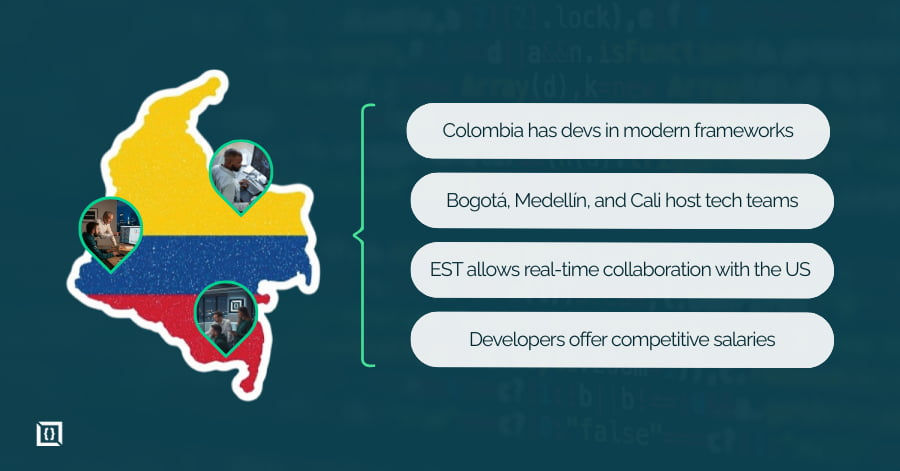
Colombia is a premier nearshoring destination for software development due to its highly skilled, cost-effective talent pool, and convenient alignment with North American time zones (EST). With skilled IT professionals and major hubs like Medellin and Bogota, companies can reduce development costs by up to 50% while accessing top-tier technical expertise
1. Strong Engineering Talent and Tech Ecosystem
Colombia produces a consistent number of computer science and engineering graduates, and major hubs like Bogotá, Medellín, and Cali host a mix of junior and senior engineers across the full stack. You’ll find expertise in JavaScript frameworks, Python, Java, C#, and cloud platforms like AWS and Azure.
Medellín has become a startup hub with companies like Rappi, while major tech firms such as Microsoft, IBM, and Oracle maintain engineering teams in the country. About 75% of software engineers in Colombia hold a college degree in a related field.
2. Time Zone Alignment with US and Nearshore Teams
Colombia operates on Eastern Standard Time (EST), which aligns directly with the US East Coast and overlaps significantly with Central, Mountain, and Pacific time zones. Real-time collaboration removes the delays that offshore teams in Europe or Asia face.
Sprint planning, code reviews, incident response, and pair programming sessions happen during normal working hours for both sides.
3. Competitive Salaries Without Compromising Quality
Senior software engineers in Colombia earn between $54K and $70K per year, compared to $125K or more in the US for equivalent roles. Mid-level developers typically fall in the $38K to $45K range.
This isn’t about cheap labor. The difference reflects local market conditions, not quality. Developers in Colombia have strong educational backgrounds, experience with modern frameworks, and familiarity with workflows used by US companies.
Why Software Companies Use an Employer of Record in Colombia
With an EOR, the company technically becomes the legal employer for your developers in Colombia, while your team stays in charge of day-to-day work and technical direction.
This setup removes administrative overhead and lets engineering teams focus on building and delivering software without getting bogged down in local employment rules.
Area | Traditional | EOR | Advantage |
Hiring | Months of entity setup | Developers under EOR entity | Fast legal onboarding |
Scaling | Slow due to setup | 2-4 week onboarding | Quickly add engineers |
Compliance | You manage contracts, payroll, benefits | EOR handles everything | Reduces legal risk |
Hiring Developers Without Opening a Legal Entity
Setting up a Colombian subsidiary involves registering with the Chamber of Commerce, opening local bank accounts, hiring local legal counsel, and establishing ongoing compliance processes. This takes months and creates administrative overhead that scales poorly for small teams.
An EOR already has a legal entity in Colombia. Your developers work under that entity's employment contracts, but you direct their tasks, set their schedules, and own their output.
Faster Scaling for Product and Engineering Teams
When you need to add developers for an MVP build, feature expansion, or capacity increase, the EOR model removes legal friction. Most EOR providers can onboard a developer within two to four weeks, compared to months for entity setup.
This speed matters when roadmaps shift, funding rounds close, or market opportunities appear. You can add backend engineers, DevOps specialists, or QA resources without restructuring your legal footprint.
Reducing Legal, Payroll, and Compliance Risk
Colombian labor law includes specific requirements around employment contracts, social security contributions, severance calculations, and termination procedures. Getting these wrong creates liability.
Misclassifying employees as contractors can trigger back taxes, penalties, and labor disputes. Incorrect severance calculations lead to legal claims. An EOR carries this compliance burden and maintains the expertise to handle it correctly.
How an Employer of Record Works for Software Development Teams
An EOR legally employs your developers in Colombia, while your engineering team manages day-to-day work, technical direction, and performance. The EOR handles contracts, payroll, taxes, social security, and compliance.
Area | You | EOR |
Legal vs Operational | Work, code, sprints, performance | Contracts, payroll, taxes, termination |
Contract Types | Hiring fit | Indefinite or fixed-term |
Payroll & Benefits | Budgeting | Health, pension, taxes |
Legal Employment vs Operational Management
The EOR is the legal employer of record. This means they sign the employment contract, run payroll, withhold taxes, make social security contributions, and handle termination procedures.
You remain the operational manager. Your engineering leads assign work, conduct code reviews, manage sprints, evaluate performance, and make promotion decisions. The developer reports to you functionally while being employed legally by the EOR.
Contract Types for Software Developers in Colombia
Colombian law recognizes several contract types. For software roles, most EOR arrangements use either indefinite-term contracts or fixed-term contracts renewable up to 36 months.
Indefinite contracts provide stability and signal long-term commitment, which helps with retention. Fixed-term contracts offer flexibility but require written documentation and proper renewal processes. Your EOR provider will recommend the appropriate structure based on your hiring goals.
Payroll, Taxes, and Social Security Explained
Colombian employers make mandatory contributions for health insurance, pension, occupational risk insurance, and family welfare funds. These add approximately 20-25% to the base salary cost.
Employees also contribute from their salary, and the employer must withhold these amounts. The EOR handles all calculations, payments to government entities, and record-keeping. You receive a single invoice covering total employment costs.
What an EOR Handles vs What Your Engineering Team Controls
The division of responsibility is simple: legal compliance sits with the EOR, technical leadership stays with you.
EOR Responsibilities: Employment contracts drafted under Colombian law, monthly payroll processing in Colombian pesos, statutory contributions to health, pension, and other required funds, annual bonuses (prima de servicios), vacation tracking and payout, termination procedures and severance calculations.
Your Team Retains: Architecture decisions and technical direction, code ownership and repository access, tool selection and development environments, sprint planning and delivery management, performance reviews and career development, security practices and access controls.
The developer integrates with your team like any other engineer. They attend your standups, use your Slack channels, and follow your engineering practices.
Employer of Record vs Other Hiring Models for Developers
Each hiring approach has practical differences. With an EOR, the company handles legal employment while your team manages the developers’ day-to-day work.
EOR vs Independent Contractors
Contractors offer flexibility but create risk. Colombian labor authorities may reclassify long-term contractors as employees, triggering back payments for benefits and taxes. Contractor relationships also complicate IP ownership and create less commitment to your codebase.
EOR provides a compliant employment relationship with clear IP assignment. Developers receive benefits that improve retention, and you avoid classification disputes.
EOR vs Staff Augmentation
Staff augmentation places developers through an agency. The agency often employs them and marks up their cost. You may have limited visibility into actual compensation, and the relationship structure can create loyalty splits.
With EOR, you select and manage the developer directly. The EOR handles compliance without sitting between you and your engineer operationally.
EOR vs Opening a Local Entity
A local entity gives you full control and works well for large, long-term operations. However, it requires significant upfront investment, ongoing administrative overhead, and commitment to maintaining presence even if hiring needs change.
EOR offers flexibility to scale up or down without entity management. For teams under 20-30 developers, EOR typically makes more financial sense.
Costs of Using an Employer of Record in Colombia
Hiring through an EOR in Colombia costs more than using contractors because of statutory contributions and service fees. In return, you get legal compliance, benefits for your developers, and more predictable retention, making it a low-risk option for growing software teams.
Salary, Benefits, and Statutory Contributions
Total employment cost includes base salary plus mandatory employer contributions. In Colombia, employer contributions run approximately 20-25% of salary for health, pension, occupational risk, and welfare funds.
Add the 13th month bonus (prima de servicios), vacation accrual, and severance reserves. For a developer with a $50K annual salary, total employment cost before EOR fees typically reaches $62K–$67K.
EOR Service Fees Explained
EOR providers charge either a flat monthly fee per employee or a percentage of salary. Flat fees commonly range from $300 to $700 per employee per month. Percentage models typically run 15-25% of base salary.
Fee structures vary by provider, volume commitments, and included services. Some providers bundle benefits administration; others charge separately.
Total Cost Comparison for Software Teams
Model | Senior Dev Annual Cost | Notes |
Independent Contractor | $54K-$65K | Classification risk, limited retention |
EOR | $70K-$85K | Compliant, benefits included |
Local Entity | $70K–$80K + overhead | Requires entity setup and maintenance |
EOR costs more than contractors on paper but provides legal certainty and better retention.
Compliance and Labor Law Considerations for Software Developers
Colombian labor law covers contracts, working hours, overtime, IP ownership, and termination rules, ensuring software teams operate within legal requirements.
Colombian Employment Law Basics for Tech Roles
Employment contracts should be written, though verbal contracts are legally valid. Written contracts clarify terms and reduce disputes. Contracts must specify salary in Colombian pesos, working hours, and job responsibilities.
The standard workweek is being reduced to 42 hours by 2026. Overtime requires additional pay at 25% for daytime and 75% for nighttime hours. Probationary periods can last up to two months.
IP Ownership and Confidentiality in Software Projects
For software companies, IP ownership is critical. Employment contracts should include explicit IP assignment clauses ensuring all code, designs, and documentation belong to your company.
Reputable EOR providers include IP assignment and confidentiality provisions aligned with Colombian law. Review these clauses before signing.
Termination, Severance, and Risk Mitigation
Termination in Colombia requires either just cause or severance payment. Termination with just cause carries legal risk and requires proper documentation.
Severance for termination without just cause depends on salary level and tenure. For salaries below 10x minimum wage, severance equals 30 days per year for the first year plus 20 days for each additional year. The EOR manages termination procedures compliantly.
When an Employer of Record Makes Sense for Software Companies
An EOR works best when you need to hire developers quickly without dealing with local legal setup.
Early-Stage Startups and MVP Teams: You need two or three developers to build your first product. Setting up an entity makes no sense. EOR lets you hire quickly, conserve capital, and focus on building.
Scaling Engineering Teams Quickly: You closed a funding round and need to add capacity fast. EOR scales without legal setup delays. Add pods, squads, or specialists as roadmaps require.
Expanding Nearshore Development Operations: You are testing Colombia as a nearshore location before committing to a permanent presence. EOR provides a trial period without entity commitment.
Common Mistakes When Hiring Developers in Colombia Without an EOR
Avoiding these problems protects your business and your team.
Misclassifying Developers as Contractors: Long-term contractor relationships with fixed schedules, company equipment, and integrated workflows look like employment to labor authorities. Reclassification triggers back payments, penalties, and potential legal action.
Underestimating Payroll and Compliance Costs: Budget planning that accounts only for base salary misses mandatory contributions, bonuses, and severance reserves. This affects runway calculations and financial planning.
IP and Security Gaps in Remote Teams: Developers need access to source code and potentially customer data. Without proper employment agreements covering IP assignment and confidentiality, you risk unclear ownership and data exposure.
How to Choose the Right Employer of Record for Software Developers
Not all EOR providers work equally well with engineering teams.
Experience with Engineering and Tech Roles: Look for providers who understand software hiring specifically. They should know market rates for different roles and how to handle IP clauses properly.
Transparency in Costs and Contracts: Avoid providers with hidden fees or unclear pricing. You should understand exactly what the monthly cost includes.
Support for Long-Term Software Teams: If you plan to retain developers for years, the provider should support contract renewals, salary adjustments, and benefit improvements.
Employer of Record in Colombia vs Other Nearshore Countries
Hiring through an EOR in Colombia provides an option between Mexico’s large-scale infrastructure and Argentina’s specialized talent. Colombia is a growing nearshore hub for U.S.-based firms, with US-aligned time zones, competitive labor costs, and a steadily expanding tech workforce.
Colombia vs Mexico: Mexico has a larger developer population and established nearshore infrastructure. Colombia offers comparable talent at slightly lower cost with strong English proficiency in major tech hubs.
Colombia vs Brazil: Brazil has the largest tech workforce in Latin America but operates in Portuguese, not Spanish. Labor costs have risen substantially and currency volatility adds operational challenges.
Colombia vs Eastern Europe: Eastern European countries offer strong engineering talent but face 6-9 hour time zone differences from the US, limiting real-time collaboration.
Your Next Step
As you look to expand your software team in Colombia, begin by defining the specific roles and skills your projects need. Using an Employer of Record allows you to onboard developers quickly, manage local contracts, payroll, and compliance, while keeping full control over day-to-day development and technical decisions.
This setup makes scaling your team smoother, reduces legal complexity, and lets your engineering leaders focus on delivering software rather than administrative work.
You can also connect with us to see how our nearshore development and team enablement services in Colombia can help you hire, onboard, and integrate developers smoothly into your engineering team.
Frequently Asked Questions
What is an Employer of Record (EOR) in software development?
An EOR is a third-party company that legally employs software developers in Colombia on your behalf. They handle contracts, payroll, taxes, social security, and compliance with Colombian labor law, while your engineering team retains full control over day-to-day work, project direction, and technical decisions.
Can I manage software developers directly when using an EOR?
Yes. Your team manages all operational aspects - assigning tasks, conducting code reviews, setting architecture, choosing tools, scheduling sprints, and evaluating performance. The EOR only handles legal employment and compliance matters.
Do I need a legal entity in Colombia to hire developers through an EOR?
No. Using an EOR allows you to hire developers without registering a local company, avoiding the months-long process of entity setup and ongoing administrative compliance.
How fast can I hire a software developer in Colombia using an EOR?
Most developers can be legally onboarded within two to four weeks, depending on role seniority and contract type. This is significantly faster than establishing a local entity.
Is intellectual property protected when hiring developers through an EOR?
Yes. Reputable EORs include IP assignment and confidentiality clauses aligned with Colombian law, ensuring all code, designs, and project deliverables belong to your company.
What types of software roles can be hired through an EOR?
EORs can support a range of software positions - from junior and mid-level developers to senior engineers and technical leads. This includes backend, frontend, DevOps, QA, data engineers, and specialized roles depending on your team’s needs.
Is using an EOR better than hiring software developers as contractors?
For long-term or core engineering roles, EORs reduce misclassification risk, clarify IP ownership, and provide more predictable retention compared to independent contractors, who may be less integrated with your team.
What is the total cost of hiring software developers through an EOR in Colombia?
Total cost includes the developer’s gross salary, mandatory contributions (roughly 20–25% for social security, health, and benefits), plus the EOR service fee. For a senior developer, annual costs typically range between $70K and $85K.
Can an EOR support long-term software teams?
Yes. Many companies use EORs to build stable, multi-year engineering teams in Colombia, particularly during nearshore expansion, MVP development, or scaling phases.
How does an EOR compare to opening a local entity?
An EOR allows faster setup, lower upfront costs, and reduces ongoing compliance overhead. Opening a local entity gives more control over contracts and payroll but requires months of setup, legal support, and continuous administrative management.


