Healthcare Data Platform Development: Architecture, Use Cases

Healthcare organizations generate large volumes of data every day, yet many struggle to use it effectively. Patient records remain isolated in one system, billing data in another, lab results in separate systems, and wearable device data is often underutilized.
This fragmentation creates real problems: clinicians make decisions without complete patient histories, administrators can't forecast capacity accurately, and finance teams chase claims errors that better data could have prevented.
A healthcare data platform addresses this by serving as the integration and intelligence layer across your organization. It doesn't replace your EHR or billing system. Instead, it connects them, normalizes the data, and makes it accessible for analytics, reporting, and operational improvement.
Let’s break down what a healthcare data platform actually is and what it is designed to do.
What Is Healthcare Data Platform Development?
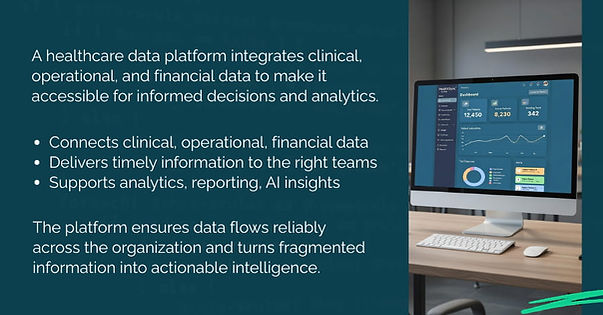
A healthcare data platform is an infrastructure that centralizes, integrates, and processes data from multiple sources across a healthcare organization. Think of it as the connective tissue between your EHR, lab systems, imaging archives, billing software, and patient-facing applications.
The core purpose is to make relevant data available to the people who need it when they need it. For a clinician, that might mean accessing a patient’s full medication history during an encounter.
For an operations manager, it could mean near real-time visibility into bed availability across facilities. For finance teams, it means consistent claims data that helps reduce denials and speed up reimbursement cycles.
This isn't about building another database. It's about creating a governed, secure environment where data flows reliably and analytics become possible at scale.
Why Healthcare Organizations Need Unified Data Platforms
Fragmented systems create problems that a unified data platform is designed to address.
Data silos exist because healthcare IT evolved in pieces. Your EHR vendor didn't build your radiology PACS, which doesn't talk to your claims processing system, which has no connection to the remote monitoring devices your chronic care patients use. Each system stores valuable information that other systems need but can't access.
Duplicate and inconsistent records proliferate when the same patient appears differently across systems. John Smith in registration becomes J. Smith in the lab system and Jonathan Smith in billing. Without master data management, you're making clinical and financial decisions on incomplete or conflicting information.
Delayed insights happen when reporting requires manual data pulls from multiple systems. By the time someone compiles a capacity report or a quality measure, the numbers are already stale.
Healthcare Data Platforms vs Traditional EHR/EMR Systems
EHR and EMR systems are transactional. They capture clinical encounters, document care, and support billing workflows. They're optimized for individual patient interactions, not for aggregating and analyzing data across your entire patient population.
A data platform complements the EHR by pulling data from EHRs plus dozens of other sources, normalizing different formats and terminologies, storing historical data for longitudinal analysis, and enabling cross-system queries and reporting. The EHR remains your system of record for clinical documentation. The data platform becomes your system of intelligence for understanding what that documentation means at scale.
Types of Data Managed by Healthcare Data Platforms
Healthcare data comes in many forms, and managing this diversity is one of the platform's primary challenges.
Data Type | Examples |
Clinical Data | Diagnoses, medications, procedures, vital signs, lab results, radiology reports, clinical notes |
Operational & Administrative Data | Scheduling systems, bed management, staffing rosters, facility utilization |
Financial Data | Claims, remittances, denial codes, accounts receivable |
Patient-Generated Data | Wearables, glucose monitors, blood pressure cuffs, patient-reported outcomes |
External Data | Public health registries, benchmarking databases, regulatory reporting datasets |
Clinical Data includes diagnoses, medications, procedures, vital signs, lab results, radiology reports, and clinical notes. This is the most sensitive and clinically essential data category. It involves both structured fields (lab values, vital signs) and unstructured text (physician notes, radiology impressions). A typical hospital generates terabytes of clinical data annually.
Operational and Administrative Data from scheduling systems, bed management, staffing rosters, and facility utilization directly impacts patient flow, wait times, and resource allocation. When operational data integrates with clinical data, you can correlate staffing levels with patient outcomes or scheduling patterns with no-show rates.
Financial Data including claims, remittances, denial codes, and accounts receivable drives revenue cycle performance. Financial data integration enables faster identification of claim errors and better visibility into payer performance.
Patient-Generated Data from wearables, continuous glucose monitors, blood pressure cuffs, and patient-reported outcomes is growing rapidly. This data has predictive value for chronic disease management but introduces challenges around data validation and noise filtering.
External Data from public health registries, benchmarking databases, and regulatory reporting requirements completes the picture. Platforms need to ingest reference data for quality measure calculations and export data for CMS reporting and public health surveillance.
Key Components of a Healthcare Data Platform
A healthcare data platform is made up of connected layers, each handling a specific part of how data flows and gets used.
Component | Purpose |
Data Ingestion & Integration | ETL, APIs, event streams; ensures reliable data flow |
Interoperability Standards | FHIR, HL7 v2; simplifies system integration |
Data Lake vs Warehouse | Warehouse for structured data; lake for raw/unstructured; hybrid common |
Data Governance & Quality | Sets ownership, access, standards; improves data trust |
Security & Access Control | Role-based access, logging, monitoring; protects sensitive data |
Analytics & AI Enablement | Dashboards, self-service analytics; foundation for AI |
Data Ingestion and Integration Layer
This layer handles getting data into the platform reliably. It includes ETL (extract, transform, load) processes, real-time event streams, API connections, and batch file transfers. The critical requirements are reliability, data lineage tracking, and error handling. When a lab feed fails at 2 AM, the platform should alert operations teams and queue data for reprocessing.
Interoperability Standards
FHIR (Fast Healthcare Interoperability Resources) has become the primary standard for healthcare data exchange. According to the 2025 State of FHIR survey by HL7 International and Firely, over 70% of countries now report active FHIR use for at least some national use cases, and 78% of surveyed countries have regulations mandating or advising FHIR adoption.
HL7 v2 remains common for legacy system integration, while newer implementations increasingly use FHIR APIs. The practical value of standards is that they reduce custom integration work. When your EHR and your analytics platform both speak FHIR, connecting them becomes significantly less painful.
Data Lake vs Data Warehouse Architecture
Data warehouses store structured, processed data optimized for querying and reporting. Data lakes store raw data in its original format, preserving flexibility for future use cases. Most healthcare organizations end up with hybrid architectures, often called "lakehouses," that combine both approaches.
The warehouse handles your standard operational reports and dashboards. The lake stores imaging data, unstructured clinical notes, and device telemetry that you might want for future machine learning projects. The key is designing for your actual use cases rather than following a theoretical model.
Data Governance and Quality
Poor data quality creates real harm in healthcare. Duplicate patient records can lead to missing allergy information, and inconsistent medication coding can cause drug interaction alerts to fail. According to the 2025 Healthcare Data Quality Report by Clinical Architecture, only 17% of healthcare professionals are currently integrating patient information from external sources - often because they do not trust the data quality.
Governance establishes who owns data, who can access it, and what quality standards apply. Master data management maintains consistent definitions for patients, providers, locations, and other core entities across systems.
Security and Access Control
Healthcare data platforms must implement role-based access control that follows least-privilege principles. A billing specialist doesn't need access to clinical notes. A researcher doesn't need patient identifiers. Access logging and monitoring should capture who accessed what data, when, and for what purpose.
The stakes are high. Healthcare data breaches average $7.42 million per incident according to IBM's 2025 Cost of a Data Breach Report, the highest of any industry for 14 consecutive years.
Analytics and AI Enablement
The analytics layer serves the reports, dashboards, and visualizations that clinicians, administrators, and executives actually use. Self-service analytics capabilities let department managers explore data without requiring IT involvement for every question.
AI capabilities depend entirely on having clean, governed, accessible data. The platform creates the foundation; AI is what you build on top of it. Without the underlying data infrastructure, machine learning projects stall during data preparation.
Healthcare Data Platform Architecture
Core architecture considerations include how the platform is deployed, how it processes data, and how it handles growth and downtime.
Aspect | Options / Approach |
Deployment | Cloud, On-Premise, Hybrid; hybrid balances scalability and control |
Data Processing | Real-Time for urgent alerts; Batch for reporting and planning |
Scalability | Must handle current and future data volumes across facilities |
Disaster Recovery | High availability and failover; recovery targets reflect clinical risk |
Deployment Options
Cloud platforms offer scalability, managed services, and reduced infrastructure burden. AWS, Azure, and Google Cloud all provide HIPAA-eligible services with healthcare-specific tooling. On-premise deployments give organizations direct control over data location, which some compliance or policy requirements mandate.
Most health systems end up with hybrid architectures. The most sensitive data or legacy systems remain on-premise while analytics workloads and newer applications move to cloud. The decision depends on your regulatory environment, existing infrastructure investments, and technical capabilities.
Real-Time vs Batch Processing
Real-time data matters when decisions can't wait. Sepsis alerts, medication interaction warnings, and critical lab value notifications need to reach clinicians within minutes. Batch processing works fine for monthly quality reports or annual planning analytics.
Design your pipelines based on actual latency requirements. Real-time infrastructure costs more to build and operate, so reserve it for use cases that genuinely require it.
Scalability and Disaster Recovery
Healthcare data volumes grow continuously. Your architecture needs to handle current workloads plus projected growth without major redesign. Multi-facility health systems face additional complexity when integrating dozens of hospitals and clinics.
System downtime in healthcare affects patient care directly. If clinicians can't access medication histories or lab results, they make decisions with incomplete information. Recovery time objectives should reflect clinical risk, not just IT convenience.
Core Use Cases
Healthcare data platforms enable clinical, operational, financial, and research applications.
Clinical Decision Support delivers relevant patient information at the point of care. This includes medication interaction checking, care gap identification, and risk scores that help clinicians prioritize their attention. The value comes from aggregating information that would otherwise require manual chart review across multiple systems.
Population Health Management requires analyzing patient cohorts over time to identify trends, measure outcomes, and target interventions. Without a unified data platform, population health analytics devolves into spreadsheet exercises.
Operational Efficiency improvements in bed management, OR utilization, appointment scheduling, and staffing optimization depend on accurate, timely operational data. Platforms that integrate operational and clinical data can predict patient discharges and forecast emergency department volumes.
Revenue Cycle Optimization improves when clinical documentation aligns with billing requirements. Platforms can identify coding patterns that lead to denials and flag potential compliance issues before claims submission.
Research and Clinical Trials require access to de-identified patient cohorts, longitudinal outcomes data, and the ability to identify eligible trial participants while maintaining patient privacy.
AI-Powered Capabilities
AI-powered capabilities rely on clean, integrated data to provide actionable insights for patient risk, operational planning, and resource management.
- Risk Stratification models identify patients likely to experience adverse outcomes, enabling proactive outreach and intervention. These models work only when they have access to comprehensive patient data including prior utilization, social factors, and clinical indicators.
- Readmission and Length-of-Stay Prediction informs discharge planning and capacity management, reducing avoidable readmissions while improving bed availability.
- Demand Forecasting predicts patient volumes by department, time of day, and acuity level for staffing decisions. Better forecasts reduce both overtime costs from understaffing and idle capacity costs from overstaffing.
Security and Compliance
HIPAA governs protected health information in the United States, requiring administrative, physical, and technical safeguards. GDPR applies to EU patient data with additional requirements around consent and data subject rights. Compliance isn't a one-time achievement. It requires ongoing monitoring, regular risk assessments, and continuous policy updates.
Common attack vectors include phishing, compromised credentials, and ransomware. The average time to identify and contain a healthcare breach is 279 days, significantly longer than other industries. Mitigation requires layered defenses: identity management, network segmentation, endpoint protection, vulnerability management, and incident response planning.
Development Process and Common Challenges
Successfully developing a healthcare data platform depends on understanding existing systems, designing for real needs, and managing integration, quality, and security challenges.
Discovery inventories current systems, data flows, and integration points before building anything. Understanding what exists prevents expensive rework later.
Architecture Design should serve your specific use cases and constraints. Resist choosing technologies based on industry hype rather than fit.
Data Integration is where most platform projects encounter difficulty. Legacy systems have undocumented interfaces, data quality issues surface during migration, and source system changes disrupt established feeds. Plan for iteration.
Validation and Testing confirms data accuracy against source systems and that security controls meet regulatory requirements.
Go-Live and Optimization marks the beginning, not the end. Production monitoring identifies issues, and optimization continues as you add new data sources and capabilities.
Common challenges include fragmented legacy systems with proprietary interfaces, poor data quality and duplication, interoperability limitations despite standards, and security complexity that consumes development resources.
Cost, Timeline, and ROI
Costs range from $500,000 for basic integration projects to $10 million or more for enterprise-scale platforms with advanced analytics. Variables include number of data sources, complexity of analytics requirements, and compliance scope.
Expect 12-24 months for meaningful initial deployment, with ongoing development continuing thereafter. Phases typically include discovery (2-3 months), architecture and design (2-4 months), initial integration (4-8 months), and validation and deployment (2-4 months).
ROI measures should include operational efficiency gains, revenue cycle improvements, clinical quality impacts, and research enablement. Expect medium-term payback periods of 2-4 years for comprehensive platform investments.
Choosing a Development Partner
Evaluate healthcare-specific experience, not just technical credentials. Healthcare data has unique characteristics, including clinical terminology, regulatory requirements, and operational workflows that generic data engineering experience doesn't cover.
Require evidence of compliance experience, including certifications, audit results, and incident response capabilities. Platform development is a long-term relationship, so evaluate organizational stability, support capabilities, and alignment on technology direction.
Looking Ahead
As healthcare workflows become more digital, real-time data will be essential for timely clinical decision-making, such as alerts for sepsis or critical lab results. AI features will become standard platform components, but only where reliable, clean, and governed data exists to support them. Data sharing will expand across organizational boundaries as patients demand portable records and regulators enforce interoperability standards.
Organizations that invest in solid data platform infrastructure now will be able to integrate new technologies, scale analytics, and improve patient outcomes. Those still managing fragmented systems will face ongoing delays, incomplete insights, and higher operational and clinical risks.
You can connect with us to explore how to unify your clinical, operational, and financial data with a secure, scalable platform, and build analytics and AI capabilities that work with your existing systems.
Frequently Asked Questions
What’s the difference between a healthcare data platform and an EHR system?
An EHR records clinical data like encounters, medications, and lab results. A healthcare data platform sits above EHRs and other systems, integrating and normalizing data for analytics, reporting, and insights. It doesn’t replace the EHR but allows organizations to access unified data for clinical, operational, and financial decisions.
How do I know if my organization is ready for a healthcare data platform?
Indicators of readiness include data maturity, clear governance, support for interoperability standards, and executive alignment. If teams spend most of their time manually collecting and cleaning data rather than analyzing it, a platform can provide measurable improvement.
What are the main interoperability standards (FHIR, HL7) and why do they matter?
HL7 v2 is a legacy messaging standard, while FHIR is modern, using APIs and structured resources. These standards simplify integration, reduce custom interfaces, and enable real-time access for analytics, apps, and patient engagement.
Can a healthcare data platform support AI and predictive analytics?
Yes, but clean, unified, and governed data is essential. AI depends on standardized terminology, consistent definitions, and accessible data. Platforms that enforce these standards make predictive models and analytics reliable and actionable.
How long does it typically take to build a healthcare data platform?
Small, incremental implementations may take 3-6 months, while enterprise-wide platforms can take 9-18 months or longer. Timeline depends on the number of source systems, data quality, interoperability readiness, compliance requirements, and internal decision processes. Phased delivery, starting with high-value data flows, helps manage complexity.