Hire Nearshore AWS Lambda Developers

Lambda developers are not just backend engineers who learned a new service. Production serverless work means dealing with cold starts, function timeouts, IAM policies that break silently, and debugging across distributed components. That experience takes time to build.
US-based developers with real Lambda experience cost $150,000+ annually and get multiple offers. Nearshore developers in Colombia, Mexico, and Argentina have the same skills at 40 to 60% lower rates, working in your time zone.
Let’s look at what a nearshore AWS Lambda developer does and how to hire one effectively.
Why Choose a Nearshore AWS Lambda Developer?
Serverless development requires a specific skill set. Lambda developers need to understand event-driven architecture, cold starts, function optimization, and AWS service integrations. Combining this technical need with the practical benefits of nearshore hiring creates a strong case for the model.
Benefits of Serverless Architecture with AWS Lambda
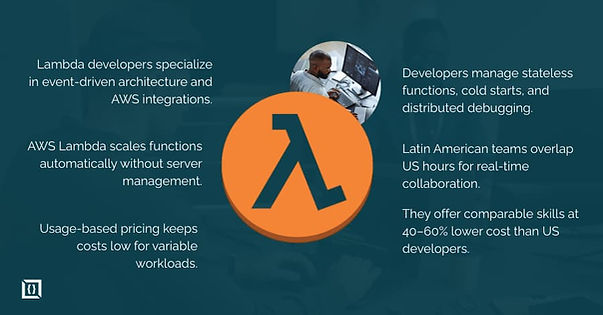
Lambda changes how backend development works. Instead of managing servers or planning capacity, you write functions that respond to events, and AWS automatically scales them.
The cost model is usage-based. You pay per invocation and compute duration. A low-traffic API endpoint costs very little, while higher-traffic endpoints scale automatically.
For startups, this allows launching an MVP without managing infrastructure. Tasks like image resizing, email sending, or data transformations run without dedicated servers. Integration with AWS services - S3, DynamoDB, API Gateway, EventBridge - is straightforward.
Some considerations include:
- Functions are stateless.
- Cold starts can introduce latency for infrequently called functions.
- Debugging distributed serverless applications requires different tooling than monolithic apps.
Advantages of Nearshore Talent and Time Zone Alignment
Nearshore hiring means working with developers in nearby countries with overlapping business hours. For US teams:
- Colombia operates in Eastern Time.
- Mexico overlaps with Central and Pacific Time.
- Argentina runs 1–2 hours ahead of Eastern.
Time-zone overlap matters for serverless projects. Lambda development involves short deploy-test-debug cycles. Real-time collaboration makes it easier to troubleshoot CloudWatch logs, debug API Gateway configurations, or adjust a function during testing.
Latin American regions like Colombia, Mexico, Argentina, and Brazil have active AWS communities. Developers often have production Lambda experience, not just tutorial-level knowledge.
The cost difference is substantial: nearshore developers generally cost 40–60% less than US-based equivalents while providing similar technical capability.
AWS Lambda and Serverless Development Services
Serverless projects vary in scope. Some teams need a single developer to build Lambda functions. Others need full project delivery including architecture, development, QA, and deployment pipelines.
Dedicated Development Team
A dedicated team works exclusively on your project for an extended period. Team members learn your codebase, attend your standups, and build context over time.
This model fits long-term product development. If you have a roadmap spanning multiple quarters and need consistent velocity, dedicated developers integrate with your workflow. They understand your architecture decisions, know where the technical debt lives, and can make informed tradeoffs.
Dedicated teams typically include a mix of experience levels. A senior developer handles architecture and complex integrations while mid-level developers execute feature work.
Software Staff Augmentation
Staff augmentation adds developers to your existing team to fill skill gaps or increase capacity. The developers work under your technical leadership, use your tools, and follow your processes.
This works when you have Lambda expertise in-house but need more hands. Maybe you have a senior architect who designed your serverless infrastructure but lacks bandwidth for implementation. Augmented developers handle execution while your team maintains architectural control.
Augmentation also helps when evaluating serverless for a new project. Adding an experienced Lambda developer for a few months lets you build initial infrastructure with guidance before committing to a larger team.
Project Delivery and Management
For defined projects with clear scope, full delivery makes sense. You specify requirements, agree on deliverables and timeline, and the team handles execution end-to-end. This includes architecture, development, QA, and deployment.
Startups without internal technical leadership often choose this model. If you have a product vision but lack engineering management capacity, handing off delivery lets you focus on business priorities while technical work progresses.
The consideration is less direct control over implementation decisions. You need clear requirements upfront and confidence in the team's technical judgment.
AI/ML, Data Engineering, and Custom Software Development
Lambda integrates well with ML workflows. Common patterns include triggering model inference on S3 uploads, processing streaming data through Kinesis, or building APIs that serve ML predictions.
Data engineering tasks also fit the serverless model. ETL jobs that run on schedules, data validation pipelines, and event-driven transformations all work well as Lambda functions.
Teams with broader capabilities can handle projects that span Lambda functions, custom backend services, and data infrastructure. This matters when your serverless components connect to larger systems.
Mobile App and Backend Integrations
Lambda works as a backend for mobile applications. API Gateway fronts your Lambda functions, providing REST or GraphQL endpoints that mobile clients consume.
Common patterns include user authentication flows with Cognito, push notification handling, image processing on upload, and real-time data sync. Lambda handles variable mobile traffic well since it scales automatically with user activity.
Developers building mobile backends need experience with API design, authentication patterns, and mobile-specific concerns like offline handling and payload optimization.
Chatbots, Game Development, and Other Specialized Solutions
Lambda's event-driven model fits various specialized use cases. Chatbot backends process incoming messages and generate responses. Game servers handle matchmaking, leaderboards, and in-game events. Analytics pipelines process clickstream data in real time.
These projects require both Lambda expertise and domain knowledge. A chatbot backend needs natural language processing integration. A game backend needs understanding of latency requirements and player experience.
Cost to Hire Nearshore AWS Lambda Developers
Rates vary by experience level, region, and engagement model. Understanding these factors helps you budget accurately.
Entry/Junior Developers ($20 to $50/hour)
Junior Lambda developers handle basic function development. They can build integrations, connect Lambda to services like S3 or DynamoDB, and implement functions from clear specifications.
They work best with supervision. Expect them to need guidance on architectural decisions, error handling patterns, and deployment configuration. They are suited for extending existing serverless infrastructure rather than designing new systems.
Mid-Level Developers ($50 to $90/hour)
Mid-level developers work independently on most Lambda projects. They understand event-driven architecture, can design function interactions, and handle debugging across distributed components.
This level suits most startup needs. They build APIs, implement business logic, configure CI/CD pipelines, and troubleshoot production issues. They make reasonable architectural decisions within established patterns.
Senior Developers ($90 to $150+/hour)
Senior developers design serverless architectures from scratch. They evaluate tradeoffs between Lambda and other compute options, optimize for cost and performance, and establish patterns for the team.
They handle complex scenarios: multi-region deployments, advanced security configurations, cost optimization at scale, and integration with ML/AI services. Also, mentor junior team members and conduct code reviews.
Cost Variations by Region and Hiring Model
Rates differ across Latin American markets. Colombian developers typically fall in the lower to middle range. Argentine developers, despite economic volatility, often command higher rates due to strong technical education. Brazilian developers vary widely based on English proficiency and specialization.
Freelancers generally cost less per hour but come with higher management overhead and availability risk. Agencies charge more but handle recruiting, HR, and often provide backup coverage. Dedicated teams through established providers balance cost and reliability.
How Hiring Model Impacts Total Cost
Hourly rate is not the total cost. Consider ramp-up time, retention risk, and management overhead.
A cheaper freelancer who takes three weeks to understand your codebase and leaves after two months costs more than a pricier dedicated developer who stays for a year. Knowledge transfer has real costs.
Staff augmentation through providers typically includes some management support, reducing your internal coordination burden. Full project delivery shifts more responsibility to the provider but costs more per hour of development work.
How to Hire and Onboard a Nearshore AWS Lambda Developer
A structured process reduces hiring risk and accelerates productivity.
Choosing Between Staff Augmentation vs. Dedicated Team
Staff augmentation fits when you have technical leadership and need execution capacity. Your architects make decisions; augmented developers implement them.
Dedicated teams fit when you need autonomous capability. They handle both decisions and execution with less ongoing direction from your side.
Consider project duration. Short engagements (under three months) work better as augmentation. Longer projects benefit from dedicated teams who build deep context.
Key Skills and Qualities to Look For
Technical requirements for Lambda developers:
Technical skills:
- Core AWS Lambda experience: function development, deployment, and debugging.
- Event source integrations: S3, API Gateway, SQS, SNS, EventBridge, DynamoDB.
- Infrastructure as Code: SAM, Terraform, or CloudFormation.
- CI/CD pipeline configuration for serverless deployments.
- Monitoring and observability: CloudWatch, X-Ray, or equivalent tools.
- Security practices: IAM roles, secrets management, VPC configuration.
Soft skills and remote work readiness:
- Clear technical communication.
- Proactive blocker reporting.
- Prior experience with distributed teams.
Onboarding Process and Best Practices for Smooth Collaboration
Effective onboarding ensures the developer ramps up without unnecessary delays:
- AWS access setup: Configure IAM roles with the right permissions. Provide access to accounts, repositories, and documentation.
- Communication patterns: Use daily standups for active development and Slack or Teams for async questions. Document key decisions in Notion or Confluence.
- Initial task assignment: Give a small, low-risk feature or bug fix first. This helps the developer explore the codebase and deployment process safely.
- Development environment and pipelines: Ensure the developer can deploy to a development environment on day one. Waiting on access or configuration slows ramp-up and productivity.
Getting Started
Once hiring and onboarding are complete, the next step is moving from planning to execution. Define the project scope clearly: Lambda functions, integrations, expected behavior, and involved AWS services. Clear requirements help candidates assess fit and demonstrate relevant experience.
Match developer level to project needs:
- Junior: Basic functions and small integrations.
- Mid-level: Most feature work and API development.
- Senior: Architecture, complex integrations, mentoring.
Set up workflow and communication: weekly sprints, pull requests, code reviews, and CI/CD pipelines. Combine synchronous meetings with async updates, and use daily notes in Slack to keep everyone aligned.
You can also connect with us to discuss your project requirements, estimate timelines, and determine the right nearshore serverless setup for your team.
Frequently Asked Questions
What is a nearshore AWS Lambda developer?
A developer located in a nearby country (typically Latin America for US companies) who specializes in AWS Lambda and serverless architecture. They work in overlapping time zones, enabling real-time collaboration.
How do nearshore Lambda developers compare to offshore or onshore?
Nearshore offers time zone alignment similar to onshore at costs closer to offshore. Offshore (Asia, Eastern Europe) typically costs less but has 8 to 12 hour time differences. Onshore costs more but provides same-timezone collaboration.
Are nearshore developers experienced with AWS tools and serverless?
Yes. Latin America has active AWS communities with certified professionals. Many developers have production experience with Lambda, having worked with US clients on serverless projects. AWS certifications (Solutions Architect, Developer) are common among experienced candidates.
How long does it take to hire a nearshore AWS developer?
Typically, one to three weeks from initial search to starting work. Established providers can present qualified candidates within days. The timeline depends on role specificity and your interview process.
What's the best way to manage a remote serverless team?
Use async-friendly workflows with clear documentation. Daily standups keep work synchronized. Written updates in Slack or similar tools maintain visibility. CI/CD pipelines and infrastructure as code reduce deployment friction. Regular code reviews maintain quality across distributed teams.