Hire Nearshore Flutter Developer | Scale Your Team

Flutter has become a go-to choice for cross-platform mobile development. One codebase for iOS and Android, strong performance, and a growing ecosystem make it attractive for startups that need to move fast without maintaining two separate native apps.
Finding Flutter developers in the US market is competitive and expensive. Senior Flutter talent commands $120,000-$160,000+ annually, and the hiring cycle can stretch for months. Nearshore hiring in Latin America offers an alternative: experienced Flutter developers working in your time zone at 30-40% lower costs.
Let’s look at why nearshore Flutter hiring works, what these developers bring to your project, the engagement models you can use, and how to evaluate candidates effectively.
Why Choose a Nearshore Flutter Developer?
Nearshore refers to hiring in nearby countries with similar time zones. For US and Canadian companies, this typically means Latin America. The model combines the cost advantages of international hiring with the collaboration benefits of working in overlapping hours.
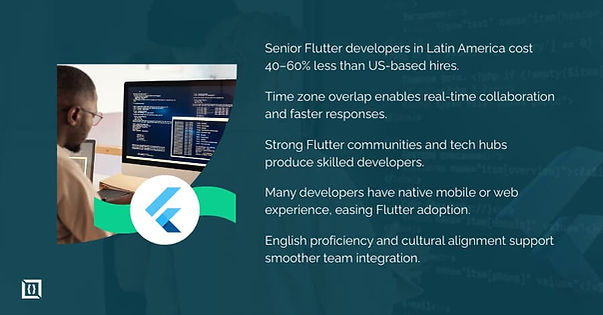
Cost-Efficiency and Time Zone Alignment
The cost difference is significant. A senior Flutter developer in the US runs $80-120/hour or $150,000+ annually. The same skill level in Colombia costs $30-49/hour. That's 40-60% savings without sacrificing technical quality.
Time zone alignment is the operational advantage that separates nearshore from offshore. Colombian developers work in EST. Mexican developers overlap with Central and Pacific time. This means real-time collaboration: synchronous standups, same-day code reviews, and immediate responses when something blocks progress.
Compare this to offshore teams in India or Eastern Europe with 8-12 hour time differences. Questions wait overnight. Pull requests sit until the next business day. Sprint ceremonies require someone to work odd hours. Nearshore eliminates these async bottlenecks.
Access to Latin America's Flutter Talent
Latin America has a mature tech sector with strong mobile development communities. Colombia, Mexico, Argentina, and Brazil all have active Flutter ecosystems with meetups, conferences, and open-source contributions.
Flutter's popularity in the region has grown steadily since Google's 2018 stable release. Many developers transitioned from native Android or iOS development and bring that platform knowledge to their Flutter work. Others came from web development backgrounds and adapted quickly to Dart and Flutter's widget-based architecture.
Cities like Medellín, Mexico City, Buenos Aires, and São Paulo have established tech hubs where Flutter talent concentrates. University programs and coding bootcamps in these regions produce developers trained on modern frameworks and agile methodologies.
Cultural Fit and Communication Ease
English proficiency in Latin American tech communities is generally strong, particularly among developers who have worked with US clients. Most candidates for nearshore roles have professional English skills sufficient for technical discussions, documentation, and meetings.
Cultural alignment helps with team integration. Latin American developers working with US companies understand American business norms: direct communication, meeting etiquette, deadline expectations, and agile workflows. There's less friction during onboarding and fewer misunderstandings about deliverables.
Many nearshore Flutter developers have prior experience working remotely with distributed teams. They're familiar with tools like Slack, Jira, and GitHub, and they understand async communication patterns even when working synchronously.
What a Flutter Developer Brings to Your Mobile Project
Flutter lets you write one codebase for both iOS and Android. A developer working with Flutter handles UI implementation, basic performance considerations, and connects the app to native features or APIs as needed. Understanding these responsibilities helps you evaluate candidates effectively.
Cross-Platform Development with Flutter
Flutter's core value proposition is building one codebase that runs on both iOS and Android. Unlike hybrid frameworks that wrap web views, Flutter compiles to native ARM code and renders its own UI using the Skia graphics engine.
This approach delivers near-native performance while eliminating the need to maintain separate Swift/Kotlin codebases. For startups with limited resources, this means one team, one codebase, and faster iteration across both platforms.
A skilled Flutter developer understands when cross-platform makes sense and when native development might be necessary. Some features, like complex platform-specific integrations or performance-critical functionality, may still require native code. Good Flutter developers know how to bridge these gaps using platform channels.
Faster Time to Market and Unified Codebase
Flutter's hot reload feature speeds up development significantly. Developers see changes instantly without rebuilding the entire app, which accelerates the design-to-implementation feedback loop.
The unified codebase means features ship to both platforms simultaneously. Bug fixes apply everywhere at once. UI changes don't require duplicate work. For teams pushing frequent releases, this reduces coordination overhead and deployment complexity.
Flutter's widget library provides pre-built components that handle common UI patterns. Developers spend less time building basic elements and more time on business logic and custom features. This translates to faster MVP delivery and quicker iteration cycles.
Expertise in UI/UX, Performance, and Native Integrations
Flutter gives developers control over the UI, allowing them to implement interfaces that follow design specifications. Developers can create animations, transitions, and responsive layouts that work consistently on both iOS and Android.
Performance is an important consideration. Developers manage widget trees, state, and rebuilds to avoid slowdowns or dropped frames.
Native integrations are often required for things like payments, push notifications, camera access, or other platform-specific features. Experienced Flutter developers handle platform channels, integrate native SDKs, and manage the technical details that come with bridging Flutter and native code.
Flexible Engagement Models for Your Project
Different project types and company stages call for different engagement structures.
Dedicated Nearshore Flutter Developer
Dedicated developers work exclusively on your project for an extended period. They become part of your team, learn your codebase, attend your meetings, and build context over time.
This model works best for ongoing product development where continuity matters. You get a consistent developer who understands your app's architecture, your users, and your business goals. They improve their contributions as they gain context.
Dedicated arrangements typically run month-to-month with notice periods for changes. You maintain full control over priorities and workflow while getting a team member who operates as an extension of your in-house engineering.
Augmented Team Extension
Staff augmentation adds Flutter developers to your existing team to fill skill gaps or handle increased workload. The developers work under your technical leadership, use your tools, and follow your processes.
This model suits situations where you have a mobile team that needs additional capacity for a sprint, release, or backlog cleanup. You maintain architectural control while adding specialized Flutter skills you don't have in-house.
Augmentation is also useful when you're evaluating Flutter for a new project and want experienced guidance before committing to a full team.
Project Delivery and Managed Services
For defined projects with clear scope, full project delivery makes sense. You specify requirements, agree on deliverables and timeline, and the nearshore team handles execution end-to-end. This includes development, QA, and sometimes product management.
This works well for MVPs, proof-of-concept builds, or specific feature sets where you want to outsource the entire delivery rather than manage individual developers. You get a fixed scope and predictable costs.
The tradeoff is less direct control over day-to-day work. This model requires clear requirements upfront and a provider you trust to make good technical decisions.
How to Vet and Evaluate Flutter Developers
When hiring Flutter developers, it helps to focus on specific skills and experience. Look at their past projects, how they handle UI and state management, and whether they can integrate native features reliably.
Technical Screening: Flutter and Dart
Evaluate core Flutter competencies:
- Dart proficiency: Strong understanding of the language, including null safety, async/await, streams, and generics
- Widget architecture: Knowledge of stateless vs stateful widgets, widget lifecycle, and composition patterns
- State management: Experience with approaches like Provider, Riverpod, Bloc, or GetX
- Platform channels: Ability to bridge Flutter with native iOS and Android code
- API integration: Experience with RESTful APIs, JSON serialization, and HTTP clients like Dio
- Testing: Unit tests, widget tests, and integration tests using Flutter's testing framework
Use practical coding exercises that reflect real work. Ask candidates to build a small feature, debug an existing issue, or review code and suggest improvements. Live coding sessions reveal problem-solving approach and communication style.
Soft Skills: Communication, Collaboration, and Agile Fit
Technical ability isn’t enough on its own, especially for remote teams. Strong communication is essential.
Check English proficiency during interviews. Can they explain technical concepts clearly? Do they ask clarifying questions? Are they comfortable contributing to discussions?
Look for prior experience with distributed teams. Developers who have worked with US clients understand meeting norms, async workflows, and collaboration tools.
Ask about familiarity with agile practices - sprint planning, daily standups, and retrospectives. Experience with these routines helps new hires integrate more smoothly into your team.
Onboarding and Retention Considerations
Good nearshore providers invest in developer retention. High turnover disrupts projects and loses accumulated context.
Ask about internal practices: career development, training opportunities, team culture, and compensation competitiveness. Providers who treat developers well tend to retain them longer, which benefits your project continuity.
Understand the backup plan if a developer leaves. What's the handover process? How quickly can they provide a replacement? Documentation practices and knowledge sharing within the provider's organization affect how smoothly transitions happen.
Your Next Step to Hiring a Nearshore Flutter Developer
1. Define Your Scope and Stack
Before talking to candidates or providers, clarify what you need. Document your app requirements, target platforms, backend stack, and timeline. Specify whether you need a full app build, specific features, or ongoing maintenance.
Clear requirements speed up hiring and improve candidate matching. Know whether you need Flutter expertise alone or full-stack capabilities including backend work.
2. Select Your Engagement Model
Consider your company stage, budget, and internal capacity:
- Dedicated developer: Best for ongoing product development with an established roadmap.
- Staff augmentation: Ideal when you have technical leadership and need additional hands.
- Project delivery: Suitable for defined scope with clear deliverables.
Each model has different cost structures, commitment levels, and management requirements.
3. Meet Your Developer and Kick Off
Once you've selected candidates, conduct technical interviews and assess fit. Good providers can present qualified candidates within days and have developers starting within 2–3 weeks.
Plan for proper onboarding: codebase access, tool setup, architecture overview, and team introductions. The first few weeks set the foundation for long-term collaboration.
Your Next Move
Nearshore Flutter hiring works when you're clear about what the role requires. Define your project scope, decide on the engagement model that fits your situation, and identify the technical skills you need.
Once those decisions are made, the process moves quickly. You can review candidates, run technical evaluations, and start onboarding within a few weeks. Time zone alignment means collaboration works from day one, and you'll have a Flutter developer shipping code to both platforms from a single codebase.
You can also reach out to us to discuss your project needs, review available Flutter talent, and see how a nearshore developer can fit into your team quickly and efficiently.
Frequently Asked Questions
What are the hourly rates for nearshore Flutter developers by country?
Rates vary by seniority and specialization. General ranges: Colombia ($30-49/hr), Mexico ($35-50/hr), Argentina ($25-45/hr), Brazil ($35-55/hr). Compare to US rates of $80-120/hr. These are estimates; actual rates depend on experience level and project requirements.
How do nearshore Flutter rates compare to onshore and offshore?
Nearshore rates are typically 40-60% lower than US/Canada rates while offering better communication and time zone alignment than offshore locations. Offshore rates (India, Philippines) may be lower, but time zone gaps create collaboration challenges that often offset the savings.
Which Latin American countries have the best Flutter talent pools?
Colombia has a strong Flutter community with good English proficiency and competitive rates. Mexico offers the largest developer population and close time zone alignment with the US West Coast. Argentina has strong technical education, but currency instability affects pricing. Brazil has a large talent pool, but Portuguese is the primary language.
What happens if my Flutter developer leaves mid-project?
Established nearshore providers plan for continuity. This includes documentation requirements, knowledge sharing practices, and shadowing periods for transitions. Ask about replacement timelines and handover processes before engaging. Good providers can typically provide replacements within 1–2 weeks.
Can nearshore Flutter developers work with my existing tech stack?
Yes. Most experienced Flutter developers work in multi-stack environments, integrate with backends built in Node.js, Python, or other languages. They're familiar with cloud services like AWS and Firebase. They use standard collaboration tools: GitHub, Jira, Slack, Figma. Clarify your stack requirements during screening to ensure alignment.