Hire Nearshore Google Cloud Build Engineer (2026)

Deployments on Google Cloud Platform can be fast and reliable but only if your CI/CD pipelines are designed and maintained properly. A Google Cloud Build engineer handles exactly that: automating builds, managing artifacts, securing pipelines, and integrating infrastructure so you can ship consistently and scale efficiently.
As we move through 2026, the scale of managing microservices and AI-driven workflows on GCP has increased. With nearshore talent, you get engineers who are technically skilled and work in your time zone, making collaboration smooth while maintaining high DevOps standards.
Let’s look at what a Cloud Build engineer does, the technical and business benefits of hiring nearshore, and how to evaluate and integrate this role into your team.
What Does a Google Cloud Build Engineer Actually Do?
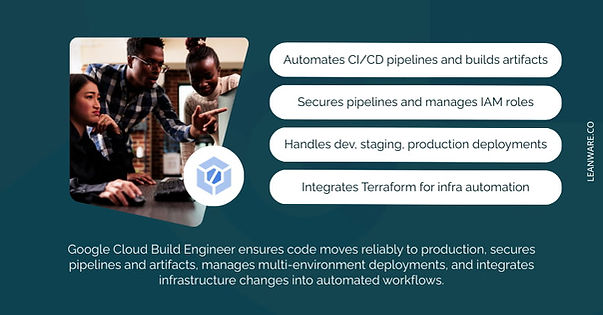
A Google Cloud Build Engineer (often a specialized DevOps Engineer) designs and manages automated CI/CD pipelines that transform source code into deployable artifacts like Docker containers. Their daily work involves writing build configurations in YAML or JSON to automate fetching dependencies, running tests, and performing security scans within the Google Cloud Build service.
They are responsible for securing the software supply chain by implementing build provenance and managing IAM roles to ensure that only authorized, verified code reaches production environments.
Core Responsibilities in CI/CD Automation
The primary job is building and maintaining automated pipelines using Google Cloud Build. That means writing cloudbuild.yaml configurations, setting up triggers that respond to repository events, and orchestrating multi-step builds that compile code, run tests, build container images, and push artifacts to Artifact Registry.
The engineer's job is to make that sequence fast, reliable, and repeatable.
Managing Multi-Environment Deployments (Dev, Stage, Prod)
Real-world deployments involve multiple environments, each needing isolation. A Cloud Build Engineer configures separate GCP projects or namespaces for dev, staging, and production with distinct IAM policies and resource quotas.
They also build rollback strategies using versioned container images, Git-stored manifests, and canary or blue-green deployment patterns on GKE.
Securing Pipelines and Artifact Management
Security in CI/CD goes beyond adding a scan step. A Cloud Build Engineer configures least-privilege IAM roles, integrates Secret Manager for credential handling, and uses Workload Identity Federation to eliminate long-lived service account keys.
On the artifact side, they configure Artifact Registry with vulnerability scanning and access controls to ensure only verified images reach production.
Infrastructure as Code and Terraform Integration
A Cloud Build Engineer integrates Terraform into the pipeline so that infrastructure changes go through the same review and automation process as application deployments.
This means running terraform plan on pull requests, applying updates through automated pipelines, and maintaining state files securely in Cloud Storage.
What Is Google Cloud Build and Why It Matters
Google Cloud Build is a fully managed, serverless CI/CD platform. A developer pushes code, a trigger kicks off a build defined in YAML, each step runs inside a container, and artifacts get pushed to Artifact Registry and deployed to the target environment. No build servers to maintain, automatic scaling, and native integration with GKE, Cloud Run, and other GCP services.
This serverless model is a big deal for engineering teams. You do not spend time patching Jenkins nodes or managing build agent pools. Google handles the compute, and you only pay for build minutes used. For teams already invested in GCP, this native integration reduces the glue code and custom scripting you need to connect your pipeline to your infrastructure.
Cloud Build vs GitHub Actions vs Jenkins
Factor | Google Cloud Build | GitHub Actions | Jenkins |
Hosting | Fully managed, serverless | Cloud-hosted (GitHub) | Self-hosted or managed |
GCP Integration | Native (IAM, GKE, Cloud Run) | Via plugins/actions | Via plugins |
Maintenance | Zero | Minimal | High |
Best For | GCP-native architectures | Multi-cloud, GitHub-centric workflows | Legacy or customized pipelines |
Cloud Build also supports containerized ML training pipelines and integrates with Vertex AI, making it practical for teams that need both application and ML deployment automation on GCP.
Why Hire a Nearshore Google Cloud Build Engineer?
Finding a skilled Google Cloud Build engineer doesn’t have to mean high costs or delayed collaboration. Nearshore talent lets you get GCP expertise while keeping real-time communication and team alignment intact.
Cost Advantage vs US-Based Engineers
A US-based GCP DevOps engineer earns around $126K per year on average, with senior roles reaching $150K–$170K.
LATAM engineers with the same skill set typically cost $30-$60 per hour, or roughly $70K–$100K annually - a 40–55% reduction in direct salary costs.
Time Zone Alignment and Collaboration Benefits
LATAM engineers usually work within 1–3 hours of US time zones, making standups, code reviews, and incident responses practical during normal working hours. For DevOps roles, having someone available immediately when a pipeline breaks is critical.
Cultural and Communication Efficiency
Many LATAM developers have experience with US teams, agile workflows, and English communication. This reduces friction, keeps sprint velocity steady, and avoids delays caused by misalignment.
Faster Hiring and Scalability
Latin America has a deep developer talent pool. Specialized nearshore staffing firms can fill GCP roles in 2–4 weeks, compared with 2-3 months for domestic senior hires, making team scaling faster and more predictable.
When Should You Hire a Google Cloud Build Engineer?
Not every team needs a dedicated Cloud Build specialist. But certain situations make it the obvious move.
Scaling microservices on GKE: When you go from three services to thirty, manual deployment breaks down. Each service needs its own build pipeline, container image, and environment-specific settings. A Cloud Build Engineer sets up templated pipelines and implements progressive delivery strategies like canary deployments.
AI/ML deployment pipelines: ML models need their own release cycle with model versioning, evaluation benchmarks, containerized inference deployment, and automated rollback if model quality drops. This is fundamentally different from standard application deployment.
Startup DevOps maturity: The transition from manual deployments (SSH into a server, pull latest code, restart) to automated CI/CD is a specific skill set. A Cloud Build Engineer builds that foundation from scratch: automated testing, containerized builds, environment promotion, and monitoring integration.
Enterprise cloud cost optimization: Poorly configured pipelines waste money through long build times, redundant artifacts, over-provisioned build workers, and failed deployments that still consume resources. Optimization here often pays for the engineer's salary on its own.
Key Skills to Look for in a Google Cloud Build Engineer
When interviewing candidates, look for these specific technical competencies:
- GCP Core Services: They must be experts in IAM (Identity and Access Management), GKE, Cloud Run, and Secret Manager.
- Containerization: Deep knowledge of Docker and Kubernetes is non-negotiable. They should understand how to optimize container images for size and security.
- Infrastructure as Code (IaC): Proficiency in Terraform or Google Cloud Deployment Manager is essential for maintaining reproducible environments.
- Scripting: They should be comfortable with Bash, Python, or Go for custom automation tasks that fall outside standard YAML configurations.
How Much Does It Cost to Hire a Nearshore GCP Build Engineer?
The costs can vary depending on seniority, experience, and specific skills. Typical US-based and LATAM rates are:
US-Based | Nearshore (LATAM) | |
Hourly Rate | $60-$90/hr | $35-$60/hr |
Annual Salary | $125K-$170K | $70K-$100K |
Total Cost (with overhead) | $155K-$210K | $80K-$120K |
Estimated Annual Savings | Baseline | $55K-$110K per engineer |
Staff augmentation works when you need one or two specialists to fill gaps. A dedicated team model makes more sense when you need a self-contained DevOps function. Beyond salary savings, pipeline optimization often delivers even larger returns through reduced build times, less cloud waste, and faster incident recovery.
Real-World Use Cases and Business Impact
Having a Cloud Build engineer in place ensures faster deployments, fewer errors, and built-in compliance across all types of workloads.
SaaS continuous deployment: According to the 2024 DORA Report, elite performers deploy on demand, recover from failures in under an hour, and maintain change failure rates as low as 5%. A Cloud Build specialist is how you get there.
AI inference pipelines: Automating model versioning, evaluation, containerized deployment, and post-deployment monitoring so data scientists focus on model quality.
High-traffic e-commerce: Blue-green deployments, automated load testing, and instant rollback triggers based on error rate thresholds. A 5-minute recovery vs. a 2-hour recovery during a sale event translates directly to revenue.
Regulated industries: Cloud Build's integration with Cloud Audit Logs and Binary Authorization provides a verifiable chain of custody from commit to production, building compliance into the pipeline.
Common Mistakes Companies Make When Hiring DevOps Engineers
Even experienced teams can stumble when hiring for DevOps roles. Common challenges often come from misaligned expertise, overlooked security, or underestimated pipeline complexity.
Hiring generalists instead of GCP specialists. Cloud Build has its own configuration syntax, trigger model, and integration patterns. IAM on GCP works differently than AWS IAM. Direct GCP experience reduces onboarding time and avoids early pipeline architecture mistakes.
Ignoring security and IAM architecture. Engineers who set up overly permissive roles or skip secret management create vulnerabilities that compound over time. Evaluate security knowledge from the start.
Underestimating CI/CD complexity. A pipeline for one service is straightforward. A pipeline architecture handling 20 microservices across three environments with different approval gates is a serious engineering challenge.
Nearshore vs Offshore vs Onshore: How They Compare in 2026
Onshore (US) runs $125K to $170K+ annually. Nearshore (LATAM) ranges from $70K to $100K. Offshore (Asia) is typically $40K to $70K. Cost is only one factor; collaboration, responsiveness, and retention also have a major impact.
Nearshore engineers in overlapping time zones join the same sprint ceremonies, respond to Slack in real time, and handle incidents without scheduling gymnastics.
Offshore teams require asynchronous handoffs that add latency to feedback loops. For DevOps, that latency has a real productivity cost. Retention rates in LATAM nearshore arrangements also tend to be higher, which means less knowledge loss and lower recurring onboarding costs.
How to Successfully Integrate a Nearshore DevOps Engineer
Start with documentation: architecture diagrams, repo structure, pipeline configs, environment details, and runbooks. Set up a structured first week with introductions to key team members, a walkthrough of existing CI/CD workflows, and a small starter task that lets them contribute early. Define communication cadence from day one: daily standups, weekly one-on-ones, and sprint ceremonies.
On the tooling side, make sure the engineer has access to Slack or Teams, Jira or Linear, GitHub or GitLab, and shared monitoring dashboards before their start date. Waiting days for IAM permissions is a common and avoidable delay that can stall momentum during onboarding.
Track impact using DORA metrics: deployment frequency, lead time for changes, change failure rate, and failed deployment recovery time. According to Google's DORA research, elite performers are twice as likely to exceed organizational goals in profitability and productivity. Set baselines before the engineer starts and track improvement over the first 90 days. Onboarding typically takes one to three weeks depending on project complexity.
Final Thoughts
For US companies running production workloads on GCP, a nearshore Cloud Build Engineer is a strategic hire. They build a CI/CD foundation that scales with your product, from automated testing and secure artifact management to reliable rollbacks. These are the practices that help you ship with confidence.
Stronger delivery drives better business outcomes. With GCP continuously evolving its CI/CD ecosystem, having a specialist ensures you stay ahead instead of catching up. The nearshore model makes it even more accessible, bringing together deep expertise, time zone alignment, and cost efficiency in one hire.
You can also connect with us to explore nearshore Google Cloud Build engineers, streamline your CI/CD pipelines, and scale your cloud deployments efficiently.
Frequently Asked Questions
What does a Google Cloud Build Engineer do?
They build, automate, and secure CI/CD pipelines in GCP. That includes configuring build triggers, managing containerized workloads, integrating Terraform-managed infrastructure, and ensuring artifacts are handled securely from development to production.
How much does a nearshore GCP DevOps engineer cost?
Rates typically range from $35–$60/hr or $70K–$100K annually. That’s notably lower than US-based engineers, who often start around $150K per year, without compromising technical expertise or collaboration quality.
What is the difference between Google Cloud Build and GitHub Actions?
Cloud Build is fully integrated with GCP services like GKE and Cloud Run, making it ideal for GCP-native architectures. GitHub Actions is more general-purpose, tied to repositories rather than the cloud platform itself.
Is Google Cloud Build suitable for AI/ML pipelines?
Yes. It supports automated model versioning, containerized deployment, artifact tracking, and integrates with Vertex AI and GKE for scalable, repeatable ML workflows.
What skills should a Google Cloud Build Engineer have?
They need hands-on experience with Cloud Build, GKE, Cloud Run, IAM, Secret Manager, Docker, Kubernetes, Terraform, YAML pipelines, CI/CD architecture, and DevSecOps practices.
How long does it take to onboard a nearshore DevOps engineer?
Onboarding usually takes 1–3 weeks, depending on project complexity. Clear documentation, defined sprint processes, and infrastructure access speed up integration significantly.
Can a Google Cloud Build Engineer help reduce cloud costs?
Absolutely. They optimize build execution, implement caching, automate scaling, and prevent faulty deployments from consuming unnecessary resources, directly reducing cloud waste.