Hire Nearshore Laravel Developers

Laravel handles the infrastructure work of web development: authentication, queues, routing, and database migrations. That makes it a practical choice for startups shipping web applications on tight timelines.
Because many companies rely on Laravel, finding senior developers in the US is competitive. Salaries range from $130,000 to $170,000, and hiring can take months.
Nearshore developers in Latin America provide a practical alternative: they work overlapping hours with US teams, have comparable technical skills, and typically cost 40 to 60 percent less.
Let’s look at why nearshore Laravel hiring works, how to assess developer levels, the hiring process, and what to expect from different engagement models.
Why Choose Nearshore Laravel Developers from LatAm
Nearshore refers to hiring in nearby countries with overlapping time zones. For US and Canadian companies, this typically means Latin America. The model combines the cost advantages of international hiring with the collaboration benefits of working during the same business hours.
Access to Top Tech Talent in LatAm
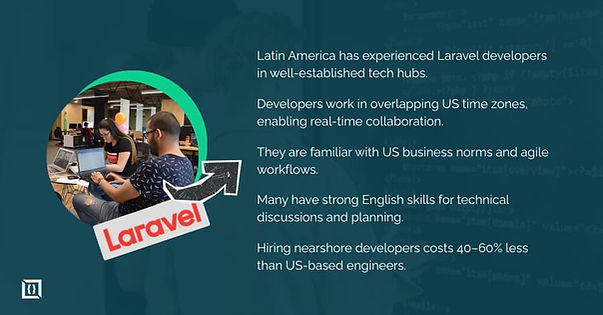
Latin America has a well-established tech sector. Countries like Colombia, Mexico, Argentina, and Brazil have growing developer communities and active tech ecosystems.
Colombia has strong web development talent, especially in Medellín, Bogotá, and Cali, where meetups and conferences are common. Mexico benefits from its proximity to the US and large developer populations in Mexico City, Guadalajara, and Monterrey.
Argentina produces highly skilled developers, particularly in Buenos Aires.
Laravel is widely used across these markets. Many developers work with it on production projects for local companies and US clients.
Working Hours Aligned with US Time Zones
Time zone alignment is the operational advantage that separates nearshore from offshore. Colombian developers work in Eastern Time. Mexican developers overlap with Central and Pacific time zones. Argentine developers are typically one to two hours ahead of Eastern Time.
This overlap allows real-time collaboration. Teams can run synchronous standups, review code the same day, and resolve blockers immediately. With offshore teams in India or Eastern Europe, 8 to 12 hour differences often create delays: questions sit overnight, pull requests wait until the next business day. Nearshore setups reduce these bottlenecks.
Cultural Compatibility and Seamless Collaboration
Cultural alignment also matters. Latin American developers working with US companies generally understand American business norms: direct communication, meeting etiquette, deadlines, and agile workflows.
Many have prior experience on distributed teams. They communicate proactively, flag blockers early, and document their work clearly. This makes onboarding smoother and reduces misunderstandings about deliverables.
Strong English Proficiency
English skills vary across the region. According to the EF English Proficiency Index, Argentina and Honduras show high proficiency, while Uruguay, Paraguay, and Costa Rica fall in the moderate range. Colombia and Mexico are lower but have been steadily improving, particularly in professional and tech environments.
Developers targeting nearshore roles can handle technical discussions, code reviews, and planning meetings. They can explain their reasoning and understand requirements without repeated clarification.
Cost-Effective Compared to Onshore or Agency Options
The cost difference is substantial. A senior Laravel developer in the US runs $80 to $120 per hour or $150,000+ annually with benefits. The same skill level in Colombia or Mexico costs $35 to $55 per hour. That translates to 40 to 60% savings without sacrificing technical quality.
For startups watching runway, this matters. You can hire two experienced nearshore developers for the cost of one US-based senior engineer. This is not about finding cheap labor. It is about accessing skilled developers in markets where the cost of living is lower.
Developer Levels and Skills Comparison
Laravel projects vary in complexity, and different developer levels suit different needs. Understanding what each level brings helps you make the right hiring decision.
Junior Laravel Developers: When to Hire Them
Junior Laravel developers typically have six months to two years of experience. They understand Laravel's core concepts: routing, controllers, Eloquent ORM, Blade templating, and basic authentication. They can build straightforward CRUD applications and implement features from clear specifications.
Junior developers work best under supervision. They need code reviews, architectural guidance, and mentorship to grow. Hire them when you have a senior engineer who can mentor them, when you are building internal tools or simple MVPs, or when budget constraints are significant.
Junior Laravel developers in Latin America typically cost $20 to $30 per hour. At this rate, they provide good value for tasks that do not require deep architectural knowledge or independent decision-making.
Mid-Level Laravel Developers: Balanced Expertise and Value
Mid-level developers have two to five years of experience and can work independently on most features. They understand Laravel's ecosystem beyond the basics: queues, events, service providers, middleware, and testing. They can make reasonable architectural decisions and write clean, maintainable code.
Mid-level developers handle most startup needs well. They can build features end-to-end, debug complex issues, and contribute to technical discussions. They still benefit from senior guidance on system design, but they do not need hand-holding on day-to-day implementation work.
Hire them when you need autonomous contributors who can ship features reliably, when your project has moderate complexity with established patterns, or when you have some technical leadership but need additional execution capacity.
Mid-level Laravel developers in Latin America typically cost $35 to $50 per hour.
Senior Laravel Developers: For Complex Projects and Mentorship
Senior developers have five or more years of experience and deep expertise in Laravel. They understand performance optimization, database design, API architecture, and security best practices. They can design systems, evaluate tradeoffs, and mentor junior team members.
Hire senior developers when you are building mission-critical systems where reliability and scalability matter, when you need technical leadership or architecture guidance, when your project involves complex integrations, high traffic, or sensitive data handling, or when you want to establish patterns and best practices for a growing engineering team.
Senior Laravel developers in Latin America typically cost $29 to $75 per hour, still well below US market rates for equivalent experience and expertise.
How to Hire Nearshore Laravel Developers (Step by Step)
A structured hiring process helps you find the right developer faster and reduces the risk of bad hires.
Define Your Project Scope and Technical Requirements
Start by documenting what you need to build. Outline the features, integrations, and technical constraints. Specify whether you need pure Laravel work or full-stack capabilities including frontend frameworks like Vue or React.
Clear requirements speed up hiring. When candidates understand exactly what they will be building, they can better assess their fit. Write a brief technical specification covering timeline, integrations, expected scale, and specific Laravel packages you require.
Screen Candidates: Skills, Portfolio, and Communication
Technical screening for Laravel developers should cover core framework knowledge, database skills, and code quality.
Evaluate these areas: Eloquent ORM proficiency including relationships and query optimization, routing and middleware implementation, authentication and authorization patterns, queue and job handling, testing with PHPUnit, API development, and Git workflow.
Request GitHub profiles or code samples. Look for clean code structure, meaningful commit messages, and evidence of working on real projects rather than just tutorials. Pay attention to how they structure their Laravel applications, whether they follow conventions, and how they handle error cases.
Conduct a practical coding exercise where candidates build a small feature or debug an issue. This reveals problem-solving approach better than theoretical questions. You might ask them to implement a simple API endpoint with validation, build a feature using queues, or refactor poorly written code.
Communication matters as much as technical skill for remote work. Assess whether candidates explain their thinking clearly and ask clarifying questions.
Interview Process and Cultural Fit Evaluation
Structure interviews to assess both technical depth and team fit. Ask candidates to walk through a complex feature they built, explain architectural decisions, or discuss how they would approach a problem in your domain.
Sample technical questions that reveal depth: How do you approach database schema design for a new feature? Describe a time when you had to optimize a slow Laravel application. How do you handle error logging and monitoring in production? What is your approach to writing testable code?
For cultural fit, explore how they handle disagreements, communicate blockers, and prioritize work. Ask about their experience with remote teams, async communication, and agile practices. Include team members who will work directly with the new hire in the interview process.
Onboarding and Integration with Your Team
Good onboarding sets up new hires for success. Provide codebase access before day one. Let new developers explore the repository, run the application locally, and familiarize themselves with the architecture. Share documentation on coding standards, deployment processes, and team workflows.
Set up communication channels. Add them to Slack, invite them to relevant meetings, and introduce them to team members. Clear expectations about availability, response times, and communication norms help establish good working patterns from the start.
Assign a starter task that is meaningful but bounded. A small bug fix or minor feature lets them learn the codebase and ship something quickly. Avoid throwing new hires into complex work before they understand the system. Schedule regular check-ins during the first month to identify blockers early and build rapport.
How Nearshore Hiring Works: What to Expect
Nearshore hiring follows a predictable structure once you understand how the work relationship is set up. Most of the differences come from the engagement model you choose and how you handle communication, access, and ownership.
Typical Engagement Models
Freelance engagement works for short-term needs or specific tasks. You hire a developer for defined work, pay by the hour or project, and part ways when complete. This offers flexibility but less continuity and accumulated context.
Dedicated developers work exclusively on your project for an extended period. They become part of your team, learn your codebase, attend your meetings, and build context over time. Monthly arrangements with notice periods for changes are typical. This model suits ongoing product development where continuity and deep product knowledge matter.
Project-based engagement involves handing off a defined scope to a team that handles execution end-to-end. You specify requirements, agree on deliverables and timeline, and the team manages the work. This works well for MVPs or specific feature sets where you want to outsource delivery rather than manage individual contributors.
For most startups, dedicated developers usually provide the best balance. You get continuity, predictable collaboration, and the flexibility to scale the team as your workload changes.
Contracts, IP Rights, and Team Management
Standard nearshore contracts include IP assignment clauses that transfer ownership of all work product to you. NDAs protect your proprietary information. Make sure contracts specify code ownership clearly.
Clarify management structure upfront. Will the developer report to your technical lead? Will they participate in sprint ceremonies? Setting these norms early prevents confusion.
Communication Channels and Time Zone Overlap
Establish clear communication norms. Most teams use Slack for daily communication, Jira or Linear for task tracking, and GitHub for code collaboration.
Define expectations for synchronous versus async communication. With nearshore developers, use real-time collaboration for standups, pair programming, and discussions. Reserve async channels for updates and documentation.
Your Next Move
Nearshore Laravel hiring works when you know what you need. Define your project scope, decide whether you need junior, mid-level, or senior developers, and choose an engagement model that fits your situation.
Once those decisions are made, the process moves quickly. You can review candidates, run technical evaluations, and start onboarding within a few weeks. Time zone alignment means collaboration works from day one.
If you’re looking to expand your team with nearshore Laravel talent, connect with us to find the right developers for your project and workflow.
Frequently Asked Questions
Is nearshore development as reliable as onshore?
Quality depends on the individual developer, not their location. The key is thorough screening. Evaluate technical skills rigorously, check references, and start with a trial period if possible. A well-vetted nearshore developer delivers the same quality as a well-vetted local hire.
How do time zones work with LatAm developers?
Most Latin American countries overlap significantly with US business hours. Colombia shares Eastern Time. Mexico City is on Central Time. Argentina is one to two hours ahead of Eastern Time. The experience is closer to working with someone in a different US city than with an offshore team.
What safeguards protect my code and IP?
Standard contracts include IP assignment clauses that give you full ownership of code written for your project. NDAs protect confidential information. Code repositories under your control ensure you always have access. Work with reputable providers who understand these requirements.
How do I evaluate candidate Laravel skills?
Combine multiple evaluation methods. Review GitHub profiles for real project experience. Conduct technical interviews that explore problem-solving and architectural thinking. Use practical coding exercises that reflect actual work. Check references from previous clients about code quality, communication, and reliability.