Hire Nearshore MongoDB Developer | Complete Guide

Finding skilled MongoDB developers is not easy. In the U.S., senior developers can cost $120–180k a year, not including benefits and equity. Offshore teams in Asia are cheaper, but working across large time-zone differences and cultural gaps can slow down your projects. Nearshore developers, particularly from Latin America, offer a balance: reasonable rates, overlapping work hours, and fewer communication headaches.
Nearshore teams can scale quickly while maintaining technical quality and keeping project timelines on track.
Let’s look at hiring nearshore MongoDB developers, their engagement models, and key technical skills.
Why Hire Nearshore MongoDB Developers?
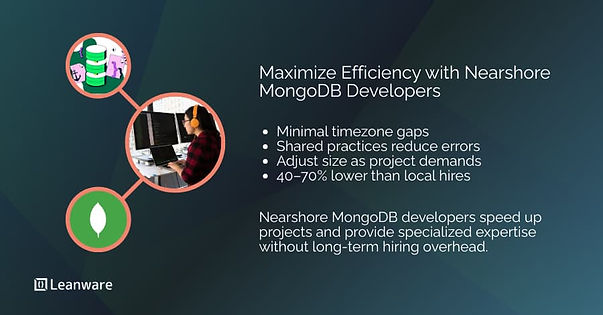
Hiring nearshore MongoDB developers provides an optimal balance of cost savings (40-70% less than domestic hires), access to a large talent pool, and enhanced real-time collaboration due to overlapping time zones.
- Synchronous Communication: Overlapping time zones enable faster feedback.
- Cultural Alignment: Similar business practices and strong English skills reduce miscommunication.
- Scalability: Flexible models allow teams to scale quickly without extra overhead.
Benefits of Nearshore vs Onshore or Offshore
Model | Timezone | Cost | Notes |
Onshore | Same | $150-180k/year | No timezone issues, high cost |
Offshore | 10-12 hours | 60-70% cheaper | Async work, slower DB iteration |
Nearshore | 1-3 hours | $35-70/hour | Real-time collaboration, moderate cost |
Onshore developers work in the same country, typically the US or Canada. They provide zero timezone friction but cost significantly more. A senior MongoDB developer in San Francisco costs $150-180k annually before equity and benefits.
Offshore developers in Asia or Eastern Europe offer rates 60-70% lower than US developers. However, 10-12 hour timezone differences create delays. A question asked at 5 PM your time gets answered the next morning. This async pattern works for some projects but slows iteration on database schema design or performance optimization.
Nearshore developers in Latin America work 1-3 hours different from US timezones. A developer in Mexico City is 2 hours behind EST, 1 hour ahead of PST. This overlap enables real-time collaboration during most of the workday. Rates run $35-70/hour depending on experience level, roughly 40-60% less than comparable US developers.
Faster Hiring & Time-Zone Alignment
Latin American tech hubs like Buenos Aires, São Paulo, Mexico City, and Medellín produce thousands of engineering graduates annually. The talent pool has grown as remote work normalized and companies established hiring processes for cross-border teams.
Timezone alignment matters more for database work than typical frontend development. Schema design decisions, query optimization, and sharding strategy benefit from synchronous discussion. When your MongoDB developer works 9 AM to 6 PM your time, you can pair program on aggregation pipeline optimization or debug replication issues together.
Cost-Efficiency Without Sacrificing Quality
Mid-level nearshore MongoDB developers charge $35-50/hour. Senior developers with 5+ years MongoDB experience run $50-70/hour. These rates include the developer's salary, benefits, equipment, and the staffing company's margin.
Compare this to US rates where mid-level developers cost $80-120/hour for contract work, or $100-140k annually for full-time positions. The cost difference compounds over 6-12 month engagements. A senior nearshore developer at $60/hour costs $9,600 monthly at 40 hours/week. The equivalent US developer costs $16,000-20,000 monthly.
Quality doesn't correlate directly with geography. Strong nearshore developers have worked at US companies remotely, contributed to open-source projects, and hold MongoDB certifications. The key is proper vetting and clear technical evaluations during hiring.
Flexible Engagement Models for Your MongoDB Needs
1. Staff Augmentation
Staff augmentation adds individual developers to your existing team. The developer reports to your engineering manager, uses your tools and processes, and integrates into your sprint cycles. This model works for 3-6 month projects or when you need specific MongoDB expertise your team lacks.
Common scenarios:
- Database optimization: analyze indexes and rewrite slow aggregations.
- Schema redesign: adapt document structure to access patterns.
- Sharding implementation: scale beyond single-server deployments.
- Proof-of-concept projects: test new features or migrations.
Mid-level developers at $35-50/hour handle standard MongoDB work like CRUD operations, basic indexing, and schema design. Senior developers at $50-70/hour tackle complex problems like aggregation pipeline optimization, replica set configuration, and performance tuning for high-traffic applications.
Onboarding takes 1-2 weeks. The developer needs access to your codebase, documentation on your data models, and context on your application architecture. After this ramp-up period, they work like any other team member.
Staff augmentation saves money compared to full-time hiring. You avoid recruiting costs, benefits, and equity dilution. You also skip the 2-3 month notice period when the project ends. The developer rolls off when you don't need them anymore.
2. Dedicated Nearshore Team
Dedicated teams work exclusively on your project long-term but remain employed by the nearshore partner. This model fits companies building data-intensive platforms or those needing ongoing MongoDB expertise for 12+ months.
A typical MongoDB-focused team includes a lead architect with deep MongoDB internals knowledge, 2-3 senior backend developers, 1-2 mid-level developers, and a QA engineer for data testing. Larger teams add a project manager to handle coordination.
How it works:
- You control technical roadmap and feature priorities.
- Partner manages HR, payroll, equipment, retention, and performance.
- Predictable monthly cost: ~$25-35k for a 5-person team.
Teams stay stable for years if managed well. Developers build deep knowledge of your data models, understand your performance requirements, and accumulate context that makes them increasingly valuable. Turnover runs 10-15% annually for well-managed nearshore teams versus 20-25% for typical engineering teams.
3. Fixed-Price Projects
Fixed-price engagements work when you have a clearly defined scope with known requirements. The nearshore team estimates the work, proposes a price, and delivers against milestones. This model transfers risk from you to the vendor since they absorb cost overruns.
Common MongoDB projects suited for fixed-price include migrating from MySQL or PostgreSQL to MongoDB where you know the existing schema and data volume. Setting up sharding across multiple servers with defined shard key strategy. Building APIs backed by MongoDB for a new microservice with specified endpoints. Implementing ETL pipelines that transform data from external sources into MongoDB collections.
Process:
- Discovery: document requirements, data volumes, performance targets.
- Estimation & pricing: approve scope and budget.
- Milestone delivery: demos and testing at each phase.
Fixed-price works well when requirements won't change mid-project. It fails when you're exploring new features, dealing with evolving data requirements, or building platforms where the roadmap shifts based on user feedback. For those scenarios, staff augmentation or dedicated teams provide more flexibility.
What to Look for When Hiring a MongoDB Developer
When hiring a MongoDB developer, look for strong expertise in data modeling (embedding vs. referencing), performance optimization with indexes and the explain() method, and managing scalability with replica sets and sharding. They should be comfortable with aggregation pipelines, understand database security best practices, and have good problem-solving and communication skills for smooth team collaboration.
Technical Skills & Database Expertise
1. Proficiency in MongoDB Database Management
MongoDB developers need fluency with CRUD operations, collection management, and database administration. They should understand how MongoDB stores documents, how indexes work, and how to structure data for your access patterns.
Basic competency includes creating and querying collections, understanding document structure and BSON format, and using the mongo shell or MongoDB Compass for data exploration. Developers should know when to embed documents versus reference them, how to model one-to-many and many-to-many relationships in a document database, and how to validate documents using JSON Schema.
2. NoSQL Database Concepts & Document Data Modeling
Document modeling differs fundamentally from relational database design. MongoDB developers need to think in terms of document access patterns rather than normalized table structures.
Strong candidates understand denormalization tradeoffs, when duplicating data across documents improves read performance versus when it creates consistency problems. They know how to structure nested arrays and embedded documents to match query patterns. They can explain why MongoDB's flexible schema allows documents in the same collection to have different fields and when this flexibility helps versus when it creates problems.
3. Performance Tuning, Replication, Sharding & Scalability
Production MongoDB systems need optimization as data grows and traffic increases. Developers should understand how to analyze query performance using explain plans, identify missing indexes through slow query logs, and optimize aggregation pipelines that process millions of documents.
Replication keeps data available when servers fail. Developers need to configure replica sets, understand how primary election works, and handle application logic when the primary server changes. They should know read preference options and when to read from secondaries versus always reading from the primary.
Sharding distributes data across multiple servers. Developers must choose appropriate shard keys, understand how chunks split and migrate, and handle queries that span multiple shards. Poor shard key choices create hotspots where one shard handles most traffic while others sit idle.
4. Index Management, Backup & Disaster Recovery
Indexes make queries fast but consume memory and slow down writes. Developers need to balance these tradeoffs by creating indexes on frequently queried fields while avoiding over-indexing.
Compound indexes cover multiple fields in a single index. Developers should understand index field order matters, that partial indexes reduce memory usage by indexing only documents matching a filter, and that text indexes enable full-text search on string fields.
Backup strategies depend on your recovery time objectives. MongoDB Atlas provides continuous backups with point-in-time recovery. Self-hosted deployments need mongodump for logical backups or snapshot-based backups for faster recovery of large datasets.
5. Advanced Querying, Aggregation & Data Migration
Aggregation pipelines transform and analyze data within MongoDB. Developers should write pipelines that group documents, calculate statistics, join data from multiple collections using $lookup, and return results in the format your application needs.
Complex aggregations require understanding pipeline stage order, when to use $match early to reduce documents processed, and how to optimize memory usage with $project to drop unused fields. Developers should know when aggregations run too slowly and it's better to pre-compute results.
Data migration involves moving data between systems or restructuring existing documents. Developers need scripting skills to transform data, knowledge of bulk operations for efficient updates, and strategies for migrating production systems with minimal downtime.
6. Cloud Platforms, Containers & DevOps Familiarity
MongoDB Atlas simplifies deployment but developers still need to understand cluster configuration, backup scheduling, and monitoring. For self-hosted deployments, developers should know how to run MongoDB in Docker containers, configure persistent volumes, and deploy to Kubernetes.
Cloud platform knowledge includes using AWS DocumentDB as a MongoDB-compatible service, running MongoDB on EC2 or GCE instances, and configuring network security groups. Developers should understand how to set up monitoring with tools like Prometheus and Grafana.
7. API Development & Integration Skills
MongoDB rarely exists in isolation. Developers build REST or GraphQL APIs that expose data to frontend applications. They integrate MongoDB with other services like Redis for caching, Elasticsearch for full-text search, or message queues for async processing.
Backend frameworks like Node.js with Express, Python with FastAPI, or Go with Gin connect to MongoDB through official drivers. Developers should know connection pooling, error handling for network issues, and how to structure database access code for testability.
Soft Skills & Team Fit
1. Problem Solving & Adaptability
MongoDB developers face performance issues, data corruption, and architectural decisions without clear right answers. Strong problem-solving means breaking complex issues into smaller parts, testing hypotheses systematically, and knowing when to research solutions versus when to ask for help.
Adaptability matters because requirements change. A feature that seemed simple reveals complexity when you start building. Schema designs that worked for 10,000 documents fail at 10 million. Developers need to adjust their approach based on new information without getting frustrated.
2. Communication & Time-Zone Compatibility
Remote work requires clear written communication. Developers should document their work, explain technical decisions in pull requests, and provide status updates without being prompted. When they're stuck, they need to articulate the problem clearly so others can help.
Timezone overlap matters for synchronous work. Nearshore developers working 9 AM to 6 PM your time can join standups, participate in architecture discussions, and pair program on complex problems. Some async work is fine but regular real-time interaction keeps projects moving.
3. Collaboration, Time Management & Openness to Feedback
Distributed teams need developers who default to collaboration. They share work-in-progress early, ask for code reviews proactively, and offer help when teammates are stuck. They manage their own time, break down tasks, and communicate when deadlines are at risk.
Feedback helps developers improve. Strong candidates accept code review comments professionally, ask clarifying questions when feedback isn't clear, and apply lessons learned to future work. They also give constructive feedback to others when they see opportunities for improvement.
Interview Questions Checklist
- How do you decide between embedding documents versus referencing them in MongoDB?
Tests understanding of document modeling tradeoffs, whether they consider access patterns, and if they know the 16MB document size limit.
- Walk me through how you'd optimize a slow aggregation pipeline.
Evaluates practical performance tuning skills, use of explain plans, and knowledge of pipeline stage ordering.
- Explain the difference between a replica set and sharding. When would you use each? Assesses understanding of MongoDB architecture, high availability concepts, and horizontal scaling strategies.
- How do you handle schema migrations in production without downtime?
Tests experience with production operations, knowledge of techniques like dual writes, and understanding of rollback strategies.
- Describe a time when you had to debug a complex MongoDB performance issue.
Reveals problem-solving approach, diagnostic tools they use, and whether they understand root cause versus treating symptoms.
- How would you design a MongoDB schema for an e-commerce application?
Tests practical design skills, ability to translate requirements into document structures, and whether they ask clarifying questions about access patterns.
- What's your experience with MongoDB Atlas versus self-hosted deployments?
Reveals operational knowledge, cloud platform experience, and understanding of managed service tradeoffs.
- How do you ensure data consistency in distributed MongoDB systems?
Tests knowledge of consistency models, read and write concerns, and real-world experience with distributed data problems.
When to Use a Dedicated Nearshore MongoDB Team vs. Staff Augmentation
Short-Term Projects vs Long-Term Strategic Growth
Staff augmentation fits projects lasting 3-6 months where you need specific expertise. A schema redesign project, sharding implementation, or performance optimization sprint all have defined endpoints. You bring in a developer, they complete the work, and they roll off.
Dedicated teams fit ongoing platform development. Building a real-time analytics dashboard that evolves based on user feedback. Scaling a SaaS application as customer count grows. Maintaining a microservices architecture where MongoDB backs multiple services. These scenarios need consistent MongoDB expertise over 12+ months.
Need for Specialized Skills (e.g. AI, Data Analytics, Mobile Backend)
MongoDB serves many use cases beyond traditional web applications. AI applications store embeddings and vectors in MongoDB for similarity search. Data analytics platforms use MongoDB's aggregation framework for real-time dashboards. Mobile backends leverage MongoDB's flexible schema for rapidly evolving mobile apps.
Specialized scenarios often need dedicated teams with domain expertise. An AI-focused team includes developers who understand vector storage and similarity queries. A data analytics team knows how to optimize aggregation pipelines and when to offload work to external analytics tools.
Budget and Time Constraints
Staff augmentation provides budget flexibility. You pay hourly rates and can scale up or down monthly. This works when your budget varies or when you're testing whether MongoDB fits before committing to a large migration.
Dedicated teams provide predictable monthly costs. A 5-person team costs $25-35k monthly regardless of exact hours worked. This predictability helps with annual budget planning and provides cost certainty for long-term projects.
Best Practices for Onboarding and Managing a Nearshore MongoDB Team
Establish Communication Cadence & Overlap Hours
Daily standups keep the team synchronized. Schedule them during timezone overlap, typically 9-11 AM PST or 12-2 PM EST. Keep standups focused on blockers, progress, and coordination rather than detailed technical discussions.
Async communication fills gaps when people aren't online simultaneously. Use Slack for quick questions, Notion or Confluence for documentation, and Loom for recording walkthroughs of complex features. Developers should feel comfortable asking questions async and getting answers within a few hours.
Weekly technical syncs go deeper on architecture decisions, schema design, and performance optimization strategies. These meetings need screen sharing and collaborative discussion that's harder to do async.
Implement Monitoring, Backup & Disaster Recovery Policies
Production MongoDB systems need monitoring for query performance, replication lag, disk usage, and connection counts. MongoDB Atlas provides built-in monitoring. Self-hosted deployments need external tools like Prometheus with MongoDB exporter.
Set up alerts for critical issues like replica set member failures, disk space running low, or queries taking longer than expected. Alerts should page on-call engineers for critical issues while logging non-urgent problems for review.
Backup frequency depends on your recovery point objective. Daily backups work for systems where losing a day of data is acceptable. Critical systems need continuous backups with point-in-time recovery. Test restores regularly to verify backups actually work.
Use Agile Workflows & Version Control
Two-week sprints provide regular delivery cadence. Teams estimate work, commit to sprint goals, demo completed features, and retrospect on what went well and what needs improvement.
Version control is non-negotiable. All database schema changes, aggregation pipelines, and data migration scripts go into Git. Pull requests require code review before merging. This prevents production surprises and creates an audit trail of changes.
CI/CD pipelines automate testing and deployment. Automated tests validate aggregation pipeline logic, check query performance, and verify schema validation rules. Deployment automation reduces manual errors and makes releases routine rather than stressful.
Getting Started
When bringing on a nearshore MongoDB developer, the first step is to clarify what your project actually needs. Choose the right engagement model - staff augmentation for short-term expertise, a dedicated team for long-term work, or fixed-price for projects with well-defined scope.
Look for developers skilled in data modeling, indexing, aggregation, and scalability, and make sure they communicate clearly with your team. Proper onboarding, access to your architecture, and regular collaboration help the team contribute effectively from day one.
You can reach out to us to hire nearshore MongoDB developers for staff augmentation, dedicated teams, or fixed-scope projects with smooth collaboration.
Frequently Asked Questions
What is the typical hourly rate for nearshore MongoDB developers?
Nearshore MongoDB developers in Latin America charge $35-50/hour for mid-level experience and $50-70/hour for senior developers. Rates vary by country, with Argentina and Mexico typically on the lower end and Brazil slightly higher. These rates include the developer's compensation, benefits, and the staffing company's margin.
How quickly can I hire a nearshore MongoDB developer?
Hiring timelines run 2-4 weeks from initial requirements to developer starting work. This includes 1 week for sourcing candidates, 1 week for technical interviews and evaluation, and 1-2 weeks for onboarding and access setup. Urgent needs can compress this to 1-2 weeks with pre-vetted candidates.
What are the main benefits of nearshore vs offshore developers?
Nearshore developers work 1-3 hours different from US timezones versus 10-12 hours for offshore teams in Asia. This overlap enables real-time collaboration for schema design and performance optimization. Cultural alignment is stronger with Latin American developers who often have experience working with US companies. Communication quality is higher with timezone overlap allowing synchronous problem solving.
Do nearshore MongoDB developers have experience with cloud platforms?
Yes, experienced nearshore developers work with MongoDB Atlas, AWS DocumentDB, and self-hosted deployments on AWS, GCP, or Azure. Many have configured replica sets on EC2, set up sharding across cloud regions, and integrated MongoDB with other cloud services like S3 for backups or CloudWatch for monitoring.
Can nearshore teams handle enterprise-level MongoDB projects?
Nearshore teams regularly work on enterprise MongoDB deployments handling millions of documents, thousands of requests per second, and multi-region replication. Senior developers have experience with sharding strategies, performance optimization at scale, and high-availability configurations. The key is proper vetting to ensure candidates have relevant experience.
What time zone overlap should I expect with nearshore teams?
Mexican developers work 0-2 hours behind US timezones. Colombian and Peruvian developers align closely with EST. Brazilian developers are 1-4 hours ahead of EST depending on the region. Argentine developers are 2-5 hours ahead of EST. Most teams can accommodate 4-6 hours of daily overlap with US business hours.
How do I ensure data security with a nearshore MongoDB team?
Standard practices include NDAs covering all developers, restricting database access to specific IP addresses or VPNs, using role-based access control so developers only access data they need for their work, encrypting data at rest and in transit, and conducting security audits before granting production access. SOC 2 compliant staffing partners provide additional assurance.
What's the difference between staff augmentation and dedicated teams?
Staff augmentation adds individual developers to your existing team for 3-6 months. They report to your managers and integrate into your processes. Dedicated teams work exclusively on your project long-term as an extension of your organization. You control technical direction while the nearshore partner handles HR and operations. Staff augmentation provides flexibility, dedicated teams provide stability.
Can nearshore developers help with MongoDB migration projects?
Yes, migration projects are common nearshore engagements. Developers assess your existing schema, plan the migration approach, write scripts to transform and load data, and validate that the migrated data matches the source. They handle incremental migrations for large datasets and develop strategies for minimal downtime during cutover.
What communication tools work best with nearshore teams?
Slack for daily communication and quick questions, Zoom or Google Meet for video calls and pair programming, Jira for task tracking and sprint planning, GitHub or GitLab for code review, Notion or Confluence for documentation, and Loom for async video walkthroughs. The specific tools matter less than establishing clear communication norms.
How do I evaluate MongoDB technical skills during interviews?
Use practical assessments like asking candidates to design a schema for a specific use case, optimize a slow aggregation pipeline you provide, explain how they'd implement sharding for a growing dataset, or debug a replication issue based on log files. Live coding exercises reveal more than theoretical questions about MongoDB concepts.
What are common MongoDB use cases for nearshore teams?
Common projects include building APIs for mobile or web applications, implementing real-time analytics dashboards, migrating from SQL databases to MongoDB, optimizing query performance for high-traffic applications, designing multi-tenant data architectures, implementing event sourcing patterns, and building data pipelines that transform external data into MongoDB collections.
Can nearshore teams provide 24/7 support for MongoDB?
Most nearshore teams work standard business hours aligned with US timezones. True 24/7 coverage requires follow-the-sun teams across multiple regions or dedicated on-call rotations. Some nearshore partners offer extended hours or on-call support for critical production issues at additional cost. Discuss support requirements upfront to ensure the engagement model matches your needs.
What certifications should I look for in MongoDB developers?
MongoDB offers the MongoDB Certified Developer Associate and MongoDB Certified DBA Associate certifications. These validate foundational knowledge but don't replace hands-on experience. Strong developers often lack formal certification but demonstrate expertise through their work history, open-source contributions, and technical interview performance. Certifications can be useful tiebreakers between similar candidates.