Hire Nearshore NestJS Developers | Expert Backend Talent

Most Node.js projects that reach 50+ endpoints end up fighting their own codebase. NestJS exists because Express gives you too much freedom and not enough guardrails. The developers who understand NestJS properly, meaning decorators, providers, module boundaries, and testing patterns, are hard to find domestically without a 4-month search and $160K+ offers. Nearshore hiring cuts that to 2 to 3 weeks at $35 to $65/hour.
Let’s explore how to assess NestJS skills, identify potential issues, and pick the right engagement model for your backend project.
Why Hire Nearshore NestJS Developers?
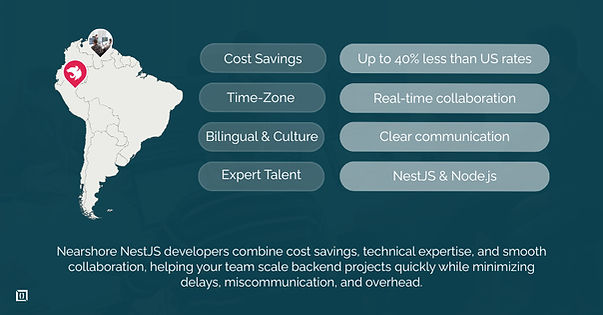
Hiring nearshore NestJS developers offers an effective combination of cost savings and collaboration. Working in similar time zones makes communication easier, feedback faster, and development smoother. You get competitive rates while keeping cultural alignment, so the team integrates naturally with your in-house staff without the delays or complications of distant offshore teams.
1. Cost Savings and Budget Efficiency
The cost difference is significant. A senior NestJS developer in the US costs $70-$100/hour through agencies or over $150,000 per year as a full-time hire with benefits. In contrast, nearshore rates in Latin America are $45-$65/hour for seniors and $30-$45/hour for mid-level developers, roughly 40% lower for equivalent skill levels.
These savings compound over project duration. A 6-month engagement with two senior developers costs approximately $120,000 less with nearshore talent. For startups watching runway, that difference funds additional features, extends timeline, or covers other critical hires.
2. Time-Zone Alignment and Real-Time Collaboration
The nearshore advantage over offshore isn't just cost. It's collaboration. Developers in Mexico, Colombia, and Argentina share 6 to 8 working hours with US teams. Standups happen in real-time. Code reviews get same-day feedback. Questions get answered in Slack, not in overnight email threads.
This matters more for backend work than you might expect. API design decisions, database schema changes, and architectural discussions need back-and-forth conversation. Waiting 12 hours for responses kills momentum. Nearshore teams eliminate that lag.
3. Bilingual Skills and Cultural Fit
Latin American developers working with US companies typically have strong English proficiency. More importantly, they understand American work culture: direct communication, deadline orientation, and comfort with ambiguity in early-stage projects. They push back when requirements don't make sense and ask clarifying questions instead of building the wrong thing.
This cultural alignment reduces hidden costs. Fewer misunderstandings mean less rework. Clearer communication means faster iterations.
4. Access to Expert Backend Talent
Mexico, Colombia, Argentina, and Brazil produce strong engineering talent from technical universities and coding bootcamps. The NestJS and Node.js ecosystem is well-established in these markets. Many developers have years of experience building APIs, microservices, and real-time systems for US companies.
Cities like Guadalajara, Medellín, Buenos Aires, and São Paulo have mature tech scenes with developers experienced in TypeScript, GraphQL, message queues, and distributed architectures.
What to Look for When Hiring a Nearshore NestJS Developer
When hiring a nearshore NestJS developer, look for a combination of technical skills and soft skills. On the technical side, focus on TypeScript, NestJS fundamentals, Node.js, database integrations, and testing frameworks. For soft skills, prioritize clear English communication, availability during your working hours, and a problem-solving mindset that fits agile workflows, ensuring smooth integration with your team.
1. Core Technical Competencies
NestJS requires specific skills beyond general Node.js knowledge. Look for developers with solid experience in TypeScript (NestJS is TypeScript-first), REST API design and implementation, GraphQL (if your stack uses it), middleware and guards, ORM tools like TypeORM or Prisma, microservices patterns with message brokers (Kafka, NATS, RabbitMQ), and testing with Jest.
Ask candidates about dependency injection, decorators, and module organization. These are NestJS fundamentals that separate developers who've used the framework seriously from those who've only completed tutorials.
2. Seniority Levels: From Junior to Senior
Junior NestJS developers (1 to 2 years) handle well-defined tasks: building CRUD endpoints, writing tests, and implementing features within established patterns. Rates run $20 to $30/hour. They need guidance on architecture decisions.
Mid-level developers (3 to 5 years) work independently on features, contribute to architectural discussions, and mentor juniors. Rates run $30 to $45/hour. They handle most backend work without close supervision.
Senior developers (5+ years) design systems, make architectural decisions, and own technical direction. Rates run $45 to $65/hour. They're worth the premium for complex projects or when you need someone to lead backend development.
3. Experience with APIs, Real-Time Systems, and Scalable Architecture
Different projects need different experience profiles. For standard REST APIs, most competent NestJS developers suffice. For real-time systems (chat, dashboards, notifications), look for WebSocket experience and understanding of connection management. For high-scale systems, seek experience with caching strategies, database optimization, and horizontal scaling.
Ask about specific projects. How did they handle 10,000 concurrent connections? What caching layer did they use? How did they structure microservices communication? Concrete answers reveal real experience.
4. Soft Skills: Communication, Collaboration, and Agile Experience
Technical skills matter, but communication determines whether remote collaboration works. Evaluate English proficiency during interviews. Look for developers who explain technical concepts clearly, ask good questions, and admit when they don't know something.
Experience with Agile/Scrum workflows helps integration with existing teams. Developers should be comfortable with daily standups, sprint planning, and working from tickets in Jira or Linear.
How the Nearshore NestJS Hiring Process Works
The nearshore NestJS hiring process starts with defining project requirements and sourcing pre-vetted candidates in the right time zone with the needed skills. Candidates go through technical assessments and interviews to verify NestJS, TypeScript, and soft skills like communication and cultural fit. The final steps include selecting the best match, formalizing the contract, and onboarding the developer to integrate quickly into agile workflows.
1. Talent Screening and Vetting
Quality nearshore agencies screen developers before presenting them to clients. This typically includes technical assessments (coding challenges, system design questions), English proficiency evaluation, and reference checks from previous engagements.
The screening process should test NestJS-specific knowledge: module architecture, dependency injection patterns, testing strategies, and TypeScript proficiency. Generic Node.js assessments miss framework-specific competencies.
2. Matching Developers to Your Project Needs
Good matching goes beyond technical skills. Agencies should consider your tech stack (TypeORM vs Prisma, REST vs GraphQL), project complexity, team culture, and timezone preferences. A developer who's built e-commerce backends might not be the best fit for a real-time trading platform.
Expect to review 3 to 5 candidate profiles and interview your top choices. Don't skip interviews. Even vetted candidates need evaluation for team fit.
3. Onboarding and Ongoing Support
Onboarding nearshore developers follows the same principles as any remote hire. Provide documentation, codebase orientation, and clear first tasks. Set up communication channels and define working hours. Assign a point of contact for questions.
Good agencies provide ongoing support: regular check-ins, performance reviews, and quick replacement if a developer doesn't work out. This support reduces management overhead on your side.
Hiring Models for Nearshore NestJS Developers
Hiring nearshore NestJS developers usually follows three models: Staff Augmentation, where developers extend your team under your management; Dedicated Team, a stable unit managed by the vendor for long-term projects; and Project-Based Outsourcing, where the vendor delivers a fixed-scope project.
1. Staff Augmentation
Staff augmentation fits short to mid-term needs: 3 to 6 month engagements where you need specific NestJS skills added to your existing team. Common scenarios include feature sprints, refactoring legacy Node.js code to NestJS, building microservices, or implementing authentication systems.
Developers integrate into your workflows, attend your standups, and report to your engineering leads. You maintain full control over priorities and technical direction. Rates typically run $30 to $45/hour for mid-level and $45 to $65/hour for senior NestJS developers.
The model offers speed and flexibility. Onboarding takes 1 to 2 weeks. You scale up or down as project needs change. Hidden cost savings come from reduced coordination overhead compared to offshore teams and no long-term employment commitments.
2. Dedicated Nearshore Team
For longer engagements or complex projects, a dedicated team model works well. You get a consistent group - typically a tech lead with strong NestJS and Node.js expertise, 2 to 4 developers at various levels, and optional QA support. You control the product roadmap and technical direction, while the nearshore partner manages operations, retention, DevOps alignment, and backfills.
This model fits API-first platforms, microservices, or distributed systems lasting 12+ months. Teams experienced in modular monoliths, domain-driven design, and event-driven NestJS systems bring particular value to complex backend projects.
3. Fixed-Price Projects
Fixed-price works for well-defined scopes with clear deliverables. Examples include migrating from Express.js to NestJS, building REST or GraphQL API layers, creating microservices with Kafka or NATS integration, implementing authentication modules (JWT, OAuth2, RBAC), or developing proof-of-concepts.
The engagement follows a structured process: discovery, scope definition, phased milestones, and fixed budget. You get cost certainty and clear accountability for deadlines.
The limitation: fixed-price struggles with evolving requirements. If your product roadmap changes frequently or you're building a long-term platform, staff augmentation or dedicated teams offer more flexibility.
Starting Your Nearshore NestJS Project
To start your nearshore NestJS project, clearly define the scope, goals, and required documentation. Choose the right hiring model - staff augmentation, dedicated team, or project-based and set up communication protocols and collaboration tools. Focus on smooth onboarding and aligning expectations with your nearshore team to ensure everyone works efficiently within agile workflows.
1. Submit Your Project Requirements
The process starts with defining what you need. Document your tech stack, project scope, timeline, and budget. Specify whether you need frontend specialists, full-stack developers, or dedicated backend engineers. Include any specific NestJS experience requirements (microservices, GraphQL, specific ORMs).
2. Review Developer Profiles and Start Interviewing
Quality agencies provide detailed candidate profiles: technical skills, project history, English assessment results, and availability. Review profiles against your requirements and interview top candidates.
During interviews, ask NestJS-specific questions. How would they structure a module for a payment system? How do they handle testing in NestJS? What's their experience with guards and interceptors? Technical depth reveals genuine framework expertise.
3. Kick Off Development
Once you select a developer, onboarding typically takes 1 to 2 weeks. First deliverables arrive within 2 to 3 weeks of start date. Set clear expectations for the first sprint: specific tickets, expected velocity, and communication norms.
You can also connect with us to access nearshore NestJS developers, backend solutions, and API or microservices development for your projects.
Frequently Asked Questions
How much does it cost to hire a nearshore NestJS developer?
Junior developers cost $20 to $30/hour, mid-level $30 to $45/hour, and seniors $45 to $65/hour in Latin America. Monthly costs for a full-time senior developer run approximately $7,500 to $10,500. Eastern European rates trend 10 to 20% higher. These rates include agency overhead for vetting and support.
How long does it take to onboard a nearshore NestJS developer?
Initial onboarding takes 1 to 2 weeks: setting up access, reviewing documentation, and understanding the codebase. First meaningful deliverables typically arrive in weeks 2 to 3. Full productivity usually takes 4 to 6 weeks, depending on codebase complexity.
What happens if the NestJS developer doesn't work out?
Quality agencies offer replacement guarantees, typically providing a new developer within 1 to 2 weeks. Most offer trial periods (2 to 4 weeks) where you can request replacement without penalty. Clarify these terms before signing contracts.
NestJS vs Express.js vs Fastify: when to choose each?
Express.js suits simple APIs and projects where flexibility matters more than structure. Fastify optimizes for raw performance. NestJS excels for enterprise-grade systems, teams wanting TypeScript-first development, projects requiring clear architecture patterns, and applications that will scale in complexity. Choose NestJS when long-term maintainability matters.
How do I evaluate NestJS developer technical skills during interviews?
Ask about dependency injection and module organization, testing strategies (unit tests, e2e tests), guards, interceptors, and middleware differences, TypeORM or Prisma experience, and microservices patterns. Include a practical coding exercise: build a simple authenticated endpoint or debug a module with circular dependencies.
What's the typical team composition for a NestJS project?
Common ratios: 1 QA engineer per 3 to 4 developers, DevOps support for projects with complex infrastructure needs. A typical mid-size project runs 1 tech lead, 2 to 3 developers, and 1 QA. Add DevOps for Kubernetes deployments, CI/CD pipelines, or multi-environment setups.
Can nearshore NestJS developers work with my existing Node.js codebase?
Yes. NestJS runs on Node.js and integrates with existing JavaScript/TypeScript codebases. Developers can work alongside Express.js services, share npm packages, and gradually migrate legacy code. The transition path from Express to NestJS is well-documented.
How do nearshore NestJS developers handle sensitive data and comply with GDPR/CCPA?
Compliance depends on contracts and processes, not location. Ensure NDAs cover data handling, developers use secure development practices, and access controls limit exposure to sensitive data. Agencies working with US/EU clients typically have standard compliance frameworks in place.
What specific NestJS features do developers typically struggle with?
Testing (especially e2e tests), advanced decorator usage, circular dependency resolution, and proper use of providers/scopes. Good vetting processes test these specifically. Ask candidates about testing strategies and how they've handled circular dependencies in past projects.
How much does it cost to build a complete NestJS API with 20 to 30 endpoints?
Rough range: $15,000 to $40,000 depending on complexity. Simple CRUD endpoints cost less. Endpoints with complex business logic, third-party integrations, real-time features, or advanced authentication push costs higher. Get detailed scoping before committing to fixed-price estimates.