Hire Nearshore NodeJS Developer - Expert Talent at Lower Cost

When you’re building with Node.js, the stack isn’t usually the problem - it’s capacity and coordination. Backlogs grow when backend work falls behind frontend needs, APIs wait on reviews, and fixes sit idle because there aren’t enough hands on the code.
Hiring senior Node.js engineers locally can take weeks or more. While you’re waiting, sprint goals shift and deadlines slip. Nearshore developers fill that gap without adding long time-zone delays or communication friction.
They work overlapping hours, join standups, and review code within your workday. The real benefit isn’t just cost - it’s tighter feedback loops, fewer handoffs, and smoother execution across your existing workflow.
Let’s explore how to scale your Node.js team with nearshore developers without slowing down delivery.
Why Choose Nearshore NodeJS Developers?
Offshoring to Asia or Eastern Europe can lower hourly rates, but long time-zone gaps make coordination harder. Nearshore hiring offers a balance: you get skilled developers in similar time zones, which keeps collaboration smoother while still reducing costs compared to local hires.
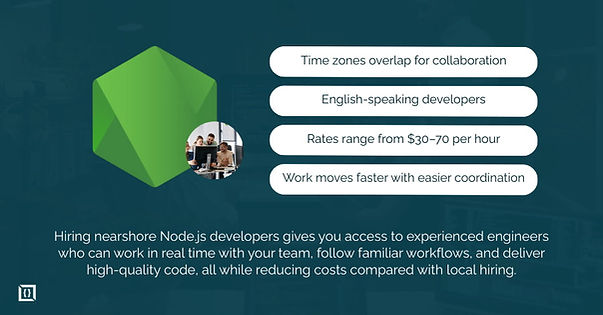
Time Zone Compatibility & Communication
Nearshore teams in Latin America usually overlap 6-8 hours with US working hours. That means your developers start when your team is already working, which allows:
- Live debugging when issues appear in staging or production
- Standups and meetings without anyone staying up late
- Same-day code reviews and pull request feedback
- Pair programming on complex problems
You’re not waiting half a day for Slack responses, and meetings don’t have to start at 6 AM. English proficiency, familiarity with North American business practices, and experience with agile workflows also help reduce friction.
Cost Efficiency Without Compromising Quality
Nearshore rates typically range from $35–$70/hour, compared with $110-$160/hour for US developers. For a senior Node.js developer, that’s roughly $6-12k per month instead of $19-28k. The savings add up when building a small backend team.
The lower cost doesn’t mean lower quality. Countries like Brazil, Argentina, and Mexico have strong technical education systems, and developers work with the same frameworks and tech stacks as US teams.
Faster Turnaround Times
Working in overlapping hours removes the delays that often slow offshore projects. Frontend teams can discuss API changes in real time, and bugs in production can be addressed immediately.
Nearshore teams often deliver projects faster simply because coordination is easier, not because developers are working faster individually.
Top Skills to Look for in a NodeJS Developer
Technical competence determines whether your project succeeds or fails. A developer who doesn't understand asynchronous patterns will create race conditions and memory leaks. Someone unfamiliar with database optimization will write queries that slow down as your user base grows. Here's what actually matters:
Skill | Key Points | Why It Matters |
JavaScript & ES6+ | let/const, arrow functions, destructuring, modules | Maintainable, modern code |
Node.js Frameworks | Express, NestJS, routing, middleware, error handling | Scalable, structured apps |
Async Programming | Callbacks, Promises, async/await, event loop | Prevents performance issues |
Databases & APIs | PostgreSQL, MongoDB, REST/GraphQL, ORMs | Efficient data handling |
Front-End Awareness | API consumption, basic React/Vue/Angular knowledge | Better collaboration with frontend |
Security & Performance | Input validation, auth, caching, profiling | Protects apps, improves speed |
Testing & Debugging | Unit/integration tests, logging, error tracking | Reduces downtime, faster fixes |
Design Patterns | Middleware, services, modular code, event emitters | Clear structure, easier onboarding |
1. Proficiency in JavaScript & ECMAScript
Node.js runs JavaScript on the server, so core language competence is non-negotiable. The developer needs to understand:
- Variable scoping with let, const, and the problems var creates
- Arrow functions and how this binding works differently from regular functions
- Template literals for string interpolation
- Destructuring assignments for cleaner code
- The spread operator and rest parameters
- ES6 modules and import/export syntax
Most modern Node.js codebases use ES6 or later features throughout. A developer still writing ES5-style code will produce code that's harder to maintain and review.
2. Node.js Frameworks (Express, NestJS, etc.)
Raw Node.js provides low-level APIs for HTTP servers and file systems. Production applications use frameworks that handle common tasks like routing, middleware, and error handling. Express.js remains the most widely used framework for its simplicity and flexibility. NestJS has gained traction for larger applications needing structure and TypeScript integration.
The developer should demonstrate experience with:
- Setting up routes and route parameters
- Writing middleware functions for authentication, logging, and request processing
- Handling errors consistently across the application
- Structuring projects in a maintainable way
- Integrating third-party libraries through the framework
3. Asynchronous Programming Expertise
Node.js achieves high concurrency through non-blocking I/O operations. Everything from database queries to HTTP requests to file reads happens asynchronously. Developers who don't understand this model will write blocking code that destroys performance.
Look for understanding of:
- Callbacks and callback hell (and why we moved past them)
- Promises and .then()/.catch() chains
- async/await syntax for writing asynchronous code that reads sequentially
- Error handling in asynchronous code
- The event loop and how it processes operations
Ask candidates to explain how they would handle parallel API calls or how they would prevent race conditions when multiple requests modify the same data.
4. Database and API Integration
Backend developers spend most of their time reading from and writing to databases, then exposing that data through APIs. You need someone who can:
Work with relational databases like PostgreSQL or MySQL, understanding table design, foreign keys, indexes, and transactions. Use ORMs like Sequelize or TypeORM to manage database operations in code. Implement NoSQL databases like MongoDB when document storage makes more sense than relational tables. Design RESTful APIs with proper HTTP methods, status codes, and resource naming. Build GraphQL APIs when clients need flexible data fetching.
The difference between a junior developer and a senior one often shows up in database design. Poorly designed schemas create performance problems that are expensive to fix later.
5. Front-End Familiarity
Node.js developers don't need to write React components, but understanding how frontend frameworks consume APIs makes collaboration easier. When they know that frontend state management expects specific response formats or that loading states depend on API response times, they design better endpoints.
Basic familiarity with HTML, CSS, and how modern JavaScript frameworks like React, Vue, or Angular work helps developers anticipate frontend needs and communicate more effectively with frontend teams.
6. Security and Performance Best Practices
Production applications face security threats and performance requirements that development environments don't expose. Your developer should know:
- Input validation and sanitization to prevent injection attacks
- Authentication patterns using JWTs or session tokens
- Authorization and role-based access control
- Rate limiting to prevent abuse
- Password hashing with bcrypt or similar libraries
- HTTPS and secure cookie handling
- SQL injection prevention when writing raw queries
On the performance side, they should understand caching strategies, how to profile Node.js applications to find bottlenecks, and when to implement pagination or streaming for large datasets.
7. Testing and Debugging Skills
Code without tests breaks when you refactor it. Developers should write unit tests for individual functions and integration tests for API endpoints. Common testing frameworks include Jest, Mocha, and Chai.
Debugging skills separate developers who can fix issues quickly from those who guess randomly. Look for experience with:
- Node.js debugging tools and breakpoints
- Logging libraries like Winston or Bunyan
- Error tracking services like Sentry
- Reading stack traces to identify error sources
8. Understanding of Node.js Design Patterns
Node.js applications follow certain architectural patterns that make code maintainable as projects grow. Experienced developers structure their code using:
- Middleware patterns for request processing pipelines
- Service layers to separate business logic from route handlers
- Repository patterns for database access
- Event emitters for decoupling components
- Module exports for organizing code across files
These patterns aren't academic exercises. They determine whether adding new features takes hours or days and whether new team members can understand the codebase quickly.
Soft Skills That Matter
Technical skills are essential, but soft skills affect how smoothly remote collaboration works. When teams are spread across time zones, these abilities become even more important.
Soft Skill | Key Points | Why It Matters |
Problem Solving | Troubleshoots independently, researches solutions | Keeps work moving without oversight |
Communication & Collaboration | Clear PRs, documented decisions, and specific questions | Prevents blockers and misunderstandings |
Teamwork & Adaptability | Accepts feedback, adapts to change, supports teammates | Keeps agile workflows smooth |
Self-Motivation & Initiative | Works without supervision, suggests improvements | Maintains productivity remotely |
Problem Solving
Remote developers need to troubleshoot issues independently. When they encounter a bug or an unexpected API behavior, they should investigate the problem, research solutions, and propose fixes without constant oversight.
This doesn't mean working in isolation but knowing when to dig deeper before escalating.
Communication & Collaboration
Written communication carries most of the load in remote work. Developers should write clear pull request descriptions explaining what changed and why. They should document decisions in code comments and technical specs. They should ask specific questions in Slack rather than vague requests for help.
Standups, sprint planning, and retrospectives all happen over video calls. The developer needs to articulate technical concepts to non-technical stakeholders, estimate work accurately, and flag blockers before they delay the entire team.
Teamwork & Adaptability
Agile teams iterate based on feedback. A developer who can't handle changing requirements or who pushes back on every code review suggestion creates friction. Look for people who treat feedback as an opportunity to improve rather than criticism to defend against.
Remote teams depend on everyone respecting working agreements, meeting commitments, and helping teammates when they're stuck. Individual brilliance matters less than consistent reliability.
Self-Motivation & Initiative
Remote work also requires self-discipline. Nobody watches you work, so you need intrinsic motivation to start tasks, complete them, and deliver quality results.
The best remote developers also show initiative by identifying technical debt, suggesting architecture improvements, or automating repetitive tasks without being asked.
Flexible Engagement Models
Different projects need different collaboration structures. A startup building an MVP has different needs than an enterprise team scaling an existing platform.
Model | How It Works | Best For |
Staff Augmentation | Add developers to your team; follow your processes | Temporary skill gaps or scaling capacity |
Dedicated Teams | Full team works exclusively on your project | Complex apps needing continuity |
Project-Based | Deliver a feature or app with a defined scope & timeline | Well-defined MVPs or feature sets |
Virtual CTO | Provides architecture guidance & roadmaps | Early-stage startups planning systems |
Software Staff Augmentation
Staff augmentation adds developers to your existing team. You manage the work, set priorities, and integrate the developer into your processes. The nearshore developer attends your standups, works in your codebase, and reports to your technical lead.
This model works when you need specific skills temporarily or want to scale capacity without permanent headcount. The developer integrates with your tools, follows your coding standards, and works within your sprint cycles.
Dedicated Development Teams
A dedicated team operates as a self-contained unit working exclusively on your project long-term. You get a complete team, including developers, a tech lead, and sometimes a project manager. They maintain continuity across releases and build deep knowledge of your product.
This model fits companies building complex applications that need sustained development over months or years. The team becomes an extension of your company rather than a temporary resource.
Project-Based Delivery
Project-based contracts define scope, timeline, and cost upfront. The nearshore team delivers a complete feature or application against specifications. You're buying an outcome rather than hours worked.
This works for projects with well-defined requirements like building an MVP, adding a specific feature set, or rebuilding a legacy system. The risk is that scope changes become expensive, so detailed specifications matter.
Virtual CTO Consulting
Early-stage startups often need architectural guidance before they need a full development team. A virtual CTO helps define the tech stack, design the system architecture, plan infrastructure, and create development roadmaps.
This engagement prevents costly architectural decisions that limit scaling later. Once the foundation is solid, the same partner can provide the development team to execute the plan.
How to Hire the Right Nearshore NodeJS Developer
Hiring decisions affect your product for months or years. A strong process reduces risk and increases the chance you get the skills you actually need.
Define Your Project Scope
Write down what you're building:
- Which features need to be implemented first
- What does the data model look like
- What third-party services will you integrate
- What does success look like in 3 months, 6 months, or 12 months
- How many developers do you need, and what experience level
Vague requirements lead to mismatched expectations. Specificity helps developers estimate accurately and helps you evaluate whether they understand the complexity involved.
Set Clear Budget & Timeline Expectations
Understand how speed, cost, and scope interact. Building faster costs more, while lowering your budget usually means reducing features or extending timelines. Be realistic about what’s achievable within your constraints.
Mid-level Node.js developers in Latin America cost $30-60/hour, while senior developers range from $50-80/hour. For full-time work (160 hours/month), budget at least 3-4 months to see meaningful progress on a new project.
Evaluate Technical & Soft Skills
Code tests reveal how candidates approach problems. Give them a realistic task like building a REST API with authentication or optimizing a slow database query. Review their code for organization, error handling, and whether they followed the requirements.
Behavioral interviews assess communication and collaboration. Ask about times they disagreed with a technical decision, how they handle ambiguous requirements, or what they do when blocked on a problem. Their answers reveal working style more than their resume does.
Start with a Trial or Short-Term Contract
A two-week trial or month-long initial contract reduces risk for both sides. You see how the developer performs on real work, how well they communicate, and whether they integrate with your team. They evaluate whether your project, team dynamics, and management style fit their preferences.
Many nearshore firms structure their engagements with trial periods built in, often with easy replacement policies if the match isn't working.
Other Services You Might Need
Backend development is just one part of a project. As your product grows, you’ll often need additional capabilities to support features, analytics, or end-user experiences.
Service | How It Helps |
Custom Software | Build full web platforms, SaaS, or internal tools. |
Mobile Apps | iOS/Android apps with React Native or Flutter. |
AI/ML | Models for recommendations, predictions, or NLP. |
Data & Analytics | Pipelines, warehouses, and BI tools. |
Chatbots & Games | Conversational or interactive features. |
Custom Software Development
Full-cycle development teams handle everything from requirements gathering through deployment and maintenance. This makes sense when you're building a complete web platform, SaaS product, or internal tool rather than just backend APIs.
Mobile App Development
If your product needs iOS or Android apps, nearshore teams can provide mobile developers. Using cross-platform frameworks like React Native or Flutter, a single team can deliver apps for both platforms. This reduces coordination overhead, ensures consistency across platforms, and keeps features aligned with your backend APIs.
AI/ML Solutions
Applications increasingly use machine learning for recommendations, predictions, or natural language processing. Nearshore teams can include data scientists and ML engineers who develop models, integrate them into your app, and deploy them at scale.
Having these skills in-house with your team helps maintain performance and accuracy while iterating on product features.
Data Engineering & Analytics
As your application generates more data, pipelines, storage, and analytics become critical. Data engineers design ETL processes, optimize databases, and implement BI tools.
This ensures data flows efficiently from your application to reports or dashboards, enabling faster insights and better decision-making without creating bottlenecks in your system.
Chatbot and Game Development
Some B2C products require conversational interfaces or interactive experiences. Nearshore developers can build chatbots, game-like interfaces, or gamified features that integrate with your existing backend.
These specialized skills enhance user engagement and can be added without disrupting your core development workflow.
Ready to Hire?
Look at the project and the skills it actually requires. In some cases, a few developers joining your existing team is enough. In others, a dedicated team handling the work from start to finish is more efficient. Fixed-scope contracts can work for well-defined features or MVPs.
Deciding this upfront makes it easier to assign responsibilities, track progress, and coordinate with other teams without unnecessary confusion.
If you’re looking for nearshore Node.js support, you can connect with us to discuss your project, choose the right engagement model, and see how our team can integrate with your workflow.
Frequently Asked Questions
How long does it take to hire a nearshore Node.js developer from first contact to onboarding?
Most nearshore firms can place pre-vetted developers in 3-10 business days once you define requirements and approve candidates. The timeline depends on how specific your needs are and how quickly you can conduct interviews. Partners with established talent pools speed this up significantly compared to recruiting from scratch.
What happens if a nearshore developer doesn't work out?
Reputable nearshore companies offer replacement policies, typically with 2-week notice periods during trial phases and no-fee terminations in the first month. Some provide free replacements if the developer leaves within the first few months. Review these terms before signing to understand your options.
How do nearshore Node.js developers handle US time zones in practice?
Most Latin American teams structure their day around 4-6 hours of overlap with US business hours, typically working 10 AM to 6 PM in their local time zone. This usually covers 11 AM to 3 PM Eastern or 8 AM to 12 PM Pacific. Teams use asynchronous tools like Slack, Loom, and Jira for non-urgent communication while scheduling standups and planning meetings during overlap hours.
Can nearshore Node.js developers work on HIPAA/SOC 2/PCI-compliant projects?
Yes, with proper training and processes in place. Compliance requires secure coding practices, encrypted data handling, access controls, and audit logging. Nearshore partners experienced with regulated industries will have these processes established. You remain responsible for ensuring your vendor meets compliance requirements, so verify their security practices and certifications during evaluation.
What specific Node.js tech stack combinations are most common in nearshore teams?
Node.js + React or Vue.js for full-stack JavaScript development appears most frequently. Backend stacks commonly pair Node.js with PostgreSQL for structured data or MongoDB for document storage. Many teams work with TypeScript rather than plain JavaScript for larger projects. Docker containerization and AWS or Google Cloud deployment are standard infrastructure choices.
How do I onboard a nearshore Node.js developer into my existing team?
Week 1 should cover: repository access and development environment setup, introductions to the team and project overview, access to communication tools (Slack, Zoom, Jira), assignment of an internal mentor or technical buddy, and a small starter task to familiarize them with the codebase and workflow. Schedule a daily check-in for the first week to answer questions and address blockers quickly. Clear documentation about coding standards, git workflow, and deployment processes helps new developers contribute faster.