Hire Nearshore React Native Developer | Staff Augmentation
React Native has become a standard choice for cross-platform mobile development. One JavaScript codebase for iOS and Android, strong community support, and backing from Meta make it practical for startups that need to ship mobile apps without maintaining two separate native teams.
Finding React Native developers in the US is competitive. Senior talent commands $130,000-$170,000 annually, and the hiring process stretches for months. Staff augmentation through nearshore teams offers a faster path: experienced React Native developers in Latin America who work in your time zone and integrate directly into your existing workflow.
Let’s explore why nearshore staff augmentation works for React Native projects, the services these teams provide, developer levels available, and how the hiring process typically unfolds.
Why Choose Nearshore React Native Developers?
Staff augmentation adds skilled developers directly to your existing team instead of handing off an entire project. Nearshore hiring focuses on nearby countries with overlapping work hours - for US and Canadian companies, that usually means Latin America.
Faster Time to Hire Compared to Traditional Recruitment
Traditional hiring for React Native roles takes 2-3 months minimum. You post the job, screen hundreds of resumes, conduct multiple interview rounds, negotiate offers, and wait out notice periods. The timeline extends further if your first-choice candidate declines.
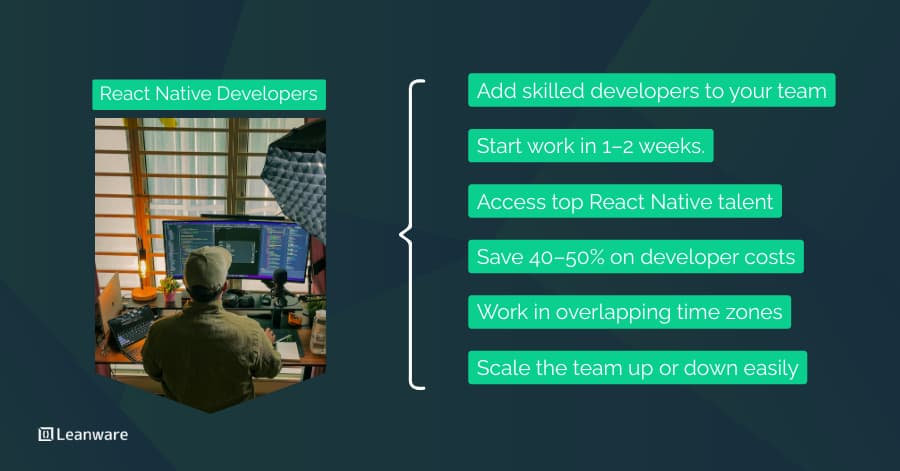
Staff augmentation compresses this significantly. Nearshore providers maintain pre-vetted talent pools. You submit requirements, receive candidate profiles within days, conduct interviews, and start onboarding within 1–2 weeks. Some engagements move from initial contact to developer start date in under 10 business days.
This speed matters when you're racing toward a launch, responding to investor pressure, or filling a gap left by a departing team member.
Access to High-Performing React Native Talent
Latin America has a strong mobile development community. React Native specifically has solid adoption in the region, with active meetups, conferences, and open-source contributions from developers in Colombia, Mexico, Argentina, and Brazil.
Many of these developers have production experience with React Native apps serving thousands or millions of users. They understand the framework's strengths and limitations, know how to bridge native modules when necessary, and have worked through the common challenges of cross-platform development.
The talent pool includes developers who have worked with US companies before. They understand expectations around code quality, testing practices, and agile delivery.
Cost-Efficiency and Time Zone Alignment
The cost difference is significant. A senior React Native developer in the US runs $80-120/hour. The equivalent role in Colombia costs $40-55/hour. That's 40-50% savings without sacrificing technical quality.
Time zone alignment is the operational advantage that separates nearshore from offshore. Colombian developers work in EST. Mexican developers overlap with Central and Pacific time zones. This enables real-time collaboration: synchronous standups, same-day code reviews, and immediate responses when issues arise.
Compare this to offshore teams with 8-12 hour time differences. Questions wait overnight. Pull requests sit until the next business day. The async lag compounds across a sprint and slows development velocity.
React Native Nearshore Services
Nearshore teams handle various project types beyond basic development. Here's what's typically available.
Custom React Native App Development
Most engagements involve building custom applications tailored to specific business requirements. This includes consumer-facing apps, internal tools, marketplace platforms, and specialized vertical solutions.
Nearshore developers work with your specifications to design component architecture, implement features, integrate with backend services, and prepare builds for App Store and Play Store submission.
SaaS Application Development and Migration
For early-stage SaaS startups, React Native offers a practical path to mobile presence. Nearshore teams help build mobile companions to web platforms or mobile-first SaaS products.
This includes authentication flows, subscription management, offline capabilities, push notifications, and synchronization with backend APIs. For existing SaaS products, teams can build React Native apps that integrate with your current infrastructure.
UI/UX Design for React Native Apps
Some nearshore providers include designers who specialize in mobile UX. They understand React Native's component model and design within the framework's capabilities rather than creating designs that require extensive custom implementation.
This integration between design and development reduces handoff friction. Designers know what's feasible, and developers receive specs that align with React Native patterns.
App Support and Maintenance
Mobile apps require ongoing work after launch. iOS and Android release new OS versions annually, introducing compatibility issues and new features. User feedback reveals bugs and feature requests. Performance monitoring surfaces optimization opportunities.
Nearshore teams provide ongoing support: bug fixes, OS compatibility updates, dependency upgrades, security patches, and incremental feature development. Having developers familiar with your codebase handle maintenance is more efficient than bringing in new people for each update cycle.
React Native Development from Scratch
For projects starting from zero, nearshore teams help with the full journey: requirements gathering, technical architecture, MVP scoping, development, testing, and launch.
This works well for founders with product ideas but limited technical capacity. The team handles technical decisions while you focus on product direction and business development.
Migration to React Native
Legacy mobile apps built with older frameworks like Cordova, Ionic, or early hybrid approaches often need modernization. Separate native iOS and Android codebases become expensive to maintain.
Nearshore teams handle migrations to React Native, preserving business logic while moving to a unified codebase. This includes assessing the existing app, planning the migration strategy, implementing the React Native version, and managing the transition.
Types of Developers Available for Hire
Staff augmentation offers different experience levels to match your needs and budget.
Senior React Native Developers
Senior developers bring 5+ years of mobile development experience, with significant time specifically in React Native. They handle:
- Architecture decisions: State management approach, navigation structure, component organization.
- Complex implementations: Native module bridges, performance optimization, complex animations.
- Technical leadership: Code review, mentoring junior developers, establishing patterns.
- Stakeholder communication: Translating technical constraints into business terms.
Senior developers work independently, make sound technical decisions, and catch issues before they become problems. They cost more but require less oversight and produce more reliable output.
Typical rates: $45-60/hour in Latin America.
Semi-Senior / Mid-Level React Native Developers
Mid-level developers have 2–4 years of experience and solid React Native fundamentals. They handle:
- Feature implementation: Building screens, components, and integrations based on specifications.
- Bug fixing: Diagnosing and resolving issues in existing codebases.
- Testing: Writing unit tests and integration tests.
- Documentation: Maintaining technical documentation and code comments.
Mid-level developers work well when you have senior technical leadership providing direction. They execute efficiently on well-defined tasks and grow their skills over time.
Typical rates: $30-45/hour in Latin America.
Benefits of Hiring Nearshore Staff Augmentation
Diverse Skill Sets and Versatility
React Native developers often bring complementary skills. Common combinations include:
- React Native + Node.js: Full-stack capability for apps with JavaScript backends.
- React Native + Firebase: Mobile apps with serverless backend integration.
- React Native + TypeScript: Strongly-typed development for larger codebases.
- React Native + Redux/MobX: Complex state management expertise.
This versatility means you can find developers who handle both mobile and related backend work, reducing coordination overhead.
Flexible Hiring Models
Staff augmentation adapts to your situation:
- Team extension: Add 1-2 developers to your existing engineering team.
- Dedicated squad: Hire a full team (developers, QA, possibly PM) that works exclusively on your project.
- Hybrid model: Combine your in-house product manager with external developers.
You can scale up for intensive development phases and scale down during maintenance periods. This flexibility is harder to achieve with full-time employees.
Transparency, Trust, and Ongoing Communication
Nearshore staff augmentation works because of communication quality. Developers join your Slack channels, attend your standups, and participate in sprint planning. They operate as team members, not external vendors.
English proficiency among Latin American developers targeting US clients is generally strong. Cultural familiarity with American business practices reduces friction. Most developers have experience with agile methodologies and distributed team collaboration.
Speedy Recruitment and Onboarding Process
The timeline advantage is significant:
- Traditional hiring: 8–12 weeks from job posting to start date.
- Staff augmentation: 1–3 weeks from initial request to developer onboarding.
This speed comes from pre-vetted talent pools. Providers continuously recruit, screen, and maintain relationships with developers. When you submit requirements, they match against existing candidates rather than starting a search from scratch.
How the Hiring Process Works
Submit Your Project Requirements
The process starts with defining what you need:
- Technical requirements: React Native version, state management approach, backend integration, testing expectations.
- Project context: New build vs. existing codebase, team structure, timeline.
- Developer profile: Seniority level, specific skills, availability (full-time vs. part-time).
Most providers offer a consultation call to clarify requirements and ensure good candidate matching.
Interview and Onboard
Providers present shortlisted candidates based on your requirements. You review profiles, conduct technical interviews, and assess fit with your team.
The interview process mirrors what you'd do for any hire: technical assessment, communication evaluation, and culture fit. The difference is you're selecting from pre-vetted candidates rather than raw applicants.
Once you select a developer, onboarding happens quickly. Providers handle contracts and logistics. You handle access provisioning, codebase orientation, and team introductions.
Begin Development, Scale Up or Down as Needed
Development starts with the developer integrated into your workflow: standups, sprint planning, code reviews, and regular communication channels. Staff augmentation provides flexibility as requirements evolve.
You can add developers for feature pushes or reduce team size during maintenance phases, keeping costs aligned with actual workload.
Getting Started
Start with clarity on your React Native requirements: the project scope, seniority level needed, and how the developer will fit into your existing team structure.
Staff augmentation works best when you have technical leadership in place and need execution capacity. If you have a clear backlog and someone to provide direction, a nearshore React Native developer can start contributing within their first sprint.
The time zone overlap means they integrate naturally into your daily workflow, and you can scale the engagement up or down as your project evolves.
You can also connect with our experts to discuss your project needs, explore available React Native developers, and determine the best staff augmentation approach for your team.
Frequently Asked Questions
What is nearshore staff augmentation for React Native?
Staff augmentation means hiring external developers who integrate into your existing team rather than outsourcing entire projects. Nearshore specifically means hiring in nearby countries with similar time zones. For US companies, this typically means Latin America. The model combines cost efficiency with real-time collaboration capabilities.
How much does it cost to hire a nearshore React Native developer?
Rates vary by country and experience level. General ranges: $30-45/hour for mid-level developers, $45-60/hour for senior developers. Colombia and Mexico tend toward the middle of this range; Argentina can be lower due to currency factors. Compare to US rates of $80-120/hour for equivalent experience.
How fast can I hire a nearshore React Native developer?
Typical timeline is 5-15 business days from initial requirements to developer start date. Simple requirements with flexible criteria move faster. Specific skill combinations or senior-only requirements may take longer to match.
Which countries are best for nearshoring React Native developers?
Colombia offers strong React Native talent, competitive rates, and full EST time zone overlap. Mexico has the largest developer population in the region and works well for West Coast teams. Argentina has excellent technical education, but currency instability affects pricing. Brazil has a large talent pool though Portuguese is the primary language.
Is React Native good for building MVPs and SaaS apps?
Yes. React Native's cross-platform capability means you ship to iOS and Android simultaneously from one codebase. This reduces development time and cost compared to native development.
The framework handles most common mobile app patterns well. For MVPs specifically, the speed advantage is significant: you can validate product ideas faster and iterate based on user feedback before investing in optimization.