White Label AI Software | Complete Guide for Resellers & Agencies

Building an AI product from scratch requires ML engineers, data infrastructure, months of development, and ongoing model maintenance. Most agencies, consultants, and SaaS operators do not need to do any of that.
White label AI software lets businesses license pre-built AI tools, apply their own branding, and sell them to clients as their own product. The underlying technology is built and maintained by the platform provider. The reseller owns the client relationship, the pricing, and the brand.
The global artificial intelligence software market is estimated at about $390.91 billion in 2025 and is expected to grow to roughly $3.5 trillion by 2033, with a projected 30.6% annual growth rate, according to Grand View Research. While adoption is still led by larger enterprises, SMEs remain significantly under-penetrated despite the clear productivity upside, making them one of the largest untapped segments driving future AI demand as access to ready-to-use solutions improves.
Key Takeaways
- White label AI removes the need to build models, infrastructure, or engineering teams by offering ready-made systems that can be branded and sold quickly.
- It separates roles clearly: providers handle development and maintenance, while resellers focus on sales, clients, pricing, and delivery.
- It enables fast go-to-market for agencies and consultants, turning months of development into days or weeks with predictable costs and strong margins.
- The biggest opportunity is in SMB and vertical markets where AI demand is rising, but most businesses still lack the capability to build or manage it in-house.
What Is White Label AI Software?
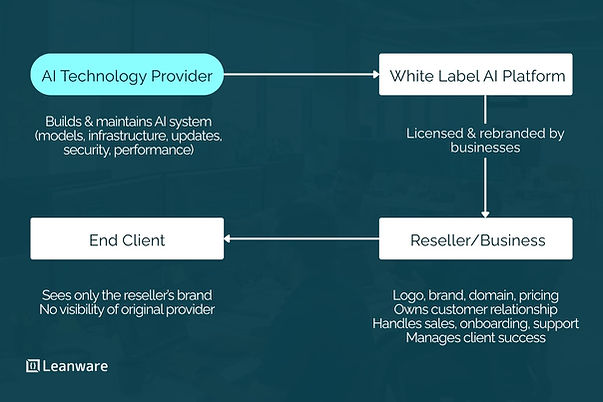
White label AI software is a pre-built AI platform developed by a technology provider that other businesses license, rebrand, and resell under their own name. The reseller adds their logo, color scheme, domain, and pricing. The end client sees the reseller's brand and has no visibility into the original provider.
The model works because it separates two distinct capabilities: building AI technology and selling AI services. The platform provider handles development, infrastructure, model updates, and security. The reseller handles client acquisition, onboarding, support, and relationship management.
How It Differs from Custom AI Development
Custom AI development means building the technology from scratch: hiring ML engineers, training models, building infrastructure, and maintaining the system over time. This approach is typically reserved for organizations with highly specific requirements that no existing platform can meet. It also requires significant budget (six figures minimum), specialized talent, and 6 to 18 months of development time before anything reaches production.
White label AI is the opposite approach. The technology already exists and is production-ready. The reseller licenses it, brands it, and starts selling within days or weeks. The tradeoff is less customization at the model level, but for most agency and reseller use cases, the pre-built capabilities cover the requirements.
Factor | Custom AI Development | White Label AI |
Time to Market | 6-18 months | Days to weeks |
Upfront Cost | $100,000+ | $50-$500/month platform fee |
Team Required | ML engineers, data engineers, DevOps | Sales, support, client management |
Customization | Full control | Branding and configuration |
Maintenance | Internal responsibility | Platform provider handles it |
Risk | High (technical and market) | Low (proven technology) |
How It Differs from AI SaaS
AI SaaS is a subscription product consumed under the original vendor's brand. The customer knows they are using ChatGPT, Jasper, or HubSpot's AI features. White label AI removes the vendor's identity entirely. The reseller presents the product as their own, sets their own pricing, and manages the client relationship directly. The end client interacts only with the reseller's brand.
Why White Label AI Is a Strategic Opportunity Right Now
Two conditions create the opportunity: rising demand for AI from businesses of all sizes, and a gap between that demand and the technical ability to deliver it.
Market Size and Growth Trajectory
The enterprise AI market reached $115 billion in 2026 and is growing at 18.9% annually according to Mordor Intelligence. Small and mid-sized businesses are entering the market through low-code platforms and subscription AI tools.
This creates a growing pool of buyers who want AI capabilities but lack the technical knowledge to evaluate, implement, and manage them directly.
The Business Case for Resellers and Agencies
Agencies and consultants already have client relationships and industry expertise. White label AI adds a recurring revenue stream to that foundation. The economics work because platform licensing costs are fixed and predictable (typically $50 to $500 per month), while client pricing is set by the reseller. Margins of 60 to 80% are common for agencies that package the AI tool with onboarding, configuration, and ongoing support.
The model requires no engineering team, no AI expertise at the model level, and no infrastructure management. The reseller's value comes from understanding the client's business, configuring the tool for their use case, and providing the support that makes the technology useful.
Core Types of White Label AI Software
Five categories cover the majority of the market.
AI Chatbots and Conversational Agents
Branded chat and voice bots deployable across websites, WhatsApp, CRMs, and messaging platforms. This is the most widely adopted white label AI category because every business with a website or support queue can benefit from automated conversation handling. Platforms typically include knowledge base training, conversation flows, handoff to human agents, and analytics.
AI Writing and Content Assistants
Platforms that generate blog posts, ad copy, emails, product descriptions, and social media content under the reseller's brand. Most include multilingual support, tone customization, and template libraries. Agencies use these to offer content services at scale without expanding their writing team.
AI Voice and Answering Services
Automated inbound and outbound call handling, appointment scheduling, and real-time call routing. These platforms handle phone-based customer interactions 24/7 without requiring the reseller to build telephony infrastructure. Particularly valuable for industries where phone calls remain the primary customer contact channel: healthcare, legal, home services.
AI Image and Video Generation
Tools for producing on-brand visuals, product mockups, marketing graphics, and automated video content at scale. Creative agencies and content platforms use these to deliver visual production services without increasing their design headcount.
AI Website Builders
No-code platforms that let end users create AI-assisted websites under a reseller's brand, complete with custom domains and styling controls. The AI handles layout suggestions, content generation, and SEO optimization while the end user provides business information and preferences.
Key Features to Evaluate Before Choosing a Platform
A strong white label AI platform should go beyond basic functionality and ensure full brand control, seamless integrations, scalable architecture, and enterprise-grade compliance so it can support real client use cases at scale.
- Custom Branding and UI Control:
Full control over logos, color schemes, domain, interface language, and all customer-facing elements. The platform provider's branding should be completely invisible to end clients. This is the baseline requirement. If the provider's name appears anywhere in the client experience, it is not a genuine white label offering.
- API and Integration Capabilities:
Compatibility with CRMs (HubSpot, Salesforce), marketing tools, payment systems, and third-party data sources. The AI tool must fit into clients' existing workflows. Limited integration options reduce the tool's value and increase implementation friction.
- Scalability and Multi-Tenant Architecture:
The platform must serve multiple clients from a single instance without performance degradation as the reseller's portfolio grows. Each client needs isolated data, separate configuration, and independent analytics. Multi-tenant architecture is what makes the economics work at scale.
- Compliance and Data Privacy:
Regional and industry-specific requirements including GDPR, HIPAA, and CCPA are non-negotiable when handling customer data. Verify the platform's compliance certifications before deploying in healthcare, finance, or legal contexts. Compliance failures reflect on the reseller's brand, not the platform provider's.
- Analytics, Reporting, and Support:
Built-in dashboards that track usage, engagement, and ROI at the client level. Dedicated onboarding and technical support from the platform provider. The reseller needs visibility into how each client uses the tool and the ability to demonstrate value through data.
Industries That Benefit Most from White Label AI
Certain verticals represent higher-value opportunities because the regulatory environment, client willingness to pay, or operational complexity makes AI adoption particularly valuable.
Healthcare and MedTech
From patient triage and appointment scheduling to HIPAA-compliant answering services, healthcare operations benefit strongly from 24/7 automation. At the same time, many providers lack the technical resources to evaluate or deploy AI systems effectively. This creates strong opportunities for resellers with healthcare domain knowledge to deliver meaningful, practical solutions.
Finance and Fintech
Use cases such as AI-driven advisory tools, fraud detection, and automated customer support are increasingly common in compliance-heavy environments. However, strict regulatory requirements often limit generic AI vendors, making specialized, white-labeled solutions more viable and trusted.
E-commerce and Retail
Conversational shopping assistants, automated product descriptions, and recommendation engines help manage high volumes of products and customer interactions. Because the impact on conversion rates and efficiency is easy to measure, ROI is typically clear and immediate.
Education and eLearning
AI tutors, adaptive learning platforms, and automated content creation tools like voiceovers and course generation are reshaping digital education. As learning moves increasingly online, demand is growing for scalable systems that can personalize and streamline delivery.
Marketing and Creative Agencies
Content generation, social media automation, and branded visual production allow agencies to scale output without expanding teams. By embedding white label AI into their service offering, agencies can improve margins while delivering more consistent and scalable results for clients.
How to Launch a White Label AI Business
Launching a white label AI business is less about building technology and more about making best strategic decisions around positioning, pricing, and client experience. Success comes from focusing on a specific niche, choosing the right platform, and building a strong layer of support around the product rather than the product itself.
1. Choosing the Right Platform for Your Niche
Match platform capabilities to a specific vertical or client profile rather than pursuing a broad-market approach. An agency serving dental practices needs different AI capabilities than one serving e-commerce brands. Vertical specialization enables better positioning, higher pricing, and stronger client relationships.
2. Pricing and Revenue Model Strategies
Three models work in reality. Monthly recurring revenue (charging clients a monthly subscription for access to the AI tool) provides predictable income. Project-based implementation fees (charging for initial setup, configuration, and training) capture value upfront. Hybrid models combine both. Most successful resellers charge $200 to $1,000 per month per client depending on the tool's complexity and the industry's willingness to pay, with platform costs of $50 to $500 per month creating margins of 60 to 80%.
3. Building a Support and Onboarding Ecosystem
Post-sale client success determines retention. Build branded training materials, onboarding workflows, and support documentation that help clients get value from the tool quickly. The platform provider handles the technology. The reseller's competitive advantage is the support and expertise that surrounds it.
Common Mistakes to Avoid
While white label AI offers a fast path to market, many businesses struggle not because of the technology, but because of how they position and operate around it.
Overpromising and Under-Delivering
AI has real limitations, and overestimating its capabilities often leads to broken expectations. Promising full automation, perfect accuracy, or unrealistic deployment timelines quickly erodes trust and increases churn. It’s better to set clear, honest benchmarks from the beginning and let performance validate the value over time.
Skipping Differentiation
Simply rebranding a generic platform is not enough to build a sustainable business. Without clear positioning, most resellers end up competing on price alone. Real differentiation comes from vertical focus, tailored onboarding flows, industry-specific templates, and added consulting or implementation support that makes the solution more relevant to a specific audience.
Underestimating Ongoing Maintenance
White label AI is not a set-and-forget product. It requires continuous refinement, including updating knowledge bases, improving conversation flows, adjusting configurations based on usage data, and incorporating client feedback. Treating this as part of the core offering from the start helps reduce churn and improves long-term client value.
The Future of White Label AI Software
The white label AI space is evolving quickly, driven by advances in model capability, platform flexibility, and industry specialization
- Multimodal AI and Agentic Platforms: The industry is moving beyond single-function tools like text-only chatbots or image generators toward unified platforms that combine text, voice, image, and autonomous agents. This shift allows resellers to deliver broader, more integrated solutions through a single branded product.
- Open-Source Models and RAG Pipelines: Open-source large language models and Retrieval-Augmented Generation are lowering infrastructure barriers while enabling deeper customization. This is accelerating the rise of more specialized platforms that can be tuned for specific industries, improving both relevance and differentiation for resellers.
- Vertical-Specific White Label Solutions: Instead of broad, horizontal tools, the market is increasingly shifting toward industry-focused AI products. Solutions built specifically for sectors like real estate, legal, or healthcare perform better because they embed domain logic, compliance requirements, and workflows directly into the product, leading to higher adoption and stronger client retention.
Your Next Step
White label AI software is one of the most accessible paths into the AI market for agencies, consultants, and entrepreneurs. The technology exists. The demand is growing. The barrier to entry is a platform license, not an engineering team.
The difference between a commodity reseller and a trusted AI partner is vertical expertise, client support quality, and the ability to configure the technology for specific business problems. The reseller who understands their client's industry and wraps the AI tool in onboarding, training, and ongoing optimization builds a business with retention and margins that justify the investment.
If you’re building a white label AI product or need custom AI development beyond off-the-shelf tools, talk to our engineering team and bring your product to life.
Frequently Asked Questions
What is the difference between white label AI and building a custom AI solution?
White label AI licenses a ready-built platform that can be rebranded and sold within days. Custom AI development builds the technology from scratch, requiring ML engineers, months of development, and significant budget. White label is the practical choice for agencies and resellers. Custom development is appropriate when no existing platform meets the organization's specific requirements.
How much does it cost to start a white label AI business?
Platform licenses typically range from $50 to $500 per month depending on features and client capacity. Additional costs include branding, onboarding material development, and support infrastructure. Total startup costs are significantly lower than custom AI development, which starts at six figures.
Do I need technical knowledge to resell white label AI software?
Most white label AI platforms are no-code or low-code, meaning resellers can configure, brand, and deploy solutions without an engineering background. Technical knowledge becomes an advantage at scale when configuring integrations, optimizing performance, and managing more complex client requirements.
Is white label AI software safe and compliant for regulated industries?
Reputable platforms include compliance features for GDPR, HIPAA, and CCPA by default. However, resellers should always verify a platform's compliance certifications independently before deploying in healthcare, finance, or legal contexts. Compliance failures reflect on the reseller's brand regardless of where the technology originated.
Can I offer white label AI under my own brand name and domain?
Yes. Full custom branding, including domain, logo, color scheme, and interface language, is a core feature of legitimate white label platforms. The end client sees only the reseller's brand and has no visibility into the underlying platform provider.