Hire Nearshore Selenium Developers | Expert JavaScript Testers

Test automation isn't optional anymore. Your release cycle depends on it, your bug count reflects it, and your team's velocity is limited by it. The solution involves hiring developers who can write solid Selenium tests, but finding them locally means competing with every tech company in your area for the same talent pool.
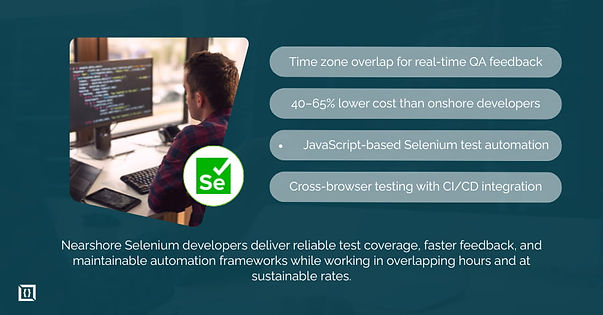
Nearshoring gives you developers in Latin America who work your hours, cost 40-65% less than onshore hires, and can write JavaScript-based Selenium tests that integrate seamlessly with your CI/CD pipeline.
Let’s explore how nearshore Selenium developers work, the value they add, and what teams should realistically expect from their expertise.
Why Choose Nearshore Selenium Developers?
The nearshore model solves three problems: timezone overlap, communication quality, and cost. When your Selenium developer is three hours behind instead of twelve, you can actually have a conversation about why a test is failing. That real-time collaboration matters more than most teams realize.
1. Time Zone Alignment for QA-Dev Sync
Latin America shares working hours with U.S. teams. A developer in Colombia or Mexico works during your morning and afternoon, not your overnight. Your Selenium tests run during your workday, failures get investigated immediately, and you don't wait 24 hours for feedback on a broken build.
Daily standups happen at normal times. When a developer needs clarification on test requirements, they ask you directly instead of guessing. The feedback loop tightens and test coverage improves.
2. Cost-Effective Test Automation Without Compromise
Nearshore rates in Latin America typically run $25 to $70 per hour for mid to senior Selenium developers. That's 40-65% less than U.S. onshore rates, which start around $80 per hour and often exceed $130 for senior engineers.
The quality doesn't drop with the price. You're hiring from the same talent pool that companies like Microsoft and Google recruit from, just at regional cost structures instead of Silicon Valley premiums.
The savings compound when you're building a full QA team. Three nearshore developers cost less than one onshore hire, and you get broader test coverage because you have more people writing and maintaining tests. The cost advantage isn't about cutting corners. It's about access to skilled developers at sustainable rates.
3. Expertise in JavaScript & Browser Automation
Selenium supports JavaScript via the selenium-webdriver npm package, allowing teams to maintain a consistent Node.js stack across frontend, API, and automated tests.
A nearshore Selenium developer typically:
- Writes tests using Node.js with async/await patterns
- Structures tests using the Page Object Model
- Automates across Chrome, Firefox, Edge, and Safari
- Integrates tests with CI/CD pipelines
The goal is maintainable, scalable test frameworks that support ongoing development and QA efforts.
Nearshore Selenium Testing Services
Nearshore Selenium testing services provide end-to-end automation built on JavaScript, covering framework setup, cross-browser testing, CI/CD integration, and clear reporting to keep test suites reliable and maintainable.
JavaScript-Based Selenium Framework Setup & Maintenance
Setting up a Selenium framework involves decisions about project structure, dependency management, wait strategies, and reporting.
A proper setup uses the Page Object Model to separate test logic from page interactions, implements explicit waits instead of hard-coded sleeps, and includes useful logging.
Maintenance is ongoing. As your application changes, tests break. A dedicated developer keeps the framework stable, refactors brittle tests, and ensures your test suite remains reliable. Tests run via Node.js with dependencies managed through npm, integrating with your chosen test runner (Mocha, Jest, Jasmine).
Cross-Browser UI Automation
Selenium supports automation across Chrome, Firefox, Edge, and Safari through WebDriver bindings. Cross-browser testing catches issues that only appear in specific browsers, like layout problems in Safari or JavaScript behavior differences in Firefox.
The implementation involves running the same test suite against multiple browser drivers using Selenium's Builder API.
Node.js Test Execution in CI/CD Pipelines
Tests should run in CI/CD pipelines to prevent production issues.
Best practices include:
- Executing tests via Node.js in CI pipelines
- Setting up the correct browser drivers for each environment
- Parallelizing tests to manage run time
- Integrating with CI tools like GitHub Actions, Jenkins, CircleCI, or GitLab CI
Test Reporting & Debugging Support
When tests fail, you need to know why. Good reporting includes screenshots of failure states, console logs, and execution traces. JavaScript test frameworks integrate with various reporters, with tools like Allure providing detailed HTML reports with historical data.
Engagement Models to Fit Your Business
Different projects need different team structures. Nearshore providers offer multiple engagement models to match your needs.
Model | Description | Best Use Case |
Dedicated Developers | Full-time, integrated with your team | Long-term automation |
Staff Augmentation | Temporary support to fill skill gaps | Short-term testing spikes |
Project-Based Outsourcing | Deliver a defined test scope | One-off projects |
Dedicated Selenium Developers
A dedicated developer works exclusively on your project, joining team meetings and building deep product knowledge. This model works when you're building long-term test automation infrastructure. The commitment goes both ways: you get consistent availability and domain expertise, they get stable work and the opportunity to own your testing strategy.
Staff Augmentation
Staff augmentation fills skill gaps quickly. You need three more testers for a major release? Add them. Project wraps up? Scale back. The flexibility helps match headcount to workload without full-time hiring overhead.
Project-Based Outsourcing
Some testing needs are self-contained: a specific feature tested, a regression suite built, or framework migration. Project-based engagement defines scope upfront and delivers. This works for discrete testing initiatives without ongoing team integration.
How to Hire the Right Nearshore Selenium Developer
Hiring for test automation requires evaluating both technical skills and process fit. You need both solid test code and effective communication.
1. Define Your Test Automation Scope
Start by clarifying what you need to automate. Are you focusing on smoke tests, regression suites, or end-to-end user flows? The scope guides which skills matter most:
- Smoke tests require fast execution and reliability
- Regression suites need maintainable frameworks
- End-to-end tests need someone who understands full user workflows
2. Evaluate Technical & Soft Skills
Review past work. Ask candidates to walk through test frameworks they've built and explain architectural decisions. Communication matters as much as code quality. Can they explain technical concepts clearly? Do they ask good questions? Will they proactively surface issues?
3. Live Automation Coding Assessment
A practical test shows how candidates handle real-world scenarios. Provide a simple page, like a login form or search feature, and evaluate:
- Code organization and maintainability
- Selector strategy
- Handling of edge cases and asynchronous behavior
This demonstrates how well their tests will hold up over time.
4. Check Team and Process Fit
Selenium developers work with your engineering team and participate in sprint planning. Experience with distributed agile teams and async communication matters. Ask about their experience with remote collaboration and how they handle blockers when teammates are offline.
Benefits of Nearshore Selenium Development
Nearshore Selenium developers speed up feedback, integrate with your team, and provide reliable test coverage using JavaScript and timezone alignment.
Benefit | Impact |
Faster JavaScript Feedback | Less context switching, quicker debugging |
Timezone Overlap | Builds fixed and questions answered same day |
Agile Collaboration | QA joins planning and standups |
Lower Regression Risk | Automated tests run on every commit |
Faster Turnaround with JavaScript Stacks
When your entire stack is JavaScript, having Selenium tests in JavaScript reduces context switching. Developers write features and tests without changing languages. Code reviews happen faster. Debugging becomes easier because the same tools work for both application and test code.
Timezone overlap accelerates this further. Questions get answered during the workday. Builds fail and get fixed in the same afternoon instead of waiting overnight.
Streamlined Collaboration with Agile Teams
Nearshore teams integrate naturally into sprint ceremonies because they're awake during your sprints. Standups include the whole team. When QA engineers participate in planning, they ask clarifying questions that prevent bugs. When they're in refinement sessions, they understand requirements before code gets written.
Lower Regression Risk with Full Suite Coverage
Comprehensive test coverage prevents regressions. Automated Selenium tests run on every commit, providing continuous validation that changes don't break existing functionality. Manual testing can't match this coverage at scale. Automated tests run consistently and scale to cover hundreds of scenarios.
FAQs About Hiring Nearshore Selenium Developers
What is Selenium testing?
Selenium is an automated testing framework for web applications. It controls browsers programmatically, simulating user actions like clicking buttons, filling forms, and navigating pages. Tests written with Selenium verify that your application behaves correctly across different browsers and scenarios. The framework supports multiple programming languages, with JavaScript being fully supported through the selenium-webdriver npm package for Node.js environments.
How much does a nearshore Selenium expert cost?
Nearshore Selenium developers in Latin America cost between $25 and $70 per hour, depending on experience level and technical expertise. This represents a 40-65% cost reduction compared to U.S. onshore rates, which typically start at $80 per hour for mid-level engineers and exceed $130 for senior specialists.
The cost advantage doesn't reflect lower quality. It reflects regional economic differences and cost of living variations between North America and Latin America.
When should I choose Selenium over other tools?
Choose Selenium when you need broad browser support (including older browsers), want flexibility in programming language choice, or are working with legacy applications. Selenium supports Chrome, Firefox, Edge, Safari, and even Internet Explorer, making it the most versatile option for cross-browser testing.
It also has the largest community and longest track record, which means extensive documentation, mature tooling, and proven reliability at scale.
What's the actual monthly cost to hire a nearshore Selenium developer for different scenarios?
Nearshore Selenium developers offer predictable monthly costs that are lower than onshore equivalents, allowing teams to scale testing capacity efficiently without compromising quality.
Level | Hourly Rate | Monthly (160 hrs) |
Junior | $35-45 | $5,600-$7,200 |
Mid-level | $45-60 | $7,200-$9,600 |
Senior | $60-75 | $9,600-$12,000 |
Lead QA Engineer | $70-85 | $11,200-$13,600 |
Note: Costs vary by experience and region. For comparison, equivalent U.S. onshore developers cost $12,800-$24,000/month. A three-person nearshore team costs roughly the same as one senior onshore developer.
How long does it take to set up a complete Selenium test automation framework from scratch?
A production-ready framework typically takes 3-6 weeks:
Week 1-2: Initial Setup - Project structure, dependency management, WebDriver configuration, basic test runner setup, and CI/CD integration.
Week 3-4: Framework Architecture - Implement Page Object Model, create reusable components, establish wait strategies, set up reporting, and build utility functions.
Week 5-6: First Test Coverage - Write tests for critical user paths, validate framework decisions, tune execution speed, and document framework usage.
Key factors affecting timeline: application complexity, existing QA processes, and requirement clarity. The timeline assumes production readiness with tests that run reliably in CI and can be maintained by multiple developers.
Selenium vs Cypress vs Playwright: Which should I choose and when?
Choose Selenium when:
- You need broad browser support including Internet Explorer or older browsers.
- Your team uses multiple programming languages.
- You're working with legacy or complex enterprise systems.
- Mobile testing via Appium integration is required.
Choose Cypress when:
- Your application is a modern JavaScript single-page application.
- Your team consists primarily of frontend developers.
- You value fast setup and excellent debugging experience.
- You're testing applications within a single origin.
Choose Playwright when:
- You need modern browser automation with cutting-edge features.
- Cross-browser testing across Chrome, Firefox, and Safari is required.
- You're testing applications with multiple domains.
- Parallel test execution and speed are priorities.
No tool wins everywhere. Selenium has the largest community and broadest compatibility. Cypress provides the best developer experience for JavaScript teams. Playwright offers the most modern feature set and best performance.
What does a production-ready Selenium framework architecture actually look like?
A scalable framework has several core layers:
- Page Object Layer: Classes representing application pages or components. Each page object encapsulates element selectors and page actions. When UI changes, you update one-page object instead of dozens of tests.
- Test Layer: Test files using page objects to verify functionality. Tests focus on business logic, not technical details of element location.
- Utility Layer: Reusable functions for screenshot capture, data generation, API helpers, and custom wait conditions.
- Configuration Management: Environment-specific settings stored separately from test code, allowing the same tests to run against development, staging, and production.
- Reporting and Logging: Structured logs for debugging, screenshots on errors, and reports showing execution history and flaky test identification.
- Parallel Execution Support: Tests run concurrently to reduce execution time, requiring proper test isolation and resource management.
What breaks most often in Selenium test suites, and how do you fix it?
Common Selenium test failures occur because of timing issues, unstable selectors, test data problems, environment differences, or network delays.
- Flaky Waits: Tests fail intermittently because elements haven't loaded. Replace hard-coded sleeps with explicit waits using Selenium's WebDriverWait.
- Brittle Selectors: Tests break when developers change CSS classes. Use stable selectors like data-testid attributes instead of styling classes.
- Unstable Test Data: Tests fail because expected data changes. Create test data during setup and clean it afterwards.
- Environment Issues: Tests pass locally but fail in CI due to missing dependencies or different browser versions. Containerize your test environment using Docker.
- Stale Element References: Element references become invalid when the DOM updates. Fetch elements fresh each time you interact with them.
- Network Timeouts: Tests fail waiting for API responses. Increase timeout thresholds for slow operations, but investigate why those operations are slow.
How many tests can one Selenium developer write and maintain realistically?
A mid-level developer can typically write 10-15 quality tests per month, accounting for framework setup, test design, implementation, and debugging.
Maintenance load varies based on application stability and framework quality. A well-designed framework with a stable application might require 10-20% of time for maintenance. A poorly structured framework can consume 50%+ of time keeping tests green.
Planning guidelines:
- One developer can maintain 100-150 well-structured tests while adding new coverage.
- Each developer can write 120-180 tests per year while maintaining existing suites.
- Test complexity matters more than count.
The productivity ceiling comes from maintenance burden. If your framework is brittle, developers spend most time fixing broken tests rather than expanding coverage. Focus on framework quality and developer/QA collaboration.
Your Next Move
Selenium is a versatile framework for browser automation, and nearshore developers deliver reliable test coverage and faster feedback without the delays or cost of offshore or onshore teams.
Focus on developers who understand both Selenium and your app’s needs. Prioritize practical experience, use real coding exercises, and set clear onboarding expectations. Skilled nearshore engineers can improve test reliability, reduce regressions, and scale automation efficiently.
You can connect with us for guidance and support in building your Selenium automation strategy, developing test frameworks, evaluating nearshore QA talent, and choosing the right engagement model.
Frequently Asked Questions
What level of involvement will nearshore Selenium developers have with my internal team?
Nearshore Selenium developers typically integrate directly into your workflows. They join daily standups, sprint planning, and retrospectives, collaborate with frontend and backend engineers, and align test automation with ongoing feature development. This isn’t a handoff model—it’s embedded QA collaboration.
Can nearshore Selenium developers adapt to our existing test stack and processes?
Yes. Experienced nearshore developers are accustomed to joining established environments. They can work with your current CI/CD tools, test runners, coding standards, and branching strategies, while gradually improving test structure, reliability, and coverage without disrupting delivery.
How do nearshore teams handle flaky tests and long-running test suites?
They focus on framework quality early: explicit waits, stable selectors, proper test isolation, and parallel execution. When flakiness appears, they analyze root causes instead of applying quick fixes, ensuring the suite stays fast, reliable, and trustworthy over time.
Is nearshore Selenium development suitable for startups, or only enterprise teams?
It works for both. Startups benefit from fast setup and cost efficiency without committing to full in-house hires, while enterprises use nearshore teams to scale automation across large applications, legacy systems, or multiple products without inflating internal headcount.
What risks should I watch for when hiring nearshore Selenium developers?
The main risks are unclear test scope, weak onboarding, and treating automation as an afterthought. These are mitigated by defining automation goals upfront, involving QA early in sprints, and choosing developers who understand both testing strategy and engineering fundamentals—not just Selenium syntax.