AI for Construction Codes & Urban Planning: RAG Systems
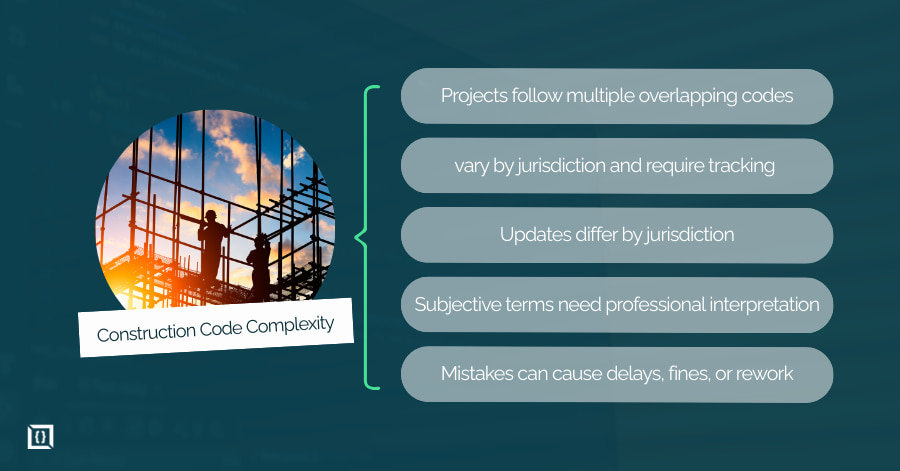
An architect working on a mixed-use development spends 12 hours cross-referencing the International Building Code, state amendments, city zoning overlays, and ADA requirements. The documents contradict each other in places. A single miscalculation on floor area ratio could mean permit rejection and months of delay.
AI systems built on retrieval-augmented generation (RAG) offer a practical approach to this problem. These systems search regulatory documents, retrieve relevant sections, and synthesize answers with citations.
They do not replace licensed professionals. But they accelerate research and reduce the likelihood of missing critical provisions.
The Complexity of Construction Codes and Urban Planning Regulations
Building codes and zoning regulations are vast, fragmented, and constantly changing. The NYC Zoning Resolution spans 14 articles, 11 appendices, and 126 zoning maps. California's Title 24 updates every three years.
Permit delays can be substantial. For example, a study in Washington State found average delays of six and a half months, adding over $30,000 in holding costs for a residential project.
Fragmented Regulations Across Jurisdictions
A single project requires compliance with federal, state, county, and municipal codes. The International Building Code provides a baseline, but states adopt it with amendments. Counties add modifications. Cities layer on zoning requirements and special district regulations.
A commercial development in Texas must comply with the IBC as adopted by Texas with state amendments, Austin's local building code amendments, city zoning requirements, and any applicable special district overlays. Cross-referencing these layers manually requires tracking multiple document versions and understanding precedence rules when requirements conflict.
Frequent Updates and Regulatory Drift
The ICC updates model codes on a three-year cycle. The current IBC is the 2024 edition. States and jurisdictions adopt new editions on their own schedules, often lagging by years. Some skip cycles entirely.
California exemplifies the update challenge. The 2025 Building Standards Code takes effect January 1, 2026, introducing new requirements for heat pumps, battery storage, and ventilation standards. Projects applying for permits before the effective date follow the 2022 code; those applying after must comply with 2025. During transition periods, professionals must track exactly which version applies to each project.
Emergency amendments add another layer. After major wildfires, California adopted emergency building standards for wildland-urban interface zones. Post-hurricane amendments in Florida modified wind load requirements. These changes can take effect with minimal notice.
Ambiguity and Interpretive Language
Codes contain subjective terms requiring interpretation. "Reasonable setback," "adequate parking," and "appropriate buffering" appear throughout regulatory text without precise definitions.
Variance criteria include terms like "unique hardship" that depend on professional judgment and local precedent. What constitutes "adequate" in one municipality may differ significantly from another.
What AI Can (and Cannot) Do
AI systems for regulatory analysis operate as decision support tools, not replacements for professional expertise. The professional seal on construction documents carries legal responsibility that cannot be delegated to software. This parallels how legal research tools assist attorneys without practicing law.
AI works well for preliminary feasibility analysis, identifying relevant code sections, and accelerating research across large document sets. It can flag potential compliance issues for human review and help professionals find relevant precedents faster.
AI is not appropriate for final permit approvals, variance justifications, or life-safety determinations without professional review. Novel interpretive questions and edge cases need human expertise. The AI assists; it does not decide.
Retrieval-Augmented Generation for Construction Codes
RAG systems combine document retrieval with language model generation. For regulatory applications, these addresses key limitations of both traditional search and generic AI chatbots.
How RAG Works in a Regulatory Context
A RAG system operates in three stages. First, it maintains a knowledge base of regulatory documents in searchable format. Second, when a user asks a question, the system retrieves relevant document sections. Third, a language model synthesizes an answer based on retrieved content with citations to source material.
This differs from generic chatbots, which can hallucinate plausible but incorrect information. A June 2024 study in the Harvard Journal of Law & Technology found that GPT‑4 produced hallucinated outputs in about 49% of basic legal case summary tasks. RAG constrains the model to answer based on retrieved documents, reducing hallucination risk significantly.
It also differs from keyword search, which returns matching documents but does not synthesize or explain. RAG combines retrieval accuracy with the language model's ability to summarize and explain complex regulatory text. Think of it as a paralegal who has read the entire code library, finds relevant sections quickly, summarizes what they say, and always tells you exactly where to verify.
Standard RAG Architecture
A typical pipeline includes:
- Ingestion: Converting source documents (PDFs, HTML, structured data) into searchable format.
- Chunking: Dividing documents into retrievable segments, typically by logical sections.
- Embedding: Converting text into vector representations for similarity search.
- Vector storage: Databases like Pinecone or Weaviate optimized for similarity queries.
- Retrieval: Finding relevant chunks for a given query.
- Synthesis: Generating answers from retrieved chunks with citations.
LangChain and LlamaIndex provide frameworks for building these pipelines. Production systems add layers for logging, monitoring, and quality assurance.
Where Basic RAG Struggles
Basic RAG handles simple lookups well but struggles with tables containing setback matrices and parking ratios, diagrams showing building envelopes, cross-document reasoning requiring information from multiple codes, and numerical calculations for FAR and parking requirements.
Cross-document reasoning presents particular challenges. A single compliance question might require information from the zoning code, building code, fire code, and accessibility standards, with potential conflicts between them. Basic RAG retrieves similar content but does not reason about relationships across documents. These limitations point toward more advanced approaches.
Advanced RAG Variants
Several architectures address specific challenges in regulatory analysis.
Multi-Modal RAG
Vision-language models like GPT-4o and Claude process images alongside text. Multi-modal RAG can analyze site plans, extract dimensions, measure distances from property lines, and check layouts against dimensional requirements.
A system might analyze a parking layout against ADA dimensional requirements or check fire egress paths against maximum travel distances. Implementation requires robust document processing with OCR and object detection.
Agentic RAG for Compliance Workflows
Agent frameworks like LangGraph enable multi-step reasoning. Instead of single retrieval-and-answer cycles, an agent can decompose a compliance question into sub-checks: verify permitted use, check height limits, calculate setbacks, determine parking requirements, compute FAR, and verify lot coverage.
LangGraph has grown as the leading framework for production agent workflows, running at companies like LinkedIn, Uber, and 400+ others.
CrewAI offers simpler role-based multi-agent collaboration. Both support complex reasoning patterns for regulatory analysis.
Hybrid RAG for Multiple Data Types
Zoning compliance often requires combining data types. A height question might require GIS lookup for zoning district, table lookup for height limits, and text search for exceptions.
Hybrid architectures combine vector databases for text with SQL for structured data and GIS for spatial information. Query orchestration routes different parts of a question to appropriate data sources.
Graph-Based RAG for Cross-References
Building codes contain dense networks of cross-references. Knowledge graphs model these relationships explicitly, with sections as nodes and relationships (references, supersedes, modifies) as edges.
When a user queries a specific section, the system traverses the graph to find related amendments and exceptions. This helps resolve conflicts by establishing precedence.
System Architecture Considerations
Data Ingestion and Version Control
Source documents arrive in various formats: scanned PDFs, HTML pages, Word documents, and structured data exports. OCR accuracy matters significantly: born-digital PDFs achieve 99%+ accuracy, good scans reach 95-98%, legacy documents may fall to 70-85%. Budget for document preprocessing when planning implementation.
Version control tracks regulatory editions over time. The system must know which code edition applies to projects at different stages. Historical versions remain accessible for projects permitted under previous codes. When California offers a 180-day choice window between code editions, the system must support querying either version.
Jurisdiction-Aware Retrieval
Multi-tenant systems must ensure queries return only relevant regulations. Architecture choices include separate databases per jurisdiction or unified storage with metadata filtering. User context determines applicable jurisdiction and scopes all retrieval accordingly.
Auditability and Citation
Every AI output must include citations, retrieval provenance, and reasoning chain. Users need to verify answers against source documents. Logging enables debugging, quality monitoring, and demonstration of due diligence if outputs are questioned.
Risk and Governance
Hybrid AI systems in construction and planning must balance automation benefits with accountability. Proper safeguards ensure outputs are reliable, traceable, and legally defensible while keeping human oversight central.
Hallucination Mitigation
Hallucinations in regulatory AI can lead to permit rejections, code violations, and liability exposure. Mitigation strategies include confidence scoring, citation requirements, validation checks, and mandatory human review for high-stakes outputs.
Systems should refuse answering when confidence is low. "I cannot determine this with confidence; please consult Section X directly" beats a plausible-sounding wrong answer.
Liability Boundaries
Typical allocation places responsibility on vendors for system functioning, on purchasers for appropriate use, on users for verification, and on officials for final determinations. Standard practice includes clear disclaimers that AI output requires professional verification.
When RAG Is Sufficient and When It Is Not
RAG works well for research assistance, preliminary feasibility analysis, training and education, and public information queries. These are lower-stakes scenarios where errors can be caught before consequences materialize.
It is inadequate for final permit determinations, variance justifications requiring legal argument, life-safety decisions, and novel interpretive questions. These require licensed professional judgment that AI cannot replace.
The decision framework: use AI to accelerate the research phase, then apply professional expertise for analysis, judgment, and final determinations.
Best Practices
Start with advisory applications. Deploy first as an internal research tool. Expand to public queries only after extensive validation. Never fully automate compliance determinations.
Design for jurisdiction isolation. Strict separation prevents cross-contamination. Ensure Los Angeles queries never return San Francisco results.
Prioritize explainability over fluency. Users will accept less polished prose if they can verify accuracy. Structured outputs with clear citations build trust.
Your Next Move
Construction codes and urban planning regulations present an information management challenge well-suited to AI augmentation. The documents are vast, fragmented, and constantly changing. Manual research is time-consuming and error-prone.
RAG systems help you navigate this information more efficiently. They don’t replace your judgment but reduce the chance of missing critical requirements. The best approach is incremental: start with pilot projects, validate outputs carefully, expand gradually, and keep professional oversight in place.
You can connect with us for guidance on regulatory AI system architecture, RAG implementation for construction and planning applications, and integration with existing workflows.
Frequently Asked Questions
What does it cost to build a construction code RAG system?
Expect $150K–$500K for a minimum viable product covering 1–3 jurisdictions. Infrastructure can run $2K–$10K per month. Data preparation is typically $50K–$150K one-time. Engineering and development usually fall between $100K–$300K.
These numbers can vary depending on complexity, number of jurisdictions, and specific system features. Costs in LATAM are often lower due to reduced labor rates and local operational expenses.
Which LLM models work best for regulatory text?
GPT-4 and Claude handle complex regulatory language and citations effectively. Fine-tuning is rarely needed since RAG systems provide domain grounding and context. Emerging open models are options but may require more setup.
What’s a realistic accuracy rate?
Retrieval typically reaches 85–95%, while interpretation accuracy lands around 70–85%. For comparison, experienced professionals achieve 90–95%, and junior staff 75–85%. 100% accuracy is unrealistic, so human review remains important.
Which agent frameworks work for compliance checking?
LangGraph is the most mature for production. CrewAI supports role-based multi-agent collaboration. Start with single-agent RAG for simplicity, adding multi-agent setups only when workflows require it.
What team is needed to build and maintain this?
A typical development team for 6-12 months includes 1-2 ML engineers, 1-2 full-stack developers, 1 data engineer, 1-2 domain experts (licensed), and a project manager. Development budgets range $750K-$1.5M; ongoing maintenance $300K-$600K per year.
In LATAM, team size can be similar, but overall costs are often lower due to reduced labor rates and local operational expenses.
Can AI interpret subjective language like “reasonable” or “adequate”?
Not reliably on its own. AI can surface past interpretations and highlight relevant factors, but judgment calls require human review. Flag subjective terms and route them to professionals for verification.
How many jurisdictions can you maintain in one system?
Technically, you can manage many, but practical limits depend on data prep, updates, and QA capacity. For pilots, 1–3 jurisdictions is realistic; production, 5–15; enterprise, 50–100 with dedicated teams.
What causes hallucinations in regulatory contexts?
Hallucinations usually result from retrieval misses, context overflow, ambiguity, calculation errors, citation mistakes, or outdated references. Prevention relies on careful retrieval tuning, context management, calculation validation, and strict version control.