


.webp)


Hire Nearshore SQL Developer: Everything You Need to Know
- Leanware Editorial Team

- Feb 12
- 11 min read
As data becomes central to how modern businesses operate, the role of SQL developers has grown far beyond writing basic queries. Today, SQL developers are responsible for ensuring data accuracy, system performance, scalability, and reliability across applications that power SaaS platforms, enterprise tools, analytics systems, and internal operations.
At the same time, hiring experienced SQL talent locally has become increasingly difficult. Competition is high, salaries continue to rise, and long hiring cycles slow down execution. This has led many CTOs, founders, and engineering leaders to explore nearshore hiring as a practical alternative.
This guide explains what it means to hire a nearshore SQL developer, when it makes sense, what skills to look for, how costs compare, and how nearshore development fits into modern engineering teams. The goal is not to push a hiring model, but to help you make a well-informed decision based on your business and technical needs.
What Does "Hire Nearshore SQL Developer" Mean?
Hiring a nearshore SQL developer means working with a database professional located in a nearby region, most commonly Latin America, for U.S.-based companies. These developers work in similar or overlapping time zones, making real-time collaboration much easier compared to offshore teams located far away.
Nearshore hiring sits between onshore and offshore models. You get closer cultural alignment and working-hour overlap than offshore, while still benefiting from lower costs and faster hiring compared to local markets.
For SQL development specifically, nearshore teams are often a strong fit because database work requires frequent collaboration with backend engineers, data teams, and product stakeholders. Time zone alignment reduces delays in debugging,
performance tuning, and production issue resolution, which are critical for database-heavy systems.
What Does a SQL Developer Do?
A SQL developer is responsible for designing, maintaining, and optimizing relational databases that support business applications. Their work directly impacts system performance, data reliability, and decision-making across the organization.
From a business perspective, a strong SQL developer helps ensure that applications remain fast as data volume grows, reports are accurate, and operational systems remain stable under load. Poor database performance often shows up as slow dashboards, delayed transactions, failed integrations, or downtime during peak usage.
SQL developers work closely with backend engineers, data analysts, DevOps teams, and sometimes directly with product or operations teams to translate business requirements into efficient data structures and queries.
Core Responsibilities of a SQL Developer
Designing and maintaining relational database schemas
Writing and optimizing complex SQL queries
Improving query performance through indexing and execution plan analysis
Ensuring data integrity, consistency, and reliability
Supporting migrations, upgrades, and schema changes
Monitoring database performance and resolving bottlenecks
Common Databases and SQL Technologies
SQL developers typically work with a range of relational and cloud-based databases depending on the system architecture. Common technologies include PostgreSQL, MySQL, Microsoft SQL Server, Oracle Database, and cloud-managed services such as Amazon RDS, Azure SQL Database, and Google Cloud SQL.
The specific database matters less than the developer’s ability to design scalable schemas, write efficient queries, and adapt to different environments.
What Is Nearshore Development?
Nearshore development refers to outsourcing or augmenting engineering teams with developers from geographically close regions. For U.S. companies, this usually means Latin America. For European companies, it may involve Eastern Europe or nearby regions.
The defining characteristic of nearshore development is time zone overlap. Teams can work together during normal business hours, attend the same standups, collaborate in real time, and resolve issues without waiting overnight.
Nearshore development is often used for long-term team augmentation, not just short-term projects. Developers become part of the internal workflow rather than external contractors working in isolation.
Nearshore vs Onshore vs Offshore Development
Onshore hiring offers maximum proximity but comes with high costs and long hiring cycles. Offshore development may reduce costs further, but time zone gaps and communication delays can slow down delivery and create coordination issues.
Nearshore development balances both. Companies gain cost efficiency while preserving collaboration speed, shared work hours, and cultural alignment, which is especially valuable for database and backend-heavy work.
Why Hire a Nearshore SQL Developer?
Companies don’t hire nearshore SQL developers just to save money. They do it to move faster, scale teams efficiently, and reduce operational friction while maintaining quality.
Cost Efficiency Without Compromising Quality
Nearshore SQL developers typically cost less than onshore hires, but the difference is not about cheap labor. It’s driven by regional cost-of-living differences. Companies often see savings while still working with senior developers who have experience in complex systems.
More importantly, the total cost of ownership is lower. Faster onboarding, fewer delays, and better collaboration reduce hidden costs that often appear with offshore models.
Real-Time Collaboration and Time Zone Alignment
SQL work often requires quick feedback loops. A slow query in production, a broken report, or a failing migration needs immediate attention. Nearshore developers can collaborate in real time with your internal team, join standups, and participate in incident response without time zone delays.
This directly improves sprint velocity and reduces downtime.
Access to Highly Specialized Database Expertise
Many nearshore SQL developers work across multiple industries and systems. They often have experience maintaining legacy databases, handling large datasets, and supporting systems that have evolved over many years.
This exposure makes them well-suited for complex database environments where performance tuning and stability matter more than greenfield development.
Faster Scaling for Growing Teams
Hiring SQL talent locally can take months. Nearshore models allow companies to add or reduce database expertise quickly based on workload, without committing to long local hiring cycles.
This flexibility is especially valuable for SaaS companies scaling rapidly or teams preparing for migrations, audits, or product launches.
Find SQL Developer
At some point, understanding nearshore hiring turns into a practical decision. The question is no longer what is nearshore, but when do we actually need SQL expertise and in what form.
Finding the right SQL developer depends heavily on how central databases are to your product or operations. Some teams need continuous database ownership, while others need targeted expertise for a defined problem. Nearshore hiring works well in both cases, but the engagement model should match the business reality.
Instead of thinking in terms of job titles, it’s more effective to think in terms of responsibility. Ask whether you need someone who owns database health day-to-day, or someone who comes in to fix, optimize, or migrate a specific system.
When You Need a Dedicated SQL Developer
A dedicated SQL developer is the right choice when databases are a core part of your product or business infrastructure. This is common in SaaS platforms, fintech systems, healthcare applications, data-heavy enterprise tools, and internal platforms that support daily operations.
In these environments, database performance issues don’t show up as “technical problems.” They show up as slow user experiences, failed transactions, delayed reports, or production incidents. A dedicated SQL developer provides continuous monitoring, proactive optimization, and deep system knowledge that builds over time.
Nearshore dedicated developers integrate into your team much like local hires. They attend standups, collaborate with backend engineers, and participate in planning discussions. The difference is faster hiring and more flexible scaling.
When You Need SQL Expertise for a Specific Project
Not every company needs full-time database ownership. Some needs are temporary but critical. Examples include cloud migrations, performance audits, schema redesigns, reporting overhauls, or stabilizing a legacy system before a major release.
In these cases, nearshore SQL developers can be engaged on a project basis. This allows teams to access senior-level expertise without committing to long-term headcount. Once the project is completed, the engagement can scale down cleanly.
This model works especially well for teams that already have backend engineers but lack deep SQL performance or migration experience.
Use Cases for Nearshore SQL Developers
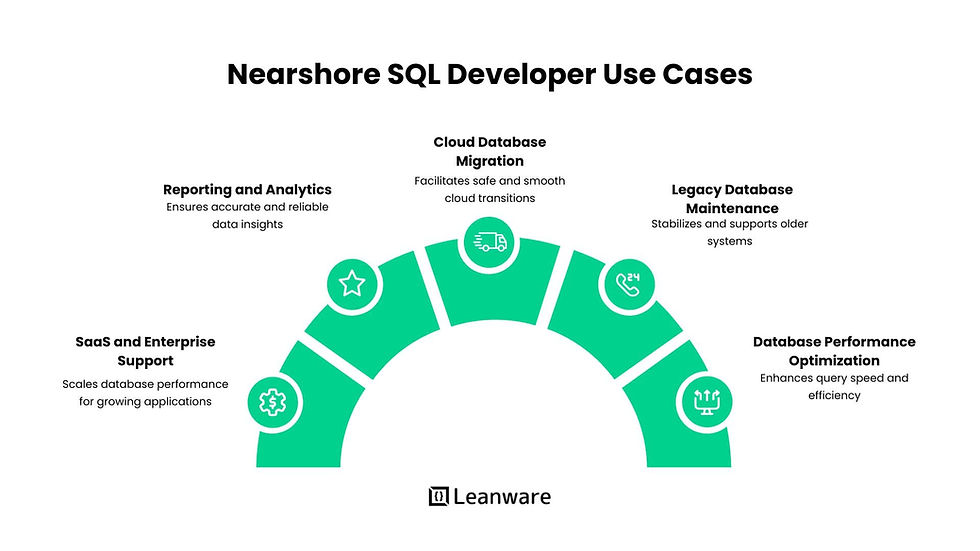
Nearshore SQL developers are typically brought in when database reliability and performance directly affect business outcomes. These are not abstract technical tasks. They are problems that impact revenue, customer experience, and operational stability.
Database Performance Optimization
As applications grow, database queries that once worked fine begin to slow down. Reports take longer to load. APIs time out. Background jobs fall behind. Performance optimization becomes necessary to maintain an acceptable user experience.
Nearshore SQL developers identify bottlenecks by analyzing execution plans, indexing strategies, query patterns, and schema design. They don’t just “make queries faster.” They help teams understand why performance degrades and how to prevent it as data volume grows.
The result is usually immediate. Reduced response times, fewer incidents, and lower infrastructure costs due to more efficient resource usage.
Legacy Database Maintenance and Support
Many companies run on databases that are years old. These systems may be poorly documented, tightly coupled to business logic, and risky to change. Rewriting them is often not feasible.
Nearshore SQL developers frequently work in these environments. They focus on stabilizing performance, improving reliability, and reducing operational risk without forcing large rewrites. This includes cleaning up schemas, improving indexing strategies, and creating safer migration paths.
For businesses, this means extending the life of critical systems while reducing firefighting.
Cloud Database Migration Projects
Moving databases to cloud platforms such as AWS, Azure, or Google Cloud is a common but high-risk initiative. Poorly planned migrations can cause downtime, data loss, or performance regressions.
Nearshore SQL developers support cloud migrations by redesigning schemas where needed, handling data migration safely, validating performance post-migration, and optimizing cloud-specific configurations.
Because migrations often require close coordination with application teams, nearshore time zone alignment becomes especially valuable.
Reporting, Analytics, and Business Intelligence
Dashboards and KPIs are only as reliable as the SQL behind them. Many organizations struggle with slow or inaccurate reports because queries were never designed for analytics workloads.
SQL developers help structure reporting layers, optimize analytical queries, and ensure data consistency across dashboards. This enables leadership teams to trust the numbers they use for decision-making.
SaaS and Enterprise Application Support
As SaaS platforms scale, database load increases quickly. User growth, feature expansion, and data retention policies all add pressure to the database layer.
Nearshore SQL developers help SaaS teams scale safely by optimizing queries, implementing partitioning strategies, and improving schema design. Their work often prevents major outages before they happen.
Key Skills to Look for in a Nearshore SQL Developer
Evaluating SQL developers should go beyond certifications or years of experience. The most valuable skills are practical and tied directly to business impact.
Advanced SQL Query Writing and Optimization
A strong SQL developer understands how queries behave under real workloads. This includes deep knowledge of joins, indexes, execution plans, and query refactoring.
They should be able to explain why a query is slow, not just rewrite it blindly. This ability becomes critical as datasets grow and systems evolve.
Database Design and Data Modeling
Good database design reduces future problems. SQL developers should understand normalization, denormalization trade-offs, schema evolution, and how data models affect application performance.
They should design schemas with scalability in mind, not just current requirements. This is especially important for SaaS and long-lived enterprise systems.
Experience With Cloud and Modern Data Stacks
Modern SQL developers often work with managed cloud databases, hybrid architectures, and distributed systems. Experience with services like Amazon RDS, Azure SQL, or Google Cloud SQL is increasingly important.
They should also understand how cloud environments affect performance, availability, backups, and cost management.
Security, Data Integrity, and Compliance
SQL developers work with sensitive data. They must understand access control, role-based permissions, encryption, and data integrity constraints.
In regulated industries, familiarity with compliance concepts such as GDPR or HIPAA is a strong advantage. Even when not directly responsible for compliance, SQL developers must build systems that support it.
How to Hire a Nearshore SQL Developer
Hiring successfully is less about speed and more about clarity. Teams that struggle with nearshore hiring often fail to define what they actually need.
Defining the Right SQL Developer Profile
Start by defining the problem you are trying to solve. Is it performance? Scalability? Migration? Reporting? Ongoing ownership?
Once that is clear, you can decide the seniority level, expected responsibilities, and engagement model. Hiring a senior developer for junior-level tasks is inefficient. Hiring a junior developer for mission-critical databases is risky.
Technical Screening and SQL Assessments
SQL skills are best evaluated through practical tests. Real-world tasks such as query optimization, schema review, or performance analysis reveal far more than theoretical questions.
A good assessment reflects your actual environment. This reduces false positives and helps candidates demonstrate relevant expertise.
Evaluating Communication and Business Understanding
SQL developers rarely work in isolation. They must explain trade-offs, risks, and decisions to backend engineers, product managers, and sometimes non-technical stakeholders.
Clear communication is especially important in nearshore teams. The best developers can translate technical complexity into business impact.
Choosing the Right Nearshore Partner
Working with a vetted nearshore partner reduces hiring risk. Partners handle sourcing, vetting, and onboarding, allowing internal teams to focus on delivery.
A good partner also provides continuity. If needs change, they can help scale the team up or down without restarting the hiring process from scratch.
Nearshore SQL Developer Cost Breakdown
Cost transparency matters when evaluating nearshore hiring. Instead of focusing on hourly rates alone, it’s better to look at the total cost of ownership.
Cost Comparison: Onshore vs Nearshore vs Offshore
Onshore SQL developers typically command the highest salaries due to local market competition and cost of living. Offshore developers may offer lower rates, but communication delays and coordination issues can increase hidden costs.
Nearshore rates usually fall in the middle. Companies save on salary costs while maintaining strong collaboration and faster delivery, which often results in better overall value.
Factors That Influence SQL Developer Rates
Rates vary based on experience level, database complexity, industry requirements, cloud expertise, and engagement model. A senior SQL developer working on a regulated financial system will cost more than one supporting internal reporting tool.
Full-time, long-term engagements also tend to be more cost-efficient than short, fragmented contracts.
Is Hiring a Nearshore SQL Developer Right for Your Business?
Nearshore hiring is not a default choice. It works best in specific scenarios.
Best Scenarios for Nearshore SQL Development
Nearshore SQL development is a strong fit for companies scaling data-driven products, managing complex databases, supporting legacy systems, or planning cloud migrations.
It also works well for teams that value collaboration and want developers integrated into daily workflows.
When Other Hiring Models May Be Better
In some cases, local hiring makes more sense. Highly regulated environments, roles requiring physical presence, or organizations with very small database needs may prefer onshore or contract-based models. The key is alignment. Nearshore hiring should solve a real problem, not just follow a trend.
Conclusion
Hiring a nearshore SQL developer is a strategic way to strengthen your data layer without the cost and delays of local hiring. It offers access to experienced SQL talent, real-time collaboration through time zone alignment, and the flexibility to scale as your needs change.
Whether you need ongoing database ownership or short-term expertise for performance, migration, or optimization, nearshore hiring can deliver strong technical results with clear business impact.
Looking to hire a nearshore SQL developer who can integrate seamlessly with your team? Contact our experts to assess your needs and find the right SQL talent—whether you need dedicated ownership or targeted support for a critical project.
Frecuently Asked Questions
What is a nearshore SQL developer?
A nearshore SQL developer is a database professional based in a nearby region, typically Latin America for U.S. companies, who specializes in SQL-based databases. They work in similar time zones, enabling real-time collaboration while supporting database design, optimization, and maintenance.
Why should companies hire a nearshore SQL developer instead of onshore?
Companies choose nearshore SQL developers to balance cost efficiency with collaboration quality. Nearshore teams offer overlapping work hours, easier communication, and faster issue resolution compared to offshore models, while reducing the high costs of local hiring.
What skills should a nearshore SQL developer have?
A qualified nearshore SQL developer should have strong SQL query optimization skills, experience with relational databases, and a solid understanding of database design. They should also be comfortable working with cloud databases and collaborating closely with backend and data teams.
How much does it cost to hire a nearshore SQL developer?
The cost of hiring a nearshore SQL developer is typically lower than onshore rates and depends on factors such as experience level, database complexity, cloud expertise, and engagement model. Full-time, long-term engagements are often more cost-efficient than short-term contracts.
What industries commonly hire nearshore SQL developers?
Nearshore SQL developers are commonly hired in SaaS, fintech, healthcare, e-commerce, logistics, and enterprise software. These industries rely heavily on data accuracy, performance, and scalability, making database expertise critical.
Can nearshore SQL developers work with legacy databases?
Yes, many nearshore SQL developers specialize in supporting and optimizing legacy database systems. They help improve performance, stability, and reliability without requiring risky or expensive full system rewrites.
How do nearshore SQL developers support cloud migration projects?
Nearshore SQL developers assist with schema redesign, data migration, performance testing, and post-migration optimization when moving databases to cloud platforms like AWS, Azure, or Google Cloud. Their involvement helps minimize downtime and reduce migration risks.
Is it safe to share sensitive data with nearshore SQL developers?
Yes, it is safe when working with vetted nearshore developers or partners that follow strict security practices. These include access controls, encryption, and compliance awareness for standards such as GDPR or HIPAA, where applicable.
How quickly can a nearshore SQL developer be onboarded?
Nearshore SQL developers can often be onboarded within days or a few weeks. This is significantly faster than traditional local hiring, which may take several months due to recruitment and notice periods.
When should a company hire a dedicated SQL developer?
A company should hire a dedicated SQL developer when databases are central to product performance, data volume is growing, or continuous optimization and monitoring are required. This is common in SaaS platforms, data-driven applications, and enterprise systems.


