Automation Opportunities in Retail in 2026: Where AI Delivers ROI

In 2026, retail automation is no longer about isolated scripts or RPA handling repetitive tasks. The real value lies in systems that integrate data, make operational decisions, and execute actions across stores, supply chains, and digital channels.
Leaders are shifting focus from experimentation to orchestration - ensuring that insights translate directly into measurable outcomes. Successful automation now requires reliable data, clear guardrails, and end-to-end workflows that improve efficiency, reduce errors, and protect margins in a fast-moving market.
Let’s explore where automation creates impact, what makes implementations succeed, and how leaders focus on high-impact investments.
Why Retail Automation in 2026 Is Fundamentally Different
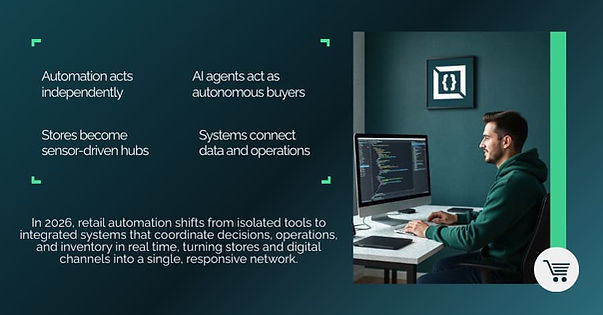
Retail automation is shifting from task-based tools to operationally mature, interconnected systems that function as the primary engine of a business. Agentic commerce is rising, where autonomous AI agents execute complex tasks like shopping for consumers, and retailers are using digital twins and RFID infrastructure to maintain living replicas of their supply chains, enabling predictive autonomy.
From Task Automation to Decision Automation
Traditional retail automation focused on replacing manual tasks. Barcode scanners replaced manual price entry, and conveyors replaced hand-carrying boxes. These solutions improved efficiency but operated within narrow, predefined boundaries.
In 2026, the focus has shifted to decision automation. For example, detecting an empty shelf is task automation. Decision automation goes further: it checks backroom inventory, estimates revenue at risk, prioritizes tasks, and dispatches a store associate with specific instructions.
The difference is significant. Task automation delivers incremental efficiency. Decision automation can produce broader operational impact by optimizing actions across multiple locations and processes.
The Rise of Agentic AI in Retail Operations
Agentic AI refers to systems that can take actions on behalf of a business within defined limits. In retail, this includes creating purchase orders, processing straightforward returns, adjusting pricing within set rules, or moving inventory between locations.
A real-world example: a customer requests a return through an app. The AI agent checks the purchase, verifies eligibility, processes the refund, issues a return label, and updates inventory records. Routine cases complete without human intervention, while exceptions are routed to customer service with relevant context.
Agentic AI carries risk if used without oversight. Best practices include limiting actions through permissions, setting approval thresholds, providing human override options, and maintaining full audit trails for all automated decisions.
Why Data Unification Is the Real Bottleneck
Most automation failures stem from data issues, not technology limits. Retailers often run multiple, disconnected systems - POS, inventory management, ecommerce, warehouse management, promotions, and customer databases - each with its own version of truth.
Automating on top of fragmented data amplifies errors instead of resolving them. For example, an AI system that reallocates inventory based on inaccurate stock counts can worsen availability issues. The principle is simple: ensure data is accurate and unified before automating decisions.
Customer Experience Automation
Customer experience automation in retail is about reducing friction, not adding features. The highest-value applications speed up transactions, resolve issues faster, and help customers find and purchase products with less effort.
AI Shopping Agents That Go Beyond Chatbots
Early retail chatbots answered FAQs and provided store hours. Current AI agents complete transactions. A customer searching for running shoes can describe their needs, receive recommendations filtered by size availability and local inventory, compare options, and complete checkout through a single conversation.
The measurable impact shows up in conversion rates and average order value. AI-powered personalization can increase conversion rates by up to 23% according to industry data, while reducing the support burden on human agents.
Hyper-Personalization at Scale
Personalization in 2026 operates at a different level than previous approaches. The shift is from cosmetic personalization (putting a customer's name in an email) to operational personalization that accounts for what a retailer can actually sell profitably.
Dynamic product bundling considers inventory levels and margin data alongside customer preferences. If a retailer has excess inventory of a complementary product, the recommendation engine can factor that into bundle suggestions. Real-time availability data prevents recommending products that are out of stock, avoiding the frustration that drives customers to competitors.
Customer Service Automation That Actually Resolves Issues
Returns processing represents one of the highest-ROI automation targets. The typical return involves multiple touches: customer contact, agent review, authorization, shipping label generation, warehouse receipt, inspection, and refund processing. Automation can handle straightforward returns end-to-end while routing complex cases to human agents with complete context.
Human escalation remains essential for situations involving judgment, empathy, or significant financial exposure. The goal is protecting human agents from repetitive, low-value work so they can focus on cases where their skills matter.
Store Operations Automation
Physical stores remain central to retail operations, and automation investments here often deliver the fastest payback periods.
Computer Vision and Sensor-Driven Store Intelligence
Computer vision systems now operate with sufficient accuracy and cost efficiency for broad deployment. The applications fall into three categories: product availability, compliance, and shrink.
On-shelf availability monitoring uses cameras to detect empty shelf spaces in near real-time. Given that inventory distortion problems cost the global retail sector over $1.7 trillion annually according to IHL Group, even modest improvements in on-shelf availability produce significant revenue recovery.
Planogram compliance verification ensures products are displayed according to specifications. Across hundreds of stores with thousands of SKUs, manual compliance checking is impractical. Automated systems identify deviations and generate corrective task lists for store teams.
Shrink and Loss Prevention Automation
Shoplifting remains a significant issue. Retailers reported a 93% increase in the average number of shoplifting incidents per year in 2023 versus 2019, along with a 90% increase in dollar loss over the same period. Operational shrinkage from administrative errors, vendor fraud, and process failures often exceeds losses from external theft.
Modern loss prevention combines computer vision, POS data analysis, and inventory tracking to identify both theft patterns and operational failures. The technology can flag suspicious behavior, but its value also comes from uncovering process breakdowns that lead to inaccuracies or losses.
Privacy and ethics remain essential. Effective deployments focus on aggregated patterns and process improvement rather than monitoring individuals, with governance covering data retention, employee awareness, and clear usage boundaries.
Automated Replenishment and In-Store Task Orchestration
Detection without action wastes investment. The value of knowing a shelf is empty depends entirely on how quickly products reach that shelf. Task orchestration systems connect detection to action by generating prioritized work lists for store associates, routing tasks based on urgency and proximity, and tracking completion.
Workforce Automation in Retail
Workforce automation in retail focuses on enablement rather than replacement.
Demand-Based Labor Forecasting
Labor represents one of the largest controllable costs in retail operations. Demand forecasting systems analyze historical sales patterns, promotional calendars, local events, and external factors to predict staffing needs at hourly and role-based granularity. Better forecasting benefits both retailers through optimized staffing and employees through more predictable schedules.
Task Management and Store Associate Copilots
Store associate copilots function as productivity tools that surface relevant information and suggested actions. Standard operating procedure automation reduces the burden of remembering process steps. J
ust-in-time training delivers relevant information when associates need it, reducing onboarding time and improving consistency across locations.
Inventory and Supply Chain Automation
Inventory automation consistently delivers the strongest ROI for retailers. The financial impact is direct: reduced carrying costs, fewer stockouts, better fill rates, and lower markdowns.
AI-Driven Demand Forecasting and Inventory Optimization
Traditional inventory planning relied on historical averages and safety stock formulas. AI-driven systems incorporate a broader range of signals: weather forecasts, social media trends, competitive activity, and macroeconomic indicators. The result is reducing overstocks while simultaneously improving fill rates.
Automated Fulfillment and Logistics Orchestration
Ship-from-store versus distribution center decisions illustrate decision automation in action. For each order, the system evaluates inventory positions at all locations, shipping costs, delivery times, store labor availability, and customer proximity.
Inventory rebalancing between locations prevents situations where one store stocks excess inventory while another faces stockouts.
Warehouse Automation and Robotics
Full warehouse automation makes sense at specific scale and volume thresholds. Hybrid models combining human workers with robotic assistance often provide the best balance of flexibility and efficiency.
Robots handle high-volume, repetitive movement tasks while humans manage exceptions and complex operations.
Pricing and Promotion Automation
Pricing automation operates in sensitive territory where trust matters.
Dynamic Pricing With Guardrails
Dynamic pricing systems incorporate demand elasticity estimates, competitive pricing, inventory levels, and margin targets. The automation value comes from processing these signals continuously rather than through periodic manual review.
Guardrails prevent problematic outcomes: price floors protect margins, price ceilings maintain customer trust, competitive thresholds prevent race-to-bottom scenarios, and approval workflows catch unusual situations. Transparency and consistency protect customer relationships.
Promotion Optimization
Promotion proliferation remains a challenge. The typical retailer runs hundreds of promotions annually, many of which cannibalize full-price sales without generating incremental volume. Automation can model cannibalization effects, forecast promotional lift more accurately, and optimize timing and depth.
Retail Media and Content Automation
Content creation at scale represents a growing automation opportunity for retailers with large product catalogs.
AI-Generated Product Content at Scale
Product descriptions, attribute enrichment, and image tagging for thousands of SKUs strain manual content teams. AI generation can produce first-draft content that human editors refine, or publish directly for standardized categories. The focus should be on accuracy, consistency, and brand voice governance.
Risk, Governance, and Trust in Retail Automation
Automation can reduce risk, but only if it’s properly governed. Without oversight, it can create new issues instead of solving existing ones.
Securing Agentic AI Systems
AI systems that take actions on behalf of the business need controls that match what they can do. Permissions should follow the principle of least privilege, monitoring should catch unusual behavior early, and audit trails should document every automated decision for accountability.
AI Governance, Compliance, and Data Privacy
Retail automation involves customer data, employee data, and financial transactions. Privacy regulations, employment laws, and consumer protection requirements all apply.
Explainability matters for high-stakes decisions. When an AI system makes a pricing decision, inventory allocation, or employee scheduling recommendation, the reasoning should be traceable. Black-box systems create compliance risk and undermine trust.
Measuring ROI From Retail Automation
Automation without measurement is risk without return. The KPIs that matter connect directly to profit drivers.
The KPIs That Actually Matter
Focus on metrics that appear on the P&L statement.
KPI Category | Metric | Automation Impact |
Operational | On-Shelf Availability (OSA) | Reduces lost sales from out-of-stocks |
Financial | Inventory Turn | Reduces working capital and carrying costs |
Labor | Task Completion Rate | Increases output per labor hour |
Customer | Return Cycle Time | Improves cash flow and customer satisfaction |
Common Measurement Pitfalls
Pilot bias inflates results when automation runs in controlled conditions with selected stores and motivated teams. Scale-up typically delivers lower returns than pilots suggest.
Vanity metrics like task completion rates or system uptime measure activity rather than business outcomes. The question is always whether the automation improved financial results, not whether the technology functioned as designed.
How to Prioritize Automation Initiatives in 2026
Not all automation opportunities warrant immediate investment. Prioritization requires balancing impact, complexity, and strategic fit.
Quick Wins vs. Strategic Bets
High-ROI, low-complexity use cases include on-shelf availability monitoring, returns automation, and workforce scheduling optimization. These applications use proven technology, deliver measurable returns within months, and build organizational capability for more complex initiatives.
Strategic bets like full agentic AI deployment, autonomous pricing, or end-to-end supply chain automation require longer investment horizons and carry higher implementation risk. These investments position retailers for competitive differentiation but demand more organizational commitment.
A Practical Automation Blueprint for Retail Leaders
Effective retail automation focuses on end-to-end journeys, ensures data foundations are solid, and maintains governance at every step.
- Focus on complete journeys: Target full customer or operational processes rather than isolated tasks. For example, automating the entire returns process - from request to refund - delivers more value than automating just one step. Similarly, inventory automation that connects demand signals to shelf replenishment outperforms point solutions.
- Build the data and technology foundation first: Reliable automation depends on accurate, integrated data. Sequence matters: ensure data quality and system integration before deploying automation. Technology selection should be driven by the specific use case, not the other way around.
- Scale without losing control: Safe scaling relies on governance, monitoring, and iteration. Start small, measure results, adjust based on what you learn, and expand gradually. Retailers that scale successfully treat automation as an operational discipline rather than a one-time project.
The Future of Retail Automation Beyond 2026
Retail automation will continue toward greater autonomy, but the path is gradual and supervised rather than sudden. Systems that make recommendations today will take limited actions tomorrow, then broader actions as trust and capability develop.
Retailers should prepare now by building data foundations, developing governance frameworks, and cultivating teams that can work effectively alongside automated systems. The technology will continue advancing. The organizational capabilities to use it effectively require longer development timelines.
Getting Started
Automation in retail has reached a point where its value is defined by how well it’s integrated into daily operations. Thoughtful implementation, structured oversight, and ongoing refinement determine which initiatives succeed.
The focus for leaders should be on applying automation where it meaningfully supports business objectives and drives measurable improvements.
Connect with us today to discuss your automation priorities, explore practical strategies, and identify high-impact opportunities that improve operational efficiency and business outcomes.
Frequently Asked Questions
What does retail automation mean in 2026?
Retail automation in 2026 goes beyond task execution. AI-driven systems can automate operational decisions across demand forecasting, inventory optimization, store task orchestration, dynamic pricing, and end-to-end workflows handled by AI agents.
What are the highest-ROI automation opportunities for retailers?
The highest-ROI opportunities typically include on-shelf availability automation, inventory and demand forecasting, returns and customer service automation, workforce scheduling optimization, and shrink prevention using tools like computer vision or RFID.
What is agentic AI and how does it apply to retail?
Agentic AI refers to systems that take actions on behalf of a business within defined guardrails. In retail, it enables automation that completes processes from detection to execution - for example, creating orders, processing refunds, reallocating inventory, or adjusting pricing automatically.
Do retailers need unified data before automating?
Yes. Automation relies on accurate, consistent data across POS, inventory, ecommerce, logistics, and promotions. Attempting to automate with fragmented or unreliable data often magnifies errors instead of solving problems.
Can small and mid-sized retailers benefit from automation?
Yes. Many solutions are modular and scalable, allowing mid-sized retailers to automate specific high-impact journeys - like inventory management or customer service - without needing a full-scale platform overhaul.