How AI Is Changing Retail Operations | Use Cases & Benefits

Retail operations have always been a balancing act. You manage inventory across locations, staff stores based on traffic predictions, price products competitively, and keep shelves stocked while minimizing waste. For decades, retailers relied on spreadsheets, historical trends, and intuition to make these decisions.
That approach no longer scales.
Consumer expectations have shifted, with omnichannel shopping now standard, while supply chains face constant disruptions and margins continue to shrink amid growing operational complexity. As a result, the global AI in retail market reached approximately $11.8 billion in 2024 and is projected to grow at a CAGR exceeding 18% through 2034, according to Precedence Research.
Let’s break down how AI transforms retail operations across demand forecasting, inventory management, supply chain logistics, pricing, and in-store operations.
What Does AI in Retail Operations Really Mean?
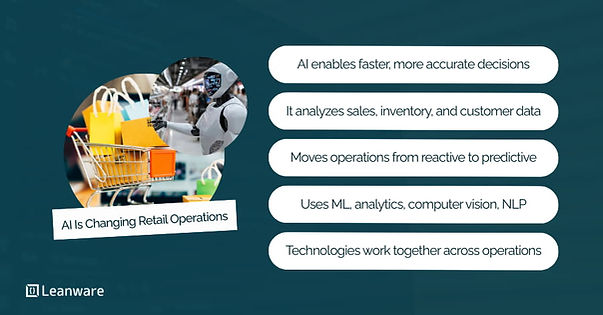
AI in retail operations refers to machine learning models, predictive analytics, and automation systems that help retailers make faster, more accurate operational decisions. These systems process data from point-of-sale transactions, inventory levels, customer behavior, external factors like weather, and competitive pricing to generate forecasts and recommendations.
Traditional operations are reactive: products run out, sales drop, or traffic surges, and teams adjust afterward. AI shifts this to prediction, using patterns across many variables to forecast demand and optimize inventory before issues occur.
Core AI technologies include:
- Machine learning for pattern recognition and demand prediction.
- Predictive analytics for forecasting outcomes
- Computer vision for monitoring shelves and in-store activity
- Natural language processing for automating routine customer interactions
These technologies work together across operations rather than as isolated tools.
Why Traditional Retail Operations Struggle Without AI
Traditional forecasting relies on historical sales data and basic seasonality patterns. These methods assume the future will mirror the past. They struggle to account for promotional impacts, competitor actions, social media trends, weather variations, and economic shifts.
According to McKinsey, AI-driven forecasting can reduce supply chain errors by 20 to 50 percent compared to traditional methods. This accuracy gap translates directly into inventory problems and lost sales.
Poor forecasting triggers a cascade of inventory issues:
- Overstock ties up capital and increases markdowns
- Stockouts lead to lost sales and frustrated customers
NielsenIQ reported that U.S. retailers lost $82 billion in 2021 due to stockouts alone. Traditional inventory systems cannot process the volume and variety of signals needed for accurate SKU-level predictions, so these problems persist.
Operations are often fragmented. Inventory, pricing, and labor systems run separately, with spreadsheets bridging the gaps. This disconnection creates blind spots, prevents optimization, and forces reactive decision-making.
Key Areas Where AI Is Transforming Retail Operations
AI is changing how retailers handle everyday operations, from demand forecasting and supply chain management to pricing, in-store activities, and customer service.
Area | AI Impact |
Demand & Inventory | Predicts demand; cuts excess stock up to 30% |
Supply Chain | Automates replenishment; lowers inventory costs 10-15% |
Pricing & Promotions | Optimizes prices and promotions |
Computer Vision | Monitors shelves; reduces out-of-stock 20–25%, shrinkage 15–30% |
Workforce & Service | Forecasts staffing; automates routine tasks |
Fraud & Risk | Detects anomalies and abuse |
AI-Powered Demand Forecasting and Inventory Management
Forecasting is the foundation of retail operations - every downstream decision depends on predicting what customers will buy, when, and where. AI models incorporate signals traditional methods can’t handle, including:
- Point-of-sale data across stores
- Promotional calendars and competitor pricing
- Weather forecasts and local events
- Social media sentiment and economic indicators
These models identify patterns that aren’t obvious. For example, a combination of warm weather, a competitor stockout, and a trending social post can drive demand for a category in specific regions.
AI also enables granular inventory decisions. Instead of blanket reorder rules, it calculates optimal stock levels for each SKU at each store, considering local demand, lead times, and service targets. Predictive insights flag slow-moving inventory, suggest markdown timing, or recommend transferring stock to higher-velocity locations. Retailers report reductions in excess inventory of up to 30 percent after deploying AI forecasting.
AI in Supply Chain and Logistics Optimization
Supply chain performance depends on getting the right products to the right place at the right time. AI improves visibility and responsiveness by:
- Automating replenishment decisions based on inventory, sales velocity, and lead times.
- Optimizing delivery routes with traffic, capacity, and scheduling data.
- Modeling disruptions to recommend alternatives like rerouting shipments or reallocating stock.
Distributors can unlock significant value by embedding AI in their operations. McKinsey & Company notes that this approach could reduce inventory by 20 to 30%, lower logistics costs by 5 to 20%, and cut procurement spending by 5 to 15 percent.
Dynamic Pricing and Promotion Optimization
Pricing decisions directly impact both revenue and margin. AI enables retailers to move from periodic price reviews to continuous optimization.
AI-powered pricing systems analyze demand patterns, inventory levels, competitor prices, and customer segments to recommend optimal prices. These systems can adjust prices multiple times per day in response to market conditions.
According to BCG, retailers implementing AI-powered pricing have increased gross profit by 5 to 10 percent while improving customer value perception. The technology enables them to capture margin opportunities that static pricing misses.
Promotion optimization uses AI to identify which products to promote, at what discount levels, and through which channels. Models predict promotional lift and cannibalization effects to maximize incremental sales rather than just shifting demand. AI also determines optimal promotion timing based on inventory positions, competitive activity, and seasonal patterns.
Electronic shelf labels connected to AI pricing systems enable physical retailers to implement dynamic pricing in stores, adjusting prices based on time of day, inventory levels, and competitive factors.
Computer Vision in Physical Store Operations
Computer vision transforms cameras into active operational tools. It can:
- Monitor shelves for empty spaces, misplaced items, or planogram compliance
- Track customer movement and dwell times to inform store layouts and staffing
- Detect suspicious behaviors in real time to reduce shrinkage
Studies show computer vision can decrease out-of-stock situations by 20–25 percent and shrinkage by 15–30 percent when implemented effectively.
Workforce Optimization and Customer Service
Labor is typically the largest controllable expense in retail operations.
AI models forecast store traffic based on historical patterns, promotional calendars, weather, local events, and real-time trends. These forecasts drive labor scheduling to match staffing levels with expected demand. Scheduling optimization considers employee availability, skills, labor regulations, and predicted demand to generate optimal schedules.
AI-powered chatbots handle common inquiries about order status, store hours, product availability, and return policies. They operate across channels including websites, mobile apps, and messaging platforms. AI also automates routine post-purchase processes by verifying return eligibility, initiating refunds, and resolving common order issues without human intervention.
Fraud Detection and Risk Management
Machine learning models analyze transaction patterns to identify anomalies indicating fraud. These models consider purchase history, device fingerprints, location data, and behavioral signals to score transaction risk.
High-risk transactions trigger additional verification or review without blocking legitimate purchases. AI identifies wardrobing patterns, receipt manipulation, and employee collusion by analyzing transaction histories across systems.
AI and Omnichannel Retail Operations
Omnichannel retail requires operational integration that traditional systems cannot achieve.
AI provides real-time inventory visibility across all channels and locations. This visibility enables features like buy-online-pickup-in-store and ship-from-store that require accurate stock information.
Order routing optimization considers inventory positions, shipping costs, delivery times, and labor capacity to select the optimal fulfillment location for each order. The system balances speed, cost, and inventory distribution. Retailers using channel-specific forecasting models achieve 35 percent faster order fulfillment and 22 percent lower shipping costs compared to aggregate forecasts.
Business Benefits of AI-Driven Retail Operations
AI helps retailers cut costs and improve efficiency by automating processes and optimizing operations. Automation and optimization reduce expenses across labor, inventory, and logistics, and AI is delivering encouraging returns: 55 percent of retailers report ROI over 10 percent, while 21 percent report returns exceeding 30 percent.
Real-time analytics let managers respond immediately to changing conditions instead of waiting for weekly reports, supporting operational efficiency and growth without adding proportional staff.
Challenges and Limitations of AI in Retail Operations
AI models require clean, integrated data to produce accurate results. Many retailers struggle with data scattered across systems, inconsistent formats, and quality problems. Addressing data infrastructure often requires more investment than the AI systems themselves.
Older systems may not support real-time data feeds or API integrations that AI platforms require. Replacing or upgrading these systems involves significant cost and risk.
Staff may resist changes that feel threatening or unclear. Successful implementations require training, communication, and involvement of operational teams.
Pricing algorithms can inadvertently discriminate against certain customer segments. Surveillance systems raise privacy concerns. Retailers must implement governance frameworks to ensure fair and transparent AI use.
How to Implement AI in Retail Operations Successfully
Implementing AI starts with solid preparation and careful planning. Begin by checking data quality and coverage, setting up governance, standardizing definitions, and building integration pipelines. This foundational work often takes longer than expected.
Next, focus on use cases that have clear ROI and manageable complexity. Demand forecasting and inventory optimization are good starting points because they address measurable problems with available data.
Test AI solutions in controlled pilots. Define success metrics, compare actual results with predictions, and identify integration or adoption issues. Once a pilot works well, expand gradually, addressing training, process adjustments, and system integrations as you go.
Step | Focus | Purpose |
Prepare Data | Quality, coverage, governance | Provides reliable inputs for AI models |
Start Small | High-ROI, manageable use cases | Tackles measurable problems first |
Pilot AI | Controlled testing, success metrics | Reveals gaps and challenges early |
Scale Gradually | Training, process updates, system integration | Expands AI across operations smoothly |
The Future of Retail Operations Powered by AI
In the coming years, AI will handle more routine decisions independently. Systems could adjust inventory, update pricing, and manage staffing for standard situations, while executives use AI insights as part of their planning.
Retailers already using AI in operations see more accurate demand forecasts, better inventory management, consistent pricing, and steadier customer service compared with traditional approaches.
AI is now in regular use, with established implementation methods and solutions available for retailers of all sizes. The main challenges are organizational - how teams adapt and processes evolve - rather than technical.
Your Next Step
Start by identifying the operational areas where AI can drive real impact - whether that’s improving forecast accuracy, optimizing inventory, or automating repetitive tasks. From there, run focused pilots to test assumptions and measure results.
Use what you learn to refine processes and gradually expand AI across functions, ensuring your teams are prepared to adopt new workflows.
Ultimately, the success of AI in retail operations depends less on the technology itself and more on how your organization integrates it into daily decision-making.
You can also connect with us to explore how AI can support your retail operations, assess high-impact use cases, and develop a practical roadmap for implementation.
Frequently Asked Questions
What is AI in retail operations?
AI in retail operations uses artificial intelligence to automate, optimize, and improve core processes like demand forecasting, inventory management, supply chain logistics, pricing, and in-store operations. It helps retailers make more informed, data-driven decisions.
How does AI improve inventory management in retail?
AI analyzes historical sales, real-time demand signals, seasonality, and external factors to predict product demand more accurately. This helps reduce stockouts, minimize overstock, and optimize inventory at both the SKU and store level.
Can AI help reduce operational costs in retail?
Yes. AI can automate manual workflows, optimize labor scheduling, improve supply chain efficiency, and cut down inventory waste, all of which help lower operational costs.
What role does AI play in pricing and promotions?
AI supports dynamic pricing and promotion planning by analyzing demand patterns, inventory, customer behavior, and competitor prices in real time. This enables retailers to adjust prices and promotions more effectively.
How does computer vision improve physical store operations?
Computer vision uses AI-powered cameras to monitor shelves, track customer movement, spot out-of-stock items, and detect potential theft. It gives retailers better visibility into store conditions in real time.
Is AI only useful for large retail enterprises?
No. AI can benefit retailers of all sizes. Mid-market and growing brands can use cloud-based AI tools to improve forecasting, automate operations, and compete more efficiently without large teams.
What are the biggest challenges of implementing AI in retail operations?
The main challenges include poor data quality, legacy systems, integration complexity, and resistance to change within the organization.
How long does it take to see ROI from AI in retail operations?
Many retailers start seeing measurable ROI within a few months when AI is applied to high-impact areas such as demand forecasting, inventory management, or pricing. Full operational benefits typically grow as AI solutions are scaled across more functions.