Machine Learning Consulting Services & Firms

Machine learning isn’t just something only the biggest tech companies experiment with anymore. These days, startups and midsized businesses use it to improve forecasts, streamline processes, and better understand their customers.
Still, building an in-house ML team takes time and budget that not every company has. Hiring the right people, setting up infrastructure, and developing models can stretch resources thin - especially if you’re moving fast or exploring ML for the first time.
TL;DR: ML consulting helps you get to practical AI results faster. Whether you’re testing a proof of concept, integrating a model, or running full-cycle projects, the right partner handles the technical part while you stay focused on the product.
Here is how it works, which engagement models to consider, and how to choose a partner that fits.
What Is Machine Learning Consulting?
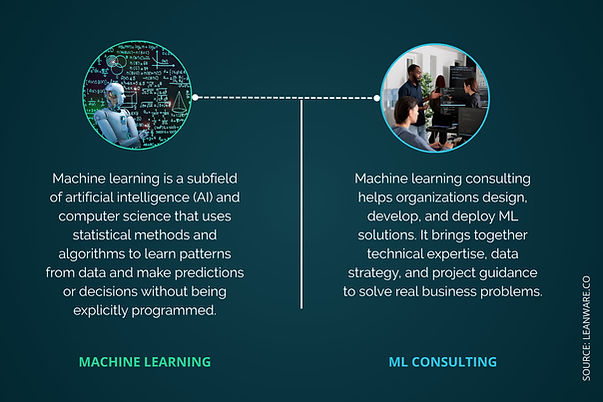
Machine learning consulting is about working with experts who help you design, build, and deploy ML solutions that fit your specific needs. These teams bring experience in data science, engineering, and model deployment, so you don’t have to start from scratch.
Unlike general software development consulting, ML work requires a solid grounding in statistics and data pipelines. Consultants usually work with your existing systems to develop models that can support better decisions and improve how your business operates.
Defining ML Consulting vs. AI Consulting
Most people often use AI consulting and ML consulting as if they mean the same thing, but there are important differences.
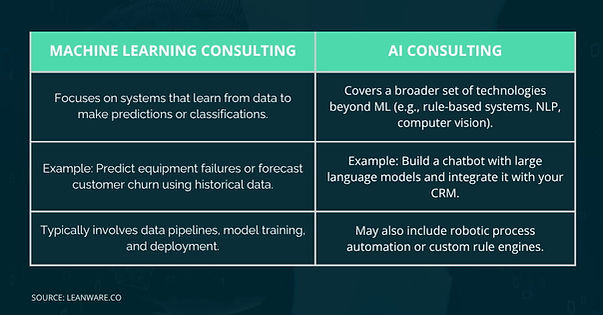
- Machine learning consulting focuses on building systems that learn from data. For example, you might use ML to predict equipment failures or estimate customer churn based on past behavior.
- AI consulting covers a wider range of technologies. It can include rule-based systems, computer vision, natural language processing, or robotic process automation.
For example, an AI consultant might help you build a chatbot powered by large language models and connect it to your CRM. An ML consultant would usually work on training and deploying a model that classifies support tickets or forecasts customer lifetime value.
Common Engagement Models: Staff Augmentation, Managed Services, Advisory

Machine learning consulting usually falls into three main engagement models:
Staff Augmentation: You bring external ML engineers or data scientists into your team. This setup provides you with direct control over daily work and works best when you already have some internal capabilities in place.
Managed Services: The consulting firm takes full ownership of delivering the solution end-to-end. This approach reduces the effort on your side but often costs more and requires clear scoping up front.
Advisory: Consultants focus on guiding your strategy, architecture choices, or technical assessments without actually building the systems. These engagements are typically shorter and more targeted.
Each model has its trade-offs. Staff augmentation offers flexibility but needs close management. Managed services can speed up delivery but demand clear expectations from the start. Advisory work helps you set direction but leaves execution to your team.
Why Work with Machine Learning Consulting Firms?
Engaging an experienced ML consulting partner can bring value beyond simple implementation. Below are a few reasons why companies choose this route.
1. Deep Expertise in Data Strategy & Preparation
Many ML projects hit roadblocks before any code gets written. A big reason is poor data readiness.
Consulting firms help you map out your data sources, check quality, and set up pipelines for collecting and cleaning data. This early groundwork often decides whether your models will keep performing or slowly fall apart.
Gartner estimates that bad data costs companies an average of $12.9 million each year. Getting the basics right early on saves you from rework and surprise costs later.
2. Predictive Modeling & Forecasting Capabilities
Well-trained ML models can spot trends that lead to better decisions, whether you’re forecasting revenue, anticipating churn, or managing inventory.
According to Gartner, 79% of corporate strategists see AI and analytics as critical to their success over the next two years.
But while most teams already use basic reporting, fewer are tapping into predictive models that can help automate planning and improve forecasting accuracy.
Experienced consultants help you build, test, and refine models that fit your data and business goals, rather than relying on off-the-shelf tools that often fall short in real-world conditions.
3. Operational Efficiency via MLOps & Automation
Deploying a model is only the start. MLOps practices help keep models running reliably and staying accurate over time.
Consulting teams often bring established tools and frameworks for monitoring performance, retraining models, and automating deployment. This cuts down manual work and supports compliance, which matters if you’re in a regulated industry.
4. Enhanced Business Decisions & ROI
A successful ML project should lead to measurable improvements. For example, McKinsey predicts that about 25% of insurance work could be automated by 2025, including claims management and policy administration.
Consulting partners can help you estimate ROI, identify the use cases with the most impact, and test early assumptions through pilots or proofs of concept.
Machine Learning Consulting Process
While every engagement differs, most follow a structured lifecycle that helps reduce risk and keep everyone aligned.
In many cases, teams also apply Agile practices - like working in short sprints and iterating on early feedback - to stay flexible as requirements grow.
1. Discovery & Assessment
The process usually starts with discovery. Consultants meet your teams to clarify objectives, constraints, success criteria, and potential risks.
This stage results in a project charter outlining the scope, timeline, and key performance indicators (KPIs).
2. Data Collection, Cleaning & Preparation
Once goals are defined, the focus shifts to data.
Consultants help you collect relevant datasets, clean inconsistent entries, and engineer features that improve model accuracy. Quality data preparation often takes more time than modeling itself but sets the stage for reliable performance.
3. Model Design, Development & Proof of Concept (PoC)
After data readiness, consultants develop and validate candidate models.
A proof of concept is commonly used to demonstrate feasibility. For instance, the team might build a churn prediction model and test it against historical data to see whether it improves accuracy over baseline methods.
Clear success criteria, like better prediction accuracy or fewer false positives, help ensure everyone is on the same page before scaling up.
4. Deployment, Integration & MLOps Pipelines
If the PoC meets expectations, the next step is moving models into production.
This phase includes integrating models into your systems via APIs, setting up CI/CD pipelines, and defining monitoring metrics.
MLflow or Kubeflow often support this work to keep workflows reproducible and make retraining easier.
5. Monitoring, Optimization & Maintenance
Once live, models need oversight.
Consultants help you track performance over time, set up automated alerts for drift detection, and schedule retraining to keep models accurate as data evolves.
6. Training & Knowledge Transfer
A solid engagement doesn’t end at deployment. Consultants document processes, train your teams, and share playbooks so you can maintain and improve your ML systems on your own.
Industry-Specific Applications of ML Consulting
Machine learning consulting spans industries. Here are a few examples of how firms apply ML across domains:
1. Finance & Banking
- Fraud Detection: Models flag unusual transactions in real-time while reducing false positives.
- Risk Scoring: Predictive analytics improves credit assessments by using more data sources.
- Automated Underwriting: ML speeds up loan approvals and keeps decisions consistent.
- Intercompany Reconciliation: Some platforms, like SAP’s intelligent reconciliation tools, use machine learning to help accountants match transactions that rule-based systems can’t resolve. For example, the system reviews unmatched entries and suggests likely matches, reducing manual effort during the close process.
2. Healthcare & Pharma
- Diagnosis Prediction: Models analyze records and images to support clinical decisions.
- Clinical Trial Matching: Algorithms compare patient history to trial criteria to identify eligible participants. For instance, during the PAXLOVID trials, Pfizer applied ML to speed up data review and quality checks, cutting processing time roughly in half compared to earlier approaches.
- NLP in EHR: Natural language processing extracts insights from unstructured medical records.
- Predictive Analytics: Platforms like IBM Watson Health apply ML to large healthcare datasets to help forecast patient outcomes and support more personalized treatment planning.
3. Retail, E-commerce & Consumer Goods
- Demand Forecasting: ML predicts what products will sell, so inventory stays balanced.
- Personalization: Recommendation systems tailor offers to individual shoppers. For example, Amazon uses ML services like Personalize to generate real-time suggestions based on browsing and purchase behavior.
- Inventory Optimization: Models manage stock levels across locations and channels. Platforms like Alibaba’s machine learning tools support large-scale forecasting and stock allocation across marketplaces.
4. Manufacturing & Supply Chain
- Predictive Maintenance: Sensor data helps forecast equipment issues before they happen.
- Defect Detection: Computer vision spots defects during production. For example, Waymo applies advanced ML techniques to monitor vehicle components and detect anomalies early.
- Logistics Optimization: ML improves routing and resource allocation in real time. Platforms like AWS Supply Chain use machine learning to unify data and surface insights that help manage inventory and deliveries more efficiently.
5. Insurance & Risk Management
- Pricing Optimization: Models set premiums based on detailed risk profiles.
- Claims Automation: ML accelerates processing and routes complex claims to human reviewers.
- Catastrophe Modeling: Advanced models estimate disaster impacts to manage portfolio risk.
How to Choose the Right Machine Learning Consulting Firm
Choosing the right ML consulting firm makes a big difference in how smoothly your project runs and whether it delivers results. Here’s what to look for.
1. Expertise & Industry Experience
Start with technical depth and domain knowledge. Look for partners/companies that have worked on similar problems in your industry and can show a portfolio of relevant projects.
Certifications (like from AWS, Azure, or GCP) are useful signals, but real-world experience matters more, especially in regulated or complex environments.
2. Engagement Models & Pricing
Understand how the firm structures its work. Some offer fixed-price projects for well-scoped work, while others work on time and materials for more flexible, evolving needs.
In some cases, outcome-based pricing ties fees to business results. Whichever model you choose, make sure the scope, costs, and responsibilities are clearly defined upfront.
3. Support, Training & Maintenance
A reliable partner stays engaged once the system goes live. Ask about their documentation standards, training for your internal team, and what’s included in post-deployment support.
Clear SLAs define how support issues will be handled over time. If the goal is long-term maintainability, make sure the team ensures knowledge transfer, not just delivery.
Your Next Move
Machine learning consulting gives you a way to adopt AI without the cost and delay of building a full internal team. The right partner helps you move faster, manage risks, and deliver results you can measure.
Treat consulting as a strategic partnership. When done right, it not only delivers solutions but also builds the internal capabilities you’ll need over time.
You can also connect with our experienced ML team to learn more about approaches, tools, and what it takes to get a project off the ground.
FAQs
What types of ML consulting engagements exist?
Most work falls into three models. Staff augmentation means external ML engineers join your team directly. In managed services, the consultant owns the delivery end-to-end.
Advisory engagements focus only on strategy, architecture, or technical evaluations.
How long does an ML consulting project typically take?
Timelines vary by scope. A proof of concept might take 4–8 weeks, while a full production model often needs 3–6 months.
MLOps implementation usually runs 2–4 months. Ongoing maintenance is continuous.
What is the ROI of hiring ML consultants?
Benefits usually include faster time to market, cost savings from automation, and better decision-making with accurate forecasts. The impact depends on how well the solutions fit your business.
How do you integrate ML models into legacy systems?
Teams often expose models through REST APIs or use middleware to connect them with existing tools. Adapters can help transform data formats. Clear planning and interfaces reduce integration friction.